
Bagaimana Cara Kerja Lift Perahu? Prinsip Kerja, Batasan Sebenarnya, dan Alternatifnya
How does a boat lift work? It supports a boat on a cradle, bunks, or platform and raises it above the water by cable, hydraulic force, buoyancy, or another mechanical drive. A frame, guide system, and lock or holding mechanism keep the load in position. The safe working load belongs to the complete lift, not to the motor alone. The best mechanism depends on the boat’s loaded weight, water depth and fluctuation, foundation, power, wave exposure, and winter conditions.
Keeping the hull out of water between trips can reduce fouling and time spent cleaning, but a lift still needs inspection and may not protect a boat from every storm. BoatUS advises owners to include the motor, gear, and other onboard weight when checking a lift’s safe working load ( BoatUS ). Compare the maintenance of the lift with the actual costs of wet storage at your site.
One clarification before the mechanics, because the word gets borrowed. This article is about the lift bolted to or floating beside your dock. It is not the self-elevating “liftboat” used on offshore oil fields, and not the forklift-style machines some marinas drive.
Typical operation is to approach slowly, align the hull with the bunks or platform, and raise it using the installed control while keeping people clear of moving parts. The cycle time varies by model, load, and travel distance. Follow the manufacturer’s instructions for positioning, stopping, locking, and lowering; do not use the lift as an elevator for people ( BoatUS safety guidance ).
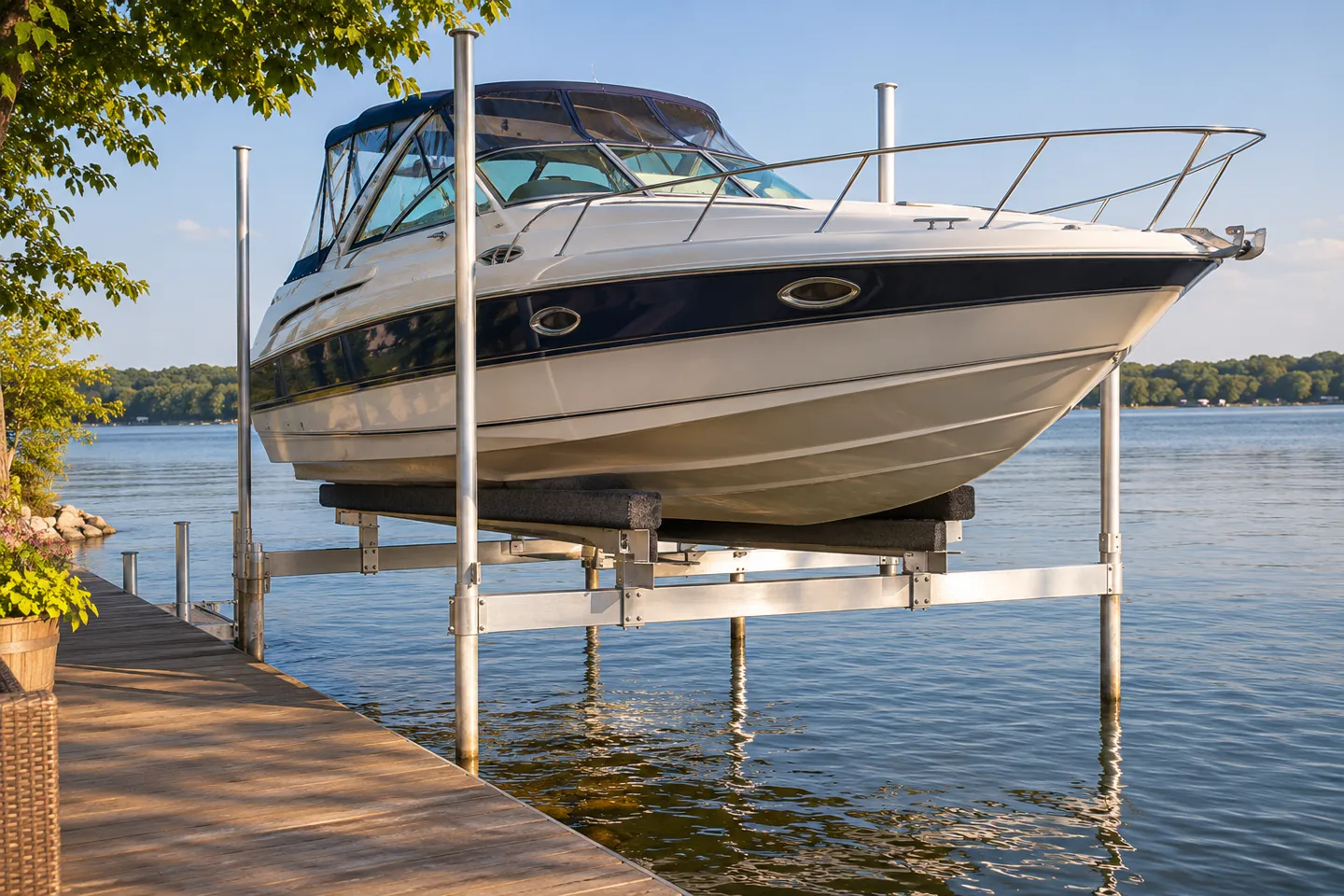
Five Common Boat Lift Mechanisms
The systems below share the same purpose but use different ways to move and hold the boat. The five categories are useful for comparison; individual products may combine mechanisms or use different names.
A pneumatic or air-assisted lift changes the buoyancy of tanks or chambers by admitting and releasing air. The tanks and cradle move with the change in displacement. The blower, valves, air lines, tank integrity, and mooring or guide system all matter. Confirm the product’s operating sequence and required water depth rather than assuming every floating lift works identically.
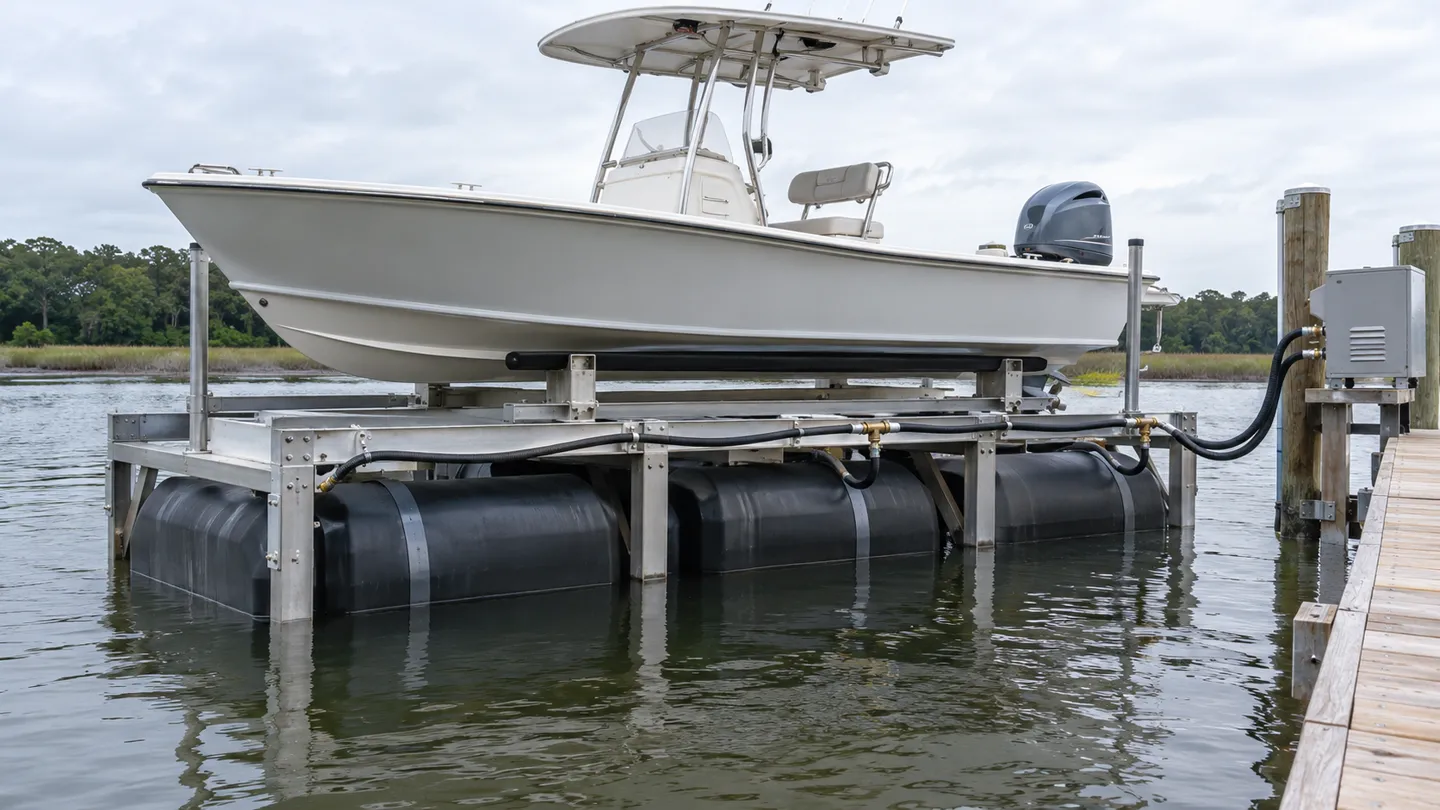
Hydraulic lifts use pressurized fluid to drive cylinders or related mechanisms that raise the boat support. Their maintenance includes the power unit, hoses, seals, and controls. Capacity and speed vary by model; hydraulic power alone does not make a lift suitable for every heavy boat or exposed site.
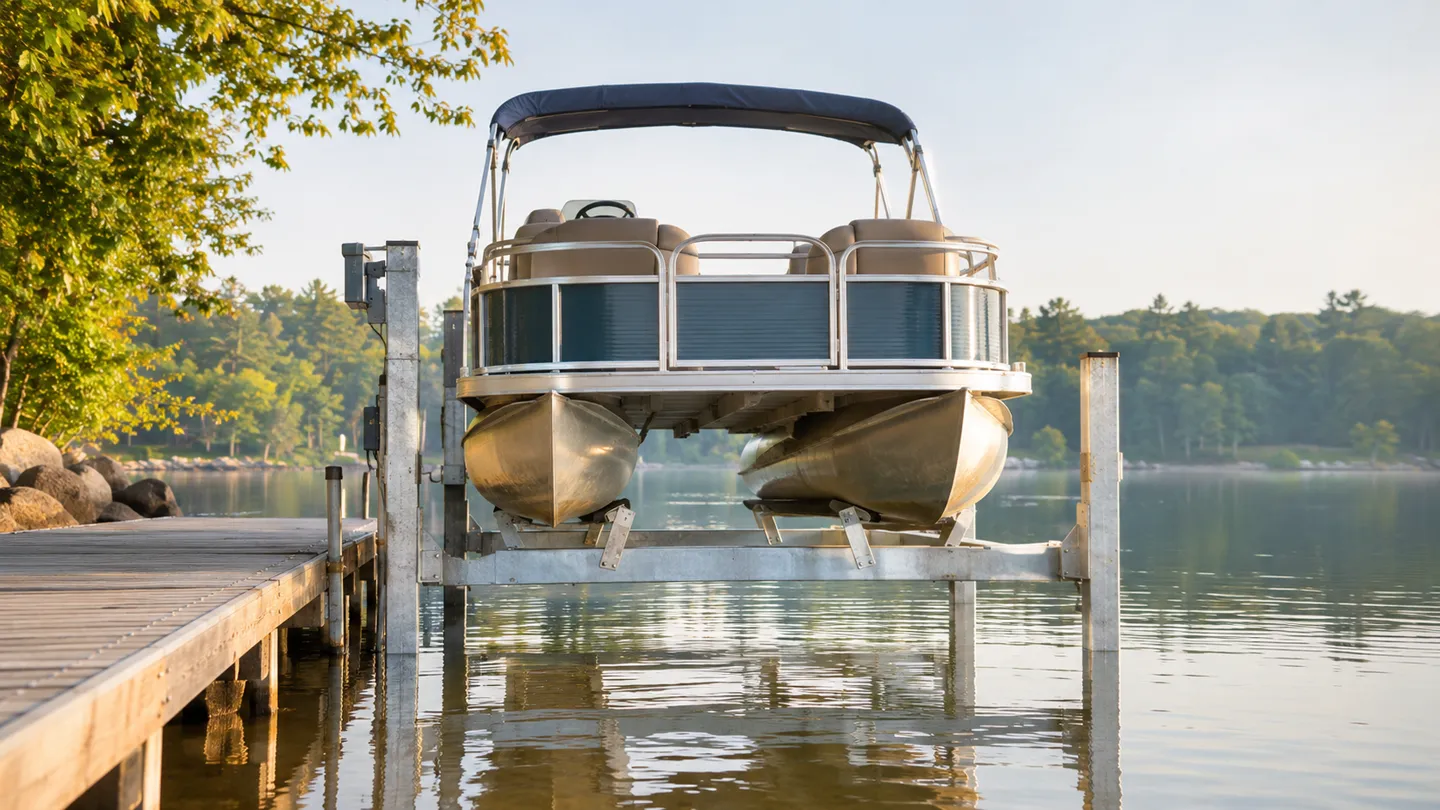
Cable-and-winch lifts use a manual crank or electric motor to wind cable through a pulley system and raise a cradle. The cable, sheaves, drum, brake, and frame require inspection. BoatUS warns that broken strands, corrosion, and poor winding can reduce cable reliability; use the size and cable type specified for the lift ( BoatUS maintenance guidance ).
Screw-drive lifts use a motor and threaded mechanism to convert rotation into vertical travel. Check the manufacturer’s limits, lubrication instructions, alignment, and controls. The exact design determines where it can be installed and how much weight it can carry.
Elevator-style lifts carry the boat on arms that travel along rails fixed to a suitable shore structure or piles. The rail support, alignment, drive, and travel range are critical. A seawall or pile line should be assessed for the imposed loads before treating it as a lift foundation.
For any mechanism, size the lift for the fully loaded boat and check weight distribution as well as the published rating. Include the hull, engine, fuel, water, batteries, gear, and installed accessories. BoatUS notes that the boat, motors, and gear must not exceed the lift’s safe working load ( BoatUS ). Ask the installer for the approved hull position and support points.
The Four Lifting Mechanisms at a Glance
| Mechanism | What moves | Ukuran standar | Maintenance face |
|---|---|---|---|
| Pneumatic tank | Air displaces water in fixed tanks | Small to very large boats, floating docks | Tank integrity, blower, hardware |
| Hidraulik | Pressurized cylinders hoist the platform | Heavier boats, fast cycles | Seals, hoses, fluid, pump |
| Cable and winch | Motor or crank winds cable through pulleys | Smaller budgets, shallow fixed installs | Cable wear, pulleys, spooling |
| Electric screw | Threaded shafts convert torque to lift | Precise positioning needs | Threads, motors, limits |
| Elevator | Arms climb rails on seawall or pilings | Seawall and canal frontages | Rails, powerheads, alignment |
How Boat Lifts Fail: The Owner’s View
Failure checks are easiest when grouped by component: cables and winches, air tanks and blowers, hydraulic equipment, electrical controls, bunks, frames, and anchors or piles. Inspection frequency and replacement intervals should follow the specific manufacturer’s instructions and the site’s exposure.
Cable and winch systems: the first thing to wear
Inspect cables for broken strands, corrosion, kinks, and uneven winding. BoatUS recommends following the manufacturer’s lubrication and replacement guidance; it also warns owners not to reach into a jammed drum or stand close to a loaded cable ( BoatUS ). Replace damaged cable with the specified type and have a qualified technician handle work under load.
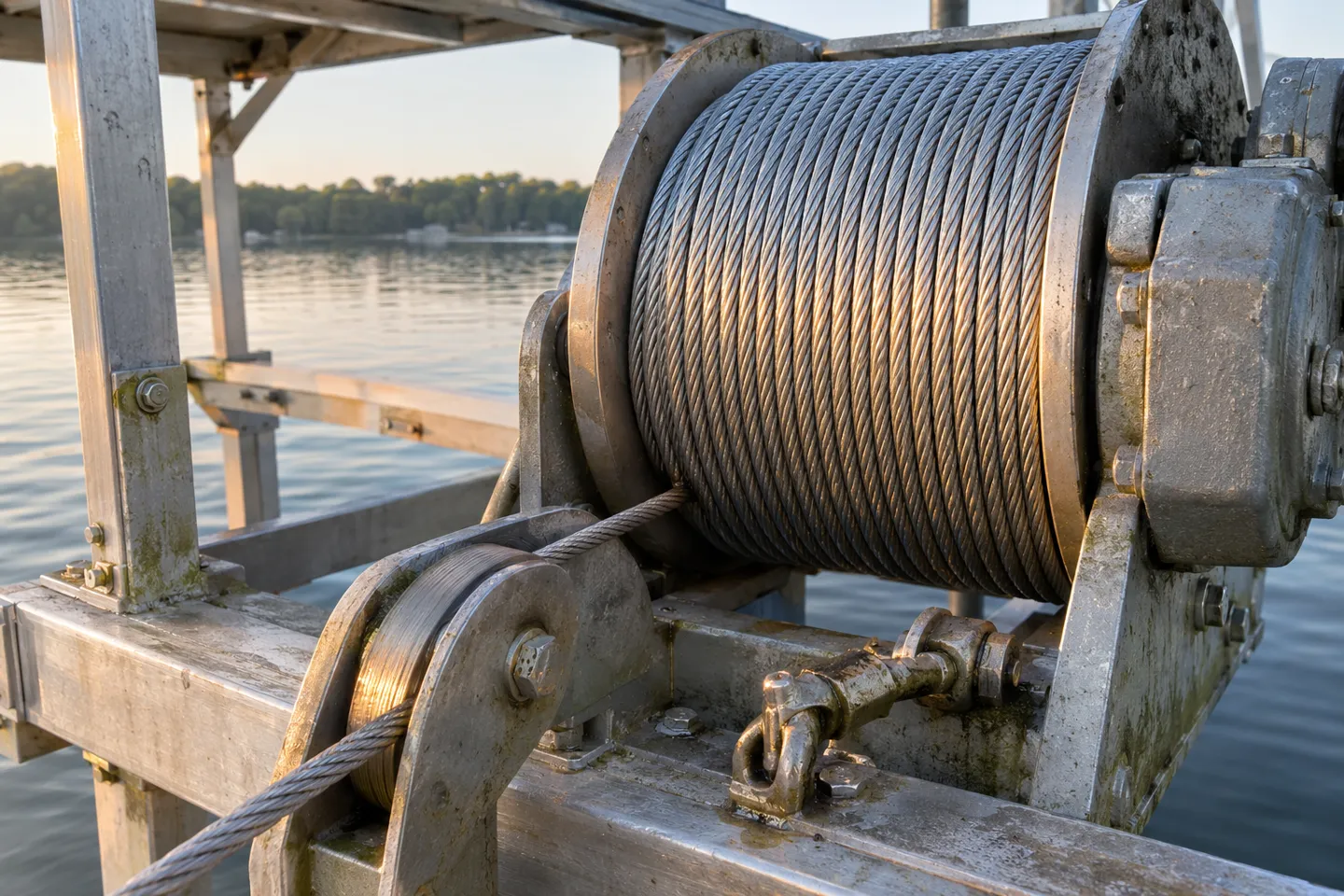
Waves, uneven loading, and a cradle that moves unexpectedly can put slack into cables and cause poor winding. Check the boat’s position, bunk support, and drum after operation. If the cables do not track correctly, stop using the lift and have the cause inspected rather than simply tightening one side.
A failed cable can leave the boat unsupported or trapped. Keep people out of the lift’s travel path and do not work beneath a raised boat without an approved support method. Arrange professional inspection when strands are damaged, winding is uneven, or the frame has shifted.
Air tanks and blowers: quiet capacity loss
Air-assisted systems can lose performance through leaking tanks, valves, hoses, or blower problems. A slow or uneven raise calls for inspection of the complete system and the boat’s position. Do not increase pressure or add a larger blower beyond the manufacturer’s instructions to compensate for a leak or an undersized installation.
Motors and wiring: the failures that strand you
Electrical faults can stop a lift mid-cycle and can present a serious waterfront hazard. Keep controls, cables, and connections in the condition specified by the installer. If a breaker or ground-fault device trips repeatedly, stop using the lift and have a qualified electrician diagnose it; do not bypass protection. BoatUS highlights the risk posed by damaged electrical equipment near swimmers ( BoatUS ).
Bunks, balance and fasteners: the slow drift
The last family is dull and important. Bunks warp, grow slime and change the friction under your hull. A boat parked off-center loads one side of the cradle and works the cables and tanks unevenly. Hardware loosens with vibration, and a lift that was fine in June can rattle by September. None of it is dramatic; all of it is found by a two-minute walk-around.
Failure Map: What Warns You, How Fast, Who Fixes It
| Komponen | Warning sign | Realistic interval | DIY or pro |
|---|---|---|---|
| Lift cables | Kinks, broken strands, uneven spooling | Follow model and site inspection plan | Owner can inspect, pro replaces under load |
| Air tanks | Boat sits lower on the cradle at full air | Follow model and site inspection plan | Owner for fittings, pro for welds |
| Blower and valves | Slow raise, motor hums without lifting | Follow model and site inspection plan | Owner with basic tools |
| Wiring and contactors | Intermittent start, tripped GFCI | Follow model and site inspection plan | Pro recommended, power off |
| Bunks and cradle | Carpet wear, hull scrapes, uneven sit | Follow model and site inspection plan | Owner |
Where a Boat Lift Stops Working
Every failure above eventually finds the owner. The boundaries below are different: they decide whether a lift should be installed at your water at all, and they are set by your site, not your budget.
Water depth and fluctuating levels
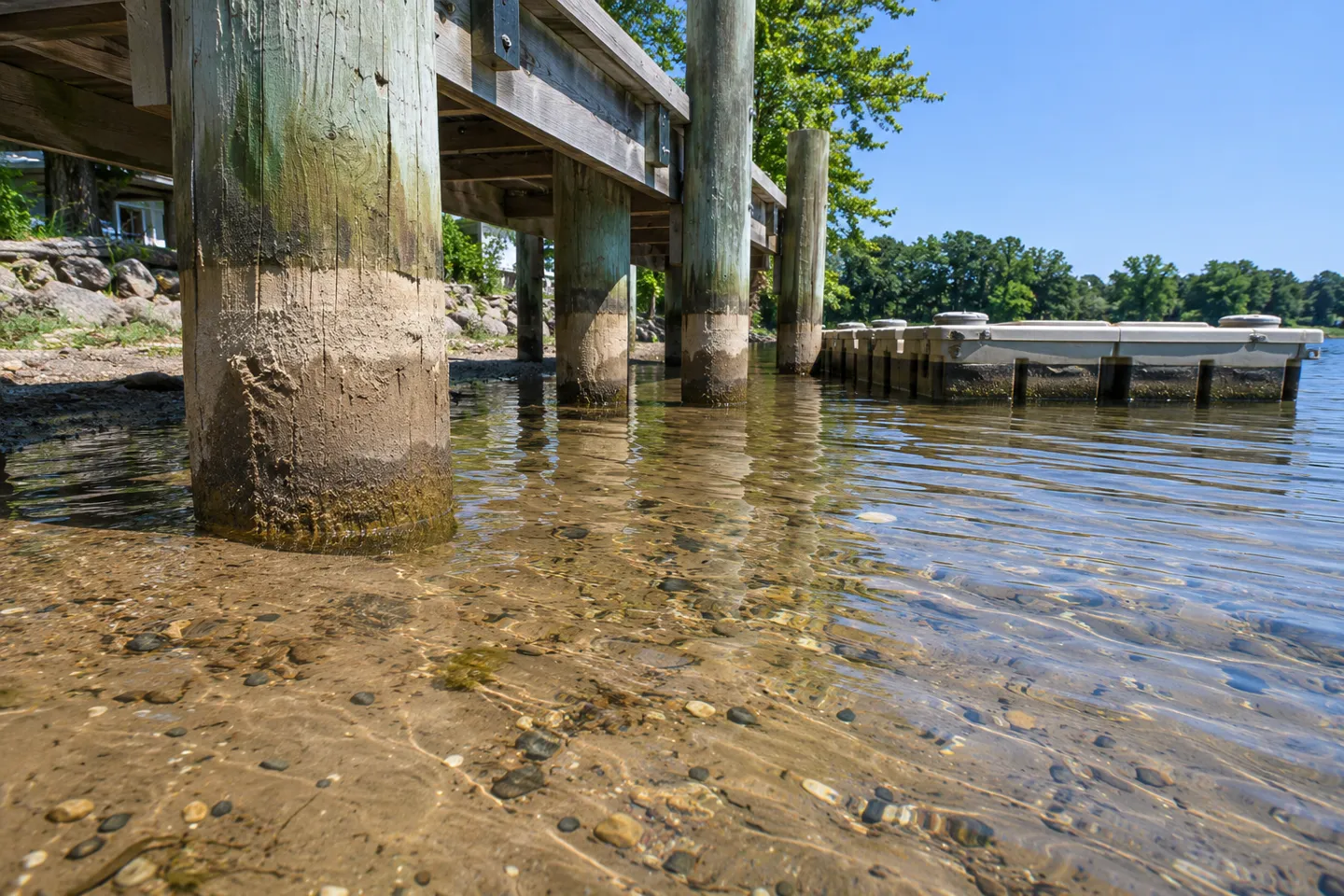
Measure water depth at the lowest operating level, including the boat’s draft and the lift’s clearance and travel needs. Manufacturer minimums vary substantially by mechanism and model; there is no universal 26-inch threshold. Also check how seasonal or tidal changes alter boarding height, cradle movement, and access to the boat. A shallow-water dock does not automatically provide enough depth for a drive-on platform.
Ice, waves and what the lakebed allows
Ice and waves change the installation requirements. Confirm whether the exact lift must be removed, winterized, or designed to remain in place. Check the shore, bottom, piles, and anchors before choosing a model. A floating alternative is not automatically ice-safe either; Wisconsin DNR advises that removing waterfront structures before freezing is the best way to avoid ice damage ( DNR Wisconsin ).
Shallow water is where this reality bites hardest.
Check permits before installing a lift or changing the lakebed. Requirements vary by location and structure. Wisconsin DNR provides a seasonal boat-lift exemption checklist for qualifying projects, while USACE regional permits may explicitly cover boat lifts in navigable waters ( DNR Wisconsin ; USACE example ). Neither example establishes a blanket exemption elsewhere.
Choosing and Specifying a Lift for Your Site
If the matrix left you in a “works” column, the purchase comes down to five checks. Do them in this order, because each one narrows the next.
Weigh or document the boat in its loaded operating condition, including motor, fuel, water, batteries, gear, and accessories. Do not rely on a fixed percentage added to a dry-weight brochure figure.
Measure the site: water depth at lowest working level, total level fluctuation, bottom type, wave exposure.
Match the mechanism: wet weight and depth together usually leave one or two viable designs.
Check the seawall, piles, dock, or lakebed for the lift’s actual loads; verify suitable electrical service when needed and plan for winter conditions.
Confirm the permit: temporary structure or fixed installation, and who files.
Request an installed price that includes the lift, foundation or mounting, electrical work, permits, freight, commissioning, and winterization. Ask for the expected inspection and consumable-part costs as separate line items. Published prices for unrelated models or locations cannot establish the cost of your installation.
Compare three complete ownership paths: a lift, a wet slip, and a compatible drive-on floating system. Use the same time horizon and include power, cleaning, maintenance, repairs, insurance conditions, and any seasonal removal. A forum quote is not a reliable basis for a general break-even claim.
If a conventional lift is unsuitable, compare other storage methods against the boat and site. A trailer, wet slip, lift with a different mounting arrangement, or drive-on platform may be viable. A floating drive-on system still needs adequate depth, buoyancy, secure mooring, suitable boat geometry, and a winter plan.
Share the boat’s loaded weight, hull dimensions, lowest water depth, level range, exposure, and available power to compare lift and floating-platform options for the site.
Request a Site ReviewWhat This Means for Dock Dealers and Marina Operators
For dealers and marina operators, the first task is to identify the boat and water conditions, then compare appropriate mechanisms. A buyer may need a cable, hydraulic, air-assisted, elevator, or drive-on solution, or may be better served by a wet slip. Ask for the complete installed and operating scope before recommending one.
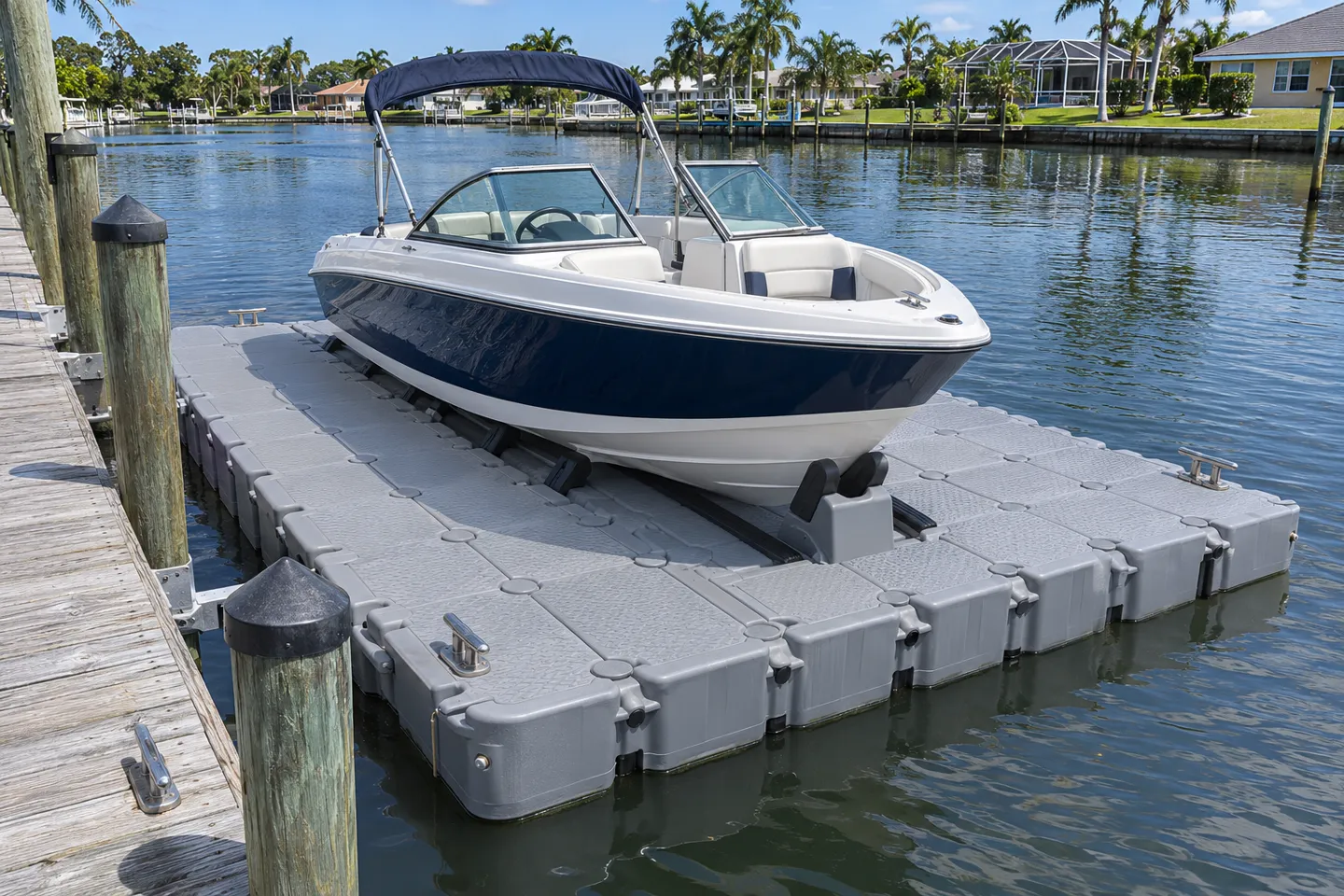
A lift can be a good choice on a suitable site, while a drive-on floating dock may suit other boats and shorelines. Neither option has a universal depth, ice, or wave advantage. Use product-specific specifications and a site assessment to compare water clearance, boat support, access, mooring, and maintenance.
HiSeaDock offers modular floating dock systems that may be configured as drive-on platforms for suitable boats. Confirm the exact float model, working load of the finished platform, boat compatibility, draft at low water, mooring, and winter conditions before proposing one. A published float buoyancy rating alone does not establish the complete platform’s allowable load.
Dry Storage for the Water a Lift Cannot Serve
Compare a drive-on floating dock with a lift using your boat dimensions, lowest water depth, level changes, mooring conditions, and winter plan. Share your site details to discuss a suitable configuration.
Get a Floating Dock QuoteDaftar Pustaka
- BoatUS. Give Your Boat a Lift .
- Departemen Sumber Daya Alam Wisconsin. Waterway Permit Frequently Asked Questions .
- Departemen Sumber Daya Alam Wisconsin. Cegah Kerusakan Akibat Es pada Bangunan Permanen .
- Korps Insinyur Angkatan Darat AS. Rhode Island General Permit: Boat Lifts and Hoists .


 English
 Thai
 Spanish
 French
 German
 Dutch
 Italian
 Arabic
 Indonesian
 Portuguese
 Turkish