
Ideeën voor steigers bij kleine vijvers: ontwerpinspiratie, slimme materiaalkeuzes en het drijvende alternatief dat de meeste eigenaren over het hoofd zien
Een steiger bij de vijver is zo’n project dat precies op het snijvlak ligt van “ik zie het al helemaal voor me” en “ik heb geen idee waar ik moet beginnen”. Je weet dat je een plekje wilt om te vissen, te zwemmen of gewoon met een kopje koffie te zitten en naar het water te kijken. Maar tussen de verschillende materiaalkeuzes, de afweging tussen een drijvende of vaste steiger en de stille zorg over wat er gebeurt als de vijver bevriest, kan de kloof tussen inspiratie en uitvoering verrassend groot aanvoelen.
In dit artikel worden alle stappen van het besluitvormingsproces behandeld — van het in kaart brengen van de draagkracht van uw vijver, tot het kiezen van het juiste type steiger en de juiste materialen, en tot de daadwerkelijke bouw ervan. Daarbij zullen we een materiaaloptie introduceren die in vrijwel geen enkel artikel over vijversteigers wordt genoemd, hoewel deze juist een oplossing biedt voor een aantal van de problemen waar vijverbezitters zich het meest zorgen over maken.
Wat u moet weten over uw vijver voordat u begint met plannen
Voordat je ook maar één ontwerp voor een aanlegsteiger schetst, heb je drie getallen nodig. Zie dit als het “vijveronderzoek” dat je arts zou laten uitvoeren voordat hij een behandeling voorschrijft — als je dit overslaat, is alles wat daarna komt giswerk.
Hoe diep is je vijver? De waterdiepte bepaalt welke soorten steigers überhaupt mogelijk zijn. Voor een vaste steiger die op heipalen is gebouwd, is doorgaans een constante waterdiepte van ten minste 3 tot 4 voet nodig, omdat de palen enkele voet diep in de bodem van de vijver moeten doordringen om het gewicht veilig te kunnen dragen. Een drijvende steiger daarentegen kan al functioneren bij een waterdiepte van slechts 1 tot 2 voet — het zijn de drijvers die het werk doen, niet de bodem.
Hoeveel verandert je waterpeil in de loop van het jaar? Dit is de vraag die de meeste mensen die voor het eerst een steiger bouwen, nooit stellen. Als het waterpeil in uw vijver tussen de afvoer in het voorjaar en de droogte in de nazomer met meer dan 2 feet schommelt, wordt een vaste steiger een gok: bij laag water hangt het dek onhandig hoog boven het wateroppervlak; bij hoog water kan het onder water komen te staan. Een drijvende steiger stijgt en daalt automatisch mee met het water. Als uw seizoensgebonden schommeling groter is dan 2 feet, is de keuze in feite al voor u gemaakt — een drijvende steiger is de enige optie met een laag risico.
Waar is de bodem van gemaakt? Zacht slib is slecht geschikt voor het heien van palen en vereist bredere funderingen of spiraalankers. Zand en grind bieden voldoende houvast. Rotsgrond is een nachtmerrie voor elke constructie met geheide palen en maakt een drijvende oplossing sterk aan te raden. Neem een stok en onderzoek de bodem op de plek waar je je steiger wilt plaatsen — 30 seconden werk dat je later dagenlange frustratie bespaart.
Zodra je deze drie antwoorden hebt, schrijf je ze op. Je zult er in elk volgend onderdeel op terugkomen.
Drijvend of vast — welk type steiger is het meest geschikt voor een kleine vijver?
Er bestaat niet zoiets als een universeel “betere” steiger – alleen de steiger die past bij de specifieke omstandigheden van uw vijver en bij het gebruik dat u ervan wilt maken. Vaste steigers bieden u rotsvaste stabiliteit en zijn geschikt voor zwaardere belasting. Drijvende steigers passen zich aan wisselende waterstanden aan en kunnen worden geplaatst met veel minder verstoring van de vijver. Met name bij kleine vijvers hangt de keuze meestal af van de consistentie van de waterdiepte en het seizoensgebonden gedrag van het waterpeil.
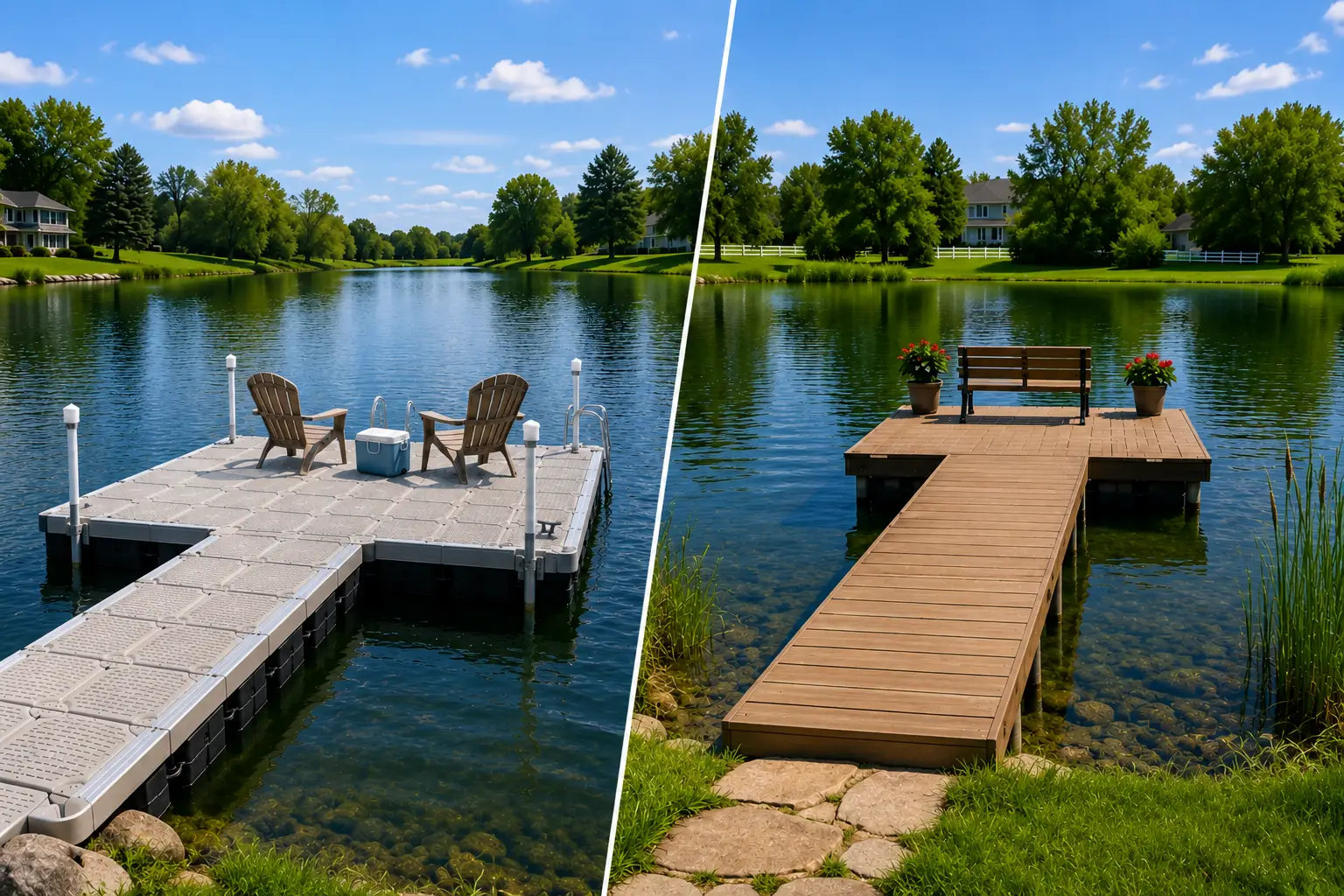
Drijvende steigers — Hoe ze in een vijveromgeving werken
Een drijvend dok werkt volgens een bedrieglijk eenvoudig principe: drijvende elementen ondersteunen een frame, en dat frame draagt het dek. De drie lagen — drijvers onderaan, het frame in het midden en het dek bovenaan — verdelen het gewicht over het water, net zoals bij een vlot, maar dan ontworpen met het oog op stabiliteit in plaats van snelheid.
De drijvers zelf zijn er in verschillende vormen. Traditionele drijvers in vatvorm — plastic vaten van 55 gallon die zijn afgesloten en vastgezet onder een houten frame — zijn de voordelige doe-het-zelfstandaard. Ingekapselde blokken van polystyreenschuim bieden een groter drijfvermogen, maar kunnen na verloop van tijd vol water lopen als de schil barst. Modulaire drijfblokken van hogedichtheidpolyethyleen (HDPE), met afmetingen van 500 × 500 mm en hoogtes van 250 mm tot 500 mm, bieden 220 tot 420 kilogram drijfvermogen per vierkante meter en worden met pennen en bouten aan elkaar bevestigd — in feite zijn het grote waterdichte bouwblokken die in elke gewenste configuratie in elkaar kunnen worden geklikt.
Voor een kleine vijver bieden drijvende steigers drie opvallende voordelen. Ten eerste is er geen bouw in het water nodig — geen heiwerk, geen betonnen funderingen die onder water worden gestort, geen zware machines op de oever van je vijver. Ten tweede blijft de vijverbodem ongestoord, wat belangrijk is als uw vijver een kleibekleding heeft of een gevestigd ecosysteem dat u wilt beschermen. Ten derde kunnen ze in de winter worden verwijderd of – met het juiste drijfmateriaal – op hun plaats blijven tijdens vorst-dooicycli (meer hierover in het gedeelte over de winter).
Het nadeel is dat drijvende steigers bewegen. Bij harde wind zal een onvoldoende verankerde drijvende steiger gaan drijven. Ze hebben ook een lager draagvermogen per vierkante voet dan een degelijk gebouwde vaste steiger. In bouwvoorschriften wordt dit verschil expliciet erkend: de International Code Council schrijft voor particuliere vaste steigers een ontwerpbelasting van 40 pond per vierkante voet (psf) voor, maar voor particuliere drijvende steigers slechts 20 psf (ICC-bouwvoorschriften voor North Carolina, artikel 3604.3). Voor een kleine steiger bij een vijver waar 2 tot 4 personen op kunnen staan, is 20 psf ruim voldoende — maar het is wel goed om te weten waar de technische grens ligt.
Vaste aanlegplaatsen — Wanneer een vaste constructie zinvol is
Een vast steiger voelt anders aan onder je voeten. Geen beweging, geen subtiele veerkracht — alleen een stevig platform dat zich over het water uitstrekt, alsof het een verlengstuk van je gazon is. Juist die duurzaamheid maakt het zo aantrekkelijk, en voor sommige vijveromgevingen is het de juiste keuze.
Bij vaste steigers voor kleine vijvers wordt doorgaans gebruikgemaakt van met drukimprägnatie behandelde houten palen (met een diameter van 6 tot 8 inch, van zuidelijke gele den of eik, die meer dan 4 voet diep in de vijverbodem worden geslagen) of van gegalvaniseerde stalen buispalen voor langere overspanningen. Het terras rust op een frame van balken en dwarsbalken, net als bij een terras bij een woonhuis, met als cruciaal verschil dat de “fundering” zich onder water bevindt.
Vaste aanlegsteigers zijn een goede keuze als aan alle drie de voorwaarden wordt voldaan: uw vijver heeft het hele jaar door een diepte van ten minste 3 voet, de bodemgesteldheid maakt het heien van palen mogelijk (zand, grind of zachte klei — geen massief gesteente) en er is in de winter geen sprake van noemenswaardige ijsbewegingen die de palen zouden kunnen vastgrijpen en tijdens de dooi in het voorjaar omhoog zouden kunnen duwen.
Ze bieden je bovendien meer architectonische vrijheid. Een vaste steiger kan een pergola, ingebouwde zitbanken of een kleine opbergkist dragen zonder dat het drijfvermogen opnieuw moet worden berekend. Het wordt een landschapselement op een manier die een drijvende steiger, vanwege zijn aard, niet kan zijn. De kosten liggen echter hoger: een standaard vaste steiger van 4 bij 12 voet kost alleen al aan materiaal $800 tot $2.500, afhankelijk van de houtkwaliteit, en de huur van apparatuur voor het heien van palen kost nog eens enkele honderden extra als je dit niet met de hand kunt doen.
Hoe neem je een beslissing? — Een eenvoudig besluitvormingskader voor je vijver
Pak de drie getallen erbij die je hebt opgeschreven in het gedeelte over de beoordeling van de vijver. Stel jezelf nu vier vragen over deze getallen:
- Is uw vijver minstens 3 feet diep en het hele jaar door stabiel? Zo ja, dan is een vast aanlegsteiger een optie. Zo nee, dan is een drijvende aanlegsteiger veiliger.
- Schommelt uw waterpeil per seizoen meer dan 2 feet? Zo ja, dan is een drijvend dok je enige betrouwbare optie.
- Ben je van plan om zware voorwerpen op de steiger te plaatsen — een pergola, een grote opbergkist, een groep mensen? Zo ja, dan biedt de vaste uitvoering een beter draagvermogen zonder dat het ontwerp ingewikkelder wordt.
- Wil je dat de steiger de hele winter in het water blijft liggen? Zo ja, dan kan een drijvend steiger dat is gebouwd met vorstbestendige materialen (HDPE-drijvers, gegalvaniseerde bevestigingsmaterialen) op zijn plaats blijven — vaste steigers in vorstgebieden lopen het risico dat ze door ijs omhoog worden gedrukt.
Voor de meeste eigenaren van kleine vijvers wijzen de antwoorden in de richting van een drijvende oplossing. De meeste vijvers zijn op de plek van de steiger minder dan 4 voet diep. Bij de meeste varieert de diepte met de seizoenen. En de meeste eigenaren willen niet worstelen met heipalen of de logistiek rond het verwijderen ervan in de winter. Een drijvende oplossing is geen compromis — het is vaak de slimmere technische keuze gezien de specifieke omstandigheden die een kleine vijver met zich meebrengt.
De juiste materialen kiezen — hout, composiet, aluminium en een verrassend alternatief
Vraag vijf buren welk materiaal ze zouden gebruiken voor een steiger, en vier zullen “hout” zeggen. Hout is wat we kennen, waarmee we al eeuwenlang bouwen en wat perfect past bij het beeld dat we in ons hoofd hebben van een vijver. Maar de afgelopen 30 jaar zijn er alternatieven bijgekomen die het onderhoud aanzienlijk veranderen — en één alternatief in het bijzonder komt bijna nooit ter sprake in gesprekken over vijversteigers, ondanks dat het speciaal voor precies dit soort toepassingen is ontworpen.
Voordat we dieper ingaan op elk materiaal, volgt hier eerst het beoordelingskader waarmee we ze kunnen evalueren. Elk materiaal voor aanlegsteigers kan op vijf aspecten worden beoordeeld: aanschafkosten, verwachte levensduur, jaarlijkse onderhoudskosten, winter- en vorstbestendigheid, en de mate waarin het product geschikt is voor doe-het-zelf-installatie. Houd hier rekening mee terwijl we de verschillende opties doornemen.
Hout — De klassieke uitstraling en de realiteit van het onderhoud
Onder druk behandeld zuidelijk geel dennenhout is niet voor niets de standaardkeuze: het is overal verkrijgbaar, relatief betaalbaar ($15 tot $25 per vierkante voet, inclusief plaatsing), en elke aannemer of doe-het-zelver weet ermee om te gaan. Cederhout zorgt voor een mooiere uitstraling en betere rotbestendigheid tegen een bescheiden meerprijs. In het duurdere segment bieden tropische hardhoutsoorten zoals IPE een buitengewone duurzaamheid — meer dan 25 jaar — tegen een prijs van $40 tot $60 per vierkante voet.
Wat er niet in de brochure staat: houten steigers hebben jaarlijks onderhoud nodig. Elk voorjaar moeten ze worden geïmpregneerd of geolied. Om de 3 tot 5 jaar moeten kromgetrokken of versplinterde planken worden vervangen. Opstaande houtvezels moeten worden geschuurd, anders worden blote voeten net speldenkussens. In een zoetwatervijver gaat een goed onderhouden steiger van onder druk behandeld hout 15 tot 20 jaar mee voordat het frame ingrijpend moet worden gerepareerd — maar die voorwaarde “goed onderhouden” maakt een groot verschil.
En dan is er nog de winter. Hout neemt water op. Als dat water bevriest, zet het uit. Na 3 tot 5 vorst-dooicycli met een vochtgehalte van meer dan 20 procent ontstaan er zichtbare scheuren. In noordelijke klimaten halen veel vijverbezitters hun houten steigers elk najaar volledig uit het water — een jaarlijks ritueel dat sneller gaat vervelen dan je zou denken.
Composiet en aluminium — Onderhoudsarme upgrades die de investering waard zijn
Composiet terrasplanken — een mengsel van houtvezels en gerecycled plastic — maken een einde aan rot, splinters en het grootste deel van het jaarlijkse onderhoud. Ze kosten $25 tot $40 per vierkante voet en gaan 15 tot 25 jaar mee. De nadelen: composiet is 30 tot 50 procent zwaarder dan hout (2,2 tot 2,5 pond per lineaire voet tegenover 1,5 tot 1,8 voor dennenhout), wat betekent dat uw drijvende steiger onder water meer drijfvermogen nodig heeft. Het zet bij temperatuurschommelingen ook sterker uit en krimpt dan hout, waardoor er bredere voegen tussen de planken nodig zijn — geen dealbreaker, maar wel een installatiedetail dat u niet mag overslaan.
Aluminium is de beste keuze: ultralicht, vrijwel onsterfelijk in zoet water (meer dan 30 jaar) en volledig bestand tegen rot en insecten. Met een prijs van $35 tot $55 per vierkante voet is het de duurste optie. Twee aandachtspunten: aluminium geleidt warmte zeer sterk — op een middag in juli is het oncomfortabel om op blote voeten over een aluminium terrasoppervlak in de volle zon te lopen. Bovendien mag aluminium nooit in direct contact komen met onder druk behandeld hout, omdat de op koper gebaseerde conserveermiddelen (ACQ) in modern behandeld hout galvanische corrosie veroorzaken — een isolatielaag is verplicht.
Zowel composiet als aluminium zijn uitstekende keuzes voor wie het principe hanteert: “Ik wil het één keer bouwen en er daarna grotendeels geen omkijken meer naar hebben.” Maar geen van beide biedt een volledige oplossing voor het winterprobleem — composiet kan bij extreme kou broos worden, en aluminium frames moeten na vorstcycli nog steeds worden gecontroleerd.
Modulaire HDPE-drijvers van kunststof — het vijervriendelijke alternatief dat de meeste eigenaren over het hoofd zien
Dit is wat bijna geen enkel artikel over vijversteigers je zal vertellen: er bestaat een hele categorie steigermateriaal die al meer dan 20 jaar wordt gebruikt in commerciële jachthavens, drijvende restaurants en industriële werkplatforms — en dat toevallig precies een aantal van de problemen oplost waarmee vijvereigenaren te maken hebben, misschien wel beter dan hout, composiet of aluminium. Het heet HDPE, oftewel hogedichtheidpolyethyleen, en in de vorm van modulaire drijvende blokken biedt het een fundamenteel andere benadering van het bouwen van steigers.
HDPE behoort tot dezelfde familie van kunststoffen die wordt gebruikt voor voedselveilige verpakkingen en opslagtanks voor chemicaliën. Als constructiemateriaal heeft het een dichtheid van 0,94 tot 0,97 gram per kubieke centimeter, een treksterkte van 26 tot 33 megapascal en een IZOD-slagvastheid die zelfs bij temperaturen ver onder het vriespunt standhoudt (Laird Plastics, Gids voor de eigenschappen van HDPE). Simpel gezegd: het is stevig, het barst niet als het water erin bevriest en het rot niet — nooit.
Het modulaire systeem werkt als volgt: afzonderlijke drijfblokken — doorgaans 500 bij 500 millimeter, verkrijgbaar in hoogtes van 250, 400 of 500 millimeter — worden met pennen en bouten aan elkaar bevestigd via voorgeboorde bevestigingsogen. U bepaalt zelf de vorm en afmetingen van uw steiger, telt het benodigde aantal blokken en zet ze op het droge in elkaar. Vervolgens schuift u het hele platform het water in, verankert het en schroeft u de dekplaten vast. Met slechts een hamer en een moersleutel kunnen twee personen in een middag een drijvende steiger van 10 bij 10 voet bouwen.
Wat dit vooral aantrekkelijk maakt voor kleine vijvers:
- Ondiep water is geen probleem. De onopvallende drijfblok van 250 millimeter heeft een diepgang van slechts 4 tot 6 inch wanneer hij leeg is, en ongeveer 8 tot 10 inch als er twee volwassenen op staan. Je kunt een steiger bouwen in 1 tot 2 voet diep water — dieptes waarin een vaste steiger onmogelijk zou zijn en een steiger met tonvormige drijvers de bodem zou raken.
- In de winter hoeft het niet te worden verwijderd. In tegenstelling tot hout neemt HDPE geen water op. In tegenstelling tot metaal wordt het niet broos bij kou. Het materiaal behoudt zijn structurele integriteit bij temperaturen van -40 °C tot +80 °C. Wanneer een vijver bevriest, zet het ijs uit en oefent het zijdelingse druk uit — maar het gladde oppervlak van HDPE voorkomt dat het ijs grip krijgt, en dankzij de elasticiteit kan de drijver onder druk licht vervormen in plaats van te barsten. Commerciële HDPE-steigers in Canada en Scandinavië blijven doorgaans het hele jaar door op het water liggen, ondanks de cycli van bevriezen en ontdooien.
- Onderhoudsrondes tot nul. Geen afdichting. Geen schilderwerk. Geen splinters verwijderen. Geen roestbehandeling. Het enige onderhoud dat nodig is, is jaarlijks even afspuiten met een tuinslang. Voor een vijverbezitter die het perceel heeft gekocht om ervan te genieten, en niet om het te onderhouden, verandert dit de ervaring als eigenaar volledig.
- Je kunt klein beginnen en later uitbreiden. Omdat het systeem modulair is, kun je dit jaar een visplatform van 4 bij 4 voet bouwen, volgend jaar vier extra kubussen toevoegen om het uit te breiden tot 8 bij 4, en het jaar daarna uitbouwen tot een volwaardig familieplatform van 12 bij 12 voet — en dat allemaal met hetzelfde verbindingssysteem en dezelfde kubussen. Je zit niet vast aan je eerste ontwerpkeuze.
Het enige wat HDPE-drijvers niet doen, is eruitzien als hout. De drijvers zelf bevinden zich onder de waterlijn of op waterniveau — je ziet het oppervlak van de terrasplanken, niet de drijvers. Als je de uitstraling van natuurlijk hout onder je voeten wilt, kun je houten of composiet terrasplanken op het HDPE-frame vastschroeven. Het materiaal van de drijvers en het oppervlak van de terrasplanken zijn twee afzonderlijke keuzes.
Hout
- $15–25 / vierkante voet
- Levensduur van 15–20 jaar
- Jaarlijkse afdichting vereist
- Bevriezings- en ontdooischeuren
- In het noorden moet het voor de winter worden verwijderd
Composiet en aluminium
- $25–55 / vierkante voet
- Levensduur van 15 tot 30 jaar
- Weinig onderhoud
- Composiet: broos bij kou
- Aluminium: duur, wordt heet in de zon
HDPE Modulair
- Concurrerende fabrieksprijzen
- Levensduur van 20–30 jaar
- Geen onderhoud nodig
- Veilig in ijs tot -40 °C
- Zelf doen: 2 personen, 1 middag
Voor vijverbezitters die willen weten hoe deze optie er in de praktijk uitziet, bieden fabrikanten zoals Hisea Dock — een specialist in modulaire drijvende steigersystemen van HDPE met meer dan tien jaar productie-ervaring — specificatiebladen en ontwerpadvies aan om u te helpen nagaan of deze aanpak geschikt is voor uw vijver. Via hun contactpagina kunt u eenvoudig productafmetingen, drijfvermogentabellen en advies over verankeringsopstellingen voor de specifieke omstandigheden van uw vijver opvragen (Hisea Dok). Het loont de moeite om de kosten en het gewicht van een systeem op basis van HDPE te vergelijken met die van de houten of aluminium bouwpakketten die u al overweegt — de cijfers verrassen mensen vaak.
Ontwerpideeën voor steigers bij kleine vijvers, voor elke vijverbezitter
Een goed ontwerp voor een vijversteiger begint niet met een foto op Pinterest. Het begint met één vraag: wat ga je daar eigenlijk doen? Je antwoord bepaalt de vorm, de afmetingen, de hoogte en de lijst met benodigdheden. Hieronder vind je drie ontwerpbenaderingen die zijn afgestemd op de meest voorkomende gebruiksscenario’s voor vijvers.
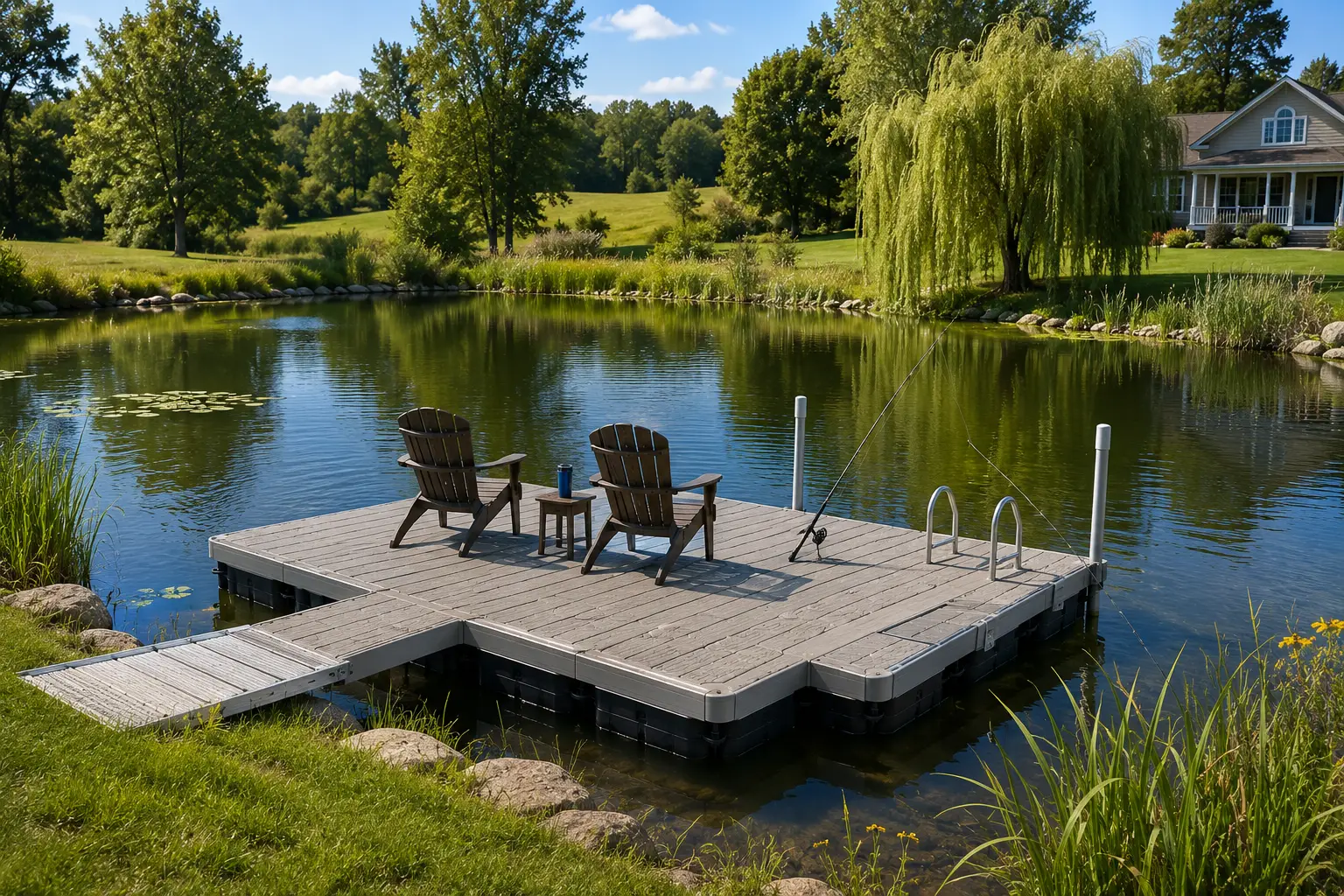
Steigerindelingen waarbij vissen voorop staat — Zodat elke worp telt
Vissen is de belangrijkste reden waarom vijverbezitters steigers bouwen, en het ontwerpdoel is duidelijk: je werphoeken maximaliseren en tegelijkertijd de benodigde bouwruimte zo klein mogelijk houden.
De rechte pier is de eenvoudigste en voordeligste opstelling: een loopbrug van 4 bij 12 voet die rechtstreeks het diepere water in loopt. Deze opstelling werkt het beste bij smalle, langwerpige vijvers waar je het midden wilt bereiken zonder een brede constructie te hoeven bouwen. De aanbevolen minimale breedte is 4 voet — genoeg voor één stoel, een viskist en voldoende bewegingsruimte om comfortabel uit te werpen.
De T-Head voegt aan het einde van de loopbrug een platform van 8 bij 8 voet toe, waardoor een werpzone van 270 graden ontstaat. Twee of drie mensen kunnen tegelijkertijd vissen zonder dat de lijnen in de knoop raken. Dit is het meest veelzijdige ontwerp voor gezinsvijvers en vereist in totaal ongeveer 100 vierkante voet aan terrasoppervlak voor het eindplatform en de loopbrug.
Het L-vormige schiereiland loopt over een deel van de lengte langs de oever, voordat het naar binnen afbuigt de vijver in. Hierdoor heb je zowel toegang tot ondiep water voor kinderen als tot diep water voor serieuze vissers, en dat allemaal vanuit één aaneengesloten constructie. Het past ook beter in het landschap dan een rechte weg naar het midden.
Zorg ervoor dat er op elke vissteiger ten minste één hengelhouder per verwachte visser aanwezig is, houd het dek splintervrij (blote voeten en houtsplinters gaan niet goed samen) en – als kinderen of oudere familieleden er gebruik van gaan maken – breng dan rondom de buitenranden leuningen aan met een hoogte van 36 tot 42 inch.
Zwem- en ontspanningssteigers — Maak van je vijver een toevluchtsoord in je eigen achtertuin
Een zwemsteiger is een heel ander verhaal. Die moet breder zijn, lager bij het water liggen en zo zijn ontworpen dat je er lekker op kunt liggen, niet alleen maar staan.
Het Platform Dock is een eenvoudige vierkant of rechthoek — 10 bij 10 feet of groter — die laag boven het water drijft, zodat men er gemakkelijk in en uit kan stappen. Het dekoppervlak mag niet meer dan 12 tot 18 inches boven de waterlijn uitsteken, zodat zwemmers zich zonder ladder kunnen optrekken (hoewel een ladder om veiligheidsredenen nog steeds sterk wordt aanbevolen). Bij drijvende steigers is dit lage profiel eenvoudig te realiseren — kies gewoon voor drijvers met een lagere vrijboordhoogte. Bij vaste steigers vereist dit een zorgvuldige hoogteplanning, rekening houdend met het hoogste verwachte waterpeil van uw vijver.
Het meerlaagse laadperron Het ontwerp verdeelt de functies op basis van hoogte: een hoofdplatform om op te relaxen op dekhoogte, een lager gelegen “splash deck” op slechts inches boven het water waar kinderen kunnen zitten en met hun voeten in het water kunnen bungelen, en een dieper gedeelte om in te springen. Dit ontwerp kost meer en neemt meer ruimte in beslag, maar voor een gezin dat hele zomermiddagen aan de vijver doorbrengt, wordt het rendement op de investering gemeten in herinneringen, niet in dollars.
Onmisbare accessoires voor een zwemsteiger: een zwemtrap met brede treden, een antislipdek (een nat houten dek is gevaarlijk glad — als je hout gebruikt, moet je antisliptape of -coating als een onvermijdelijke uitgave meerekenen) en schaduw — hetzij een vrijstaande parasol met een stevige voet, hetzij een eenvoudig zonnescherm dat tussen palen is gespannen. Een kleine drijvende opbergbak voor zonnebrandcrème, zwembrillen en waterflessen zorgt ervoor dat je zo min mogelijk naar het huis hoeft te lopen.
Een belangrijke veiligheidsopmerking: een duikplank vereist een waterdiepte van ten minste 6 voet om veilig te zijn. De meeste kleine vijvers halen die diepte bij de steiger niet. Als je vijver maximaal 4 of 5 voet diep is, is met je voeten eerst vanaf de rand van de steiger springen het uiterste — en dat zou in het artikel vermeld moeten worden, want geen enkel ontwerpidee is een ruggenmergletsel waard.
Multifunctionele steigers voor boerderijvijvers — Ontworpen voor werk en plezier
Boerderijvijvers zijn de Zwitserse zakmessen van de vijverwereld. Op hetzelfde steiger kan ’s ochtends worden gevist, kan rond het middaguur een irrigatiepomp worden bevestigd en kunnen de kinderen na het avondeten kikkers vangen. Het ontwerp moet dit allemaal aankunnen, zonder concessies te doen.
Een steiger bij een boerderijvijver vereist meer structurele veiligheidsmarge dan een recreatieve steiger. Gezien de irrigatiepomp (50 tot 120 pond), de kans dat vee op de rand stapt en het feit dat er tijdens de oogst of het uitzetten van vis meerdere mensen tegelijk aan het werk zijn, lijkt de standaard belasting voor woningen van 40 psf aan de optimistische kant. Een ontwerpdoelstelling van 60 psf biedt een ruime marge — en modulaire drijfsystemen bereiken dit door simpelweg meer drijfblokken onder hetzelfde dekoppervlak toe te voegen, waardoor de drijfkrachtdichtheid wordt verhoogd zonder de decconstructie erboven te wijzigen.
De ideale indeling is een breed platform — minimaal 10 bij 12 voet — met afgebakende zones in plaats van afzonderlijke constructies. Aan de kant van het diepe water zijn hengelhouders aangebracht. Aan de kant dicht bij de oever bevindt zich een versterkte bevestigingszone voor de leidingen van de pomp (een vastgeschroefde beugel voorkomt schade aan het dek door trillingen). Het midden is vrij voor algemeen gebruik. Een verwijderbaar deel van de reling aan de kant waar het vee staat, voorkomt dat dieren het dok op lopen als je er niet bent.
Met name voor boerderijvijvers zijn er sterke argumenten voor een modulair drijvend platform van HDPE. Het waterpeil in boerderijvijvers schommelt sterk door wateronttrekking voor irrigatie en seizoensgebonden regenval. Een drijvend platform past zich automatisch aan het waterpeil aan. Winterijs kan HDPE-drijvers niet beschadigen, zoals het hout doet versplinteren of aluminium doet verbuigen. En omdat het onderhoud vrijwel nihil is, is er weer een zorg minder op de toch al eindeloze takenlijst van de boerderij. Als het alternatief is om elk jaar in november een houten steiger uit het water te halen en elk voorjaar delen ervan opnieuw op te bouwen, verdient de hogere aanschafprijs van HDPE zich binnen enkele jaren terug door de bespaarde weekenden.
Benieuwd of HDPE geschikt is voor uw vijver?
Bekijk productspecificaties, drijfvermogentabellen en aanbevelingen voor het ankeren, afgestemd op uw specifieke omstandigheden.
Specificaties voor een steiger bij de vijver opvragenUitdagingen in de praktijk — winter, ondiep water en seizoensgebonden verrassingen
Als je een auto koopt, waarschuwt niemand je voor winterbanden totdat de eerste winterstorm toeslaat. Bij aanlegsteigers aan een vijver geldt hetzelfde: er zijn dingen die je onverwachts kunnen overvallen als niemand er iets over zegt. Hier zijn de drie zaken die steeds weer terugkomen op forums voor vijverbezitters, en hoe je ze kunt aanpakken voordat ze tot dure problemen uitgroeien.
Als de vijver bevriest
Het gevaar zit niet in het ijs zelf dat tegen de steiger drukt. Het gevaar zit hem in het ijs dat beweegt. Als een vijver bevriest, zet de ijslaag zijdelings uit, waardoor er duizenden ponden kracht per lineaire voet wordt gegenereerd. Als dat uitzettende ijs zich vastgrijpt aan een houten paal of een aluminium frame, tilt het deze op — een fenomeen dat “ice jacking” wordt genoemd en dat de belangrijkste oorzaak is van steigerbreuken in noordelijke klimaten. Zodra de dooi in de lente intreedt, laat het ijs los en zijn uw steigerpalen 6 inches uit de bodem van de vijver getrokken, waardoor de hele constructie scheef komt te staan als een dronkaard.
Vaste steigers in vorstgebieden vereisen ofwel diep ingeslagen palen onder de vorstgrens (duur, vereist professionele apparatuur) ofwel een jaarlijks terugkerende verwijderingsprocedure (vermoeiend, vereist opslagruimte). Drijvende houten steigers hebben dezelfde verwijderingsverplichting: nat hout bevriest aan de ijslaag en wordt meegesleurd naar waar het ijs ook maar drijft.
HDPE-drijvers voorkomen deze faalwijze dankzij twee materiaaleigenschappen. Ten eerste heeft HDPE van nature een glad oppervlak met lage wrijving — ijs kan er geen mechanische grip op krijgen, zoals dat wel het geval is bij poreus, met water doordrenkt hout. Ten tweede behoudt HDPE zijn elasticiteit bij temperaturen tot -40 °C. Wanneer ijs tegen een HDPE-drijver uitzet, wordt de drijver licht samengedrukt en keert hij terug naar zijn oorspronkelijke vorm — hij barst niet, en het ijs glijdt erlangs in plaats van hem op te tillen. Dit is geen marketingtaal; het is materiaalkunde. Dezelfde eigenschap maakt HDPE tot het materiaal bij uitstek voor leidingen die geschikt zijn voor arctische omstandigheden en voor maritieme boeien in koude klimaten.
IJsvorming is de belangrijkste oorzaak van defecten aan laadkades in koude klimaten. Wanneer ijs zich vastklemt aan een houten paal en deze omhoog trekt, kan de hele constructie in één winter worden verwoest. Het gladde oppervlak van HDPE voorkomt dat ijs zich mechanisch kan vastgrijpen. Als uw vijver bevriest, controleer dan vóór de eerste strenge vorst de spanning van de ankerketting — laat 6 tot 8 inch speling over voor thermische krimp.
Als u een drijvende steiger de hele winter in de vijver laat liggen, controleer dan vóór de eerste strenge vorst of de ankerketting strak genoeg zit. Kettingen die in de zomer strak zitten, worden in de winter gevaarlijk strak doordat het frame krimpt. Laat 6 tot 8 inch speling over om rekening te houden met thermische bewegingen.
Als je vijver ondieper is dan je dacht
Veel “kleine vijvers” — met name kunstmatige boerderijvijvers en retentievijvers in voorsteden — zijn in het midden maximaal 3 tot 4 feet diep en lopen naar de randen toe taps toe tot minder dan 2 feet. Een vast aanlegsteiger is onder deze omstandigheden ofwel onmogelijk, ofwel absurd: palen van 8 feet die in 2 feet modder zijn geslagen, waarbij 6 feet van de paal boven de waterlijn uitsteekt.
Drijvende steigers zijn uitstekend geschikt voor ondiep water, maar niet alle drijvende steigers zijn hetzelfde. Bij steigers met drijfvaten is minimaal 18 tot 24 inch vrije ruimte onder de vaten nodig. HDPE-drijfblokken van standaardhoogte (400 tot 500 millimeter) hebben ongeveer 10 tot 14 inch nodig. Lage kubussen van 250 millimeter hebben leeg een diepgang van slechts 4 tot 6 inch — wat betekent dat je een steiger kunt laten drijven in water dat zo ondiep is dat je erin kunt staan.
Voor het ankeren in extreem ondiep water is een andere aanpak nodig. Traditionele verticale ankerkettingen zijn niet lang genoeg om de kettinglijn te vormen die golf- en windkrachten opvangt. Gebruik in plaats daarvan horizontale spanlijnen: roestvrijstalen kabels die van de buitenste hoeken van de steiger naar ankerpunten op de oever lopen. Zo ontstaat een stabiele driehoekige bevestiging die bij elke waterdiepte goed functioneert.
Wanneer de seizoenen je waterlijn opnieuw bepalen
Een vijver in het voorjaar, volgestroomd met smeltwater, kan wel 3 voet hoger staan dan diezelfde vijver in augustus, na twee maanden van irrigatie en verdamping. Vaste steigers die zijn gebouwd voor het waterpeil in het voorjaar, zijn in de zomer onbruikbaar — het platform ligt te hoog, de ladders reiken niet tot aan het water en het geheel voelt gewoon niet goed aan. Als ze zijn gebouwd voor het zomerse peil, lopen ze in het voorjaar onder water.
Drijvende steigers doorstaan de storm. De steiger blijft op een constante hoogte ten opzichte van het wateroppervlak, ongeacht het absolute waterpeil. De enige aanpassing die nodig is, betreft de loopplank — de helling of loopbrug die de steiger met de oever verbindt — die aan beide uiteinden scharnierend moet zijn om rekening te houden met veranderende hoeken. Een eenvoudig pen-scharnier aan de oeverzijde en een drijvend scharnier aan de steigerzijde zijn voldoende.
Van plan naar werkelijkheid — Hoe je je vijversteiger daadwerkelijk laat bouwen
Je hebt je vijver in kaart gebracht. Je hebt een type steiger gekozen. Je hebt de materialen afgewogen. Je hebt een ontwerp in gedachten en een plan voor de winter. Nu komt het moment waarop ideeën worden omgezet in iets waar je op kunt staan. Er zijn drie manieren om verder te gaan, elk geschikt voor een ander type vijverbezitter.
Volledig doe-het-zelf
Je bouwt het zelf. Maximale besparing, maximale tevredenheid, maximale leercurve.
Begint bij ~$800Modulaire bouwset
Kant-en-klaar ontworpen, u zet het zelf in elkaar. De beste balans tussen kosten, snelheid en kwaliteit.
1 dag, 2 personenProfessioneel
Schakel een aannemer voor maritieme projecten in. Gemoedsrust, volgens de voorschriften uitgevoerd, zonder gedoe.
$ 3.000–12.000Optie 1: Volledig zelf doen — De doe-het-zelfroute
Als je over basisvaardigheden op het gebied van timmerwerk beschikt, een weekend of twee over hebt en bereid bent om al doende te leren, is het bouwen van je eigen steiger de meest bevredigende — en meest betaalbare — manier. De belangrijkste stappen, in volgorde: markeer de indeling met paaltjes en touw, bouw het frame op het droge (daar zul je jezelf later dankbaar voor zijn), monteer de drijvers of plaats de palen, afhankelijk van het type dat je hebt gekozen, leg de vloerplanken aan, voeg leuningen en accessoires toe, en – als het een drijvende steiger is – sleep de voltooide steiger op zijn plaats voordat je hem verankert.
Waar je op moet letten: alles wat onder water gebeurt, is moeilijker dan het lijkt. Het slaan van palen vanaf een boot of het waden in borstwaders is fysiek zwaar en gaat niet erg nauwkeurig. Het plaatsen van ankers in troebel water stelt je geduld op een manier op de proef zoals dat bij bouwwerkzaamheden op het droge nooit het geval is. Reken op twee keer zoveel tijd als je denkt dat het onderwatergedeelte in beslag zal nemen, en neem een helper mee — het in je eentje bouwen van een steiger is een rechtstreekse weg naar frustratie.
Optie 2: Modulaire dock-set — Het slimme compromis
Modulaire aanlegsteiger-sets bieden het beste van twee werelden: u profiteert van de voldoening en kostenbesparingen van zelfbouw, zonder dat u hoeft te gissen naar de technische details. De fabrikant heeft het drijfvermogen al berekend, de benodigde onderdelen gespecificeerd en de componenten op maat gesneden of voorgevormd. Uw taak is het in elkaar zetten, niet het ontwerpen.
Bouwpakketten met houten frames van bedrijven als Tommy Docks en bouwpakketten met aluminium frames zijn al lang bestaande opties. Bouwpakketten op basis van HDPE-drijvers vormen een nieuwere categorie — de drijvers worden geleverd als stapelbare kubussen met voorgeboorde bevestigingspunten, het bevestigingsmateriaal is inbegrepen en de dekpanelen (hout, composiet of aluminium — naar keuze) worden bovenop vastgeschroefd. Standaardmaten kunnen door twee personen in minder dan een dag worden gemonteerd, en dankzij het modulaire ontwerp is uitbreiding volgend jaar slechts een kwestie van het bestellen van meer kubussen en panelen.
Het kostenvoordeel ten opzichte van een volledige professionele installatie is aanzienlijk. Bij een standaard steigerproject maken de arbeidskosten 50 tot 60 procent van het totaalbedrag uit. Als je de arbeidskosten weglaat, kost een modulaire steiger uit een bouwpakket vaak minder dan de helft van de installatiekosten van een op maat gemaakte steiger — met als bijkomend voordeel dat je precies weet hoe elke verbinding werkt, omdat je die zelf hebt aangebracht.
Optie 3: Professionele installatie — De ‘hands-off’-aanpak
Schakel een professional in voor complexe ontwerpen, constructies met meerdere niveaus of gewoon voor de gemoedsrust dat het werk volgens de voorschriften wordt uitgevoerd. Zoek specifiek naar aannemers met ervaring in waterbouw of maritieme bouw — een terrasbouwer die alleen op het droge heeft gewerkt, weet niets van ijsverheffing, galvanische corrosie of berekeningen van de verankeringbelasting. Vraag om foto’s van hun eerdere steigerprojecten. Vraag hoe ze omgaan met de winter in uw klimaat. Als ze geen zelfverzekerd, specifiek antwoord hebben op de wintervraag, zoek dan verder.
De professionele installatie van een standaard drijvende steiger van 10 bij 10 voet kost doorgaans tussen de $3.000 en $7.000, afhankelijk van de gebruikte materialen en de regio. Vaste steigers met heipalen zijn duurder — tussen de $5.000 en $12.000 — vanwege de benodigde gespecialiseerde apparatuur en arbeid.
Een opmerking over vergunningen
In de meeste Amerikaanse counties is geen bouwvergunning vereist voor aanlegsteigers voor privégebruik van minder dan 200 vierkante voet aan privé-vijvers. Maar “de meeste” is niet “alle”, en uw county kan een uitzondering vormen. Een telefoontje van 5 minuten naar uw lokale dienst ruimtelijke ordening is de goedkoopste verzekering die u ooit kunt afsluiten tegen een bouwstop. Als uw vijver in verbinding staat met een natuurlijke waterweg of is aangemerkt als wetland, wordt de regelgeving complexer — in die gevallen is professioneel advies over vergunningen elke dollar waard.
Als u de aanpak met modulaire HDPE-steigers interessant vindt — met name de winterbestendigheid en het feit dat ze vrijwel geen onderhoud vergen — en u de specificaties wilt vergelijken met die van de houten of aluminium bouwpakketten die u overweegt, biedt Hisea Dock gedetailleerde productgegevensbladen, drijfkrafttabellen en ontwerpadvies voor drijvende steigerprojecten op vijverschaal. U kunt contact opnemen met hun team via de contactpagina op hiseadock.com/contact-us om de afmetingen, draagvermogens en verankeringsaanbevelingen voor de specifieke omstandigheden van uw vijver te verkrijgen.
Ga aan de slag met je ontwerp voor een steiger bij je vijver
Vertel ons iets over uw vijver — de afmetingen, de diepte, waarvoor u hem wilt gebruiken — en wij sturen u een passende configuratie terug.
Gegevens van mijn vijver verzendenBronvermeldingen
- Laird Plastics. “HDPE-gids: eigenschappen, toepassingen en gebruiksmogelijkheden.” 2025. https://lairdplastics.com/resources/hdpe-guide-properties-uses-applications-2025-update/
- International Code Council. “Bouwvoorschriften van North Carolina, hoofdstuk 36 — Steigers, pieren, schotten en waterwegconstructies, paragraaf 3604.3 Dynamische belastingen.” https://codes.iccsafe.org/s/NCBC2018/chapter-36-docks-piers-bulkheads-and-waterway-structures/NCBC2018-Ch36-Sec3604.3
- ECK Plastic Arts. “Eigenschappen van HDPE: vloeigrens en technische gegevens.” https://eckplastics.com/high-density-polyethylene-hdpe/
- Hisea Dock. “Fabrikant van drijvende steigers van kunststof.” https://www.hiseadock.com/
- Hisea Dock. „Neem contact met ons op.” https://www.hiseadock.com/contact-us/

 English
  Thai
Thai  Spanish
  French
  German
  Dutch
Dutch  Italian
  Arabic
  Indonesian
  Portuguese
  Turkish