
Do You Need a Dock Permit? Five Measures That Actually Decide It
What Actually Decides Whether You Need a Dock Permit
Most waterfront owners arrive at this question carrying a phrase they have already heard: floating docks don’t need permits. It gets repeated on supplier blogs, in dealer showrooms, and in dock-purchase conversations across the country. In a lot of jurisdictions it is also flatly wrong, and the mistakes it produces are expensive ones.
New Jersey’s rules are a useful corrective. The state describes the construction of a dock or pier in tidal regulated waters as “a fixed or floating dock, pier, or boathouse.” One authorization covers both. Its permit-by-registration 10 goes further and names “temporary or seasonal structures like floating docks and mooring rafts” as activities it covers. Floating changes the structure. It does not change the category.
So what does decide it?
Not the material. Not whether the thing floats. What a regulator actually measures is a delta, meaning what your project adds to a state of affairs that was already settled. A dock replacing an existing legal structure at the same size and in the same location adds nothing, and many jurisdictions let it pass. A dock putting a new mooring where none existed adds something, and that something is what gets reviewed.
Floating is not an exemption. New Jersey’s rules cover fixed and floating docks in the same authorization, and explicitly name temporary or seasonal floating structures. Check your own state’s text before repeating the claim.
The reframe matters because it replaces an unanswerable question with an answerable one. “Do you need a dock permit?” has no national answer. The pages that appear to give one are describing their own state. “What am I adding, and to what?” has a consistent answer you can work out from your own situation, and it runs on the five measures below.
If you came here only to find the office you apply to, the next section gives you the three levels to check. Then come back, because knowing which office you are dealing with still leaves it to decide what it thinks you are adding.
Who Has Jurisdiction — and the Checklist They All Apply
Three levels of government, plus two private parties, can each stop your project independently.
Who Can Stop Your Dock Project
| Niveau | Who | What they decide | When they appear |
|---|---|---|---|
| Federal | U.S. Army Corps of Engineers — Section 10 (Rivers and Harbors Act) for structures in navigable waters; Section 404 (Clean Water Act) where wetlands or fill are involved | Whether the structure may occupy federal waters | Projects in navigable waterways or near wetlands |
| Staat | Environmental protection or natural resources agency (DEP, DEC, DNR or equivalent) | Wetlands, water quality, submerged lands | Most docks, in most states |
| Local | Building, zoning and fire departments | Setbacks, construction standards, electrical work | Almost always |
| Association | HOA or community association | Design, size, colour, placement | Private lake communities |
| Slip owner | Marina or condominium association | Whether you may attach a structure to their infrastructure | Leased slips |
Two things get missed constantly. The first is that water-side and land-side are separate approvals. Electrical hookups, water, sewer and parking are governed by different authorities than the dock itself, often by different people in the same building.
The second is the checklist itself. Wherever you are, agencies tend to apply the same headings: dimensions and length, setbacks from neighbouring property lines, navigation, water depth, materials, and proximity to environmentally sensitive areas. Navigation is the one owners underestimate. Many waterways require you to leave a set proportion of the channel open, with 25% appearing commonly.
The process then runs in a recognisable order. You apply, get reviewed (with public notice or a hearing in some cases), and receive approval. From there you build exactly what you drew, take the inspection, and close the file, which means as-built drawings and in some jurisdictions an occupancy permit. On timing, residential applications commonly take a few weeks to 30–90 days. Marina and commercial projects typically run 90–120 days, with larger or more complex ones extending past six months (MSA, marina planning firm).
Five Measures of What You’re Adding
The delta runs on five measurable quantities. Most projects turn on one or two of them.
The Five Measures
| Measure | Values | What it changes |
|---|---|---|
| 1. Is anything new | New construction vs. attaching to what already exists | The coarsest cut; decides whether you are inside an exemption or outside one |
| 2. Bottom contact | Piling to the bottom vs. anchoring without contact | The weight of the review |
| 3. Scale | Area, length, number of berths or vessels | Fast-track authorisation vs. full review — and whether you are already in violation |
| 4. Time | Permanent vs. seasonal-removable vs. temporary | Which rule set applies, and what you owe across seasons |
| 5. Use | Private vs. community, commercial or public | Entire chain is replaced |
Is Anything New — or Are You Attaching to What Already Exists?
Florida shows how many answers a single rule can run on. Under §403.813(1)(s), a floating structure qualifies for exemption only if it clears three tests at once. It must float at all times “for the sole purpose of supporting a vessel,” so the boat leaves the water when it is not in use. It must sit inside a previously permitted boat slip, or measure no more than 500 square feet combined, or 200 square feet in an Outstanding Florida Water. And it may not be used “for any commercial purpose or for mooring vessels that remain in the water when not in use.”
Read the shape of that, because the shape is the point. The same platform floating in the same place moves in and out of exemption based on what it does, how large it is and who uses it. Nothing about the material changed. The delta did.
Same object, three tests
Doel
Sole purpose of supporting a vessel, with the boat out of the water when not in use.
Maat
Inside a permitted slip, or no more than 500 sq ft — 200 sq ft in an Outstanding Florida Water.
Commercial use
Not used for any commercial purpose, and not mooring vessels that stay in the water.
The structure is identical. What it adds is not.
Attaching to a legally existing structure is one route, but it is narrower than it gets described. Florida’s exemption also covers a platform “attached to a bulkhead on a parcel of land where there is no other docking structure,” so an existing dock is not required. New Jersey runs a different test: a replacement in the same location and size, not increasing the footprint, legally existing before 1 January 1981, needs no waterfront development permit.
The direction most owners miss is the other one. If the structure you are modifying was never permitted to begin with, you may not simply replace it. A replacement certificate generally requires the existing structure to be brought into compliance first. A shortcut taken by a previous owner can resurface as your problem.
Are You Adding Contact With the Bottom?
New Jersey sorts dock structures into three states and routes each through different authorisations: supported on pilings driven into the bottom, floating on the surface, or cantilevered over the water. The same dock, in the same water, changes its path when its relationship to the bottom changes. Disturbing the bed is the trigger most likely to escalate a review, because that is the part regulators cannot undo.
Two consequences are worth checking. New York City requires that a float which could possibly sit on the bottom be chocked at a minimum of 18 inches. Any walkway crossing a vegetated wetland to reach a float must sit at 4.5 feet above grade. Where bottom contact is unavoidable, the pile-to-float interface becomes a specification item in its own right. Pile diameter has to be known before the hardware can be chosen, which is why a pile guide rated for piles up to 220 mm diameter exists at all.
How Much Are You Adding — and Does It Cross a Threshold?
Thresholds decide whether you take an expedited route or a full review, and they also decide whether what you already have counts as a violation. They are set locally, and they are not interchangeable:
| Jurisdiction | Threshold | What it governs |
|---|---|---|
| New York City | 200 sq ft | Residential floating dock qualifies for Standard Activity Permit review |
| Massachusetts | 600 sq ft | Post-1984 structures eligible for exemption |
| Georgia | 800 sq ft | Floating portion of a community dock |
| New York State | >5 vessels or >4,000 sq ft perimeter | Triggers the DEC’s Dock Application Supplement Form D-2 |
| Texas (LCRA, Highland Lakes) | 1,500 sq ft | Residential docks below this need no LCRA permit or fee. A floating dock above it falls under the marina ordinance |
That table is the single most misused thing in this topic. A 500-square-foot figure read in Florida and applied in Texas means nothing. Carry the jurisdiction with the number, always.
Two measures remain that rarely get their own heading but change the answer outright. The first is permanence. New Hampshire permits permanent docks only on lakes larger than 1,000 acres, and restricts smaller lakes and navigable rivers to seasonal structures. In those waters, being removable is not a convenience. It is the condition of being allowed at all. Grandfathering dates vary the same way: New Hampshire’s begin 22 June 1967 for tidal structures, 2 July 1969 for freshwater permanent ones and 4 September 1978 for freshwater seasonal ones.
The second is use. The moment a dock serves more than its owner’s household, the chain changes, and some authorities write that line into statute explicitly rather than leaving it to interpretation.
What Getting It Wrong Actually Costs
Five consequences, in rough order of how often they land.
Fines, and they are not symbolic. In June 2026 Florida’s Department of Environmental Protection fined the City of Fort Pierce roughly $16,000 over unpermitted docks built on state-owned land at Little Jim Bait & Tackle. The city was granted a 90-day extension to resolve it (TCPalm, 26 June 2026). That is a municipality with legal staff. A private owner has fewer options.
Forced removal at your own expense. A removal order puts the cost of undoing the work on you, and the structure has no salvage value that offsets it.
Denied future permits. An enforcement record follows the site. Owners who want to expand, replace or renew later find the earlier violation is part of the file.
A resale problem. An unpermitted dock has to be disclosed, and liability can transfer. A waterfront owner can be held responsible for an unpermitted pier even if it already existed when they bought the property (Pender & Coward, Virginia law firm). Grandfathering is not a property right you inherit automatically. New Hampshire recognises a structure as legally existing only if three conditions hold. It must have been continuously maintained, must not have been abandoned for more than five years, and must not be built on land created by unauthorised filling.
June 2026
$16,000
Florida DEP fines the City of Fort Pierce over unpermitted docks on state land, with 90 days to resolve (TCPalm).
The mechanism that ties these together is the one from the previous section: an unpermitted structure blocks its own replacement. You do not get to leave the problem in place and fix it later with a permit application. The shortcut travels with the dock.
Before you order anything, get the footprint and the threshold to agree.
Send us your water body and layoutDesigning the Dock to Fit the Test
The goal here is not to slip past a regulator. It is to size the delta to what you actually need. A dock bigger than its job costs more, takes longer to approve, and sits closer to the thresholds above than it has to.
Fitting the Increment Under the Threshold
The thresholds are written in area, length or berth count. A modular system’s footprint is a function of how many modules you assemble. That makes sizing the one lever you can pull with precision. A 500 × 500 mm cube and a 1,000 × 1,000 mm float differ fourfold in area at the same thickness. Float heights of 250 mm, 400 mm and 500 mm change the structure without changing the plan area at all.
The sequence matters more than the arithmetic. Measure what you need first: berths, walkway width, the reach to usable depth. Then derive the module count, and only then compare that number against your authority’s threshold. Done the other way round, owners buy modules for the layout they imagined and discover afterwards that the footprint pushed them into a category they did not want.
Do it in this order
Measure what you need: berths, walkway width, the reach to usable depth.
Derive the module count from that.
Only then compare the number against your authority’s threshold.
Bottom Contact: Piling, Anchoring, or Neither
This is where a floating configuration has the most room to move, and where it is most often misrepresented as a simple either/or. There are three states, not two. Driven piles reach the bed. A float rides the water column and never touches bottom. A cantilever is carried off the shore or off an existing structure. Only the first disturbs the bed.
Where piles are required, the pile-to-float interface becomes a real specification decision, and pile diameter drives it. Where they are not, anchoring resolves into genuinely different options: embedded pipes, deadweight anchors, piling brackets, or stiff arms. Each has a different relationship to the bed, and therefore a different conversation with the regulator.
Where a Floating Dock Stops Working
The boundary is not a caveat at the end of the article. It is the practical limit of the approach, and it varies by water body.
When a Floating Configuration Stops Working
| Situation | Floating viable? | The limit | What to confirm first |
|---|---|---|---|
| Ordinary private use, non-sensitive water | Usually | Still bound by size and setback limits | Confirm which figure your water body applies |
| Floating footprint exceeds the local threshold | Yes, but reclassified | Above the threshold the structure is administered as a marina (LCRA: over 1,500 sq ft of water surface) | Measure water surface area before designing, not after |
| Water body allows seasonal structures only | Permanent option does not exist | New Hampshire: lakes under 1,000 acres and navigable rivers are seasonal-only; LCRA prohibits floating habitable structures | Confirm whether seasonal removal is mandatory |
| Floating habitable structure prohibited | Nee | Prohibited outright under LCRA’s Land and Water Use Regulations | Confirm how ‘habitable’ is defined in the rule |
| Anchoring requires rights to the submerged land | Yes, with a precondition | You need ownership or permission over the underwater land | Secure the right before finalising the design |
| Tidal water | Yes, with an added layer | A separate tidelands authorisation may apply (New Jersey) | Establish tidal vs. freshwater status first |
| Already relying on ‘removable means exempt’ | Not viable | New Jersey covers temporary and seasonal floating structures explicitly | Check whether your state names floating structures in its rules |
Read the last row twice. It is the one that catches owners who did the reading.
Who Supplies the Dock — and the Data the Packet Needs
Once you know which route you are on, the application starts making demands on whoever supplies the hardware.
A full review will typically ask for engineered drawings sealed by a licensed professional in your jurisdiction. In some places it will also ask for water-depth data certified by a licensed surveyor, rather than a measurement you took yourself. Anchoring method, structural dimensions and load data all have to go into those drawings. That means the supplier has to be able to produce them, not just ship a product.
Load data deserves its own warning, because the same product can be described on two different bases. A supplier publishing a surface load of 350 kgs/m² and one publishing roughly 90 kg (200 lbs) per cube may be describing the same capability. The arithmetic checks out: 350 kgs/m² multiplied by a 500 × 500 mm cube’s 0.25 m² gives 87.5 kg, which is the same number rounded. Surface load per square metre and load per individual float are not interchangeable. A figure quoted on one basis cannot be checked against a threshold or a lift rating quoted on the other. Ask which basis a number is on before you use it.
Public and commercial projects pick up one more layer: accessibility requirements, including ramp gradients, transfer systems and non-slip surfaces, plus railing specifications that a private single-berth dock usually escapes.
The Dealer’s Side: Selling a Dock That Passes
If you sell or install floating docks, everything above changes what you are actually selling.
The five measures do not treat a modular floating system evenly. Bottom contact and permanence are the two where a floating configuration has structural room to move. A piling-driven dock has already settled both before it reaches the water. Use is the one that cannot be engineered around at all. Cross into commercial or public service and the entire chain reopens, however careful the design.
So the specification sheet is doing compliance work whether or not anybody calls it that. Three line items in particular put a customer on one permit path rather than another: the anchoring method, the module count, and whether a pile guide is in the bill of materials. Quoted as accessories, they are a margin line. Quoted as the answer to a regulatory question, they are the reason a customer does not receive a violation notice eighteen months after installation.
There is also a tightening trend worth pricing. LCRA’s board approved a revised marina ordinance on 24 May 2023 for the Highland Lakes. It sets a two-year deadline for marinas to replace unencapsulated foam or enter a replacement agreement, and it bans new community marinas. That is one authority in one state, not an industry rule. But it points a direction, and encapsulated air-filled float construction sits on the right side of it.
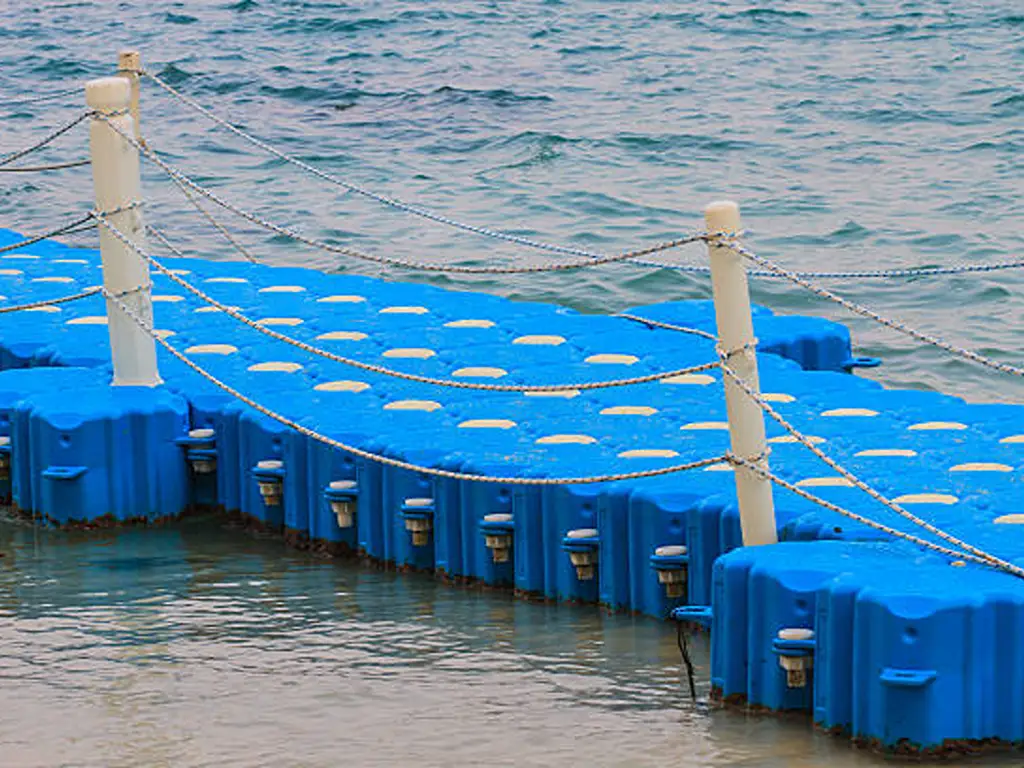
For the portion that can be configured, that flexibility is the product. Hisea Dock builds a modular dock cube range spanning published surface load ratings from 200 to 420 kgs/m². Float heights run 250, 400 and 500 mm, across U, single, double and V float types. A layout can therefore be sized to the threshold a water body actually applies, rather than the other way around. Structure, colour, shape and size are customisable, and custom sizes and float heights are available for OEM and smaller custom orders, with custom runs quoted at around 15 days.
If you would rather start from your own water body than from a catalogue, tell us your water body and we’ll size it.
Size the dock to your jurisdiction, not the other way round
Tell us the water body, the use, and the bodies you answer to. We will come back with a module count, float heights, an anchoring method, and the load data your permit packet needs.
Send us your water bodyBronvermeldingen
- New Jersey Department of Environmental Protection. “Construction of a Dock or Pier.” https://dep.nj.gov/wlm/lrp/common-projects/dockpier/
- Florida Senate. “The 2025 Florida Statutes — §403.813, Permits; Specific Activities.” https://www.flsenate.gov/Laws/Statutes/2025/403.813
- NYC Waterfront Navigator. “Floating Dock — Typical Projects.” https://waterfrontnavigator.nyc/typical-projects/floating-dock/
- New Hampshire Department of Environmental Services. “Docks in Non-Tidal Areas FAQs.” https://www.des.nh.gov/water/wetlands/faqs/docks-non-tidal-areas
- Lower Colorado River Authority. “Boat Docks and Marinas.” https://www.lcra.org/water/permits-contracts/docks-and-marinas/
- Massachusetts Department of Environmental Protection. “Waterways Permitting — Frequently Asked Questions.” https://www.mass.gov/guides/waterways-permitting-frequently-asked-questions
- Georgia Department of Natural Resources. “Ga. Comp. R. & Regs. R. 391-2-3-.03.” https://www.law.cornell.edu/regulations/georgia/Ga-Comp-R-Regs-R-391-2-3-.03
- TCPalm. “Florida DEP Fines City of Fort Pierce for Marina Docks at Iconic Bar.” https://www.tcpalm.com/story/news/local/st-lucie-county/2026/06/26/florida-dep-fines-city-of-fort-pierce-for-marina-docks-at-iconic-bar/90707932007/
- Pender & Coward. “How to Build a Pier in Virginia: Five Things Waterfront Property Owners Need to Know.” https://www.pendercoward.com/resources/blog-opinions-and-observations/how-to-build-a-pier-in-virginia-five-things-waterfront-property-owners-need-to-know/
- MSA. “Understanding the Marina Permitting Acquisition Process.” https://www.msa-ps.com/understanding-the-marina-permitting-acquisition-process/
- Hisea Dock. “Modulaire drijvende steigerkubussen.” https://www.hiseadock.com/modular-floating-dock-cubes/
- Hisea Dock. “Boat Dock Solutions.” https://www.hiseadock.com/waterfront_solutions/boat-dock/
- Hisea Dock. „Neem contact met ons op.” https://www.hiseadock.com/contact-us/
- Hisea Dock. „Hisea Dock.“ https://www.hiseadock.com/

 English
  Thai
Thai  Spanish
  French
  German
  Dutch
Dutch  Italian
  Arabic
  Indonesian
  Portuguese
  Turkish