
أفكار لإنشاء متنزهات مائية: خمسة أساسات يمكنك البناء عليها، من الفناء الخلفي إلى المياه المفتوحة
ابحث عن “أفكار للمتنزهات المائية” وستحصل على قوائم من العناصر: الزلاقات، ومنصات الرش، والأنهار البطيئة، ومسارات الحواجز، والأنهار البطيئة مرة أخرى. هذه القوائم دقيقة لكنها عديمة الفائدة تقريبًا، لأن قائمة العناصر تتجاهل القرار الذي يأتي أولاً. فكل عنصر من هذه العناصر يجب أن يُركب على شيء ما. وما يُركب عليه هو الذي يحدد عمق المياه المطلوب، وما إذا كنت بحاجة إلى ترخيص، وتكلفته، وبالنسبة للنسخ العائمة، معايير السلامة التي تنطبق عليها.
إذن، هذه قائمة بالمواقع بدلاً من ذلك. خمسة منها، تتراوح بين حديقة ومياه مفتوحة. تابع القراءة حتى تجد الموقع الذي تبحث عنه.
الركائز الخمس التي يمكن أن يقوم عليها متنزه مائي
| القاعدة | كيف يبدو الأمر | ما يتطلبه الأمر | من يناسبه |
|---|---|---|---|
| الأرض | المروج، والحصى، والرصف، وأجهزة الرش، وأماكن اللعب المائية، والمنزلقات المائية | لا شيء دائم: الماء يأتي من خرطوم ويخرج بنفس الطريقة | الساحات الخلفية، وملاعب الأطفال، والمروج المخصصة للفعاليات |
| الماء على سطح صلب | حوض مثل حوض سباحة، أو حوض للسباحة للأطفال، أو نافورة مائية على مستوى سطح السفينة | حاوية، مما يجعلها هيكلاً وليس لعبة | الحدائق التي تحتوي على مسبح قائم، ومناطق رش مائية تجارية صغيرة |
| سطح الماء، حمولة خفيفة | منصة سباحة عائمة، رصيف يمكنك السباحة منه | الطفو بالإضافة إلى الإرساء: المرة الأولى التي يُذكر فيها مصطلح “الهيكل” في النقاش | المنازل المطلة على البحيرة، والمخيمات، ومرافق رياضات التجديف |
| سطح الماء، الحديقة بأكملها | منصة عائمة ذات تصميم معياري تضم مناطق للدخول والتجول والاستراحة واللعب | هيكل يتحول إلى أرضية | المنتجعات، والمناطق ذات المناظر الخلابة، والمعالم السياحية المطلة على المياه |
| هال | منزلق لليخت أو منصة مؤخرة اليخت | أنت تمتلك السفينة بالفعل | أصحاب القوارب |
على ماذا يُقام المنتزه المائي في الواقع؟
على الأرض، لا حاجة أبدًا إلى احتجاز المياه. فهي تتدفق من خرطوم، وتمر عبر قماش مشمع، ثم تتصرف بعيدًا. ولأنه لا يتم تخزين أي شيء، فلا حاجة إلى إنشاء أي شيء: لا حوض، ولا بطانة، ولا غرفة مضخات، ولا عمليات تفتيش. وتعمل هذه الفئة بأكملها وفق مبدأ واحد: الماء المتحرك، وليس الماء الساكن.
هذا المبدأ هو السبب في أن المتنزه المائي المقام على مستوى الأرض يُعد خيارًا رخيصًا وسريعًا وقابلًا للإزالة تمامًا، وهو السبب أيضًا في أن المسائل المتعلقة بسلامته تختلف عن أي مكان آخر في هذه القائمة. وفي ظل عدم وجود مياه راكدة، لا يُعد الغرق الخطر الرئيسي؛ بل يُعد الانزلاق والإشراف هما الخطران الرئيسيان. تحقق أولاً من نظام الصرف والسطح: فالعشب الناعم تحت المياه المستمرة يتحول إلى طين، أما السطح الصلب الذي يفتقر إلى النسيج الخشن فيصبح منزلقًا لم تكن قد صممته.
هناك قاعدة خامسة لا تصل إليها معظم القوائم أبدًا: هيكل القارب، وهي ليست قاعدة تختارها بقدر ما هي قاعدة تمتلكها بالفعل.
القواعد التي تظل على اليابسة
في اللحظة التي يتعين فيها أن يبقى الماء لفترة كافية للسباحة فيه أو للانزلاق فيه، فإنك تحتاج إلى وعاء، والوعاء هو بنية. وهذا الانتقال أكبر مما يبدو.
يُحدث حوض السباحة ثلاثة تغييرات في آن واحد. فهو يضفي عمقًا، مما يتيح ممارسة السباحة. كما يضفي حافةً، وهي المكان الذي تحدث فيه الإصابات، وحيث تصبح الدرابزينات والأسطح المانعة للانزلاق أمورًا لا غنى عنها. كما أنه يحول معدات الصيف إلى هيكل دائم, ، وهو العنصر الذي ينسى الناس تحديد سعره.
تخزين الماء يجعله هيكلاً، وليس لعبة
قبل اختيار حوض، تأكد من ثلاثة أمور مع الجهة المختصة المحلية: ما إذا كان بناء منشأة لتخزين المياه يتطلب الحصول على موافقة، وما إذا كانت تُعتبر تحسينًا ثابتًا على العقار، وما إذا كان يمكن إزالتها أم يجب إيقاف تشغيلها في مكانها. تختلف الإجابات باختلاف الولاية القضائية ولا يمكن الافتراض مسبقًا.
إلا أنه إذا كانت أرضك تحتوي بالفعل على مياه، فلن تكون أي من القاعدتين الأوليين هي المكان الذي ستنتهي إليه.
المرة الأولى التي يجب أن يطفو فيها
إذا كان لديك بحيرة أو بركة أو نهر محمي أو بحيرة شاطئية، فأنت تمتلك قاعدة لا تكلفك شيئًا لبنائها: فالمياه موجودة بالفعل. ما ينقصك هو الأرضية. أي شيء تضعه هناك يجب أن يدعم نفسه، ويبقى ثابتًا، ويصمد طوال الموسم.
ما الذي يتغير لحظة أن يطفو على السطح
تتميز قوة الطفو بخاصية لا تتوفر في حوض السباحة: فهي تفصل السطح عن القاع. فأرضية حوض السباحة هي الأرض؛ أما أرضية المنصة العائمة فهي المنصة نفسها. ولهذا السبب يمكن لمتنزه مائي عائم أن يصل إلى أماكن لا يستطيع حوض السباحة الوصول إليها، ولهذا السبب يخضع لقواعد مختلفة.
والنتيجة العملية لذلك هي أنك تتوقف عن تحديد المنتج وابدأ في تحديد الهيكل. هناك ثلاثة عوامل تحدد كل شيء: عمق الماء، وتكوين القاع، وما الذي يبقي الشيء مغمورًا.
ما هو العمق المطلوب للمياه؟
ليس حسب سعة الزوار. يتم تحديد العمق بناءً على ما هو ارتفاع أعلى شيء تقف عليه؟. ما تحددها هذه الصيغة فعليًّا هو المسافة التي يقطعها الجسم بعد السقوط. ويقوم موردو المنتجات القابلة للنفخ التجارية بنشر الصيغة المستخدمة على النحو التالي:
الحد الأدنى لعمق المياه = (ارتفاع أعلى هيكل + 1.8 متر، وهو متوسط طول الإنسان) ÷ 2
قم بتصنيفها حسب فئات المعدات:
الرقم الوحيد الذي يحدد نجاح الموقع من عدمه
يتم تحديد العمق الأدنى بناءً على ما تقف عليه
أربعة ارتفاعات للمعدات، وأربعة عتبات، ومسطح مائي واحد. يتم تحديد منصة عائمة معيارية صلبة بناءً على معيار مختلف تمامًا: حيث يُقاس غاطسها تحت الحمل الخفيف بالبوصة، والغاطس ليس متطلبًا يتعلق بالعمق. وهذان المفهومان غير قابلين للتبادل.
لذا فإن النصيحة الغامضة التي تنتشر على الإنترنت والتي تقول “تحتاج إلى حوالي ثلاثة أمتار” هي في الحقيقة رقم يُقصد به ارتفاع محدد لأحد الأجهزة. يتطلب جدار التسلق مساحة 2.4 متر؛ بينما يتطلب برج القفز الذي يبلغ ارتفاعه ستة أمتار مساحة 3.9 متر. وتتناسب المساحة المطلوبة مع حجم المعدات، وليس مع عدد الحاضرين.
ولهذا السبب يمكن أن تكون نفس المساحة المائية موقعًا صالحًا أو غير صالح، اعتمادًا بشكل كامل على ما تخطط لوضعه عليها. والبديل هو منصة عائمة معيارية صلبة، ترتكز على الحجم المزاح بدلاً من ضغط الهواء. وهي لا تتطلب أي أمتار على الإطلاق: ففي حالة عدم تحميلها، تغوص بضع بوصات في الماء. وهذا الرقم هو مسودة, ، وليس شرطًا متعلقًا بالعمق، ولا يمكن استبدال أحدهما بالآخر. لكن هذا هو السبب الذي يجعل التصميم الذي يعتمد على منصة قادرًا على استخدام الماء، في حين أن التصميم القابل للنفخ لا يستطيع ذلك.
يتم تحديد كمية المياه التي يحتاجها موقعك تحت المتنزه بناءً على القاعدة التي تختارها، وليس بناءً على عدد الزوار. فهذا الرقم وحده هو الذي يحدد ما إذا كان الموقع قادرًا على استضافة متنزه مائي أم لا.
كيف يمكن منعها من الانجراف؟
أي شيء يطفو يجب تثبيته. هناك نظامان يغطيان معظم المنشآت التجارية، ويُحدد الاختيار بشكل شبه كامل بناءً على نوع القاع:
- تثبيت الكتل الخرسانية: النظام الأكثر استخدامًا على مستوى العالم، ويُصنف بأنه ممتاز على الطين والرمل والحصى، وجيد على الصخور. ويتطلب معدات رفع وقوارب عمل، كما أن تكاليف نقله وتركيبه أعلى.
- المثبتات الحلزونية (اللولبية): تم توجيهها نحو السرير. فهي ممتازة على الرمال، وجيدة على الطين الناعم، ومقبولة فقط على الحصى، و غير مناسب للصخور الصلبة, ، حيث يتطلب الأمر حلولاً مخصصة أو حلولاً مصممة خصيصاً.
هناك عاملان متعلقان بالظروف الميدانية أكثر أهمية من اختيار المرساة بحد ذاتها. الطين اللين: فالطبقة شديدة الليونة تتسبب في غرق الكتل والمرساة، لذا يجب التحقق من سماكة الطين وقدرته التحملية قبل التصميم. والتعرض للرياح. ففي المياه المفتوحة، فإن ثبات نظام التوصيل قد يكون ذلك أكثر أهمية من قوة تثبيت المراسي، لأن المساحة الكبيرة تعمل كالشراع. كما يجب إجراء القياس في الوقت المناسب: فما يهم هو أدنى مستوى للمياه خلال موسم التشغيل, ، وليس العمق في يوم التركيب.
عندما تتحول المياه إلى أرضية
الآن أصبح المتنزه بأكمله يقع فوق الماء: المدخل، والممرات، ومناطق الاستراحة، ونقاط الخدمة، ومناطق اللعب. لم تعد المنصة مجرد شيء تقف عليه، بل أصبحت الأرض التي تم تخطيط المتنزه عليها.
الطريقتان اللتان يمكن أن يطفو بهما المتنزه العائم
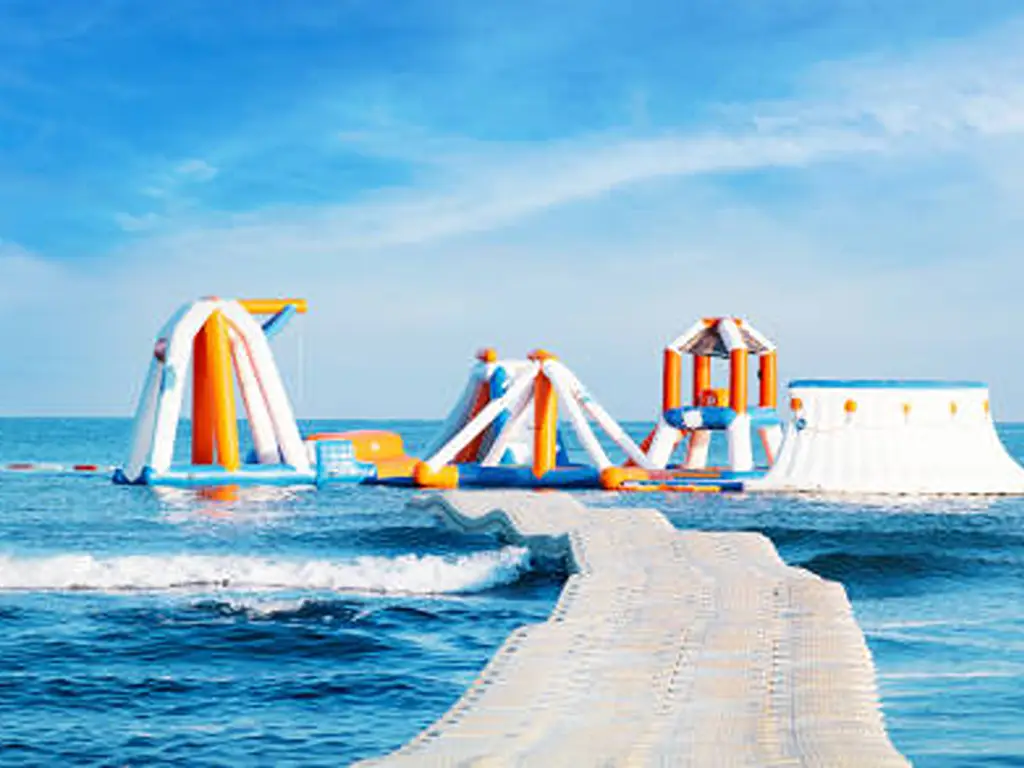
تقريبًا كل ما يُسوَّق على أنه «متنزه مائي عائم» يندرج تحت أحد نظامين هيكليين. وتختلف طريقة عمل هذين النظامين بشكل كافٍ بحيث يكون الاختيار في الحقيقة مرتبطًا بالإمكانيات المتاحة في موقعك.
طريقتان يمكن أن يطفو بهما متنزه مائي عائم
| قابلة للنفخ (مدعومة بالهواء) | عوامة معيارية صلبة (إزاحة) | |
|---|---|---|
| تستند على | ضغط الهواء في القماش المرن | حجم الماء المزاح في الخلايا المغلقة |
| أرضية مناسبة للمشي | سطح ناعم ومتحرك تتسلق عليه بدلاً من المشي عليه | سطح صلب وثابت يمكنك المشي عليه |
| العمق المطلوب | Metres, set by structure height (1.4–3.9 m) | Draft measured in inches under light load |
| Non-play functions (entry, rest zones, service) | Supplied separately, and the industry lists floating dock blocks as its own product category | Carried by the platform itself |
| Season handling | Deflated and removed | Can remain in place |
| Failure mode | Anchoring and connection fatigue under wind load | Connection and anchoring at the perimeter |
| Regulatory path | Pushed to floating-leisure-article standards, not inflatable-amusement standards | Structural and marine construction route |
That regulatory row is the one most buyers never see. The US standard for inflatable amusement devices, ASTM F2374-22, covers land-based inflatables. Its scope states that it does not apply to devices “designed primarily as floating devices to be installed in or on bodies of water.” The sibling standard for water slide systems, ASTM F2376-22, also excludes inflatable water slides floating on a body of water and points to EN/ISO 25649 instead. So the moment the equipment floats, the inflatable-amusement rulebook stops applying.
This is not a footnote. It is the depth table’s principle in regulatory language: the base you choose determines which standard your project is judged against.
Zoning and Flow: the Rules the Industry Already Agrees On
A floating park is a floor plan, and the industry has converged on a layout logic for it. Zones are functional: a thrill zone for high-activity modules, a family zone in shallower or near-shore water for easier supervision, and a rest zone of platforms where people stop. Circulation runs entrance → thrill → rest → family, with the entry near shore and return passages around the outside.
Three operating numbers come with it:
- Buffer distances below large elements: around 3 m for general products, 5 m for small and medium slides, 8–12 m for large slides and launcher systems.
- Capacity discount: operate at roughly 70% of the manufacturer’s stated maximum, dropping to about 50% at peak. The published maximum is not an operating capacity.
- Entry difficulty: easiest obstacles nearest the entrance, ramping up toward the centre, so people build confidence before they are committed.
Note where the non-play functions land. Entry platforms, re-entry ramps, connecting walkways and evacuation bridges are all specified separately from the play equipment; the inflatable industry sells them as a distinct product line. On a rigid platform, the floor plan and the structure are the same object.
What to Ask a Supplier For
Whether you are buying or reselling, these questions separate a quote you can build from one you can’t:
- Surface load or point load? Ask for the rating in kgs/m², and state the load case. They are different figures with different meanings.
- How does the hardware index? Ask how connection points are numbered and whether the system distinguishes single-layer from double-layer joins.
- Where does the power go? Lighting, pumps and ticket booths need a route. Ask whether the platform itself provides a duct.
- What holds it, and who decides that? Establish whether the supplier specifies the anchorage or leaves it to you.
- What happens at the end of the season? Removal and re-installation is labour, and it should be in the price.
Here is what those answers look like when they are concrete. Hisea Dock publishes its ratings as surface loads, split by float height rather than given as a single headline figure: 220, 350 and 420 kgs/m² across the three heights. That is the load case you actually need for a floor plan. Connection hardware is indexed by corner position and distinguishes single-layer from double-layer joins, so extending a layout does not mean re-engineering the seam. The pipelined float carries a duct for water pipe and power cable, which is where a park’s lighting and pumps get their route to the water. Floats are customisable on four axes: size, colour, shape and height. The height options run 250, 400 and 500 mm, which is what lets a layout follow a shoreline instead of a rectangle. See how the modules are rated at different heights.
Carry these five to the first call
What Goes Wrong — and Where It Doesn’t Work at All
Failure in a floating water park is almost never an equipment failure. It is a foundation failure, and it is predictable.
The documented failure modes cluster in four places. Anchoring systems lose grip and the structure begins to travel laterally, twisting out of shape. A footprint grown without a matching upgrade to the anchoring grid catches wind like a sail and can be lost in the first serious storm. Soft sediment lets blocks and anchors sink out of position. And connection systems from different manufacturers do not mate, so mixing suppliers compromises the assembly. Add one operational failure: exceeding capacity. Insurers advising on aquatic inflatables converge on three controls: cap the number of people in the water at any time, shorten continuous swim time, and operate in daylight only.
Base by Base: Where Each One Fails
| القاعدة | Minimum depth | How it’s held | End of season | Carries non-play functions | أين يكمن القصور |
|---|---|---|---|---|---|
| الأرض | لا شيء | Not held | Nothing to remove | It is the ground | Poor drainage, soft or sloped surface |
| Hard surface + basin | The basin’s own | The basin | Permanent structure | Only what the deck allows | Cannot be removed, needs approval, land-locked |
| Water surface, inflatable | 1.4–3.9 m by structure height | Concrete blocks or helical anchors | Deflate and remove | Only with separately supplied platforms | Shallow water, soft mud, solid rock, large seasonal level swings |
| Water surface, rigid modular float | Draft in inches under light load | Piles, mooring, ballast, stiff arms | Can remain in place | Yes, it is the floor | Anchors still need a bed that holds, plus ice and long open fetch |
| هال | The vessel’s own | The vessel | Haul out | لا | You don’t own a boat |
Site self-check before you request a quote
- Measure depth at your seasonal low, not today’s level
- Identify the bottom: mud, sand, gravel or rock
- Check mud layer thickness for bearing, not just depth
- Map maximum wind speed, prevailing direction and wave height
- Measure the seasonal high and low water marks
- Confirm the maximum height of anything you plan to stand on the platform
- Confirm local approval requirements before design, not after
Every failure line in that table is about what the base can hold, not what the play equipment can do. That is the argument for reading a water park idea from the ground up.
What Changes When It’s a Business
If you sell or build waterfront structures, everything above changes what you ask first.
The play equipment layer is commoditised, seasonal and copyable; every supplier quotes the same slides and obstacle modules, and a competitor can match your offer in a season. The base layer is none of those things. It decides whether a site can be developed at all, how deep the water has to be, and whether the project can be built in phases. As the two ASTM scopes show, it also decides which regulatory path the project travels down. The industry’s own expansion guidance assumes a phased model: start small, prove the concept, then scale. That phasing only works because the base can be extended and the play elements simply re-mounted on it.
So lead with the four questions: how deep, on what bottom, held by what, and removed when. Asked early, they filter out sites that were never viable before anyone spends money on a layout.
To be clear about where we sit in that picture: we don’t make slides, inflatable modules, pool shells or wave equipment. Those come from other suppliers, and this article deliberately does not cover them. Hisea Dock makes the base, and we have built this application before. The floating water platform in Ningguo, Anhui Province, is 1,850 m² of modular pontoons. They sit on aluminium keels, carry wood-plastic composite decking, and were installed with railings and safety fittings alongside. Read the Ningguo floating water platform project. Our anchoring options run to pipes, deadweight anchors, piling brackets and stiff arms, and our products carry a 5-year replacement warranty with 24/7 after-sales support.
Start With the Depth and the Load
We make the modular float platform a water park sits on — not the slides and inflatables. If that is the part your project needs specifying, tell us the water depth and the load, and we will work it through with you.
Tell Us the Depth and the Loadالمراجع
- ASTM International. “ASTM F2374-22: Standard Practice for Design, Manufacture, Operation, and Maintenance of Inflatable Amusement Devices.” 2022. https://www.astm.org/f2374-22.html
- ASTM International. “ASTM F2376-22: Standard Practice for Classification, Design, Manufacture, Construction, and Operation of Water Slide Systems.” 2022. https://www.astm.org/f2376-22.html
- Aqua Play Parks. “How to Expand a Floating Water Park: A Strategic Guide for Commercial Operators.” 2026. https://blog.aquaplayparks.com/how-to-expand-a-floating-water-park-a-strategic-guide-for-commercial-operators/
- Great American Insurance Group. “Understand the Risk of Aquatic Inflatables.” Loss Control. https://www.greatamericaninsurancegroup.com/content-hub/loss-control/details/understand-the-risk-of-aquatic-inflatables
- Hisea Dock. “Case Study: The Floating Water Park Project in Ningguo City, Anhui Province.” https://www.hiseadock.com/case/case-study-the-floating-water-park-project-in-ningguo-city-anhui-province/
- Hisea Dock. «مكعبات الرصيف العائم القابلة للتركيب». https://www.hiseadock.com/modular-floating-dock-cubes/
- Hisea Dock. «المنتجات». https://www.hiseadock.com/products/
- Hisea Dock. “FAQ.” https://www.hiseadock.com/faq/
- Hisea Dock. «اتصل بنا». https://www.hiseadock.com/contact-us/
- مرسى هيسيا. «مرسى هيسيا». https://www.hiseadock.com/

 English
  Thai
Thai  Spanish
  French
  German
  Dutch
Dutch  Italian
  Arabic
  Indonesian
  Portuguese
  Turkish