
Dock Lighting Installation: The One Question That Decides Mounting, Wiring and Cost
If you have read three guides to dock lighting installation and come away with three different answers, you are not the confused one. The guides are. Almost all of them were written for a dock that does not move. That assumption is never stated, so it never gets checked.
One note on the word itself: here, Hafenbecken means the platform you tie a boat to, fixed or floating. It is not a warehouse loading dock. The two share a name and nothing else.
Why There Is No Single Dock Lighting Installation Guide
Installing a light on a dock always means solving three problems at once. You need a surface strong enough to carry the fixture. You need a path for the power, which may mean nothing more than a place in the sun for a solar unit, or a cable that starts at a panel on land. And you need to keep Wasser away from every part of it, at whatever height the water actually reaches.
Changing the fixture changes none of that. Changing the structure changes all of it.
So before you compare fixtures, answer one question: does the platform you are mounting to move relative to the water?
One question, three consequences
| Dock that doesn’t move | Dock that moves with the water |
|---|---|
| Mounting surface: pilings and posts hold still, so fixtures can be strapped, lag-bolted or clamped to them | Mounting surface: nothing holds still against the water, so fixtures mount to the platform itself and travel with it |
| Power and cable: a rigid run can be fixed at both ends because neither end moves | Power and cable: at least one end moves constantly, so the cable has to absorb that movement somewhere |
| Water exposure: the water line is predictable against the structure | Water exposure: the water line travels up and down the structure every day |
Source: adapted from manufacturer installation guidance and marine electrical practice.
That single question sorts every installation into one of four situations. This article walks through them in the order you meet them: a dock that does not move, a platform that floats, the shore connection between the two, and the multi-berth version of the same problem at a marina or resort.
The Standard Route: Lighting a Dock That Doesn’t Move
Start with the case the guides assume. It is the easiest to get right, and it shows what “normal” actually depends on.
Where the light goes, and what to confirm first
| Mounting position | Typical fixture | Strom | Confirm before you buy |
|---|---|---|---|
| Deckfläche | Flush or recessed deck light | Low-voltage (12 V) or line voltage | Walk-over rating and drainage around the housing |
| Piling or post top | Post-cap or piling light | Solar or low-voltage | That the post diameter matches the cap, and that the cap cannot trap water |
| Railing posts and uprights | Downward-facing surface mount | Low-voltage | Post spacing, and that the fixture hood clears anyone walking past |
| Platform edge or underside | Directional downlight or strip | Low-voltage | Clearance above the highest water you expect, not today’s water level |
| Unter Wasser | Submerged LED | Line voltage, isolated circuit | That local rules and the fixture’s own rating both allow it |
Source: compiled from CAST Lighting, Lighting Warehouse, Apex Lighting and Dock Lights installation guidance.
Power arrives three ways. Self-contained solar units need no cable at all, which is why they dominate remote and seasonal docks. Their limit is not the environment but the sun: a shaded slip or a northern winter will starve them. Low-voltage systems step 120 V down to 12 V through a transformer, and that low voltage is what puts most of the work within reach of a competent owner. Line-voltage circuits hold up better over long runs, and they are where licensed electrical work usually becomes mandatory.
The wet-zone rules do not change with the architecture. Use marine-grade cable rather than burial or landscape cable, and size the conductor for the run: voltage drop over a long dock is the quiet cause of dim fixtures at the far end. Keep every splice above the water line. Seal every penetration with marine sealant, and use stainless hardware. Fixtures and enclosures for wet locations are rated under IEC 60529, where IP67 means protection against temporary immersion and IP68 means protection against continuous immersion (IEC, current edition). The two are not a simple ladder from worse to better. IP68 is a manufacturer-declared depth and duration, so the number on the box means only what the manufacturer says it means.
The DIY question is simpler than the forums make it. The line is not confidence but circuit level. Low-voltage systems and solar fixtures are within reach of most owners. Line-voltage work, underwater fixtures and anything feeding a panel belong with a licensed electrician, and in most jurisdictions the permit requires it.
Three power routes, and where each one stops working
Solar, self-contained
No cable at all.
Stops working when the sun does not reach it: a shaded slip, or a northern winter.
Low voltage, 12 V
A transformer stepping 120 V down to 12 V.
Stops working on a long run: voltage drop dims the fixtures at the far end.
Line voltage
Holds up better over long runs.
Stops being a DIY job: licensed electrical work, and usually a permit.
Then layout. Two conventions are worth knowing before you place anything. Allow roughly 5–10 lumens per square foot of deck area for walkway visibility (Apex Lighting), and aim or hood fixtures downward so the light lands on the deck rather than in a neighbour’s window. Published spacing guidance, though, runs from 6–8 feet between fixtures (Dock Lights) to 20 feet on centre (CAST Lighting). That two-to-three-fold gap reflects site conditions, fixture output, and the fact that most of it is written by people selling fixtures.
What it costs makes a useful sanity check on any quote, and the published figures do not reconcile. A professionally installed residential system is quoted from roughly $1,000–5,000 (Simply Wired). A do-it-yourself low-voltage system of six to eight fixtures totals $3,000–7,500, with the fixtures alone at $400–800 each (Dock Lights). Individual fixtures span roughly $105 at entry level to $1,000 or more at the top (Apex Lighting). Those three ranges measure three different scopes. Read each number as a scope statement, not a price.
Before you compare quotes
Ask which of the three a number is quoting.
One thing to write down before you move on. Everything above assumes the structure holds still. On a fixed dock that assumption is invisible, because it is true. On a floating dock it stops being true, and the guidance above does not degrade gracefully. It inverts.
When the Platform Floats: Where Lights Go and How Cable Survives
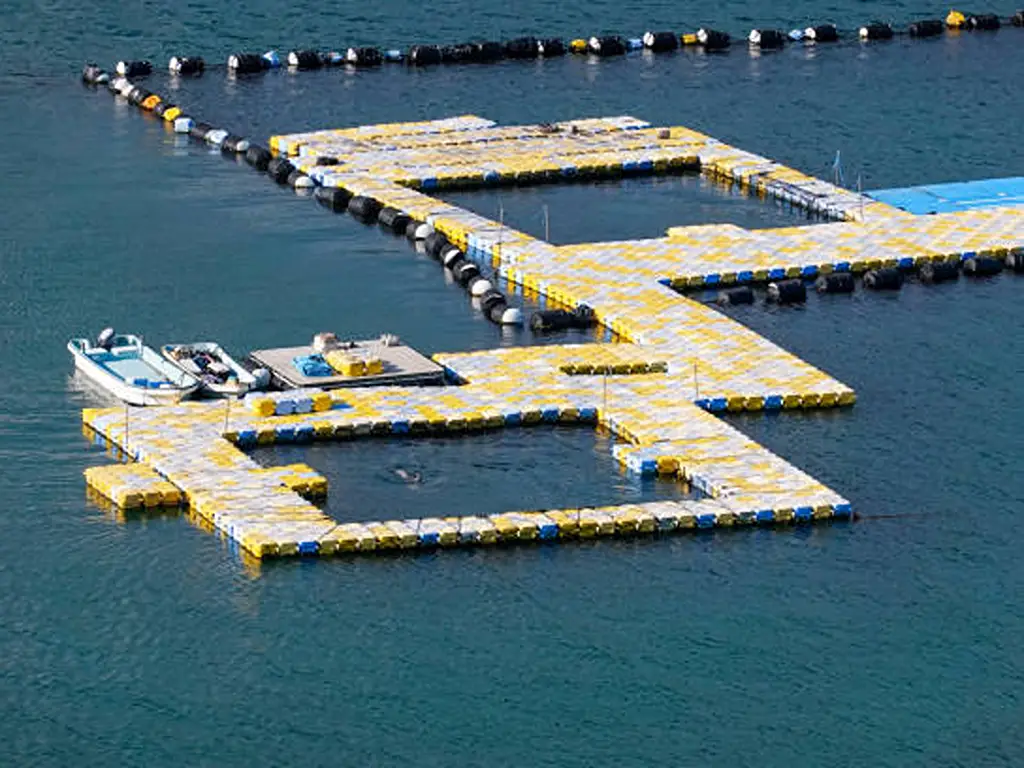
A floating dock rises and falls with the water, and moves again under every wake and gust. That is the point of it. It also means the classic advice stops applying, one instruction at a time: strap the light to a piling, run rigid conduit, anchor both ends of the cable.
The surfaces you actually have
The first thing an electrician notices on a floating platform is that there is nothing to strap to. Where the platform slides up and down a guide pile, the pile is a fixed point standing in a moving structure. You can mount to it, but only if the fixture clears the platform through its whole travel. Where the platform is held by deadweight anchors or stiff arms instead, there is no pile at all, so every fixture has to mount to the structure itself.
That leaves the platform’s own surfaces, and a modular dock gives you more of them than it appears to:
Mounting surfaces on a floating platform
| Surface | Workable approach | When it stops working | Confirm before you install |
|---|---|---|---|
| Deckfläche | Flush or surface-mounted deck lights, wired below | When the deck is the only walkway and the fixture protrudes | Walk-over rating, and that the housing drain is not blocked by the deck profile |
| Existing uprights (handrail and baluster posts) | Downward-facing lights bolted to the post above head height | When the post is not rated to take a side load, or the fixture fouls a mooring line | Post diameter and wall, and where the fixing lands relative to the base |
| Platform edge and underside | Directional downlights and strips under the lip | When clearance to the highest water level is too small, or the fixture sits in spray | Clearance over the full tidal range, plus access for cleaning |
| Pile or pile guide | Clamped fixture on the fixed pile above platform level | When there is no pile, or the platform’s travel exceeds the clamp’s clearance | Total travel, and that the cable does not span between pile and platform |
Source: compiled from floating dock manufacturer guidance and marine electrical practice.
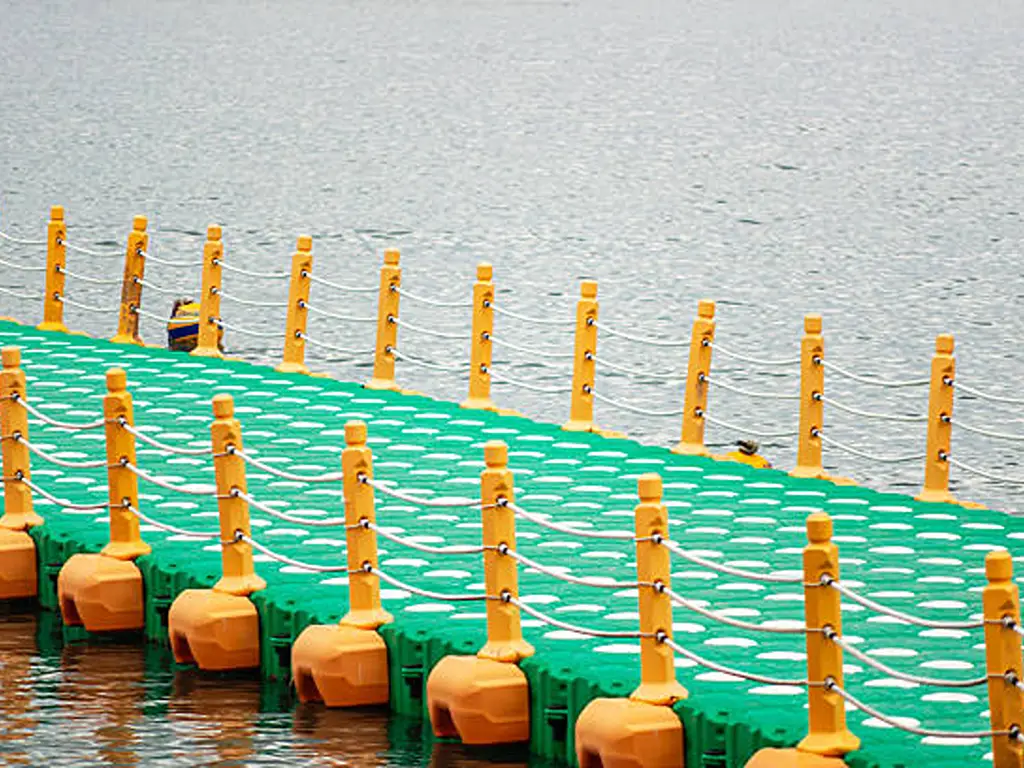
The channel you are looking for is usually already there. Modular floating platforms are assembled from blocks with lugs, grooves and reserved holes along their edges, and that is how the blocks pin together. On a deck with no void beneath it, those same features are the only sensible route for cable. Run the cable along a groove at the platform edge and clip it every short interval, and it stays out of the walking surface and out of the water.
The float itself is not a route. A dock cube floats because its buoyancy chamber is sealed: a hollow, closed shell whose trapped air is the flotation. Public specs from rotomoulded and blow-moulded cube and pontoon manufacturers put nominal wall thickness in the roughly 5–8 mm range. In every case it is the sealed chamber, not the wall, that carries the load. Drilling a float to pass a cable converts a sealed chamber into a flooded one, and a flooded chamber stops being flotation. The cable goes outside the structure, always.
Two hardware traps on floating platforms
First, mixed metals: stainless fasteners threaded into aluminium fixtures, or aluminium hardware in contact with stainless, form a galvanic couple in salt spray, and the corrosion attacks the seal faces first, so isolate dissimilar metals or keep to one family. Second, movement: any fixing that is rigid at both ends will fatigue. Tie the cable at intervals, but leave it slack between ties.
What fails first, and how you would know
On a moving platform, the failure order is different from a fixed one. Fasteners loosen before fixtures fail. Seal faces degrade before water reaches the electronics. Water intrusion shows up as flicker long before it shows up as a dead fixture. If you are maintaining a floating dock, those three signals (loose hardware, cloudy or weeping seals, intermittent flicker) are your maintenance calendar. They belong to the structure’s movement, not to the fixture’s quality.
The Shore Connection: What Flexes Every Time the Water Moves
Now the part that neither the fixture guides nor the fixture manufacturers can answer for you, because it is not about a fixture at all. It is about the gap between the land and the water.
The hinge is the whole system
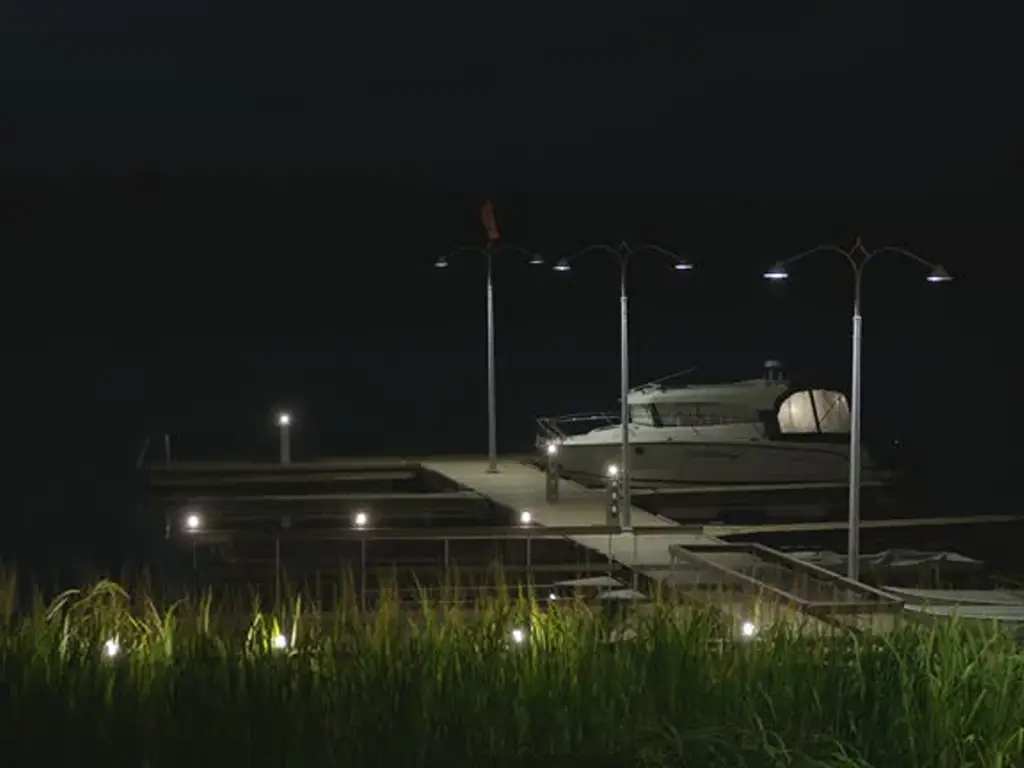
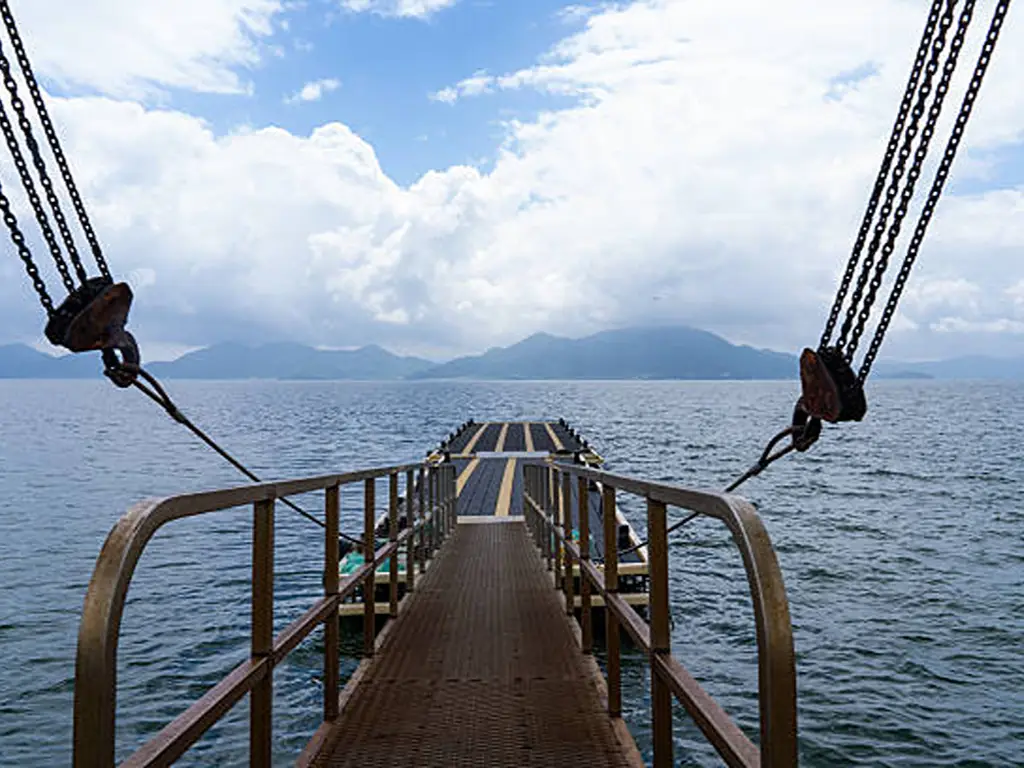
Somewhere between the panel on shore and the first fixture on the platform, the power crosses from something that does not move to something that does. That crossing may be a gangway, a ramp, a hinged joint or just a span of open air. Whatever form it takes, it has a property no other point in the system has: every time the water level changes, and every time a wake rolls through, that crossing flexes.
Treat it accordingly. Leave a service loop, so the movement consumes slack instead of conductor. Fix the cable on the shore side and on the platform side, but let the middle move. Never let cable weight hang from a connector: strain relief is a fitting, not a knot.
How low can you go — and how high must the connection be
Height is where two sets of rules pull in opposite directions, and it is the most useful thing to understand before you mount anything.
Wildlife lighting requirements push fixtures down and shielded. On sea turtle nesting coasts the requirements are explicit and enforced. Fixtures are mounted as low as possible, with bulbs of the lowest wattage that will do the job. The light must be long-wavelength only: 560 nanometres or greater, which means amber, orange or red. And the fixture itself must be completely downward-directed, so the lamp is shielded from the beach (Florida Fish and Wildlife Conservation Commission, current guidance). That is not a stylistic preference. On some coastlines it is a condition of a permit.
Electrical rules push connections up. Article 555 of the National Electrical Code governs wiring and equipment on piers, wharves and docks. It is explicit that equipment must not sit below a defined elevation called the electrical datum plane, measured from expected high water rather than today’s waterline. That is a moving reference, and the definition has been revised between code editions. The working rule is to get the current definition from your local authority before you fix a height.
So the resolution is not a compromise between the two. It is to stop treating “the light” and “the connection” as one thing. The fixture goes low and shielded. The connection stays high and dry. Run the conductor up to a junction point above the datum plane, make the splice there, and bring the low-voltage side down to the fixture. Everything the wildlife rule wants, and everything the electrical rule wants, in one arrangement.
700+
flex cycles a year on a dock that rises and falls a metre twice a day
The shore crossing is the one point in the system that flexes every time the water moves. It is where the system eventually fails, and where the money actually goes.
Three more points about the code, because the trade has argued about this for years.
First, Article 555’s scope has moved. From the 2002 edition onward, private non-commercial docking facilities serving a single-family dwelling were expressly excluded. From the 2017 edition, the scope was widened to cover docking facilities associated with one-family, two-family and multi-family dwellings and residential condominiums (NFPA 70 Article 555.1, 2014 and 2017 editions). If you are working from a forum thread that says private docks are out of scope, check the date of the thread before the date of the dock.
Second, some jurisdictions go further or earlier than the code. Washington State, for example, explicitly brought private non-commercial docking facilities into the Article 555 scope by state amendment (Washington State Register). The same private dock can be in scope or out of it depending on which side of a state line it floats.
Third, where the article does apply, it carries requirements that a general lighting guide will never mention. Supply ground-fault protection must not exceed 30 mA, and permanent signage must warn of shock hazard in the water (NFPA 70 Article 555.3 and 555.24, 2017 edition). Those exist because the failure mode here is not a dark dock. It is a live one.
Before you drill anything, answer four questions
Which edition of the electrical code does your jurisdiction enforce, and does its Article 555 reach private docks? What is the electrical datum plane, as your local authority defines it today? What is the total water-level movement (tide plus storm surge) at this location? And does a wildlife lighting ordinance apply to this shoreline? Any of the four can move your mounting height, and none of them is answered by the fixture’s spec sheet.
Scaling Up: Marinas, Resorts and Multi-Berth Facilities
A marina is the same problem repeated, with a different set of constraints on top.
The unit of design changes. One dock is one circuit and one decision. A marina is zones (berths, walkways, working areas), each with its own lighting level, its own control and its own maintenance access. Central control with per-zone override is the usual answer, with photocells or timers handling the nightly switching.
Compliance stops being optional. In nesting areas the wildlife requirements above apply to the facility rather than to a single dwelling, so they shape the whole layout: shielded, downward, long-wavelength, low. White floodlights aimed across the water are precisely what those ordinances exist to prevent.
Then a checklist you can take into the design meeting:
- What illuminance does each zone need (berths, walkways, working areas), and is it measured or assumed?
- Which edition of the electrical code applies, and does the site fall under Article 555?
- Where is the electrical datum plane for this site, and does every connection sit above it?
- Which wildlife lighting requirements apply, and does every visible fixture meet all three: low, long-wavelength, shielded?
- Can each zone be isolated for maintenance without darkening the rest?
- How does the cable cross from shore to platform at every berth, and where does each crossing flex?
- Who confirms all of the above before the fixtures are ordered?
What the Installation Really Costs — and Who Should Own It
Which brings us to the number everybody wants and nobody publishes consistently. Quotes for the same nominal job come in anywhere from four figures to five, and the spread is not explained by fixture quality.
Re-read the last three sections and the reason is visible. The expensive part of dock lighting is never the luminaire. It is the surface you had to find, the route the cable had to take to get there, the crossing that has to flex forever without fatiguing, and the height that had to satisfy an electrical rule and a wildlife rule at once. On a fixed dock those costs are modest and mostly predictable. On a moving platform they are the majority of the job, and every one of them is cheaper to solve before the platform is built than after it is in the water.
That is the argument for treating the lighting interface as part of the platform specification rather than as an accessory bought later. The mounting surfaces, the cable route, the point where power enters the platform, and the access to service it are all configuration decisions. On a floating dock, they are decisions you cannot revisit cheaply once the structure is assembled and moored.
Hisea Dock does not sell lighting and does not install it — no fixtures, no solar units, no wiring. We build the platform underneath, and we build our modular floating dock cubes around exactly that idea. Single, double, U and V float types come in 250, 400 and 500 mm heights, with 19 mm connection lugs, grooves along all four sides and reserved pin-and-bolt holes. The surface you mount to and the channel you run cable along become choices made on the drawing, rather than improvisations at the water’s edge. Structure, shape, size and height are customizable, down to a moulded logo area on the cube face. Every system carries a 5-year warranty with free replacement of damaged parts, along with the anchoring schemes and installation guidance the build depends on. If you are specifying a platform for a customer, start with our modular floating dock cubes and keep the lighting provisions in the same conversation; if you resell or install docks, the dealer programme is where we start that one.
The one question from the top of this article still decides everything else. Answer it before you choose a light, and if you can, answer it before the platform exists.
If the platform itself is part of what you are quoting, we are happy to talk it through. The wiring design stays with your electrician either way.
Everything above depends on what you are mounting to
Hisea Dock makes the floating platform, not the lighting — the surfaces, float types and cable channels an installer has to work with. If a dock is what you are specifying, we are glad to hear from you.
Kontakt zu Hisea DockLiteraturverzeichnis
- Florida Fish and Wildlife Conservation Commission. “Sea Turtles and Lights — Sea Turtle Lighting Guidelines.” https://myfwc.com/wildlifehabitats/wildlife/sea-turtle/lighting/
- National Fire Protection Association. “NFPA 70, National Electrical Code — Article 555, Marinas, Boatyards, and Docking Facilities.” http://www.electricshockdrowningmn.com/Documents/Article%20555%20Marinas%20and%20Boatyards%20Excerpts%20-%202017-03-24.pdf
- Washington State Register. “WSR 17-12-021 — Amendments to WAC 296-46B, Article 555.1 Scope.” https://lawfilesext.leg.wa.gov/law/wsr/2017/12/17-12-021.htm
- International Electrotechnical Commission. “Ingress Protection (IP) Ratings — IEC 60529.” https://iec.ch/ip-ratings
- North Carolina Office of State Fire Marshal. “North Carolina Appeals Board Order — Docking Facilities and NEC Article 555.1.” https://www.ncosfm.gov/appeals/160323-ncaec-bcc-order-docks/open
- CAST Lighting. “Dock Lighting — Layout, Examples, & Fixtures.” https://cast-lighting.com/blog/post/dock-lighting-by-cast-lighting-layout-examples-fixtures-to-make-your-dock-look-great-at-night
- Lighting Warehouse. “How to Install Dock Lights.” https://www.lightingwarehouse.com/learn/how-to-install-dock-lights
- Dock Lights. “The Complete Guide to Installing Boat Dock Lighting.” https://www.docklights.com/boat-dock-lighting-installation/
- Apex Lighting. “Exploring Dock Light Fixtures: Top 40 FAQs Answered.” https://www.apexlighting.com/blog/exploring-dock-light-top-faqs-answered/
- Simply Wired. “What Is the Cost to Install Dock Lighting in South Florida?” https://simplywiredfl.com/what-is-the-cost-to-install-dock-lighting-in-south-florida/
- Amprite Electric. “Boat Dock Wiring — Flexible Connections at the Gangway.” https://amprite.com/boat-dock-wiring/
- Mike Holt’s Forum. “Dock Lighting.” https://forums.mikeholt.com/threads/dock-lighting.32345/
- Hisea Dock. „Modulare schwimmende Dock-Kuben.“ https://www.hiseadock.com/modular-floating-dock-cubes/
- Hisea Dock. „Dock-Zubehör.“ https://www.hiseadock.com/dock-accessories/
- Hisea Dock. „Werden Sie Händler.“ https://www.hiseadock.com/become-a-dealer/
- Hisea Dock. „Kontakt“. https://www.hiseadock.com/contact-us/
- Hisea Dock. „Hisea Dock.“ https://www.hiseadock.com/

 English
  Thai
Thai  Spanish
  French
  German
  Dutch
Dutch  Italian
  Arabic
  Indonesian
  Portuguese
  Turkish