
Coste de un elevador para embarcaciones tipo pontón: lo que realmente pagas, desde el kit hasta la instalación
Pontoon boat lift cost is the price of a complete installation, not just the advertised lift kit. Capacity, bunk support, water depth, bottom conditions, electrical work, delivery, labor, permits, and seasonal removal can all change the total. A floating drive-on dock is another storage option, but its quote has different components. This guide shows how to compare those options using one loaded pontoon and one actual shoreline rather than mixing catalog prices with unrelated owner reports.
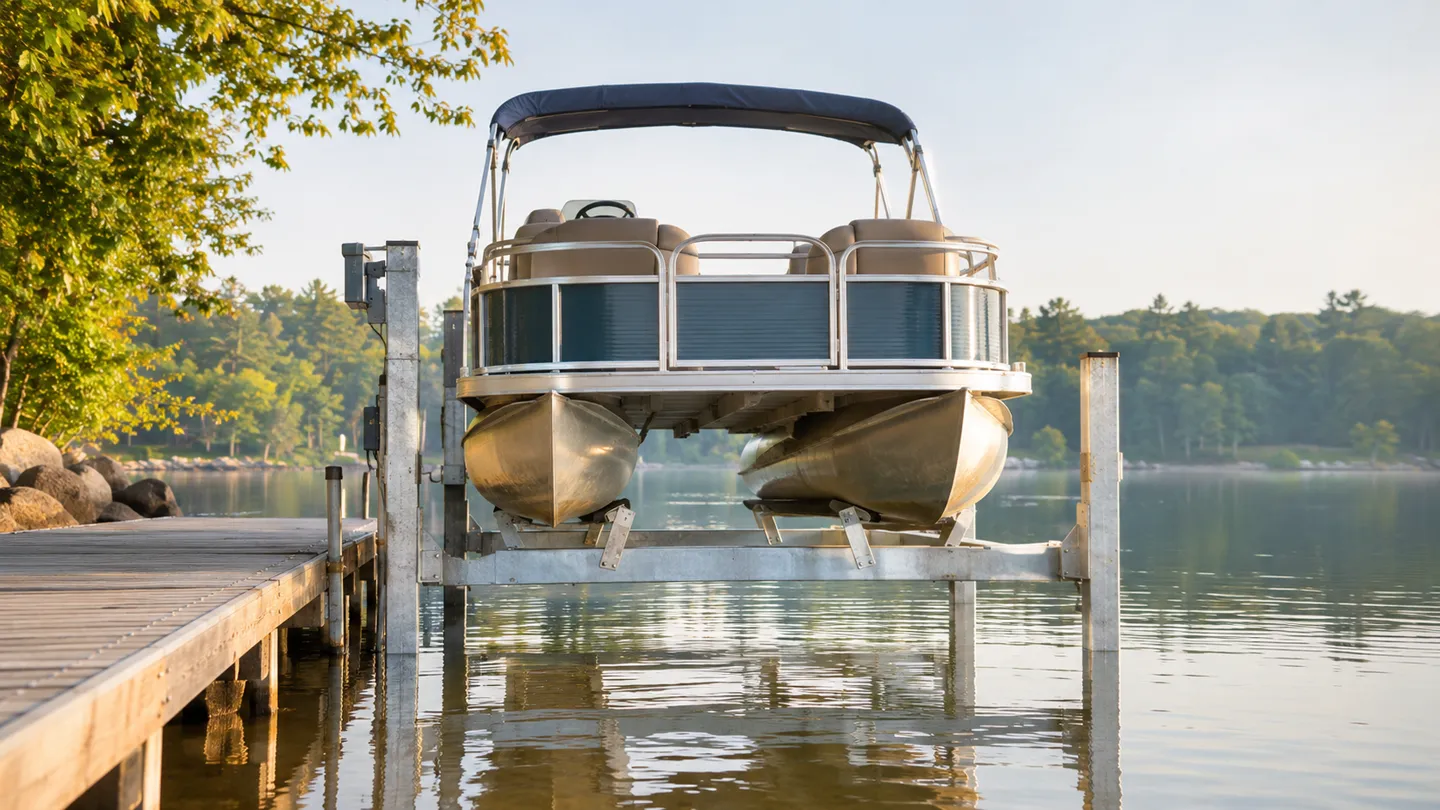
What a Pontoon Boat Lift Is and When You Actually Need One
A conventional lift raises the pontoon on supported bunks or a cradle using a manual, electric, or hydraulic mechanism. A floating drive-on platform supports a compatible boat on a buoyant system and usually stays at the water surface. Both can reduce time the hull spends immersed, but neither suits every boat or site. Compare the finished system, installation, maintenance, and winter plan.
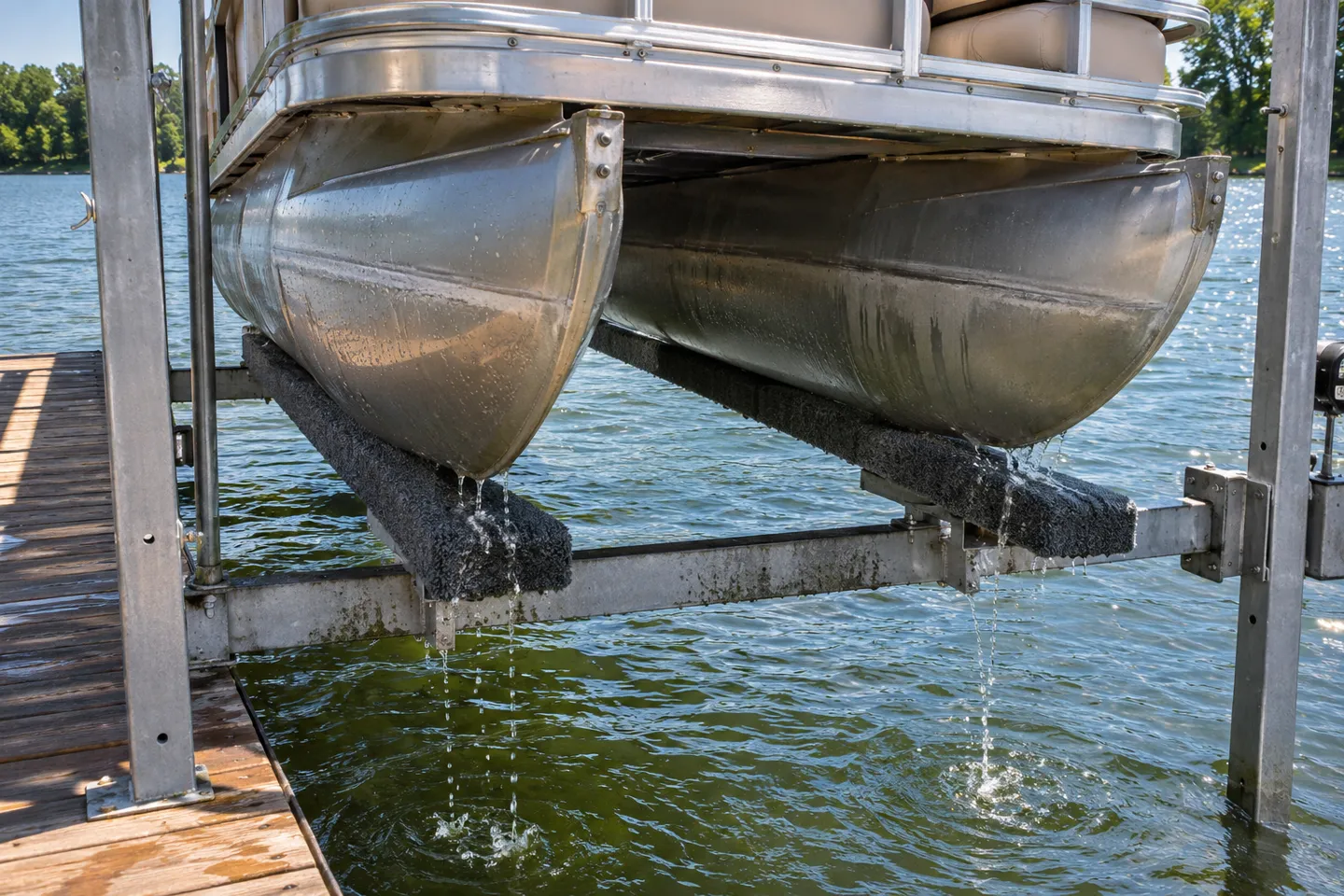
Start with the boating pattern. How long does the boat sit in the water between trips? What does the marina or lake require? Can a lift or platform be installed and serviced at the slip? BoatUS advises that the boat, motor, and gear must stay within the lift’s safe working load ( BoatUS ). A lift is not automatically economical just because fouling occurs, and a trailer or wet slip may still be the better choice.
The entry numbers, so you can orient before the breakdown: small manual lifts and PWC models start around $2,000 to $3,000 in North American retail listings. A typical electric lift for a full-size pontoon lands between $6,000 and $12,000 once it is standing in your slip. Big hydraulic units run $10,000 to $25,000 and up, and a boat-sized floating drive-on dock spans roughly $3,500 to $16,000 depending on configuration ( RGC Marine , 2024). The rest of this article shows where those numbers come from and how to keep your budget tied to reality. Two quotes for the same boat can differ by a factor of seven, and the sections below explain why.
Pontoon Boat Lift Prices by Type, and Why Quotes Vary So Much
Every price range you will see online is real; the disagreement between them is also real. The mechanism sets the base price, and everything attached to your site multiplies it. The ranges below are North American retail figures assembled from supplier guides and live listings between 2024 and 2026, so treat them as planning numbers rather than quotes.
Price note: The figures below are the original article’s dated retail and owner-reported examples, not verified current market prices. A kit list price, an installed owner quote, and a complete floating platform are different scopes. Confirm each amount with a current local quote before budgeting.
Kit price vs installed price, same 4,000-6,000 lb class
$2,304
Kit list, direct retailer
The full kit range runs $2,304-$2,635.
3-7x
The gap
$16,000
Installed quote, documented
Out-the-door totals run $8,090-$16,000.
Price the steel last: budget on the installed total for your region.
Manual Crank Lifts
Manual vertical lifts run $2,500 to $8,000 and suit lighter boats in shallow, protected water ( RGC Marine , 2024). You supply the labor: a handwheel cranks the boat up, which takes real effort with a loaded pontoon and gets old fast in a season of daily use. What the low price hides is option creep: wheel upgrades, bunk guides and installation all stack on the base number. For a weekend boat on a calm cove, manual remains the honest budget choice. For a heavy tritoon or daily use, it is the wrong tool.
Electric Cable and Belt Lifts
This is the pontoon mainstream, and the ⭐ of this price page. Powered vertical lifts run $5,000 to $18,000 depending on size and options, with capacity up to about 10,000 lbs ( RGC Marine , 2024). Most pontoons sit in the 2,000 to 4,500 lb class, one tier down from the ceiling. What owners actually pay lands higher than the base range. A 4,500 lb lift with wheels, shallow-water guides and power came to $8,090 out the door in one owner forum record ( Club Bennington thread , 2020). Marina-installed quotes in recent owner discussions run $13,000 to $16,000 for full-size rigs ( r/boating discussion , 2025). Solar charging kits start near $500 and spare you shore power ( RGC Marine , 2024).
Hydraulic Lifts
Hydraulic systems command $10,000 to well over $25,000, sized all the way to 30,000 lb yachts ( RGC Marine , 2024). They lift faster, run on fewer wearing parts and shrug off heavy cycles. For a pontoon, this tier is usually overkill unless you run a heavy tritoon on exposed water or share a rental fleet’s duty cycle. Paying hydraulic money for a weekend toon buys speed you will use twice a day at most.
Floating Drive-On and Legged Platforms
Boat-sized floating dry docks show the wildest spread in the category. The floor is roughly $3,500, an owner setup built from modular blocks in Australia. The ceiling is about $16,000 plus installation, a premium boat-dock conversion quote in the US ( r/boating discussion , 2023). The spread is not random. Float count, buoyancy grade, roller specification, anchoring and site work each move the number, and station four below turns those variables into a checklist. Legged floating platforms (the Sea Legs class) occupy the niche where fixed lifts are banned or useless: shallow, fluctuating water. Owners who switched describe the trade plainly: no more depth anxiety, but the canopy usually goes. On a fixed lift that canopy prices at $3,000 to $8,000 ( r/Pontoons discussion , 2026).
Accessories, Installation and the Kit-to-Installed Gap
Here is why the same capacity class swings seven-fold. A 4,000 to 6,000 lb pontoon lift kit lists at $2,304 to $2,635 from a direct retailer ( Boat Lift World listings , 2026). Add delivery, piling or footing work, electrical, assembly labor and depth-related engineering. The installed total then reaches $8,090 to $16,000 in documented owner cases ( Club Bennington thread , 2020; r/boating discussion , 2025). Accessories multiply too: canopy $3,000 to $8,000, guide-ons $300 to $2,000, lighting packages $200 to $1,000 ( RGC Marine , 2024). The kit-to-installed gap also explains the used-market paradox that confuses buyers. “$15k for a used 4,000 lb lift is very expensive,” one owner wrote. He was comparing against the kit number, not against what a new installed unit actually costs ( r/boating discussion , 2025). Budget from installed totals in your region, never from catalog sheets.
Pontoon storage hardware: price reality by type
| Hardware type | Typical price (US retail, 2024-2026) | Best fit | Hidden add-ons to price before you sign |
|---|---|---|---|
| Manual crank vertical | $2,500-$8,000 | Light boat, shallow protected water, tight budget | Wheel upgrade, bunks, install labor |
| Electric cable/belt vertical (pontoon mainstream) | $5,000-$18,000 | Most pontoons 2,000-4,500 lb | Piling work, electrical, solar ($500+), canopy ($3,000-$8,000), guide-ons ($300-$2,000) |
| Hidráulico | $10,000-$25,000+ | Heavy tritoons, exposed water, high duty cycles | Same site work at bigger scale |
| Floating drive-on dock | $3,500-$16,000+ | Fluctuating water, no-pile rules, multi-use docks | Float count/buoyancy grade, rollers, anchoring, site work |
| Legged floating platform | Quote-based | Shallow fluctuating water where fixed lifts are banned | Canopy loss (budget a $3,000-$8,000 cover alternative) |
Site Conditions That Make or Break a Lift
Site conditions explain much of the price difference. Measure the lowest and highest operating water levels, depth at the berth, bottom type, wind and wave exposure, available power, ice conditions, and access for delivery equipment. Ask the local authority about lift, dock, anchor, and shelter rules. A quote without these inputs can only be provisional.
Check depth and bottom at the intended installation location. Legs, piles, moorings, and floating platforms each have different requirements. Wisconsin DNR provides location-specific permit and exemption checklists for seasonal boat lifts and shelters; other jurisdictions may differ ( Departamento de Recursos Naturales de Wisconsin (DNR) ). Do not assume a floating option is permitted simply because it uses no piles.
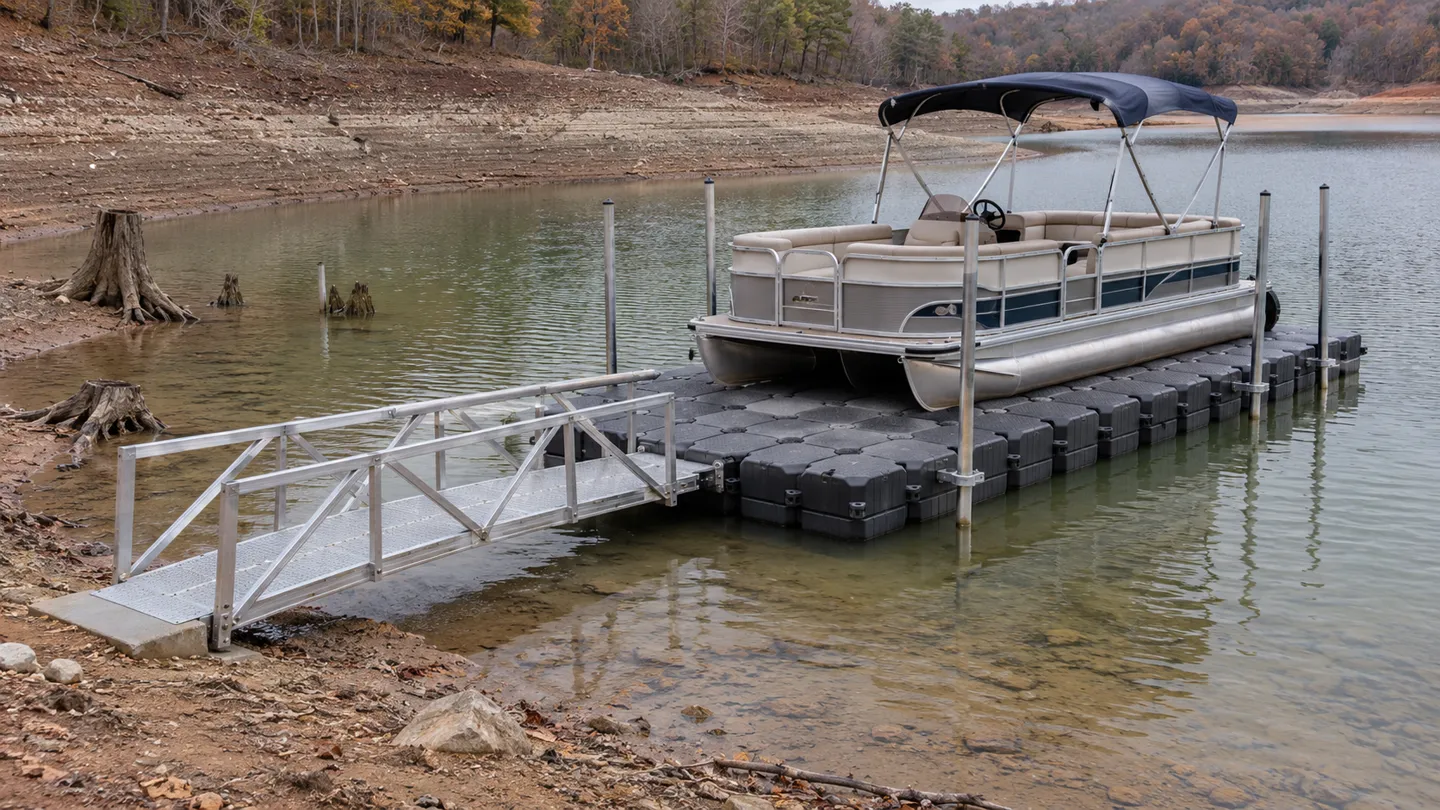
If one system does not fit the site, compare alternatives rather than forcing the original choice. A different lift mounting method, drive-on platform, wet slip, or trailer routine may be viable. Obtain boat-specific and site-specific proposals for each option, including a winter and inspection plan.
Six-point site check before any lift quote
01
Water-level swing
Measure low-to-high range; reservoir rules may ban fixed lifts.
02
Depth and bottom
Firm substrate for legs; depth = longer pilings = money.
03
Rules
Association, authority and permit checks first.
04
Waves and exposure
3-ft chop turns loading into hull contact; pontoons drift downwind.
05
Hielo
Removal every winter or ice-rated design.
06
Access
Can a truck reach the shoreline for delivery and service?
How to Choose: Capacity, Support and Floating Dock Configuration
If your site passed the six checks, you are rating lifts against a spec sheet. If it failed a couple, you are speccing a floating dock. The disciplines differ, so take them one at a time.
Size the Lift to the Loaded Weight, Not the Brochure
Use the pontoon’s loaded operating weight, including engine, fuel, batteries, water, gear, and installed accessories. Avoid a fixed percentage added to a dry-weight brochure number. The lift or platform supplier should confirm the rated capacity and how the weight is distributed over the support points ( BoatUS lift guidance ).
Send us your boat weight, water-level range and shoreline basics, and we will reply with the hardware family and configuration that fits your site.
Request a configured quotePontoon Tubes Need Their Own Support
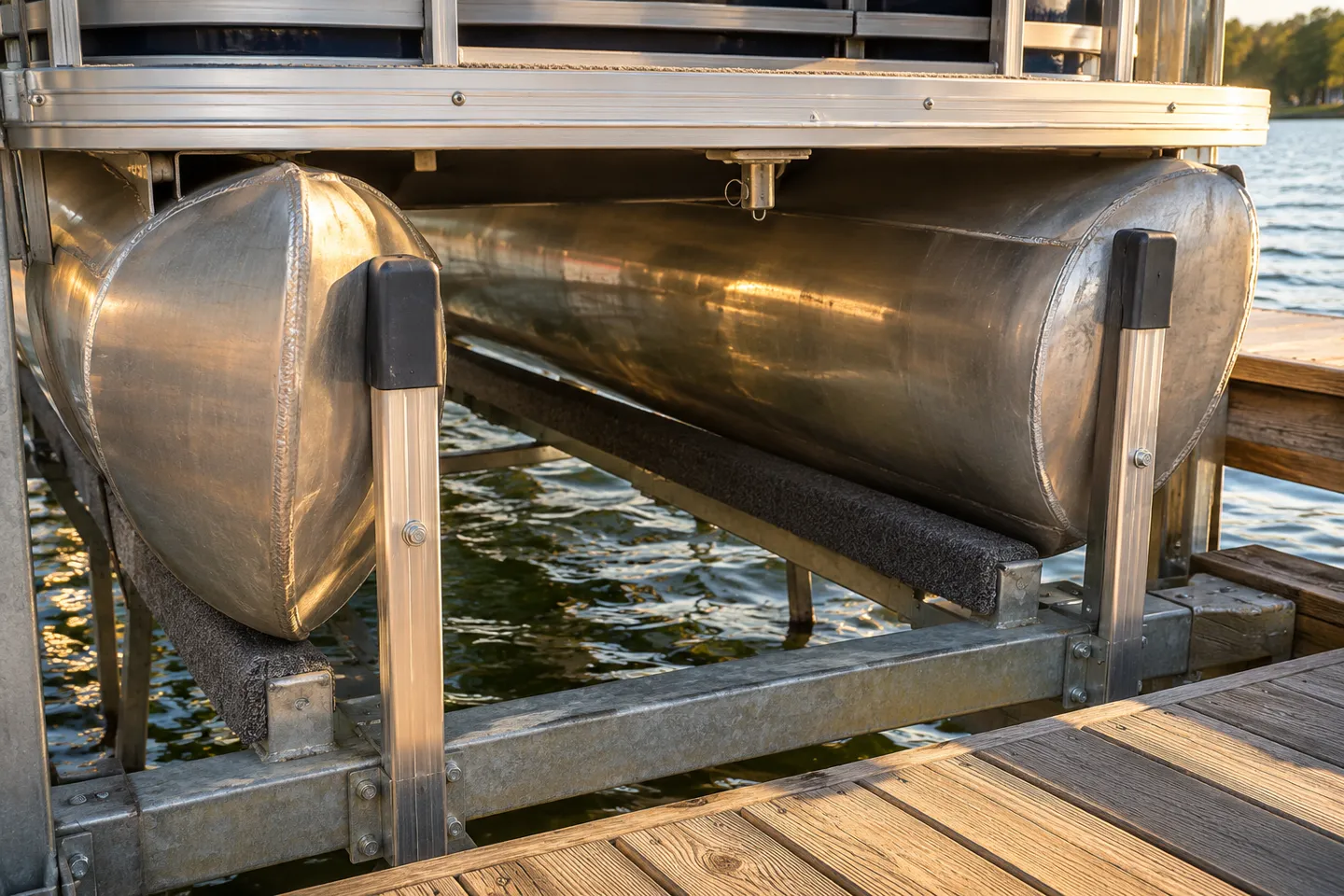
Pontoon boats may have two tubes or three. The support must suit the actual tube spacing, diameter, engine position, and hull manufacturer guidance. Request a drawing showing bunks, cradles, rollers, and side guides for the specific boat. Tritoon support should not be assumed from a twin-tube kit description.
Speccing a Floating Drive-On Dock
The floating family’s price spread, remember, runs $3,500 to $16,000 and up. Five variables explain almost all of it. First, rollers: keel-roller-only layouts are the cheapest and the harshest. One owner who runs his boat onto a dock regularly reported mid-body rollers as the upgrade that stopped bottom scratches. Second, drive versus winch: light boats power up and reverse off unaided. Heavier hulls often end up driving halfway and winching the rest, which one owner rigged after finding pure drive-on too hard on his rig ( r/boating discussion , 2023). Third, side bracing: boat-weight loads on a dock built for foot traffic deform it, and the owners who added aluminum bracing did so after watching theirs flex. Fourth, anchoring: pipes, stakes or chains, priced against your bottom and your water-level swing. Fifth, float quality, which is where quotes quietly diverge most.
Material
Ask for the plastic grade and UV stabilization in writing (raw HDPE with UV additive resists the brittleness that kills cheap floats).
Flotación
Ask for per-float buoyancy in kg/m2 and match it to your loaded weight per square meter of dock.
Conexiones
Ask for lug thickness in millimeters and the fastener hardware spec.
Proof
Ask for a documented connection tensile test result in newtons; a serious manufacturer publishes the number.
Backup
Ask for warranty length, free-replacement terms and spare-parts availability after year one.
Treat those five columns as the entry ticket, not the whole exam. The harder question is fit: which of these hardware families actually belongs on your water, and where does each one stop being the right answer? The matrix below puts the whole category on one grid, so you can find your row before anyone quotes you.
Boundary matrix: which storage hardware survives which site
| Hardware | Works when | Fails or explodes in cost when | Confirm before you sign |
|---|---|---|---|
| Manual crank lift | Stable water, firm bottom, light boat | Heavy boat or daily use (labor), deep water (pilings) | Capacity vs loaded weight, crank effort acceptable |
| Electric vertical lift | Stable water, permitted pilings, power access | Reservoir drawdown, ban rules, no shore power (add solar) | Installed total incl. piling and electrical, canopy priced |
| Hydraulic lift | Exposed water, heavy tritoon, high cycles | Budget pontoon use (paying for speed you don’t need) | Service network nearby, warranty terms |
| Floating drive-on dock | Fluctuating water, no-pile sites, multi-use docks | Keel-only rollers on heavier boats, no side bracing under boat load | Roller count, bracing, buoyancy grade, tensile test, warranty |
| Legged floating platform | Shallow fluctuating water, banned fixed lifts | Deep or soft bottoms, canopy requirement | Leg reach vs water range, cover alternative priced |
| Trailer routine | Any site with ramp access | Rough-water days, no dock convenience | Storage cost and haul frequency vs hardware amortization |
What Lifts and Floating Docks Cost to Keep Working
The purchase is the cheap half of some ownership stories, so price the maintenance line before you sign anything. On lifts, cables are consumables: expect $100 to $300 per cable when replacement time comes ( ShoreMaster , 2025), and cheap, but only if rigged right. One lift owner replaced his cables over a winter, then spent the next season asking whether the new set was measured wrong. The boat sat crooked on the cradle ( r/boating discussion , 2024). Motors, batteries and switchgear are the other recurring suspects; solar kits remove the shore-power dependency but not the battery. Freeze zones add the annual question of whether the frame comes out or gambles on ice.
Floating docks run a different maintenance line. Their wetted surfaces grow the same lake life your hull would. A professional hull cleaner who maintains them for a living described the trap. Shells left in water full-time get brittle, hard growth fuses to the underside, and a pressure washer that would clean a hull will punch holes in an aged float. The work reverts to hand tools ( r/boating discussion , 2023). The failure archive in the same thread is worth an hour of any buyer’s time. One modular dock owner reported underwater aluminium bracing that nobody could inspect until the structure buckled after seven to ten years. A float on another system began taking on water slowly over a week. Neither failure is dramatic on day one, and both are findable early with a checklist.
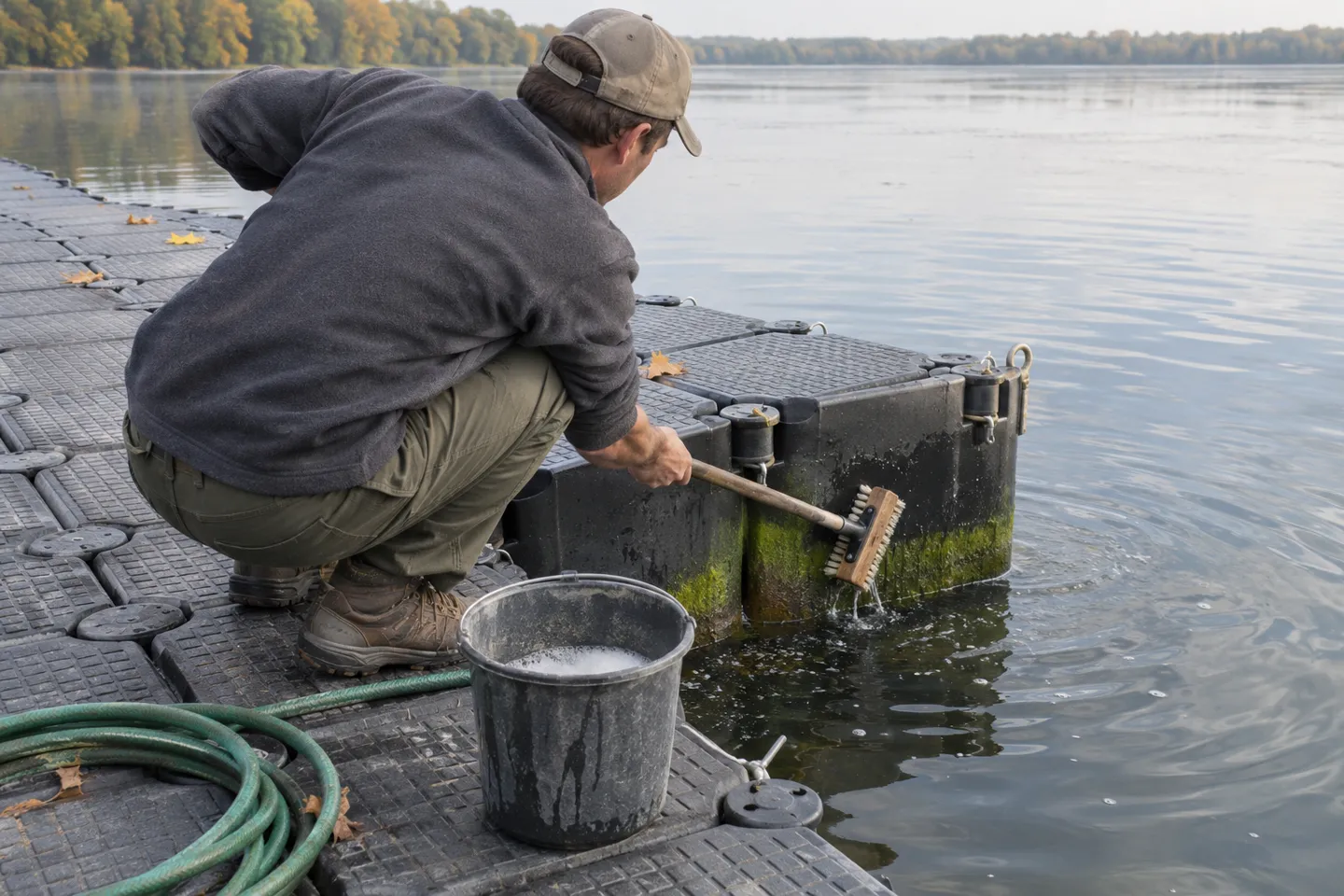
Record a seasonal inspection for whichever system is installed. Check movement, wear, corrosion, cracked components, loose connections, and changes after storms or winter. Keep the boat off a damaged lift or platform until the responsible installer has assessed it.
Annual check card
Lifts: cables for fraying and drift (replace at $100-$300 each), motor and battery condition, grease points per manual, winter removal plan.
Floating docks: floats riding low (slow ingress), connection pins and lugs, anchoring tension, hull-contact zones at rollers and guides.
Compare lifecycle cost using the same period for every option: installed price, power, inspection, replacement parts, cleaning, winter work, and eventual removal. Document each assumption. A material specification or connector test helps assess a product, but does not by itself predict maintenance cost at a given site.
Reading Lift and Floating Dock Costs the Way Operators Do
Marina, resort and rental operators read the same price lists through a different lens. They are not pricing one boat, they are pricing berths, and the berths on one property rarely share the same site conditions. The quiet-water berths near the gas dock are classic lift territory, stable levels, firm bottom, permitted pilings. The shallow flats at the property’s edge, the fluctuating reservoir arm, the no-pile zoning strip: that is where fixed-lift quotes come back at five figures or not at all. There, floating drive-on systems are not the budget alternative but the only working answer. Operators who structure quotes by feasibility zone instead of by catalog price stop losing bids to sites they were never going to serve profitably.
Dealers can offer accessories and spare parts, but the initial recommendation should follow boat compatibility and site conditions. Quote rollers, guides, anchors, and replacement modules as needed, not as generic upgrades. Keep the warranty and service responsibility clear between supplier, installer, and operator.
For imported components, request freight, unloading, customs handling, lead time, and replacement-part availability in writing. The best product price is not necessarily the best installed cost when delivery equipment, assembly labor, and service access differ.
Operator berth mapping: match the hardware to the water
| Berth condition | First-choice hardware | ¿Por qué? | Stock accordingly |
|---|---|---|---|
| Stable level, firm bottom, pilings permitted | Compare site-compatible options | Standardized, mature service ecosystem | Lift accessories and parts |
| Fluctuating level or drawdown zone | Compare site-compatible options | Feasibility beats price; fixed lifts fail here | Floats by buoyancy grade, anchors |
| Shallow flats, no-pile zoning | Compare site-compatible options | Only working hardware class | Roller variants, shallow anchors |
| Exposed, choppy water | Compare site-compatible options | Wave handling dominates the economics | Guide posts, heavy-duty bunks |
| Multi-use dock plus boat parking | Compare site-compatible options | Una plataforma sirve tanto para pasarela como para aparcamiento | Flotadores de repuesto y accesorios de conexión |
HiSeaDock ofrece sistemas de flotadores modulares y puede asesorarte sobre configuraciones con acceso directo para embarcaciones adecuadas. Solicita el modelo exacto, la evaluación de la carga de la plataforma terminada, las especificaciones de los conectores, el plano de amarre, las condiciones de la garantía y el alcance de la entrega. Las capacidades de carga de los flotadores públicos varían según el modelo, por lo que no se debe presentar una sola cifra como capacidad para todas las configuraciones.
Configura tu amarre con cifras reales
Envíanos los datos sobre las condiciones del agua y el peso de la embarcación cargada; te responderemos con los índices de flotabilidad, las especificaciones de los tirantes, los datos de las pruebas de tracción y un presupuesto basado en ellos.
Solicita un presupuesto para un muelle flotanteReferencias
- BoatUS. Eleva tu embarcación .
- Departamento de Recursos Naturales de Wisconsin. Preguntas frecuentes sobre permisos para vías navegables .
- Departamento de Recursos Naturales de Wisconsin. Evita los daños causados por el hielo en las estructuras permanentes .


 English
 Thai
 Spanish
 French
 German
 Dutch
 Italian
 Arabic
 Indonesian
 Portuguese
 Turkish