
Diseño de embarcaderos residenciales: una guía completa para elegir el embarcadero adecuado para tu vivienda frente al mar
Conocer tu zona ribereña: fundamentos de la evaluación del emplazamiento
Antes de pensar en las formas, los materiales o el presupuesto del embarcadero, hay una pregunta que lo determina todo: ¿en qué tipo de aguas lo vas a construir? Un embarcadero que funciona a la perfección en un embalse interior en calma puede ser un desastre en una bahía costera azotada por el viento, y viceversa. Adaptar el embarcadero a las condiciones específicas de tu zona ribereña es la decisión de diseño más importante que tomarás.
Empieza por la profundidad del agua. Para una embarcación pequeña —una barca de pesca, una lancha o un pontón— necesitas al menos de tres a cinco pies de profundidad al final del muelle para que la embarcación flote con seguridad y evitar que encalle durante los periodos de estiaje. Las embarcaciones más grandes con un calado mayor pueden necesitar seis pies o más. Si es posible, recorre la orilla en diferentes épocas del año; los cambios estacionales en el nivel del agua pueden ser drásticos, especialmente en los embalses destinados al control de crecidas o al riego.
A continuación, evalúa el lecho del lago o del río. Un fondo duro y rocoso ofrece una excelente sujeción para los pilotes hincados y los anclajes de hormigón. Un fondo blando y limoso —habitual en embalses antiguos y ríos de corriente lenta— requiere un enfoque diferente, ya que los postes hincados pueden hundirse o desplazarse con el tiempo. Si no estás seguro, un constructor de embarcaderos o un contratista marítimo de la zona suele poder indicarte cuál es la composición del fondo en tu zona en tan solo unos minutos de conversación.
La exposición al viento y al oleaje constituye el tercer pilar. En una cala pequeña y protegida, casi cualquier tipo de embarcadero es adecuado. En la parte principal de un lago grande o en una bahía abierta, las olas impulsadas por el viento pueden ejercer una fuerza lateral enorme sobre la estructura de un embarcadero. El concepto de recoger — la distancia sin obstáculos a lo largo de la cual sopla el viento sobre aguas abiertas — determina cuánta energía de las olas absorberá tu embarcadero. Un alcance de una milla o más significa que debes plantearte seriamente el tema del fondeo y la rigidez estructural.
Por último, hazte la pregunta típica del invierno: ¿se congela tu masa de agua? Si la respuesta es sí, ¿vas a retirar el embarcadero cada otoño o tiene que aguantar envuelto en hielo durante meses? Esta única variable descarta ciertos tipos de embarcaderos y hace que otros sean más adecuados. Volveremos más adelante a tratar en detalle el diseño en función del clima, pero ten en cuenta el factor de la congelación mientras lees las opciones estructurales que se describen a continuación.
Explicación de los tipos de embarcaderos: fijos, flotantes y sistemas de pilotes
El tipo estructural de tu embarcadero viene determinado por tres factores: la estabilidad del nivel del agua, la composición del lecho y la cantidad de trabajo de mantenimiento estacional que estés dispuesto a asumir. Cada una de estas tres categorías principales presenta una relación entre ventajas e inconvenientes. Comprender esta relación es la base de todas las decisiones de diseño posteriores.
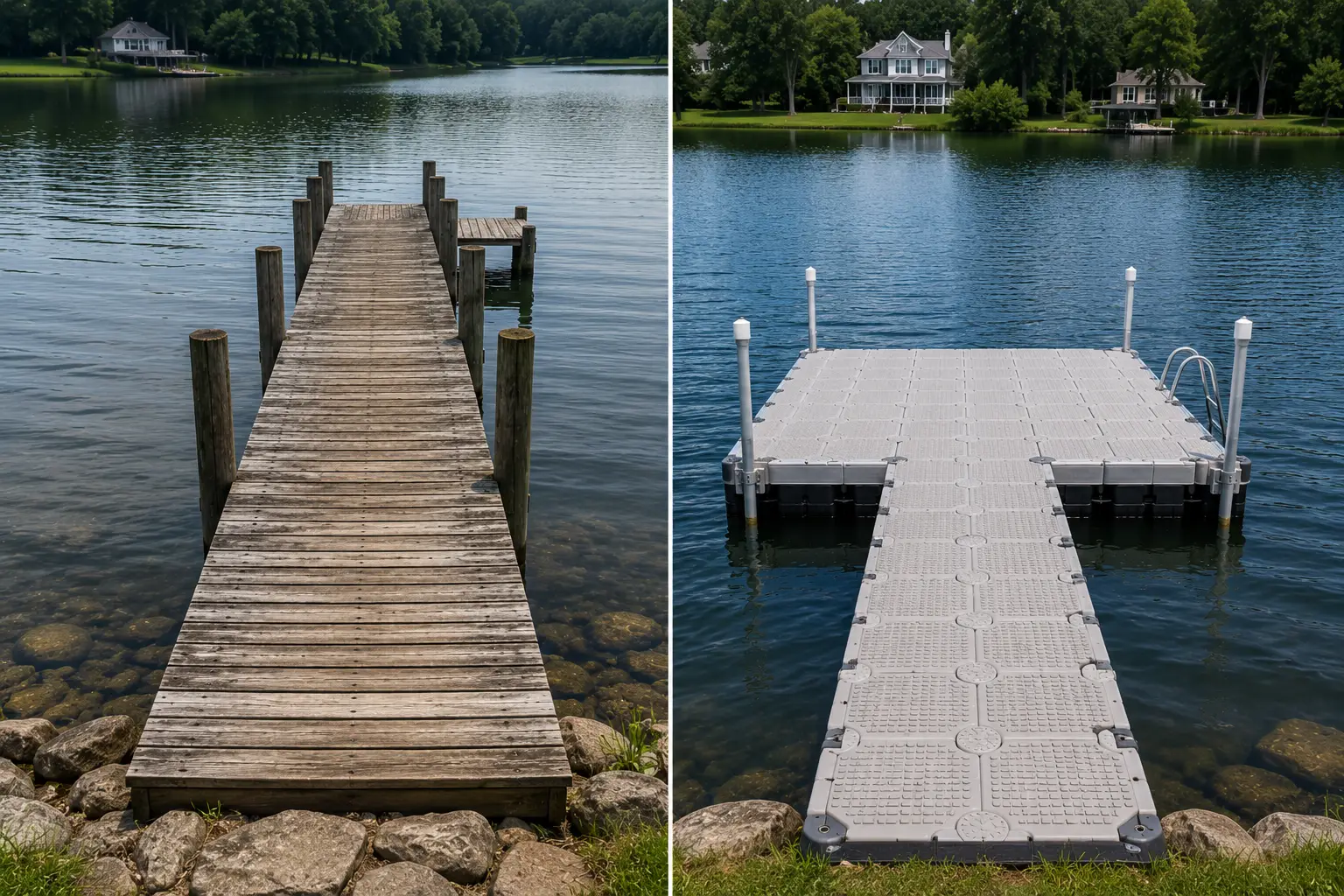
Muelles fijos: estructuras tipo «crib», muelles y pilotes
Un muelle fijo es el peso pesado de las estructuras ribereñas: permanente, inamovible y construido para durar décadas. Existen dos enfoques clásicos.
Un muelle de cajones utiliza estructuras de madera maciza —básicamente, grandes cajones de madera— rellenos de rocas y colocados directamente sobre el lecho del lago. El peso del relleno de piedra (a menudo varias toneladas por cajón) ancla la estructura contra el hielo y las olas. Los muelles de cajones son excepcionalmente resistentes y muy adecuados para ubicaciones expuestas a condiciones meteorológicas adversas. El inconveniente es el coste: la construcción de los muelles de cajones requiere mucha mano de obra, exige maquinaria pesada y, una vez construidos, es prácticamente irreversible. En climas gélidos, la expansión del hielo puede desplazar o agrietar la estructura del muelle, lo que conlleva costosas reparaciones.
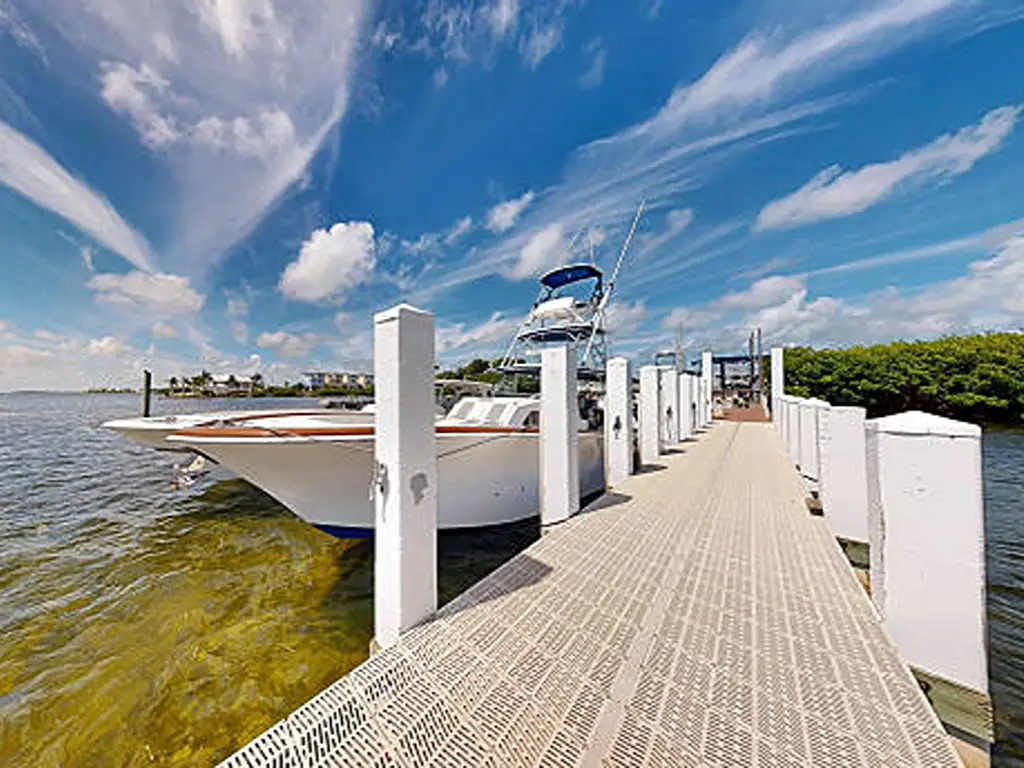
Un muelle de pilotes sigue un enfoque diferente: se clavan postes de acero o madera a gran profundidad en el lecho del lago —normalmente tres pies o más— utilizando un martillo pilón. A continuación, se construye la estructura del muelle sobre estos postes, elevada por encima del agua. Los muelles sobre pilotes ofrecen una estabilidad excelente y funcionan bien en aguas de hasta 15 o 20 pies de profundidad. Son la opción preferida para puertos deportivos comerciales e instalaciones residenciales de alta gama. Sin embargo, comparten con los muelles de cajones la misma vulnerabilidad frente al hielo. Cuando el hielo del lago se expande y se desplaza, puede agarrarse a los pilotes y desalinearlos. Además, no se pueden ajustar a los cambios en el nivel del agua: lo que se clava, ahí se queda.
Muelles flotantes: cómo funcionan y en qué destacan
Un muelle flotante hace exactamente lo que su nombre indica: se asienta sobre la superficie del agua, sostenido por flotadores o pontones, y sube y baja al variar el nivel del agua. En lugar de luchar contra el agua, se mueve con ella.
La flotabilidad proviene de flotadores sellados y llenos de aire —tradicionalmente, tambores o cámaras rellenos de espuma, pero cada vez más cubos modulares de polietileno de alta densidad (HDPE)—. Estos flotadores se conectan formando una rejilla estructural y se cubren con una plataforma. Todo el conjunto se mantiene en su posición mediante un sistema de anclaje: normalmente pilotes guía (postes verticales sobre los que el muelle se desliza hacia arriba y hacia abajo, como un ascensor sobre raíles), anclajes de peso muerto (bloques de hormigón en el lecho del lago unidos por cadenas) o soportes rígidos fijados a la orilla.
Los muelles flotantes ofrecen cuatro ventajas convincentes. En primer lugar, se adaptan automáticamente a las fluctuaciones del nivel del agua, desde unos pocos pulgadas de variación estacional hasta varios pies de descenso del nivel del embalse. En segundo lugar, se pueden desmontar para su almacenamiento durante el invierno, lo que elimina por completo el riesgo de daños causados por el hielo. En tercer lugar, su instalación no requiere martillos pilones, grúas ni grandes excavaciones en la orilla: muchos sistemas de muelles flotantes pueden montarse entre dos personas con herramientas manuales básicas. En cuarto lugar, los requisitos que plantean respecto al lecho del lago son mínimos: ya sea lodo blando, roca dura o terreno irregular, da igual, porque el muelle flota por encima de todo ello.
La contrapartida es la estabilidad. Un muelle flotante se mueve: suavemente en aguas tranquilas, y de forma más notable cuando le alcanzan las estelas de las embarcaciones que pasan. Para algunas personas, ese movimiento sutil resulta agradable, como estar en un barco. Para otras, resulta inquietante. En zonas de mucho tráfico, con grandes embarcaciones de oleaje que generan estelas que pueden superar las 10 000 libras de desplazamiento, un muelle flotante necesita un anclaje sólido para evitar un movimiento excesivo.
Opciones de muelles desmontables y de temporada
Entre la permanencia de un muelle fijo y la flexibilidad de un muelle flotante se encuentra una categoría de sistemas estacionales y desmontables que merece ser mencionada, sobre todo porque aparecen con frecuencia en foros y debates de propietarios.
Los muelles desmontables sobre ruedas cuentan con ruedas montadas en la base de sus postes de soporte, lo que permite desplazar toda la estructura hacia el agua cada primavera y volver a sacarla cada otoño. Funcionan mejor en aguas poco profundas (menos de cuatro pies) con un fondo firme y duro y una pendiente suave en la orilla. Los muelles con postes utilizan un armazón de acero o aluminio sostenido por postes colocados en el lecho del lago, y están diseñados para desmontarse y almacenarse cada invierno. Los muelles de torre utilizan una torre montada en la orilla con un sistema de cables y poleas para elevar el muelle fuera del agua; son la opción desmontable más práctica, pero requieren espacio de instalación en la orilla.
Todos los embarcaderos desmontables comparten una desventaja común: requieren trabajo dos veces al año, año tras año. Para los propietarios que desean un embarcadero que puedan instalar en un fin de semana y del que no tengan que preocuparse durante los siguientes seis meses, un embarcadero flotante bien anclado o un embarcadero fijo construido por profesionales suele ser la mejor solución a largo plazo.
Formas y distribuciones de las estaciones de carga: adapta el diseño a tu estilo de vida
Una vez que te hayas decidido por un tipo de estructura, la siguiente cuestión es la forma. La forma del embarcadero no es una decisión estética, sino funcional, que determina cómo utilizas tu zona ribereña, cuántas embarcaciones puedes albergar y si tu embarcadero se convierte en un espacio de encuentro social o en un mero lugar de aparcamiento para embarcaciones.
Hazte tres preguntas: ¿qué vas a hacer principalmente en tu embarcadero?, ¿cuántas embarcaciones necesitas que quepa y quieres que el embarcadero sirva también como espacio de estar al aire libre? La tabla siguiente muestra las formas más habituales de los embarcaderos residenciales y sus usos ideales.
| Forma del muelle | Lo mejor para | Dimensiones habituales | Ventaja clave | Lo que hay que saber |
|---|---|---|---|---|
| Muelle recto | Una sola embarcación, fácil acceso, pesca | 6–12 pies × 20–40 pies | El permiso más barato y sencillo | Limitado a un uso principal |
| Base en forma de L | Una plaza de amarre + zona de descanso | 12–16 pies de longitud principal, 8–10 pies de longitud de la pata | Separa el aparcamiento del ocio | Una familia clásica |
| Muelle en forma de T | Varias embarcaciones, diversión | Pasillo de 8–12 pies, altura libre de 16–24 pies | Capacidad máxima de embarcaciones por superficie ocupada | Anclajes más complejos |
| Muelle en forma de U | Varias embarcaciones de mayor tamaño | Más de 20 pies entre los brazos | Amarre protegido, de primera categoría | El mayor coste de los materiales |
| Plataforma / Personalizada | Natación, ocio | Totalmente personalizado | Adaptado a tu costa | Requiere un diseño profesional |
El American Boat and Yacht Council (ABYC) recomienda que las pasarelas de los muelles residenciales tengan una anchura mínima de ocho pies para garantizar un desplazamiento seguro y cómodo: lo suficientemente estrechas como para que resulten económicas, pero lo suficientemente anchas como para que dos personas puedan cruzarse sin tener que salirse del borde. En el caso de los muelles en los que se vayan a colocar muebles, una barbacoa o en los que se celebren reuniones habituales, una anchura de doce pies o más transforma el espacio de una simple pasarela en una auténtica sala al aire libre.
La forma que elijas hoy no tiene por qué ser la forma con la que tengas que conformarte para siempre, pero la facilidad con la que se pueda modificar depende en gran medida del tipo de embarcadero que tengas. Un embarcadero fijo tradicional, una vez construido, resulta caro y complicado de reconfigurar. Un embarcadero flotante modular, por el contrario, se puede ampliar, remodelar o reconfigurar añadiendo o reorganizando unidades estándar, un aspecto que analizaremos en profundidad en breve.
Análisis en profundidad de los materiales: la composición de tu muelle es importante
Un embarcadero está compuesto, en realidad, por dos elementos superpuestos: una estructura que soporta la carga y resiste las inclemencias del tiempo, y una superficie de paso que se ve, se toca y sobre la que se transita. Los materiales que elijas para cada capa determinan la vida útil de tu embarcadero, la carga de mantenimiento y el coste total de propiedad. Los constructores tradicionales de embarcaderos tratan estas cuestiones como decisiones independientes. Los sistemas modulares, como veremos, las fusionan en un enfoque integrado.
Estructura portante: madera, aluminio y acero
La estructura es el esqueleto: casi invisible una vez colocada la tarima, pero es la que soporta cada libra de peso que el muelle vaya a soportar jamás.
La madera tratada a presión ha sido el material por excelencia para la estructura de los embarcaderos durante generaciones. Es asequible, fácil de encontrar y cualquier contratista puede trabajar con ella sin problemas. La contrapartida es el mantenimiento: la madera que está en contacto constante con el agua y el sol acaba pudriéndose, deformándose y astillándose. Una estructura de madera tratada suele durar entre 10 y 15 años antes de que sea necesario sustituir sus componentes principales, y requiere una inspección anual para detectar fijaciones sueltas, puntos débiles y deterioro del acabado.
El aluminio se ha convertido en el estándar moderno para las estructuras de muelles de alta gama, y con razón. Pesa aproximadamente un tercio de lo que pesa el acero, es resistente a la corrosión de forma natural sin necesidad de ningún recubrimiento y puede durar entre 25 y 30 años con un mantenimiento mínimo. Las estructuras de aluminio son la columna vertebral de la mayoría de los sistemas de muelles residenciales de alta gama que hay actualmente en el mercado. La contrapartida es el coste inicial: el aluminio suele ser entre dos y tres veces más caro que el acero, y bastante más que la madera.
El acero —concretamente, el acero galvanizado por inmersión en caliente— ocupa un término medio. Ofrece una resistencia superior a un coste menor que el aluminio, pero es extremadamente pesado (lo que complica su instalación y desmontaje) y, con el tiempo, se oxida si el recubrimiento galvanizado se raya o se desgasta. Las estructuras de acero son las más habituales en los muelles comerciales fijos, donde el peso no supone un problema a la hora de desmontarlas y la resistencia es fundamental.
Superficies para terrazas: desde la madera tratada a presión hasta los materiales compuestos
La tarima es por donde caminas, en la que te sientas y que contemplas cada día. Debe ser cómoda al pisarla descalzo en agosto, seguir siendo antideslizante cuando está mojada y mantener un buen aspecto temporada tras temporada.
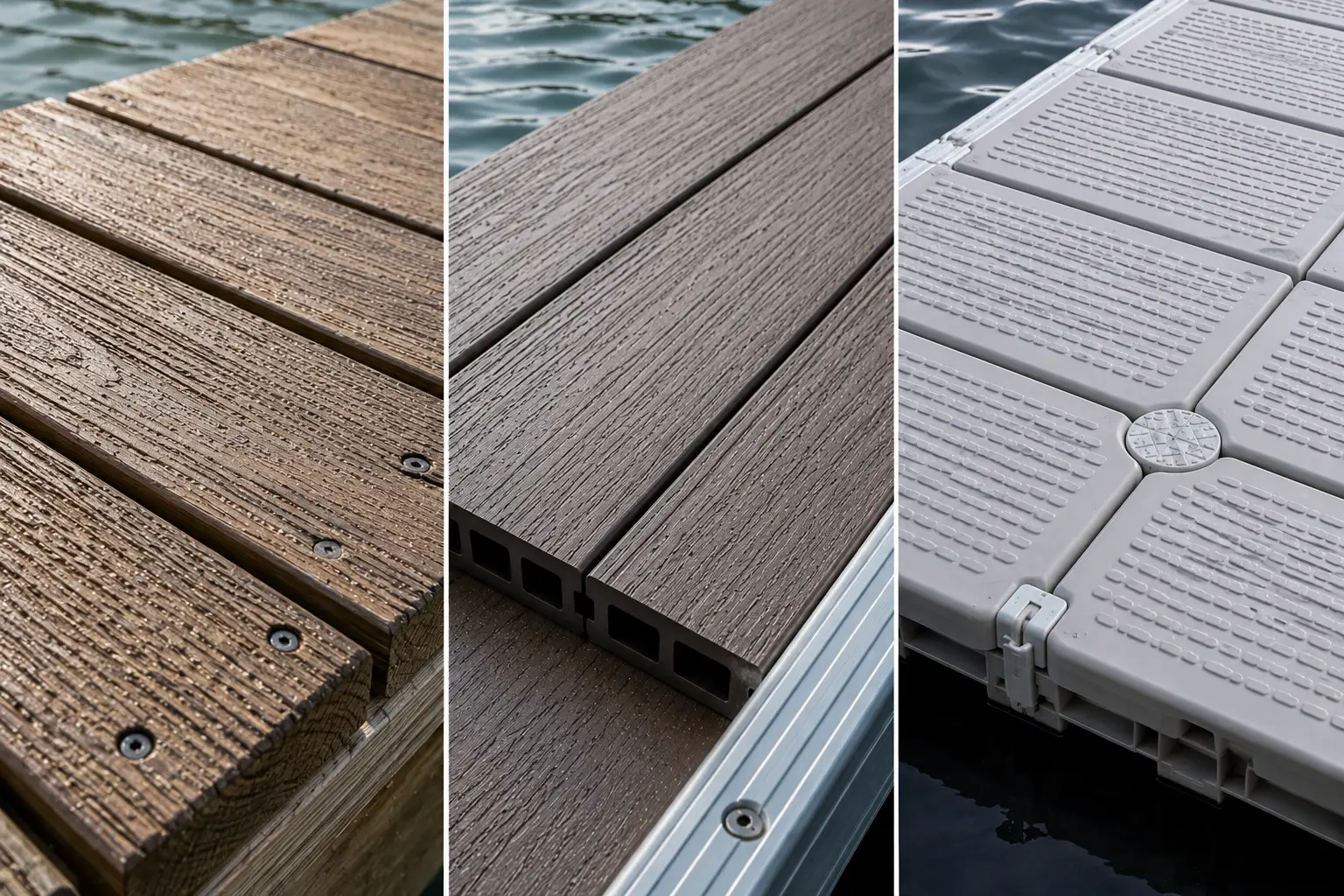
Las tarimas de madera tratada a presión son la opción más asequible y se mantienen naturalmente frescas bajo el sol directo —una ventaja real en los calurosos días de verano, cuando las superficies de material compuesto pueden llegar a estar dolorosamente calientes para los pies descalzos—. Sin embargo, las tarimas de madera se astillan, se decoloran hasta volverse grises y, por lo general, necesitan un nuevo sellado o repintado cada dos o tres años. En un entorno junto al agua, donde las escamas de pintura y los selladores químicos pueden filtrarse al agua, este ciclo de mantenimiento también conlleva implicaciones medioambientales que algunas jurisdicciones regulan.
Las tarimas compuestas —una mezcla de fibra de madera y plástico reciclado, comercializadas bajo marcas como Trex y TimberTech— resuelven el problema del mantenimiento. No necesitan pintarse nunca, no se astillan y son resistentes a la putrefacción y a los insectos. El inconveniente es el calor: las tarimas compuestas expuestas al sol directo pueden alcanzar temperaturas superficiales superiores a los 140 °F (60 °C), lo que hace que sea doloroso o imposible caminar descalzo sobre ellas. También suponen un mayor coste inicial de material, aunque la eliminación de los costes de mantenimiento anuales puede compensar esa diferencia en un plazo de entre cinco y siete años.
Las tarimas de PVC, como DockDeck de Trusscore, son una alternativa más reciente. Son aproximadamente un 40 % más ligeras que las de material compuesto, disipan el calor con mayor eficacia y son 100 % reciclables al final de su vida útil. La madera modificada —madera blanda natural tratada mediante un proceso patentado para alcanzar la durabilidad de la madera dura tropical sin el coste medioambiental que esta conlleva— ofrece la estética de la madera auténtica con un mantenimiento prácticamente nulo. Kebony es la marca más conocida de esta categoría, con una presencia cada vez mayor en proyectos de puertos deportivos de alta gama y muelles residenciales.
Plástico técnico de HDPE: propiedades del material que marcan la diferencia
El polietileno de alta densidad (HDPE) merece un análisis aparte, ya que su comportamiento difiere fundamentalmente del de cualquier otro material utilizado en los muelles, y porque constituye la base científica de los sistemas modulares de muelles flotantes que analizaremos en la siguiente sección.
El HDPE es un termoplástico de ingeniería con una densidad de entre 0,941 y 0,967 gramos por centímetro cúbico —ligeramente inferior a la del agua—, razón por la cual flota. Esto no es casualidad; es el punto de partida de toda una categoría de diseño de embarcaderos. Cuando se formula con estabilizadores UV y modificadores de impacto, el HDPE de grado marino resiste la degradación solar durante 20 a más de 30 años, no absorbe agua (por lo que no se pudre), no se corroe y no conduce la electricidad —una ventaja de seguridad que a menudo se subestima en los muelles con instalación eléctrica. Su resistencia al impacto, medida mediante el ensayo IZOD, supera con creces a la de la madera y el PVC, lo que significa que resiste sin problemas los golpes contra el muelle, la presión del hielo y los residuos flotantes que agrietarían o astillarían otros materiales.
La clave para el diseño de muelles: el HDPE puede moldearse por rotomoldeo o por soplado para crear formas complejas, huecas y selladas —cubos con cámaras de aire internas, salientes de conexión, texturas antideslizantes y puntos de fijación integrados—. Un único proceso de fabricación permite obtener un módulo de embarcadero flotante, estructural, transitable y resistente a los rayos UV. En la construcción tradicional, se necesitan cuatro materiales distintos (estructura, flotadores, cubierta y elementos de fijación) procedentes de cuatro cadenas de suministro diferentes para lograr el mismo resultado. Esa ventaja que supone la integración de materiales es lo que hace posibles los sistemas modulares de embarcaderos de HDPE, y la razón por la que representan una filosofía de diseño genuinamente diferente, en lugar de ser simplemente otra opción de material.
Sistemas modulares de embarcaderos flotantes: un enfoque moderno del diseño de embarcaderos
La construcción tradicional de embarcaderos consiste, en esencia, en un trabajo de carpintería a medida sobre el agua. Un contratista mide la línea de costa, encarga madera o aluminio, fabrica un armazón in situ (o en un taller), monta flotadores en la parte inferior y fija la tarima en la parte superior. El resultado se adapta a tu propiedad —y su precio se ajusta en consecuencia—. Si un año después cambias de opinión sobre la distribución, básicamente tendrás que empezar de cero.
Los sistemas modulares de muelles flotantes invierten esta lógica. En lugar de un armazón a medida, se parte de cubos estandarizados de HDPE que encajan entre sí; cada uno de ellos es una unidad autónoma que combina flotabilidad, estructura y superficie de paso en una sola pieza moldeada. Se conectan mediante pasadores y pernos para formar la configuración que se necesite. En esta sección se explica cómo funcionan y por qué merece la pena tenerlos en cuenta junto con las opciones tradicionales.
Cómo funcionan los sistemas modulares de muelles flotantes
El elemento básico es el cubo flotante —que suele medir 500 por 500 milímetros (unas 20 por 20 pulgadas) y está disponible en tres alturas estándar: 250 milímetros (perfil bajo, 220 kilogramos por metro cuadrado de flotabilidad), 400 milímetros (estándar, 350 kilogramos por metro cuadrado) y 500 milímetros (alta resistencia, 420 kilogramos por metro cuadrado). Cada cubo está moldeado por soplado a partir de polietileno de alta densidad (HDPE) con inhibidores de rayos UV, lo que crea una cámara hueca y sellada con una superficie antideslizante integrada en la parte superior.
Los cubos se unen entre sí mediante salientes de 19 milímetros de grosor situados en cada esquina: pasadores cortos para uniones de una sola capa y pernos largos para el refuerzo de doble capa. Se puede acceder a todos los puntos de unión desde arriba con herramientas manuales básicas. Dado que el sistema de unión está estandarizado, es posible acoplar cualquier cubo a cualquier otro en cualquier orientación, creando tramos rectos, retornos en forma de L, cabeceras en forma de T o plataformas con formas totalmente personalizadas.
Toda la plataforma montada flota libremente y se mantiene en su posición gracias a un sistema de anclaje —normalmente pilotes guía sobre los que el muelle se desplaza hacia arriba y hacia abajo, o anclajes de peso muerto fijados al lecho del lago—. El muelle se desplaza verticalmente al variar el nivel del agua, pero se mantiene exactamente en la misma posición horizontal en la que lo hayas colocado.
Diseños de muelles con acceso directo — La rampa flotante para embarcaciones y motos acuáticas
Una aplicación de la tecnología de muelles flotantes modulares que merece una atención especial —ya que está prácticamente ausente de las guías de diseño de muelles más habituales— es el muelle de acceso con vehículo. Si tienes una moto acuática, una moto de agua o una pequeña lancha, probablemente te hayas planteado el dilema de dónde guardarla. Amarrarla en el agua expone el casco a las algas, a las incrustaciones y a la acción constante de las olas. Un elevador de embarcaciones tradicional funciona, pero cuesta miles de dólares, requiere electricidad y ocupa espacio en el muelle de forma permanente.
Un muelle de acceso con vehículo resuelve esto de otra manera. Utiliza módulos flotantes con formas especiales —cuñas en forma de V para motos acuáticas y jet skis, y canales en forma de U para embarcaciones pequeñas de hasta unos 20 a 25 pies— que forman una rampa flotante. Basta con conducir la embarcación por la rampa a baja velocidad para que se deslice hacia arriba y salga del agua, sostenida por completo por la plataforma flotante. Sin cabrestantes, sin electricidad, sin piezas móviles. Los rodillos integrados en la superficie flotante reducen la fricción para facilitar la botadura y la recogida.
En comparación con un elevador de embarcaciones tradicional, un embarcadero flotante al que se puede acceder en coche suele costar entre un 50 % y un 70 % menos en cuanto a compra e instalación, no requiere infraestructura eléctrica alguna y deja libre el espacio del embarcadero principal para otros usos. Se trata de un diseño especializado, pero para el propietario de una vivienda a orillas del agua adecuado, resuelve un problema real que pocas guías sobre embarcaderos abordan.
Montaje fácil de realizar por uno mismo y el potencial de la expansión modular
Una de las señales más claras que nos llegan de las comunidades de propietarios de viviendas frente al mar —en foros, en hilos de Reddit y en conversaciones con constructores de embarcaderos— es la tensión entre el presupuesto y las aspiraciones. Un propietario quiere un embarcadero, pero no puede justificar un precio de $50.000. O bien puede permitirse un embarcadero modesto este año, pero quiere margen para ampliarlo en el futuro. Los sistemas modulares de embarcaderos flotantes dan respuesta directa a ambas situaciones.
Cada cubo flotante estándar pesa aproximadamente entre 15 y 25 kilogramos, lo suficientemente ligero como para que una sola persona pueda transportarlo y colocarlo. Para unir dos cubos se necesita un mazo y un pasador corto: sin soldaduras, sin maquinaria pesada y sin hormigón. Dos personas pueden montar en un fin de semana un modesto embarcadero recto de entre seis y ocho módulos, suficiente para una sola embarcación y una pequeña zona de descanso. Compárese esto con la logística de un embarcadero fijo tradicional: martillo pilón, planificación de la obra por parte del contratista, excavación de la orilla y semanas de construcción.
La historia de la ampliación es igualmente convincente. Un embarcadero modular que construyas hoy con diez cubos, como una sencilla pasarela recta, puede convertirse el año que viene en un embarcadero en forma de L añadiendo ocho cubos más y reconfigurando algunas uniones. Al año siguiente, podrías añadir un cabezal en T para un segundo amarre. Cada ampliación utiliza el mismo sistema de unión estándar y las mismas herramientas básicas. No se trata de renovar una estructura a medida, sino de añadir piezas a un sistema diseñado para un crecimiento gradual. Para un propietario cuyas necesidades en la costa evolucionen con el tiempo —una familia que crece, una segunda embarcación, un nuevo interés por el piragüismo—, esta flexibilidad supone una auténtica ventaja económica y práctica.
Modular frente a tradicional: una comparación real de costes y mantenimiento
La pregunta que, en última instancia, se hace todo propietario es: «¿Merece la pena?». Para dar una respuesta sincera, hay que ir más allá del precio inicial y tener en cuenta lo que te costará el embarcadero a lo largo de una década o más de propiedad.
| Factor de coste | Muelle fijo tradicional | Muelle flotante modular de HDPE |
|---|---|---|
| Materiales iniciales | De moderado a alto — varía según el material | Moderado — módulos fabricados en serie |
| Mano de obra de instalación | Alto — contratista + maquinaria pesada | Bajo — Se puede hacer uno mismo, 2 personas |
| Mantenimiento anual | Moderado: sellado, pintura, reparaciones | Casi nulo: sin podredumbre, pintura ni óxido |
| Retirada invernal | Daños causados por el hielo que conllevan un coste elevado o un riesgo elevado | Cero — no se vacía, apto para hielo |
| Coste de la ampliación | Alta — básicamente, una reconstrucción | Bajo: comprar más módulos, conectarlos |
| Vida útil habitual | Entre 15 y 25 años con mantenimiento | 20-30+ años (HDPE estabilizado frente a los rayos UV) |
El patrón es claro: los muelles tradicionales concentran el coste en la mano de obra y el mantenimiento continuo. Los muelles modulares de HDPE concentran el coste en la compra inicial de material y, a partir de ahí, prácticamente no suponen ningún gasto adicional. El punto de equilibrio económico —en el que el menor coste a lo largo de la vida útil de un sistema modular compensa el menor coste inicial de un muelle tradicional de madera— suele alcanzarse entre el tercer y el quinto año, cuando comienza el primer ciclo de mantenimiento importante del muelle de madera.
Cabe destacar que algunos fabricantes de muelles modulares respaldan sus productos con garantías sustanciosas: una cobertura de sustitución gratuita de cinco años no es infrecuente en este sector, y refleja la confianza que inspira un producto que no se pudre, no se oxida ni se deslamina. A la hora de evaluar cualquier inversión en un muelle, las condiciones de la garantía revelan tanto sobre las expectativas del fabricante respecto a la durabilidad del producto como cualquier afirmación publicitaria.
Diseño adaptado al clima: invierno, olas y preparación para las inclemencias meteorológicas
Tu embarcadero no está en una sala de exposición. Está en el agua de verdad, bajo el sol de verdad, y soporta inviernos de verdad. Diseñar teniendo en cuenta tu clima específico no es algo secundario, sino un factor de diseño que debe influir en tus decisiones sobre materiales y estructura desde el principio.
En climas gélidos, la principal amenaza es la expansión del hielo. Cuando un lago se hiela, la capa de hielo puede expandirse y contraerse con los cambios de temperatura, generando una enorme presión lateral. Los muelles fijos de madera son especialmente vulnerables: el hielo puede agarrarse a los pilotes y levantarlos del lecho del lago, o aplastar las estructuras de cajones. Los muelles flotantes fabricados en HDPE tienen aquí una ventaja natural: la ligera elasticidad del material y el diseño de cámaras huecas llenas de aire permiten que los cubos se compriman ligeramente bajo la presión del hielo sin agrietarse. Muchos sistemas de muelles flotantes de HDPE están diseñados para quedarse congelados en el hielo en su sitio y salir intactos durante el deshielo primaveral, lo que elimina la necesidad de retirarlos cada año.
En lugares expuestos al viento —bahías abiertas, grandes lagos con millas de alcance, ensenadas costeras—, la prioridad del diseño recae en el anclaje. Un muelle flotante en una zona de vientos fuertes necesita más puntos de anclaje, anclas más pesadas o ambas cosas. Los pilotes guía deben hincarse a una profundidad suficiente para resistir las cargas laterales. Las anclas de peso muerto deben dimensionarse para la peor tormenta que se pueda prever razonablemente, no para una tarde normal. Los muelles fijos en estos entornos necesitan un arriostramiento transversal robusto y elementos estructurales más pesados.
En climas intensos de la «franja solar» —el suroeste de Estados Unidos, Australia, el Mediterráneo—, la degradación por rayos UV es el asesino silencioso de los muelles. Cualquier material plástico o compuesto que se deje expuesto a la luz solar directa durante años acabará por descolorarse, volverse quebradizo y perder su resistencia, a menos que esté formulado específicamente con estabilizadores UV. Por eso, el polietileno de alta densidad (HDPE) de grado marino para aplicaciones en muelles siempre incluye aditivos inhibidores de los rayos UV; sin ellos, incluso el HDPE se degradaría en un plazo de tres a cinco años. Con una estabilización UV adecuada, el mismo material puede durar décadas. A la hora de comparar productos, preguntar por la estabilización UV es más revelador que preguntar por la duración de la garantía.
En entornos de agua salada, la corrosión es el principal problema. Las estructuras de aluminio deben estar anodizadas o recubiertas con pintura en polvo. El acero debe estar galvanizado por inmersión en caliente; e incluso así, los arañazos en el recubrimiento se convertirán en puntos de óxido. El HDPE es naturalmente inmune a la corrosión salina, lo que constituye una de las razones por las que se ha convertido en el material predominante para los muelles flotantes en puertos deportivos y aplicaciones costeras de todo el mundo.
Aspectos imprescindibles sobre seguridad, permisos e instalación
Ya has elegido el tipo de embarcadero, el material, la forma y la estrategia climática. Antes de empezar a construir, hay tres pasos prácticos que todo propietario de una vivienda frente al mar debe seguir: la seguridad, los permisos y la logística de la instalación.
La seguridad empieza por la superficie de paso. Una cubierta antideslizante no es opcional: marca la diferencia entre un paso seguro y una visita a urgencias. A la hora de elegir el material para la cubierta, opta por superficies texturizadas, revestimientos de goma o materiales intrínsecamente antideslizantes, como el HDPE con dibujos moldeados en la superficie. Instala barandillas si tu embarcadero está elevado más de un par de pies por encima del agua, o si lo van a utilizar habitualmente niños o personas mayores de la familia. La ABYC recomienda que las barandillas residenciales tengan una altura mínima de 34 pulgadas. Si llevas la instalación eléctrica hasta el embarcadero —para un elevador de embarcaciones, la iluminación o una toma de corriente—, la protección mediante un interruptor diferencial (GFCI) es obligatoria según la norma E-11 de la ABYC. La electricidad y el agua son una combinación peligrosa.
La tramitación de los permisos es un paso que muchos constructores de embarcaderos novatos subestiman. Ponte en contacto con tu ayuntamiento, la autoridad responsable del lago o el Departamento de Recursos Naturales de tu estado antes de gastarte ni un solo dólar en materiales. Es posible que necesites un permiso de construcción, una evaluación medioambiental (sobre todo si tu zona ribereña contiene humedales o hábitats protegidos) y la autorización de tu comunidad de propietarios, si la tienes. Los embarcaderos flotantes suelen tener una ventaja en cuanto a los permisos: dado que no implican hincar pilotes en el lecho del lago ni excavar la orilla, muchas jurisdicciones los clasifican como estructuras temporales con una normativa menos estricta. Pregunta específicamente por esta distinción cuando llames.
La logística de la instalación se reduce a una pregunta: ¿necesitas un contratista o puedes hacerlo tú mismo? Un embarcadero fijo tradicional casi siempre requiere una instalación profesional: los martillos pilotes, los trabajos de hormigón y las estructuras pesadas no son proyectos de bricolaje para el fin de semana. Un embarcadero flotante modular, por el contrario, está diseñado para que lo monte el propio propietario. El proceso estándar es sencillo: montar los módulos en tierra, conectarlos según la configuración deseada, llevar la plataforma montada al agua a pie o dejándola flotar, y fijar el sistema de anclaje. Dos adultos con herramientas básicas pueden completar una instalación residencial típica en uno o dos días. Si contratas a un contratista para un sistema modular, estás pagando por la mano de obra, no por maquinaria pesada, lo que mantiene los costes de instalación significativamente más bajos que los de la construcción tradicional.
Cómo sacar el máximo partido a tu inversión en un muelle
Un muelle no es una compra puntual. Se trata de una relación de 20 años (o más) con una estructura que se encuentra en uno de los entornos más exigentes que se puedan imaginar: sumergida en el agua, abrasada por el sol, congelada por el hielo y azotada por las olas. Las decisiones económicas que tomes en la fase de diseño tendrán repercusiones durante todos los años que lo tengas en tu poder. Un embarcadero barato que cuesta $2.000 al año en mantenimiento no es más barato que uno bien diseñado cuyo mantenimiento no cuesta nada; simplemente tarda más en revelar su verdadero coste.
El marco de referencia para valorar un embarcadero es el coste total de propiedad. Los costes iniciales de los materiales representan aproximadamente entre el 40 y el 60 por ciento de lo que gastarás en un embarcadero tradicional a lo largo de una década. El resto se destina al mantenimiento (resellado, repintado, sustitución de tablas podridas), al servicio estacional (desmontaje y reinstalación) y a posibles reparaciones o mejoras. Un embarcadero flotante modular de HDPE invierte esta proporción: se destina una mayor parte del presupuesto al producto en sí y mucho menos a los años posteriores. El umbral de rentabilidad se alcanza entre el tercer y el quinto año, y a partir de ahí la diferencia no hace más que aumentar.
Entonces, ¿cómo se sintetiza todo esto para tomar una decisión? A continuación te ofrecemos una guía práctica de cuatro pasos que recorre el proceso de diseño que se ha tratado en esta guía.
Paso uno: determina el tipo de estructura en función de las condiciones del agua. ¿Niveles de agua estables y un fondo firme? Tanto un embarcadero fijo como uno flotante servirán. ¿Niveles de agua variables, fondo blando o heladas estacionales? Un embarcadero flotante es la mejor opción.
Segundo paso: elige una forma en función del uso que le vayas a dar realmente al agua. Sé sincero: la mayoría de los propietarios sobreestiman el número de embarcaciones que tendrán y subestiman lo mucho que utilizarán el embarcadero para sentarse, nadar y contemplar la puesta de sol.
Tercer paso: decide entre la construcción tradicional y un sistema modular. Si valoras la personalización por encima de todo y el presupuesto no es una limitación fundamental, un embarcadero tradicional construido a medida te ofrecerá exactamente lo que deseas. Si valoras la previsibilidad de los costes, el bajo mantenimiento, la opción de hacerlo tú mismo y la posibilidad de ampliarlo con el tiempo, un sistema modular de embarcadero flotante de HDPE está diseñado específicamente para satisfacer tus prioridades.
Paso cuatro: comprueba las medidas de adaptación climática y los requisitos de licencia. Estos son los pasos imprescindibles para convertir un proyecto de diseño en un embarcadero real, legal y seguro.
Tu embarcadero no es solo una infraestructura. Es el umbral entre tu hogar y el agua: el lugar donde las mañanas comienzan con un café y una caña de pescar, donde los niños aprenden a nadar, donde se botan las embarcaciones y se contemplan las puestas de sol. Acertar con el diseño garantiza que ese umbral se mantenga sólido, seguro y acogedor durante décadas. Los fabricantes de sistemas modulares de embarcaderos flotantes de HDPE, como Hisea Dock, respaldan esta promesa con datos de ingeniería: productos sometidos a ensayos independientes (incluidos ensayos de tracción diagonal que superan los 14 000 newtons de fuerza de desconexión), fabricación con certificación ISO 9001 y CE, y una garantía de sustitución gratuita de cinco años que refleja la confianza en una vida útil del producto entre un 20 % y un 30 % más larga, comparada con las alternativas convencionales. A la hora de comparar opciones de muelles, no se fíe únicamente de lo que dicen los folletos y solicite los datos de las pruebas, los registros de certificación y las condiciones de la garantía. Un muelle cuyo diseño esté respaldado por pruebas verificables es un muelle construido para durar más que su precio de compra.
Referencias
- Grand View Research. “Tamaño y perspectivas del mercado de muelles en Estados Unidos, 2033”. 2025. https://www.grandviewresearch.com/horizon/outlook/docks-market/united-states
- Consejo Americano de Barcos y Yates (ABYC). Normas e informes de información técnica para embarcaciones pequeñas. https://abycinc.org/
- Dock Boxes Unlimited. “Normas de diseño de embarcaderos a medida para tu propiedad frente al mar”. 2024. https://www.dockboxes.com/blog/boat-docks/boat-dock-design-standards-for-your-waterfront-property/
- Wahoo Docks. “7 aspectos clave a tener en cuenta en el diseño de embarcaderos residenciales”. 2025. https://www.wahoodocks.com/7-key-residential-boat-dock-design-considerations/
- Hisea Dock. “Calidad y certificaciones”.” https://www.hiseadock.com/quality/
- Hisea Dock. Página de inicio. https://www.hiseadock.com/

 English
  Thai
Thai  Spanish
  French
  German
  Dutch
Dutch  Italian
  Arabic
  Indonesian
  Portuguese
  Turkish