
Le choix des flotteurs adaptés déterminera si votre ponton flottera pendant cinq ou quinze ans. Chaque fabricant se présentant comme le meilleur, il est difficile de distinguer un flotteur jetable d'un flotteur haut de gamme. Ce guide passe en revue les matériaux, la flottabilité et les meilleures marques pour vous aider à réaliser le bon investissement.
Types de flotteurs pour pontons : renseignez-vous bien avant de comparer les produits
Avant de comparer les marques ou calculer la flottabilité, il faut savoir ce que l'on regarde. Les flotteurs de quai se répartissent en quatre grandes catégories, et ils ne sont pas interchangeables.
| Type | Comment ça marche ? | Durée de vie typique | Meilleur pour | Attention à |
|---|---|---|---|---|
| Flotteur en mousse encapsulée | Coque en PEHD moulée par rotation, remplie de mousse EPS à cellules fermées | 10 à 20 ans | Quais résidentiels et commerciaux, quel que soit leur état | Plus lourd que les modèles creux ; coût initial plus élevé |
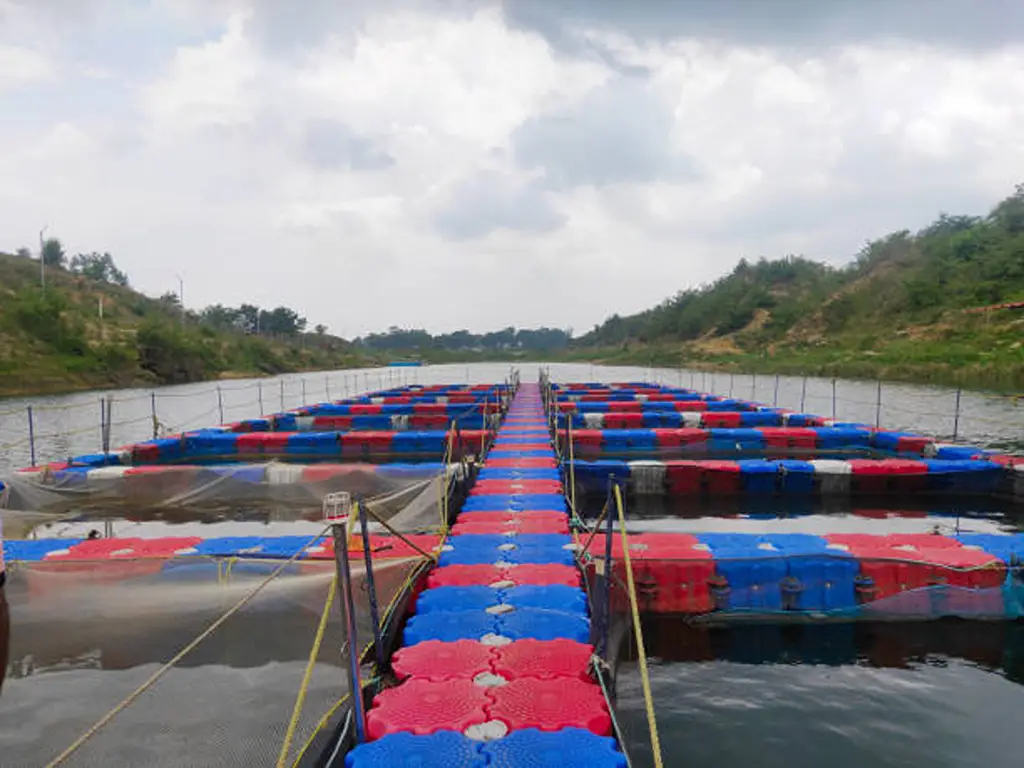
| Ponton / cube creux en PEHD | Chambre creuse en PEHD moulée par soufflage ; flottabilité due à l'air emprisonné | 5 à 12 ans (avec protection anti-UV) | Quais modulaires, constructions à faire soi-même, eaux peu profondes | Une seule perforation peut provoquer une inondation de la chambre ; la qualité des soudures est cruciale |
| Réservoir de levage à air comprimé | Réservoir rotomoulé à parois épaisses dont la flottabilité repose entièrement sur l'air | 8 à 15 ans (usage industriel) | Plates-formes de travail, ponts, équipements industriels pour charges lourdes | Les fuites lentes restent indétectables jusqu'à ce que la perte de flottabilité devienne critique |
| Baril / Improvisé | Fûts en plastique ou en métal réutilisés | 2 à 5 ans | Configurations temporaires ou ultra-économiques | Défaillance imprévisible ; absence de garantie ; corrosion (métal) |
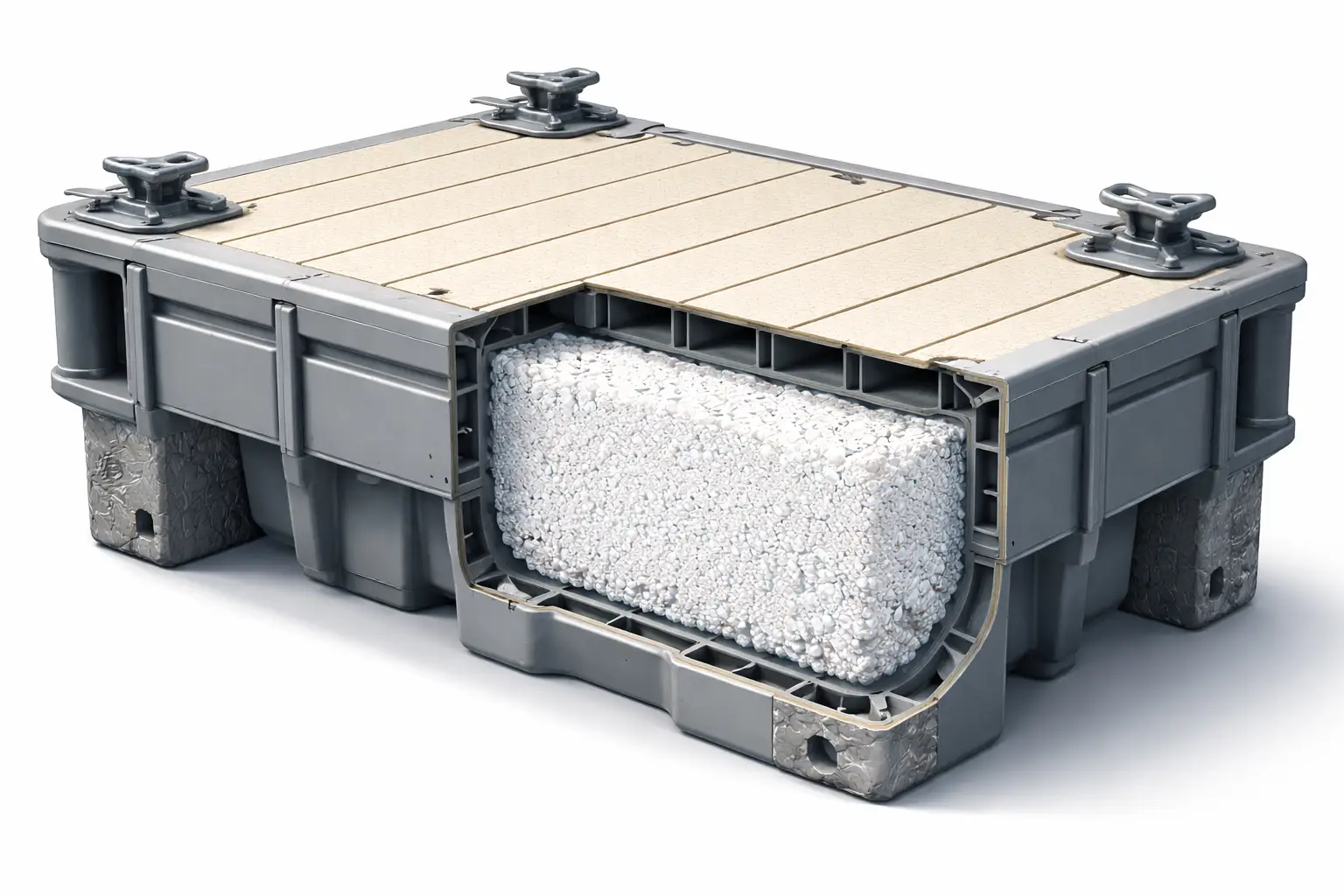
Pour un ponton que l’on souhaite voir durer plus de cinq ans, ce sont les deux premiers types qui dominent le débat. Les flotteurs en mousse encapsulée constituent la norme dans le secteur pour les installations permanentes. Les pontons creux en PEHD offrent une alternative plus légère et plus modulaire, particulièrement prisée pour les constructions « à faire soi-même » où la facilité de manutention est un critère important.
Les fûts ne coûtent pas cher, et ils ont l'air bon marché. Ce qui commence par un raccourci pour faire des économies se transforme souvent, deux ans plus tard, en une remise à neuf plus coûteuse.
Maintenant que vous savez distinguer chaque type, la véritable comparaison commence au niveau des matériaux.
Matériaux utilisés pour les flotteurs de quai : PEHD, mousse EPS et les propriétés chimiques qui déterminent leur durée de vie
La différence entre un flotteur de 5 ans et un flotteur de 15 ans ne réside pas dans le nom de la marque gravé sur le côté. Elle tient au type de polymère, à la composition de la mousse et au fait que le fabricant ait ou non intégré des stabilisateurs UV lors de la formulation de la matière première. Ce sont ces trois couches qui font toute la différence.
Nuances de polyéthylène haute densité (PEHD) pour coques : vierge ou recyclé, et pourquoi l’épaisseur de la paroi n’est pas le seul critère déterminant
Le polyéthylène haute densité (PEHD) est le matériau le plus couramment utilisé pour la fabrication des coques des pontons flottants, et ce à juste titre. Il résiste aux chocs, ne craint pas l’eau de mer et ne se corrode pas. Mais tous les PEHD ne se valent pas.
Le PEHD vierge est constitué de longues chaînes polymères uniformes produites directement à partir d'éthylène. Ces longues chaînes confèrent au matériau sa résistance à la traction, aux chocs et à la fissuration. Le PEHD recyclé ou broyé subit des cycles thermiques supplémentaires qui raccourcissent ces chaînes polymères. Chaque refusion dégrade légèrement la structure moléculaire, et le matériau obtenu est nettement plus cassant.
Concrètement : un flotteur fabriqué à partir de polyéthylène haute densité (PEHD) vierge absorbera les chocs contre les quais et les charges dues aux vagues sans se fissurer. Un flotteur fabriqué à partir d'une forte proportion de matière recyclée peut sembler identique au début, mais après deux ans de cycles thermiques et d'exposition aux UV, des microfissures apparaissent.
L'épaisseur de la paroi a également son importance, mais ce critère, pris isolément, peut induire en erreur. Une paroi de 5 mm en PEHD vierge de haute qualité, dotée d'une stabilisation UV adéquate, durera plus longtemps qu'une paroi de 8 mm en matière recyclée non stabilisée. La référence du secteur en matière de coques de flotteurs en mousse encapsulée est ≥ 0,150" (3,8 mm), obtenues par moulage par rotation. Le moulage par rotation permet de produire des coques sans soudure, exemptes de contraintes, avec une épaisseur de paroi uniforme. Les flotteurs en PEHD moulés par soufflage présentent généralement une épaisseur de paroi comprise entre 3 mm et 6 mm, les points de contrainte critiques, tels que les pattes de fixation et les angles, étant renforcés jusqu'à 19 mm.
Comment reconnaître la qualité : Demandez explicitement au fabricant s'il utilise du PEHD vierge ou recyclé, et dans quelle proportion. S'il ne peut pas ou ne veut pas répondre, partez du principe que c'est le pire scénario.
Technologie des âmes en mousse : EPS encapsulé ou chambres d'air creuses ?
Il s'agit là de la distinction structurelle la plus importante dans la conception d'un ponton flottant, et celle qui aura les conséquences les plus graves si vous faites le mauvais choix.
Un flotteur en mousse encapsulée est constitué d’une coque extérieure en PEHD remplie de mousse de polystyrène expansé (EPS) à cellules fermées, dont la densité est généralement comprise entre 1,0 et 2,0 lb/ft³ (16–32 kg/m³). La mousse et l’enveloppe sont liées lors du processus de moulage par rotation, créant ainsi une structure monolithique. Si l’enveloppe extérieure est perforée par des débris, de la glace ou une hélice de bateau mal orientée, le noyau en mousse continue d’assurer la flottabilité. Le flotteur ne coule pas. Il ne perd même pas de franc-bord de manière significative. Il suffit de réparer l’enveloppe lorsque cela est possible, et le quai reste opérationnel.
Un flotteur creux rempli d’air ne comporte pas de noyau en mousse. Sa flottabilité provient entièrement de l’air emprisonné à l’intérieur de la chambre étanche. Ce système fonctionne parfaitement… jusqu’à ce qu’il cesse de fonctionner. Une perforation, une couture fissurée, un embout abîmé : la chambre se remplit d’eau. La perte de flottabilité est immédiate et souvent catastrophique. Pire encore, les fuites lentes provenant de microfissures au niveau des coutures sont pratiquement impossibles à détecter jusqu’à ce que le quai commence visiblement à gîter.
La différence de performance est flagrante : un flotteur encapsulé peut perdre 80% de l'intégrité de son enveloppe tout en conservant une flottabilité proche de 90% de sa capacité nominale. À l'inverse, un flotteur rempli d'air présentant une fuite minuscule perd sa flottabilité de manière progressive et irréversible. Pour les installations permanentes dans des eaux soumises à l'action des vagues, à la présence de débris ou de glace, la mousse encapsulée s'impose comme la norme, et ce n'est pas sans raison.
Épreuve pratique : Si vous entendez de l'eau clapoter à l'intérieur d'un flotteur, c'est qu'il est déjà défectueux.
Stabilisateurs UV et additifs : la chimie invisible qui prévient le vieillissement prématuré
Deux flotteurs en PEHD d'apparence identique sont exposés au soleil pendant trois ans. La surface de l'un est crayeuse et fissurée. L'autre a l'air presque neuf. La différence ne réside pas dans le PEHD, mais dans ce qui y a été ajouté.
Le rayonnement ultraviolet dégrade le PEHD au niveau moléculaire, en sectionnant les chaînes polymères et en provoquant une fragilisation de la surface, l'apparition de microfissures et, à terme, une défaillance structurelle. Sans protection contre les UV, le PEHD exposé en permanence au soleil peut perdre plus de 40% de sa résistance à la traction en l'espace de quelques années d'exposition en extérieur. Cette dégradation s'accélère dans les milieux marins, où le brouillard salin et les cycles thermiques aggravent les contraintes.
Les stabilisants UV constituent la solution. L'approche la plus courante consiste à ajouter du noir de carbone à une concentration comprise entre 2 et 31 TP3T. Peu coûteux et très efficaces, ils absorbent le rayonnement avant qu’il n’atteigne les chaînes polymères. Les stabilisants à base d’amines encombrées (HALS), généralement ajoutés à raison de 0,1 à 0,51 TP3T, fonctionnent différemment : ils piégent les radicaux libres générés par l’exposition aux UV, neutralisant ainsi la réaction de dégradation avant qu’elle ne se propage. Les formulations haut de gamme utilisent les deux.
La question à poser à tout fabricant : “ Votre composé de PEHD contient-il des inhibiteurs d’UV, et à quelle concentration ? ” Si la réponse est vague — “ notre matériau résiste aux UV ” — ce n’est pas une réponse. Un PEHD correctement stabilisé à l’aide de noir de carbone ou d’additifs HALS peut conserver ses propriétés mécaniques pendant plus de 15 ans d’exposition continue à l’extérieur. Un PEHD non protégé commence à se dégrader de manière mesurable au bout de 12 à 18 mois.
Posez trois questions à chaque fabricant : (1) S'agit-il de PEHD vierge ou recyclé ? Quel est le pourcentage ? (2) Quels stabilisants UV le composé contient-il, et à quelle concentration ? (3) Pouvez-vous fournir des données issues d'essais de traction réalisés par un organisme indépendant pour vos cosses de raccordement ? S'ils répondent de manière vague ou refusent de répondre, considérez cela comme une information en soi.
De quelle flottabilité avez-vous réellement besoin ? Guide pratique pour choisir la bonne taille
Choisir le “ meilleur ” flotteur de ponton ne sert à rien si vous achetez la mauvaise taille. Des flotteurs trop petits font que votre ponton se trouve trop bas dans l'eau : il devient instable, est constamment mouillé et présente un danger lorsqu'il est chargé. Des flotteurs trop grands constituent un gaspillage d'argent et créent un franc-bord trop élevé qui rend l'embarquement difficile.
La formule fondamentale est simple :
Flottabilité totale requise = (charge morte + charge vive) × coefficient de sécurité
Charge permanente : 8 à 12 psf pour le bois / 5 à 8 psf pour l'aluminium · Charge variable : 20 à 40 psf · Coefficient de sécurité : 1,5× en zone calme / 2,0× en zone exposée
Charge permanente Il s'agit du poids de tous les éléments fixes : la structure de votre ponton (bois ≈ 8 à 12 livres par pied carré ; aluminium ≈ 5 à 8 psf), le revêtement du ponton, la quincaillerie et tous les accessoires fixes tels que les taquets ou les échelles. Pour un ponton en bois classique de 10 × 20 pieds, la charge morte à elle seule peut atteindre 1 600 à 2 400 livres.
Charge variable tient compte des personnes, du mobilier, des glacières et des équipements. La norme de référence pour les pontons privés est de 40 psf de surface de pont, bien que les calculs de flottabilité des pontons flottants utilisent souvent 20 psf pour la conception de la flottabilité. Le système de flottaison doit uniquement maintenir la structure au-dessus de l'eau, et non supporter les charges concentrées qui sont prises en charge séparément par l'ossature du pont. Pour les pontons commerciaux et les ports de plaisance, les exigences en matière de charge vive s'élèvent à 50–100 psf.
Coefficient de sécurité tient compte des conditions dynamiques. Multipliez par 1,5 pour les eaux calmes et protégées, comme les lacs intérieurs et les baies abritées. Multipliez par 2,0 pour les emplacements exposés aux vagues, aux courants de marée ou à la glace. Cette marge garantit la stabilité de votre ponton lorsqu'un groupe de personnes se déplace simultanément vers un même côté. Ne tenez pas compte de cette recommandation à vos risques et périls.
Exemple détaillé : Un ponton en bois de 10 × 20 pieds (200 pieds carrés) sur un lac calme.
| Composant | Calcul | Poids (lb) |
|---|---|---|
| Charge permanente (ossature en bois + terrasse à 10 psf) | 200 × 10 | 2,000 |
| Charge variable (personnes + équipement à 20 psf) | 200 × 20 | 4,000 |
| Sous-total | 6,000 | |
| Coefficient de sécurité (1,5× en eaux calmes) | 6 000 × 1,5 | Flottabilité totale requise : 9 000 livres |
Divisez ensuite ce résultat par la flottabilité nominale du flotteur que vous avez choisi. Si vous utilisez un flotteur encapsulé standard de 24″ × 48″ × 16″, d'une flottabilité nominale de 600 livres chacun :
9 000 ÷ 600 = 15 chars
Deux erreurs courantes à éviter. Premièrement : calculer la flottabilité en fonction de la charge statique uniquement. Votre ponton restera à peine au-dessus de l'eau jusqu'à ce que quelqu'un monte dessus. Deuxièmement : ne pas tenir compte du coefficient de sécurité. Les calculs semblent corrects sur le papier, mais dans la réalité, le ponton donnera une impression de souplesse et d'instabilité sous l'effet de charges dynamiques.
Pensez également au franc-bord, c'est-à-dire la hauteur de votre pont au-dessus de la ligne de flottaison. En eaux calmes, une hauteur comprise entre 12 et 18 pouces est suffisante. En eaux exposées, visez plutôt entre 18 et 24 pouces. Le franc-bord dépend à la fois de la hauteur physique du flotteur et de sa flottabilité ; tenez donc compte de ces deux éléments lors de votre choix.
Qu'est-ce qui permet à un ponton de flotter pendant plus de 10 ans ? La liste de contrôle de la durabilité
La durée de vie d’un ponton flottant ne dépend pas d’un seul facteur. Elle résulte de la combinaison de trois éléments : la résistance du matériau à son environnement, la solidité de la structure physique et la confiance que le fabricant accorde à son propre produit. Si l’un de ces éléments fait défaut, le temps commence à s’écouler plus vite qu’il ne le devrait.

Résistance aux agents environnementaux : rayons UV, eau de mer, glace et salissures marines
L'environnement est la principale cause de destruction des pontons flottants. Pourtant, la plupart des acheteurs se contentent de demander “ Est-ce qu'il va couler ? ” au lieu de “ Est-ce qu'il va tenir le coup ? ”
- Rayonnement UV : Comme indiqué plus haut, le PEHD non protégé se dégrade progressivement sous l'effet du soleil. Dans les régions très ensoleillées comme la Floride, le Texas, l'Australie ou la Méditerranée, la stabilisation aux UV fait toute la différence entre un flotteur d'une durée de vie de 5 ans et un flotteur d'une durée de vie de 15 ans.
- Eau de mer : L'un des principaux atouts du PEHD : sa neutralité chimique face au sel. Contrairement à l'acier, qui se corrode, ou au bois, qui pourrit, le PEHD ne réagit pas au contact de l'eau de mer. En revanche, les fixations métalliques et les éléments de charpente se corrodent. Optez pour de l'acier inoxydable ou de l'aluminium de qualité marine pour toutes les fixations.
- Conditions de congélation : La température de fragilisation du PEHD est d’environ -70 °C (-94 °F) ; ce matériau ne devient donc pas cassant, quel que soit le climat dans lequel il est utilisé. Cela dit, l’eau emprisonnée dans les joints ou les filetages des embouts peut geler et se dilater, provoquant des fissures de contrainte au fil des cycles répétés de gel-dégel. Les flotteurs en mousse encapsulée offrent de meilleures performances dans ce cas, car leur âme en mousse limite le volume d’eau susceptible de s’infiltrer.
- Croissance marine : Les balanes, les algues et les moules zébrées colonisent toutes les surfaces immergées. La bonne nouvelle : elles n’endommagent pas structurellement le PEHD. Elles augmentent toutefois le poids et la traînée, et leur élimination constitue une tâche d’entretien. Il existe des revêtements antisalissures, mais ils sont rarement nécessaires pour les pontons privés.
Auto-évaluation rapide : Votre eau est-elle saumâtre ou salée ? Votre ponton est-il exposé plein sud ? Votre région connaît-elle des gelées sévères ? Chaque réponse affirmative rend plus exigeants les critères permettant de déterminer si un produit est “ suffisamment résistant ”.“
Eau salée ou saumâtre ?
Privilégiez les ferrures en acier inoxydable et le PEHD (inert au sel)
Exposition plein sud ?
Exiger la documentation relative à l'inhibiteur d'UV
Des gelées sévères chaque hiver ?
Les poignées en mousse encapsulée résistent mieux aux cycles de gel-dégel
Intégrité de l'enveloppe : épaisseur de paroi, qualité des soudures et pattes de raccordement
La structure physique du flotteur comporte trois points critiques, et une fabrication bon marché a tendance à présenter des défaillances au niveau de chacun d'entre eux.
Épaisseur de paroi est l’indicateur de qualité le plus évident, mais ce n’est pas tout. Un flotteur encapsulé moulé par rotomoulage, doté d’une paroi uniforme de 0,150 pouce, est structurellement supérieur à un ponton moulé par soufflage dont les parois mesurent 0,200 pouce au centre mais seulement 0,080 pouce aux angles. Le rotomoulage permet d’obtenir des coques monoblocs sans soudure, avec une épaisseur de paroi uniforme. Le moulage par soufflage crée une ligne de joint à l’endroit où les deux moitiés du moule se rejoignent, et ce joint constitue un point faible naturel. Un mauvais contrôle du processus peut réduire l’épaisseur de la paroi au niveau de la ligne de joint de 20 à 40%, créant ainsi un point de rupture qui n’est pas mentionné dans la fiche technique.
Cosses de raccordement Ce sont les points où les flotteurs du quai s'emboîtent physiquement les uns aux autres et au châssis. Ces languettes absorbent tout le choc des vagues, de la dilatation de la glace et des mouvements du quai. Une épaisseur de languette de 19 mm (0,75 pouce) constitue la norme de référence pour les flotteurs destinés à un usage intensif. Des languettes plus fines, de 12 mm ou moins, peuvent se déchirer sous l'effet des charges liées aux tempêtes. Lorsqu'un flotteur se détache, les charges se redistribuent sur les flotteurs voisins, provoquant une défaillance en cascade. C'est précisément ce que mesure l'essai de traction en diagonale : les flotteurs haut de gamme résistent à plus de 14 000 N (environ 3 150 lbf) avant que les pattes ne cèdent.
Qualité des coutures Sur les flotteurs creux, c'est une question de vie ou de mort. Les embouts filetés des pontons en PEHD doivent s'ajuster parfaitement contre les joints toriques ou les joints d'étanchéité pour garantir l'étanchéité à l'air. Un joint torique de type $0.50 qui se détériore sous l'effet des UV peut provoquer l'inondation d'un flotteur $200. Les fabricants de qualité utilisent des joints en EPDM ou en silicone conçus pour une exposition continue à l'extérieur.
La garantie, gage de qualité : que signifient réellement les durées de 5, 10 et 15 ans ?
Dans le secteur des pontons, une garantie n’est pas une simple politique de service client. Il s’agit d’une déclaration technique. Le fabricant vous indique, en années, la durée de vie estimée de ses matériaux et de ses procédés de fabrication.
| Durée de la garantie | Ce que cela signifie | Ce qu'il faut vérifier |
|---|---|---|
| 1 à 3 ans | Couverture légale minimale. Cela implique une confiance limitée dans la longévité du matériau. | Prévoyez de le remplacer d'ici 5 ans. |
| 5 ans | Référence sectorielle pour les fabricants soucieux de la qualité. Indique la présence de polyéthylène haute densité (HDPE) vierge + stabilisation UV de base. | S'agit-il d'un remplacement gratuit ou d'un remboursement au prorata ? La garantie couvre-t-elle la dégradation due aux rayons UV ? |
| 8 à 12 ans | Confiance supérieure à la moyenne. Il s'agit généralement de flotteurs en mousse encapsulée, moulés par rotomoulage, proposés par des marques reconnues. | Vérifiez si les frais de livraison sont inclus dans le remplacement. |
| 15 ans | Le haut de gamme. Seule une poignée de fabricants proposent ce niveau de qualité. Cela implique l'utilisation de matériaux haut de gamme, un contrôle qualité rigoureux et une marge de sécurité structurelle. | Eagle Floats (Permafloat) est l'exemple le plus souvent cité à ce niveau. |
Mais la durée de la garantie à elle seule ne dit pas tout. Lisez attentivement les clauses en petits caractères pour vérifier trois points : (1) La garantie couvre-t-elle explicitement la dégradation due aux UV, ou uniquement les défauts de fabrication ? (2) S'agit-il d'un remplacement gratuit ou d'un remboursement au prorata, dont le montant diminue chaque année ? (3) La garantie est-elle subordonnée à une “ installation par un professionnel ”, ce qui pourrait en invalider la couverture pour les bricoleurs qui constituent la majorité de ce marché ?
Un fabricant proposant une garantie de remplacement gratuit de 5 ans couvrant tous les dommages prend un engagement fondamentalement différent de celui qui offre une garantie dégressive de 10 ans excluant les rayons UV, les chocs et les “ catastrophes naturelles ”. Le premier assume pleinement la responsabilité de son produit. Le second s'en remet à son service juridique.
Par exemple, des fabricants comme Hisea Dock offrent sur leurs flotteurs une garantie de remplacement gratuit de 5 ans couvrant tout dommage survenant pendant la période de garantie, assortie d’un service après-vente disponible 24 h/24 et 7 j/7 ainsi qu’une disponibilité totale des pièces de rechange. Leur formulation en PEHD intègre des inhibiteurs d’UV incorporés directement dans la matière première, et leur chaîne de production soumet les flotteurs à des essais de traction en diagonale atteignant 14 389 N. Ce niveau de contrainte met en évidence les faiblesses invisibles à l’œil nu. Ces quatre éléments combinés — un processus certifié ISO 9001, des certifications produit CE/SGS/TÜV, des résultats spécifiques d’essais de traction et une garantie sans clauses d’exclusion — offrent aux acheteurs un critère de référence mesurable pour comparer les autres fabricants. Si un fournisseur n’est pas en mesure de fournir une documentation équivalente pour son propre produit, cette lacune constitue une information précieuse.
L'équation de la durabilité
La longévité ne se résume pas à une seule caractéristique. Elle résulte de la combinaison de ces trois éléments. Un flotteur fabriqué dans un excellent matériau mais dont les coutures sont mal assemblées finira par céder tout aussi sûrement qu’un autre doté d’une coque fine et d’une mousse haut de gamme. Il faut évaluer l’ensemble du triangle, et non pas seulement l’un de ses sommets.
Installation de flotteurs pour ponton : matériel, compatibilité des structures et erreurs courantes lors du bricolage
L'installation n'est pas le sujet principal d'un guide consacré aux “ meilleurs flotteurs de ponton ”, mais c'est à cette étape que même le meilleur choix de flotteur peut être compromis par une mauvaise mise en œuvre.
Fixation des flotteurs au châssis : La plupart des flotteurs sont conçus avec des brides de fixation moulées ou des fentes permettant l'insertion de boulons, de goupilles ou de supports en U. L'utilisation de matériel en acier galvanisé ou inoxydable est indispensable. Les boulons zingués standard rouillent en quelques mois dans un environnement marin. Les flotteurs doivent être placés très près les uns des autres, avec des espaces ne dépassant pas ¼ de pouce, afin de répartir uniformément les charges et d'empêcher que certains éléments ne se détachent.
Compatibilité des matériaux du cadre : Le bois, l’aluminium et l’acier sont les trois matériaux les plus couramment utilisés pour la fabrication des armatures. L’aluminium est idéal pour l’eau douce : il est léger, résistant à la corrosion et solide. Si vous utilisez de l’acier, vous devez l’isoler électriquement des éléments en aluminium afin d’éviter la corrosion galvanique. En eau de mer, la présence de métaux différents crée une pile électrique qui ronge le métal le moins noble. Le bois traité sous pression convient, mais il ajoute un poids considérable ; vous devez donc en tenir compte dans vos calculs de flottabilité.
Les deux erreurs les plus courantes en matière de bricolage : Premièrement, un espacement irrégulier entre les flotteurs. Un écart d’un pouce d’un côté et d’un demi-pouce de l’autre entraîne une répartition inégale de la charge, ce qui accélère l’usure du côté le plus serré. Ensuite, un ancrage inadéquat. Un ponton flottant qui n’est pas correctement ancré dérivera, se tordra et finira par s’endommager en heurtant la rive ou les structures voisines. Les options d’ancrage comprennent des blocs de lest en béton, des supports de pilotis qui coulissent sur des poteaux verticaux, des liaisons rigides au rivage et des systèmes d’ancrage à tubes passant par les trous d’angle du flotteur. Le choix approprié dépend de la profondeur de l’eau, des conditions du fond et des variations saisonnières du niveau de l’eau.
Est-ce que deux personnes peuvent faire ça ? Oui. C'est là l'avantage principal de systèmes flottants modulaires. Les flotteurs résidentiels standard pèsent entre 30 et 50 livres chacun ; deux adultes peuvent facilement les mettre en place et les fixer à l'aide de boulons. La construction d'un ponton de 10 × 20 pieds peut se réaliser en un week-end si l'on s'y prend bien.
Prêt à comparer les caractéristiques techniques ? Obtenez les fiches techniques des fabricants et un devis sur mesure pour votre projet de ponton.
Comparatif des meilleures marques de flotteurs pour quais : tableau comparatif pour les acheteurs
Il n'existe pas de “ meilleur ” flotteur de ponton en soi. Il existe en revanche le flotteur le mieux adapté à votre budget, aux conditions de votre plan d'eau et à la durée pendant laquelle vous comptez conserver votre ponton. Le tableau ci-dessous vous fournit les données brutes nécessaires pour prendre cette décision, classées en fonction des critères que vous savez désormais prendre en compte.
Matériaux et fabrication : épaisseur de la coque, type de mousse et procédé de fabrication
| Marque | Pays | Type de flotteur | Matériau de la coque | Épaisseur de la paroi | Remplissage du noyau | Fabrication | UV Protection |
|---|---|---|---|---|---|---|---|
| Eagle / Permafloat | ÉTATS-UNIS | Mousse encapsulée | PEHD vierge | ≥ 0,150 pouce | Mousse EPS à cellules fermées | Moulé par rotomoulage | Noir de carbone stabilisé |
| CWI (Carolina Waterworks) | ÉTATS-UNIS | Mousse encapsulée | PEHD vierge | ≥ 0,150 pouce | EPS haute densité | Moulé par rotomoulage | avec protection anti-UV |
| AccuDock | ÉTATS-UNIS | Ponton modulaire en PEHD | HDPE + cadre en aluminium de qualité marine | - | Options creuses / en mousse | Moulé par soufflage + extrudé | PE résistant aux UV |
| Quai de Hisea | Chine | Ponton en mousse encapsulée / PEHD | PEHD vierge + inhibiteurs d'UV | 3 à 6 mm (ponton), cornes de 19 mm | Mousse EPS / options creuses | Moulé par soufflage + moulé par rotation | HALS + additifs à base de noir de carbone |
| Candock | Canada | Cube modulaire en PEHD | PEHD vierge | - | Creux, rempli d'air | Moulé par soufflage | Stabilisé aux UV |
| EZ Dock | ÉTATS-UNIS | Système propriétaire | Polyéthylène | - | Mousse encapsulée (Permafloat) | Exclusif | Résistant aux UV |
| Jet Dock | ÉTATS-UNIS | Système d'accès en voiture | Polyéthylène | - | Creux / mousse | Moulé par soufflage | Résistant aux UV |
| Blocs de quai | ÉTATS-UNIS | Ponton en polyéthylène haute densité | PEHD | - | Creux | Moulé par soufflage | Stabilisé aux UV |
“ — ” = information non communiquée publiquement par le fabricant. Demandez toujours les fiches techniques directement.
Flottabilité et capacité de charge : adapter les caractéristiques techniques des flotteurs aux poids réels des quais
| Marque / Modèle | Dimensions (L×W×H) | Flottabilité (lb) | Meilleur pour | Fourchette de prix (environ) |
|---|---|---|---|---|
| PermaFloat 48 × 96 × 32 | 48″ × 96″ × 32″ | 4,804 | Ports de plaisance, usage commercial, usage intensif | $$$$ |
| Flotteur standard CWI | Divers | 600–4,500 | Du résidentiel au commercial | $$$ |
| Hisea Dock 500 × 500 × 400 mm | 19,7 pouces × 19,7 pouces × 15,7 pouces | 485–925 (par module) | Modulaire : résidentiel et petits commerces | $$ |
| Candock Cube | 19,7 pouces × 19,7 pouces × 15,7 pouces | ~485 | Résidentiel, modulaire à monter soi-même | $$$ |
| Section EZ Dock | Divers | 450–2,500 | Usage domestique, consommation d'eau variable | $$$$ |
| Blocs de quai 24″ × 48″ × 16″ | 24 pouces × 48 pouces × 16 pouces | 600 | Residences, petits quais | $$ |
Catégorie de prix : $ = économique/bricolage, $$ = rapport qualité-prix, $$$ = haut de gamme résidentiel, $$$$ = qualité professionnelle. Les prix réels varient en fonction des quantités et du revendeur.
Lorsque vous comparez la flottabilité, tenez compte de la flottabilité par pied carré de surface de flottaison, et non pas uniquement de la flottabilité totale. Un flotteur offrant une flottabilité de 50 livres/pied² est plus dense et plus stable qu’un autre offrant une flottabilité de 30 livres/pied² pour une même taille. Cet indicateur est particulièrement important pour les quais étroits où le nombre de flotteurs est limité.
Garantie et assistance : la promesse après-vente que vous achetez réellement
| Marque | Garantie | Protège-t-il contre les UV ? | Remplacement gratuit ? | Pays d'origine |
|---|---|---|---|---|
| Eagle / Permafloat | 15 ans | Oui | Oui | ÉTATS-UNIS |
| CWI | 12 ans | Oui | Oui (dans les limites des conditions générales) | ÉTATS-UNIS |
| AccuDock | 10 ans | Limitée | - | ÉTATS-UNIS |
| Quai de Hisea | 5 ans | Couvre tous les dommages | Oui (remplacement gratuit) | Chine |
| Candock | 10 ans (variable) | - | - | Canada |
| EZ Dock | 10 ans (garantie limitée) | - | Au prorata | ÉTATS-UNIS |
| Jet Dock | Limitée | - | - | ÉTATS-UNIS |
Une vue d'ensemble : ce que révèle ce tableau
Si votre priorité est de bénéficier de la garantie la plus longue et d’une conception de fabrication la plus robuste possible, Eagle/Permafloat et CWI dominent le haut de gamme, à un niveau de prix correspondant. Si vous construisez un ponton résidentiel avec un budget limité et que vous privilégiez la modularité pour le bricolage, les cubes modulaires de Dock Blocks et Hisea Dock constituent une solution d’entrée de gamme plus abordable. Si vous avez besoin d’une solution de levage pour motomarines ou bateaux accessible en voiture, Jet Dock et EZ Dock sont spécialement conçus pour cet usage et leur prix est fixé en conséquence.
C’est dans les lacunes que réside la véritable information. Les marques qui ne peuvent ou ne veulent pas publier l’épaisseur des parois, les données des tests de flottabilité ou les spécifications des stabilisateurs UV vous demandent de faire confiance à leur nom de marque plutôt qu’à leur ingénierie. Après avoir lu ce guide, vous en savez suffisamment pour demander ces chiffres. Et vous en savez suffisamment pour considérer un refus de les fournir comme une information en soi.
Fiez-vous aux caractéristiques techniques publiées, et non à la réputation de la marque. Un fabricant qui refuse de communiquer les données relatives à l'épaisseur des parois ou aux stabilisateurs UV vous demande de lui faire confiance aveuglément. Préférez plutôt les produits dont les caractéristiques techniques sont clairement indiquées.
Comparez la flottabilité par pied carré, et non par flotteur. Un flotteur plus grand, dont la densité de flottabilité est plus faible, offre moins de stabilité qu'un flotteur compact, dont la densité est plus élevée. Il faut comparer ce qui est comparable.
Les conditions de garantie sont plus importantes que la durée de la garantie. Une garantie proportionnelle de 10 ans qui exclut les dommages causés par les UV vaut moins qu'une garantie de remplacement gratuit de 5 ans qui couvre tout. Lisez attentivement les clauses en petits caractères.
Où acheter des flotteurs pour quai : comparaison entre la vente au détail, la vente en gros et l'achat direct auprès du fabricant
Vous avez choisi le type et les caractéristiques de votre flotteur. Maintenant, où pouvez-vous vous le procurer ? Le canal de vente que vous choisissez a une incidence sur le prix, les options de personnalisation, les délais de livraison et le service après-vente. Souvent, cela compte même plus que la marque elle-même.
| Chaîne | Prix unitaire | Commande minimale | Personnalisation | Délai de livraison | Assistance |
|---|---|---|---|---|---|
| Concessionnaire local / Fournitures nautiques | Le plus élevé (marge commerciale de 30 à 50%) | 1 unité | Aucun (catalogue uniquement) | Disponible immédiatement (en stock) | En présentiel, recommandations d'installation |
| Vente en gros en ligne | Milieu de gamme | 10 à 50 unités | En quantité limitée (couleurs, tailles) | 1 à 2 semaines (en France) | Par téléphone ou par e-mail, selon le détaillant |
| En provenance directe du fabricant | Prix le plus bas (sans marge des intermédiaires) | 50 à 100 unités et plus (selon l'usine) | Complet : structure, couleur, taille, logo, assistance technique | 7 à 15 jours de production + 20 à 40 jours de transport maritime (international) | Vente directe d'usine, équipe d'ingénieurs techniques |
Pour l'acheteur particulier bricoleur Pour l'achat d'une station d'accueil : s'adresser à un revendeur local ou à un site de vente en ligne est la solution la plus simple. Le prix unitaire est certes plus élevé, mais vous bénéficiez d'un service pratique, d'une livraison rapide et d'un interlocuteur à contacter en cas de problème.
À l'attention des ports de plaisance, des entrepreneurs et des exploitants commerciaux Achat en gros : la différence de prix entre la vente au détail et l’achat direct auprès du fabricant est considérable. Elle se situe généralement entre 30 et 50% par unité, ce qui, pour une commande de 200 flotteurs, peut représenter une économie de plusieurs dizaines de milliers de dollars. En contrepartie, il faut tenir compte des délais de livraison et de la logistique. Les fabricants internationaux qui expédient par conteneur maritime ont besoin de 20 à 40 jours de transit, ce qui doit être pris en compte dans le calendrier du projet. En revanche, vous avez la possibilité de spécifier les couleurs, les dimensions, les indices de flottabilité et même les emplacements pour le logo de votre marque sur chaque flotteur. Des options tout simplement indisponibles via les canaux de vente au détail.
Par exemple, les fabricants qui desservent les marchés mondiaux à partir d’un seul site de production peuvent proposer des produits standard dans des délais de fabrication de 7 à 10 jours et des commandes sur mesure en environ 15 jours, avec un transport maritime vers plus de 80 pays. Hisea Dock, qui opère depuis un site de plus de 5 000 mètres carrés doté de quatre lignes de production et d’une capacité quotidienne dépassant les 1 100 unités, est l’un de ces fabricants. Une telle envergure signifie que vous n’êtes pas confronté aux contraintes de stock des détaillants : si les caractéristiques techniques d’un flotteur standard répondent à vos besoins, c’est le délai de production, et non la disponibilité en stock, qui détermine votre date de livraison. Si vous vous approvisionnez pour un port de plaisance, un complexe touristique ou un projet comportant plusieurs quais, la pratique courante dans le secteur consiste à demander des devis à 2 ou 3 fabricants simultanément. Comparez leurs spécifications techniques, leurs conditions de garantie et leurs délais de production, et pas seulement leur prix unitaire. Un flotteur qui coûte 15% de moins mais dont la teneur en stabilisateur UV n’est pas vérifiée et qui n’est couvert que par une garantie d’un an n’est pas une bonne affaire.
Obtenez un devis personnalisé pour un flotteur de quai
Envoyez-nous les dimensions et les spécifications de votre quai. Vous recevrez dans les 24 heures un devis détaillé comprenant les calculs de flottabilité et les tarifs.
Références
- ScienceDirect. “ Évaluation de la dégradation du polyéthylène haute densité (PEHD) sous l'effet des rayons UV ”. 2024. https://www.sciencedirect.com/science/article/abs/pii/S0048969724070049
- UpCodes. “ Section 3604 : Charges minimales de conception — Piliers et quais fixes ”.” https://up.codes/s/minimum-design-loads
- Gaythwaite, John W. Conception des installations maritimes. Bibliothèque de l'ASCE. https://ascelibrary.org/doi/book/10.1061/9780784414309

 English
  Thai
Thai  Spanish
  French
  German
  Dutch
Dutch  Italian
  Arabic
  Indonesian
  Portuguese
  Turkish