
Dock Lighting Requirements: What Applies, What Doesn’t, and What to Settle Before You Order
Search this term and you get three different rulebooks, because three different things are called a dock.
Three things called “dock”
| What it is | Where the fixture sits | Measured in | Governed by |
|---|---|---|---|
| Loading dock | On the freight platform | Horizontal illuminance, lux or foot-candles | Workplace and warehouse safety rules |
| Docking light | On the boat itself | Visibility distance in nautical miles | Navigation rules for vessels |
| Waterfront dock | On the dock structure | Foot-candles and lumens over a defined area | Electrical codes, wildlife rules, local ordinances, facility rules |
The first is the warehouse platform, governed by workplace lighting rules and measured in horizontal illuminance. The second is vessel equipment, judged by how far away it can be seen. Neither rulebook applies to the third, and the numbers from the first will mislead you if you carry them across.
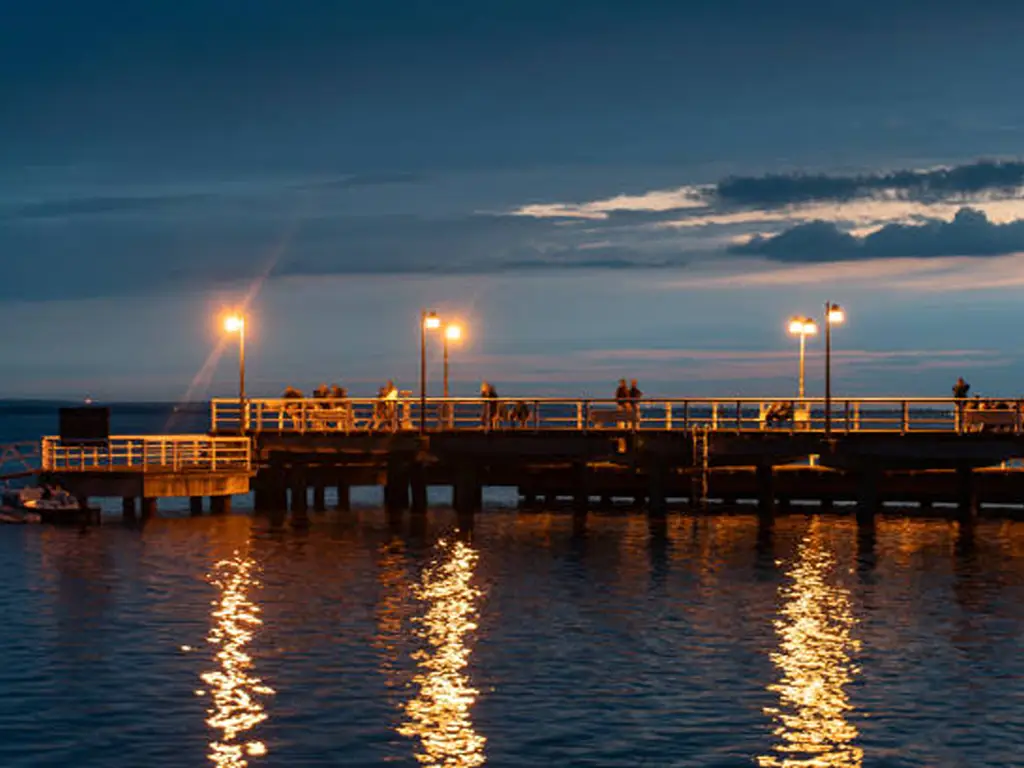
This article is about the third: lighting attached to the dock structure. Its rulebook is complicated because four conditions occur together here and nowhere else. People are in the water where the electricity is. Water levels change, so “how high is high enough” is never fixed. Salt and spray attack every enclosure and connection. And the light is partly a navigation signal, so visibility from the water is a requirement, not a feature.
Where Dock Lighting Requirements Come From — and Which Ones Reach You
Four Sets of Rules, and They Don’t Always Agree
There is no single dock lighting code, but four sources that can all apply at once:
The four layers that can bind one dock
Electrical codes
Article 555 of the National Electrical Code covers wiring and equipment at piers, wharfs, docks, docking facilities, marinas and boatyards.
Wildlife and environmental rules
State resource and environmental agencies regulate lighting near sensitive shorelines, often limiting intensity, shielding and wavelength.
Navigation safety
Federal and local rules govern what may be shown over the water.
Local ordinances and facility rules
Municipal zoning, homeowners’ associations and marina management can each be stricter than the code above them.
They contradict each other in practice. Some sources state that residential docks are commonly required to be lit from sunset to sunrise. Local ordinances state the opposite: lighting on seasonally used berthing structures “shall be turned off when not required for safety or security.” Both are real. Which binds you depends on your water, so read your own ordinance before designing to either.
Three Variables Decide Which Rules Reach You
Whether the installation connects to shore power at all. A self-contained fixture on its own panel and battery never enters the shore-power wiring system. That removes a large block of electrical requirements at once. The trade is capability: you give up dimming, colour tuning and central control, and output depends on available sun. Low-voltage systems fed from a transformer on land, and line-voltage systems fed from a shore panel, step progressively further into the code.
What kind of facility it is. A single-family dock, a multi-family or condominium dock, a commercial marina and a boatyard do not carry the same thresholds.
Where the fixture sits on the structure. This variable changes the most, and the rest of this article is built on it.
Same Requirement, Different Section Number
Requirements here are not static, and every change has moved the same way. The ground-fault protection threshold for equipment supplying docking facilities was 100 mA in the 2014 edition. It applied only to the main device feeding the marina. The 2017 edition tightened it to 30 mA and extended it to commercial and non-commercial docking facilities. That revision also added the permanent shock-hazard sign requirement. The accompanying commentary was blunt: it “makes it clear that non-commercial facilities aren’t exempt.” The 2023 edition added a dedicated luminaire section.
The practical consequence is not the direction of travel. It is that any answer you find online may be correct for an edition that no longer governs your site. The datum plane, the ground-fault provisions and the sign requirement all moved to different section numbers in the 2023 restructuring. Citing “555” is not enough. You need the edition your authority having jurisdiction enforces.
The Mounting Surface Decides the Requirement Set — Five Places a Dock Light Can Live
Every requirement you read falls out of one decision: which surface the fixture is mounted to. A protection rating, a wiring method, a shielding rule, a height above water — change the surface and the whole set changes.
Land Side and Deck Level: Where the Boundary Actually Sits
On land, a low-voltage landscape system is a well-established, largely self-contained practice. The same cable and fixtures do not follow you onto the dock structure. The boundary is where the dock structure begins, not the water’s edge, which is where most people assume the line falls.
Once on the deck, wiring must be in a raceway and the conductor rated for wet locations. Direct-burial landscape cable and standard building cable are not acceptable above a dock deck. Equipment not intended to operate submerged must sit at least 12 in above the deck, but never below the electrical datum plane, whichever is higher.
Piling Caps and Post Tops: Where the Constraints Pile Up
The most common position is also the most squeezed, because two rules pull against each other. The fixture has to read as a mark from the water, which is a navigation-safety function. It is also the position most exposed to wildlife lighting rules, which typically call for downward shielding, low intensity and long-wavelength light.
Wavelength thresholds show why you read your own ordinance. Publicly available guidance gives the amber cut-off as either 560 nm or 580 nm depending on the source, and neither is universal. Confirming your jurisdiction’s number before ordering is a checkable step. Discovering it after is not.
There is a physical constraint too. Cap-style fixtures fit a specific post size, and a fixed timber piling and the pile guide on a floating dock are different objects.
Rails, Risers and Pile Guides: The Mounting Surfaces a Floating Dock Already Has
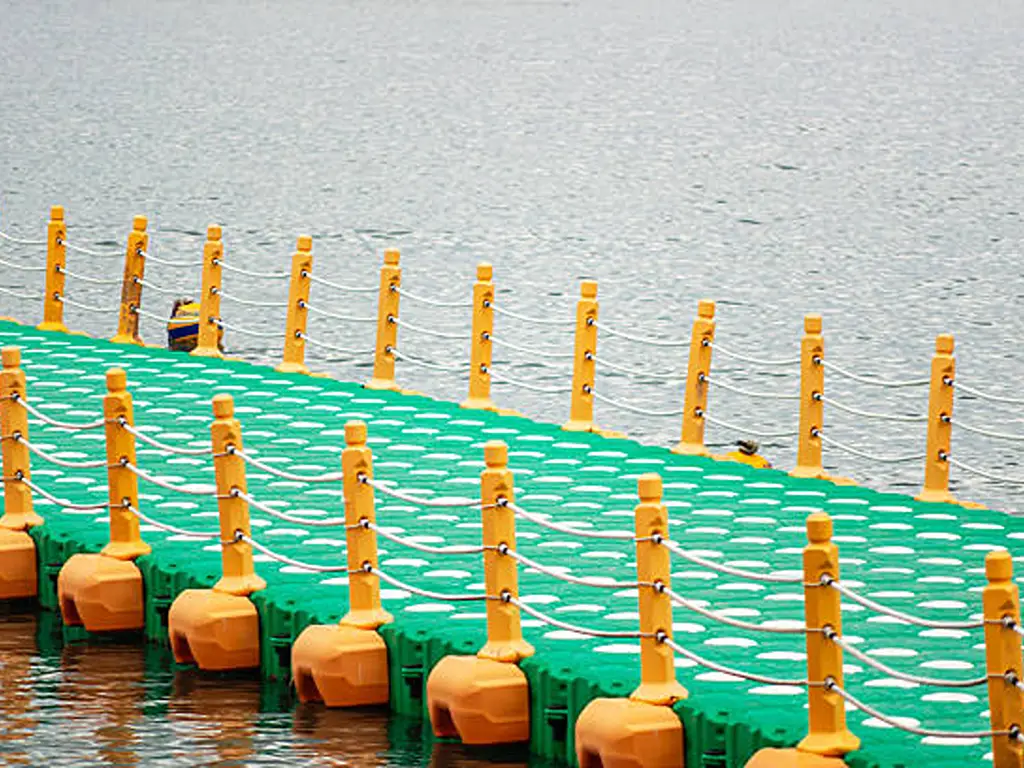
A floating dock changes the problem rather than simply making it harder. The structure rises and falls with the water, so a fixture mounted to it keeps a constant height above the deck. Its height relative to shore and the waterline keeps changing. On a floating pier the electrical datum plane is defined as 30 in above the water level et at least 12 in above the deck, both at once. On a floating structure, the plane moves.
The other reality is material. A rotomolded plastic float is non-conductive and provides no metallic structure, so a metal fixture housing cannot rely on the dock to complete an equipotential path. The bonding conductor has to run back to shore. And a buoyancy chamber is not a load-bearing panel: it is a sealed hollow body, measured in millimetres of wall, and it est the floatation. The practical question is not “where can I drill” but “what is already there to mount to.”
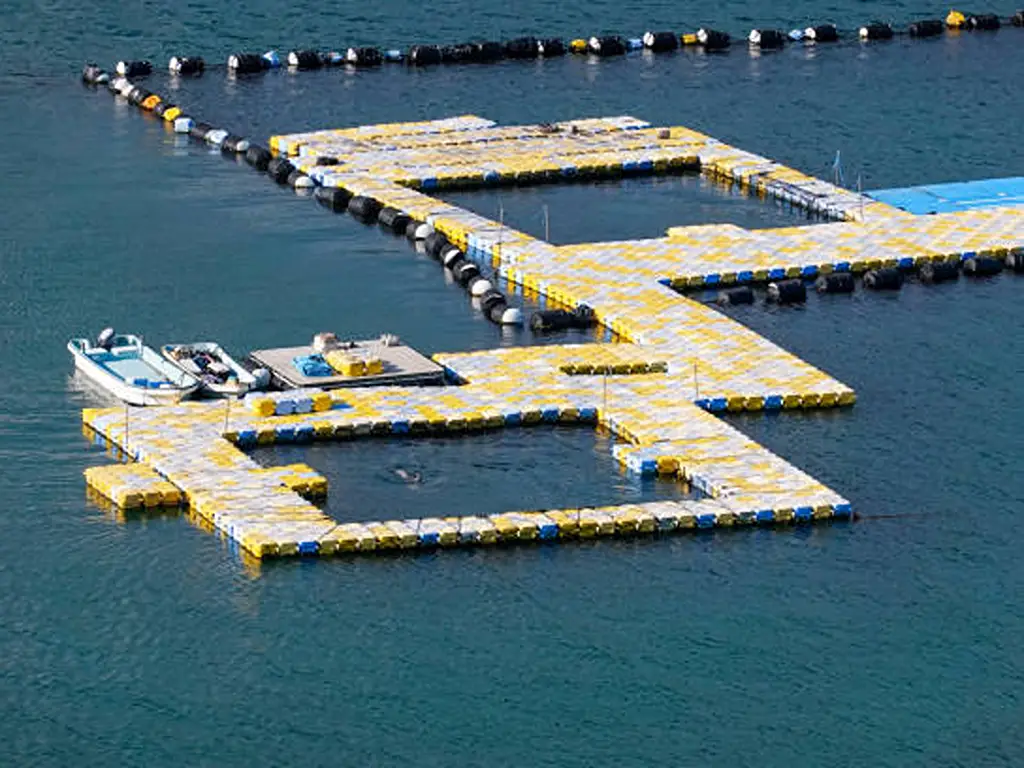
This is where the dock stops being a neutral variable. Hisea Dock builds modular floating dock cubes — rotomolded and blow-molded HMW-HDPE — with the connection points moulded in rather than added later: 19 mm-thick lugs, grooves on all four sides, reserved pin and bolt holes, and a threaded end cap that seals the cavity. Our accessory line does the same work above deck. Handrail and side baluster posts of 110 mm diameter and 1,000 mm height give a continuous vertical mounting line at a usable height. Pile guides sized for piles up to 220 mm diameter mark where the float meets a fixed point in the water. None of that is lighting hardware — we don’t make any, and we don’t sign off on anyone else’s. It exists because a dock must be assembled, anchored and walked on, which is why it is the surface a fixture can be mounted to without opening a float. What is missing matters just as much: there is no load-bearing panel to cut into after the fact.
Below the Waterline: The Most Heavily Regulated Surface
The code treats submersible fixtures separately. Luminaires installed below the highest high-tide level or below the datum plane, and likely to be periodically submerged, are limited to fixtures identified as submersible, ones operating below the low-voltage contact limit, or ones supplied by a swimming-pool transformer. They must also be secured so they limit watercraft damage and prevent interaction with sea life.
It is also the position most likely to be prohibited outright, and the one where marine growth does the most damage.
Mounting surface × applicability × limit × what to confirm first
| Mounting surface | Applies when | Stops working when | Confirm before ordering |
|---|---|---|---|
| Land side and approach | The circuit never reaches the dock structure | Cable or fixtures cross onto the deck without a raceway | Where the dock structure begins on your site |
| Deck and walkway | Below the datum plane, in a raceway, wet-rated conductors | Direct-burial landscape cable or building cable is used on the deck | Datum plane elevation and required connection height |
| Piling cap and post top | Visibility from the water is required and wildlife rules permit the spectrum | Fixture is sized for a different post type, or the wavelength and shielding rule is unmet | Post or pile diameter, plus your jurisdiction’s wavelength and shielding rule |
| Below the waterline | Fixtures are submersible-rated, bonded and protected | Local rule prohibits underwater lighting, or the fixture is not submersible-identified | Whether the position is permitted at all, before pricing it |
How You Know You Got It Right: Five Checks Before Inspection
What each luminaire is listed for. Article 555 requires luminaires and retrofit kits to be listed and identified for use in their intended environment. A fixture rated for wet outdoor locations is not automatically identified for a dock. Get the cut sheet for every fixture before ordering. This is the check most often skipped, and the one that fails inspection.
The wiring method. Any Chapter 3 method identified for wet locations with an insulated equipment grounding conductor is permitted, but above the deck the wiring must be raceway-protected. Run the grounding conductor insulated, sized to the overcurrent device, and never smaller than 12 AWG.
The protection layers. These complement rather than substitute for each other. Ground-fault protection of equipment on the conductors feeding the dock protects the water. Ground-fault circuit-interrupter protection on receptacles protects a person at the point of use. On a boat, a separate leakage device protects the dock from vessel-side faults. None of the three covers a fault originating on a neighbouring boat sharing the same water, which is why the sign requirement exists.
The fixings. Luminaires and their supply connections must be secured so they resist watercraft impact and do not entangle sea life. Fasteners chosen for a terrestrial wall are not obviously sufficient where lines drag across fixtures and growth creates leverage.
The sign and the permit path. A permanent safety sign is required. It must warn of shock hazard to people using or swimming near the facility, be visible from all approaches, and state that electrical currents may be present in the water. It applies to non-commercial docks too, and it is the most commonly missing item.
Two documented failures are worth knowing. A published electrical inspection of a small-boat harbour found the dock lighting system without ground-fault protection, not one fixture but the system, recorded as not meeting code. And electric shock drowning is why the thresholds are measured in milliamps. A fault current can paralyse a swimmer at levels far below what anyone would recognise as a shock. The risk is higher in fresh water than in salt, because fresh water resists current while the human body does not, making the body the easier path. Debris packed against a seal, or growth working a gasket loose, is how the current reaches the water.
What to Confirm Before You Order: Eight Questions for Any Supplier
Eight questions to send any supplier
Expect the answers to vary widely between suppliers, and treat that variation as information. Published fixture-life figures, for instance, range from roughly 25,000 hours to 30,000–50,000 hours depending on source and product class. That is a fourfold spread on the same nominal quantity. Controls are worth asking about too, but check them against local rules. Some jurisdictions cap outdoor fixture output and require continuous dimming, so a timer that satisfies one authority may conflict with a seasonal restriction from another.
The Account That Decides It: Why the Mounting Surface Outlives the Light
Put the two service lives side by side. A dock light is a consumable. At published figures, it is a component you will replace more than once, possibly several times, over the life of the structure it is attached to. A floating dock is built to last decades. Whatever you choose as the mounting surface will still be in place after several generations of fixtures.
The light is replaced several times. The surface is decided once.
Decide the surface first, then the fixture.
That comparison settles the ordering. Decide the surface first, then the fixture. Do it the other way and every replacement light has to work around a decision made for the first one. On a float, a surface that isn’t there cannot be added later without opening a sealed buoyancy chamber. The rules reinforce the same sequence. The ground-fault threshold tightened, the sign requirement arrived and the luminaire listing section was added in successive editions, so retroactive work is done against a stricter target than work designed in at the start.
For anyone selling or specifying a floating dock, that reframes the question customers ask. “Can I add lights?” is not answered by a fixture specification. It is answered by the surfaces the dock already has, the path a conductor can take back to shore, and whether the position can satisfy the rules that apply on that water. All of that is cheapest to settle at the point of order, while structure, float type and height are still open. Those are configurable: single, double, U and V floats, deck heights of 250, 400 or 500 mm, and the mounting provisions that go with them. If a dock is what you are buying, that is the conversation we are useful in.
Which rules you can satisfy depends on the dock
Hisea Dock makes modular floating docks — the mounting surfaces and deck heights a compliant position has to come from. Whether an installation meets Article 555 stays your licensed electrician’s call. If you need the dock, get in touch.
Contacter Hisea DockRéférences
- Mike Holt Enterprises. “Article 555 — Marinas, Boatyards, and Docking Facilities, Based on the 2017 NEC.” https://www.mikeholt.com/newsletters.php?action=display&letterID=1795
- Mike Holt Enterprises. “Marinas and Boatyards, Based on the 2023 NEC.” https://www.mikeholt.com/newsletters.php?action=display&letterID=2977
- Electrical Contractor Magazine. “2017 National Electrical Code Changes.” https://www.ecmweb.com/national-electrical-code/article/20901637/2017-national-electrical-code-changes
- Electrical Contractor Magazine. “NEC Requirements for Marinas and Boatyards.” https://www.ecmweb.com/national-electrical-code/code-basics/article/55335551/nec-requirements-for-marinas-and-boatyards
- Hisea Dock. « Cubes modulaires pour pontons flottants. » https://www.hiseadock.com/modular-floating-dock-cubes/
- Hisea Dock. « Accessoires pour pontons ». https://www.hiseadock.com/dock-accessories/
- Hisea Dock. “Floating Marina Dock.” https://www.hiseadock.com/waterfront_solutions/floating-marina-dock/
- Hisea Dock. « Nous contacter ». https://www.hiseadock.com/contact-us/
- Hisea Dock. « Hisea Dock. » https://www.hiseadock.com/

 English
  Thai
Thai  Spanish
  French
  German
  Dutch
Dutch  Italian
  Arabic
  Indonesian
  Portuguese
  Turkish