
Préface
When it comes to waterfront property development, a docking system is not just a purchase; it is a capital investment that completely changes the utility and the valuation of a property. Be it a home, a fishing dock, a business marina, or an industry floating platform, to comprehend the economic environment of a new dock one must leave the realm of price-tag shopping and enter the realm of a strict evaluation of the total cost of ownership.
The sea is infamously inhospitable, and it puts mechanical strain and chemical corrosion on any structure that comes in its path. Thus, a knowledgeable investor should balance initial capital expenditure (CAPEX) and long-term operational expenditure (OPEX). This guide gives a detailed analysis of the variables that affect these costs, ensuring quality craftsmanship and maximum utility per dollar expended.
Floating vs. Fixed Docks: Which is More Cost-Effective to Your Waterfront?
The first architectural choice that any waterfront owner has to make is whether to have a fixed (permanent) dock or floating dock systems. The hydrodynamics and geology of the site determine the cost-effectiveness of each.
Fixed Docks are conventionally built by sinking piles into the seabed or lakebed. Although they provide a feeling of permanence and solid ground, their cost-effectiveness decreases quickly in deep-water settings (more than 10 feet) or high tidal settings. A fixed dock is a liability in a tidal zone, either when it is submerged (submergence risk) or when it is inaccessible.
Floating dock systems, on the other hand, have a fixed freeboard (height above water) independent of the water level. Cost wise, floating docks have a number of unique benefits:
- Adaptability: They are not susceptible to the drowning expenses of the sea level rise or seasonal weather conditions.
- Installation Efficiency: They do not need the heavy pile-driving equipment that pushes the fixed dock prices into the tens of thousands.
- Scalability: A floating dock project allows for incremental investment, but fixed docks demand a complete initial investment.
In the case of modern waterfronts, particularly where water depths or bed conditions are variable, the floating dock is a more effective capital allocation, offering better life and reduced structural risk.
What is the Real Cost of a Floating Dock?
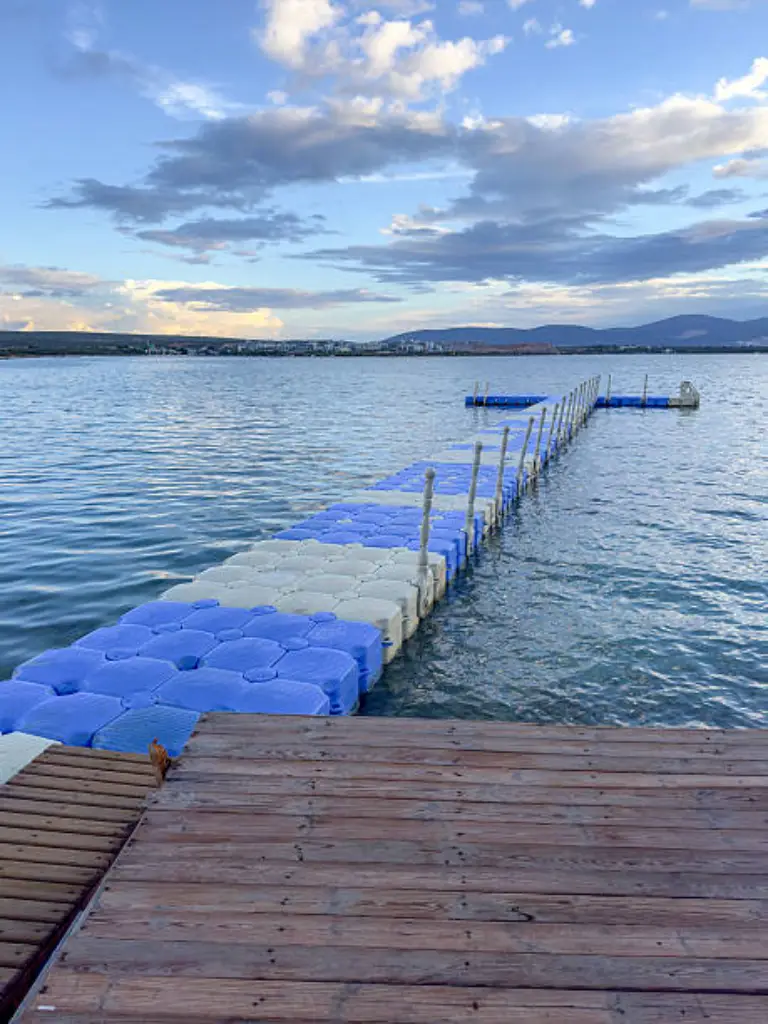
The price of a floating dock is like a building; it is mostly based on the material, size, and the load. Typically, the market prices are between 15 and 35 dollars per square foot of modular plastic systems and the high-end timber or steel frame docks may cost more than 70 and 100 dollars per square foot.
A typical 10 x 20 boat dock for residential use rangesbetween 3000 and 15000 dollars on average. The cheaper end usually includes DIY friendly plastic cube systems and the more expensive end includes professionally installed timber or aluminum frames.
The total cost can be divided into four fundamental layers to gain a better insight into your budget:
- Flotation Units (40% -50% of total cost): These are the engine of the dock, and they give the required buoyancy. High-quality units often feature an encapsulated polyethylene shell for maximum durability.
- Decking and Frame (25% -30% of total cost): This is the surface that is seen and the skeleton that supports it. This involves premium materials like aluminum or composite materials. This layer determines the look of the dock and its ability to withstand the elements.
- Anchoring System (15% -20% of total cost): This is an important mechanism that helps to avoid the dock drifting.Prices depend on water depth and potential acts of nature, with simple weights and chains being the simplest and permanent piling brackets being the most expensive.
- Soft Costs and Accessories (10% -15% of total cost): This last layer encompasses logistics, delivery fees and permits. It also includes the necessary add-ons such as a boat cleat or boat bumper and professional labor costs in case you are not opting to install it yourself.
With these proportions, you can better determine the overall price per square foot and determine which materials will be the most economical in the long term to use on your project.
6 Major Factors that Influence the Cost of Floating Docks
Budgetary planning requires the knowledge of the allocation of costs. In most cases, the budget is divided into 50-60 percent materials and the rest is labor and anchoring.
Core Material Costs
The material selection is the most important factor that defines the base price of the product and the final true cost (including maintenance).
| Type de matériau | Initial Cost (per sq. ft) | Maintenance Requirement | Expected Lifespan | Key Characteristics |
| Wood (Pressure Treated) | $20 – $35 | High (Annual sealing/staining) | 10 – 15 Years | Aesthetic appeal; prone to rot/splinters. |
| Aluminium | $35 – $60 | Faible | 30+ Years | Lightweight; corrosion-resistant; high cost. |
| Concrete Floats | $60 – $110 | Very Low | 50+ Years | Extremely stable; requires heavy machinery. |
| HDPE/Plastic | $15 – $30 | Minimal | 15 – 20+ Years | Modular; UV-resistant; easy to install. |
The choice of material is the main cause of initial investment and long-term costs. Although wood may seem cheap, its high maintenance and low life cycle pose a high cost in the long run with hidden costs. On the other hand, concrete and aluminum are durable, but they demand huge initial investment and machinery. The best option is HDPE/Plastic, which has the lowest initial cost (15-30/ sq. ft.) and requires minimum maintenance and installation. It is the best compromise, providing a high-quality waterfront solution at the lowest overall cost of ownership.

Positioning System and Anchoring
Your boat dock is anchored, and in case of failure, your whole investment is in danger. Although the anchoring factor usually takes 15-20 percent of the overall project budget, the main reason that may lead to the variation of costs is the method you select.
- Piling (Piles): The Premium Fixed Solution. Piles are the gold standard of stability, which entails the insertion of wood or steel poles into the seabed. It is the most costly process, which is between 1500 and 4000 dollars per pile. Since this option involves the use of specialized barges and heavy machinery, it will greatly add to your Soft Costs, and in many cases, will push the anchoring budget far beyond the typical 20% threshold.
- Anchor and Chain: The Economical Standard. The most popular and cost-effective option of residential docks is to use concrete deadweights and heavy-duty chains. This approach will keep your budget at the lower 15 percent range with total costs between 500 and 2,000. It is very efficient in deep water where pushing piles is not feasible or too expensive.
- Elastic Mooring (e.g., Seaflex): The High Tech Option. These systems employ high-strength elastic cables that extend with the tides, providing the stability of piles and flexibility of chains. They have a high price tag- they are usually 2 to 3 times more expensive than the conventional chains. Although the initial cost is greater, they are eco-friendly and minimize wear and tear during harsh weather conditions in the long run.
The simplicity of the system you have chosen directly influences your overall bill: simple chain systems can be assembled by yourself, whereas piles and elastic moorings tend to be installed by a professional and demand special equipment.
Site and Environmental Factors
Environmental factors are the silent architect, and can change your overall budget by 15 to 30 percent because of the specialized hardware and labor involved.
- Water Depth and Bed Composition: The topography under the water is the direct determinant of installation costs. Soft silt is simple to operate with, but when drilling into solid rock or operating in extremely deep water, specialized hydraulic equipment is necessary. These complications may increase or even triple your Soft Costs (labor and machinery) as compared to normal installations.
- Wave & Wind Loads: Exposure defines the strength of your components that is needed. A dock in a lee shore pond may be made of ordinary parts, but an open coastal location where heavy wakes are experienced must have reinforced connectors and high density floats to withstand acts of nature. The cost of upgrading to these marine grade materials is usually 20-30 percent to your Flotation and Frame budget.
- Marée : Large changes in the water level need more complicated engineering to access. A large tide needs more gangways and special sliding pile guides to ensure the dock is safe during the rise and fall. These required additions may increase the accessory costs by $2,000 to 5,000 over a fixed lake project.
The assessment of these three factors at the outset will make sure that you choose a system that is not under-engineered to fit the environment or over-budgeted to meet your requirements.
Complexity and Dimensions of Design
In addition to square footage, the complexity of your layout design is a major factor in the final price, and can change your overall investment by 15 to 50 percent.
- Surface Area and Dimensions: Costs tend to increase linearly with size. A bigger dock may need more materials, but can be a better value in terms of cost per square foot because of bulk shipping and shared anchoring systems.
- Shape and Layout Complexity: Simple rectangles are the most economical as they reduce wastage. Complex U-shapes or L-shapes need special corner reinforcements and extra connectors and reinforcements on the sides of dock, which usually adds 15-20 percent to the cost of a plain rectangle of the same size.
- Freeboard and Load Capacity: In case the dock has to carry heavy machinery or large groups of people, then you will require greater buoyancy. Doubling the height (freeboard) and weight of the dock by stacking two flotation units atop each other may add 50 percent or more to your overall project budget.
With a simple design that suits your real load needs, you can get the most out of your structure at a minimum structural cost.
Soft Costs
The Soft Costs are the required, but not always visible, costs that fill the gap between the purchase of materials and the completion of a dock. Although they usually constitute 10-15 percent of a typical budget, they may soon rise to half or even more of the overall project value, depending on the degree of professional assistance needed.
- Installation Labor (30% -50% of total budget): When you employ a professional marine team, hiring a professional installation crew is a major expense but ensures safety. This includes specialized assembly, operating heavy machinery, and underwater positioning. The best method of removing this important cost layer is to select a modular system that is intended to be installed by the user.
- Permits and Approvals: In most areas, the construction of water-based structures involves environmental assessment and navigational approvals. These charges are usually between 500 and more than 5000 dollars. The time and paperwork are also critical cost of entry considerations that will not change with the material used in the dock.
- Logistics and Shipping: Large components may require an oversized hauling permit and result in higher delivery fees. Shipping is basically the process of moving big boxes of air, and thus, when your location is remote or inaccessible, the logistics cost will be a substantial premium to the underlying price of the materials.
By considering these hidden layers at the outset, you can move beyond a theoretical estimate of the material to a realistic, final budget of a fully functional and legally compliant dock.
Other Features and Accessories
The accessories will generally cost you an extra 10-15 percent of your budget, but luxury upgrades such as boat lifts can add a lot to the overall investment.
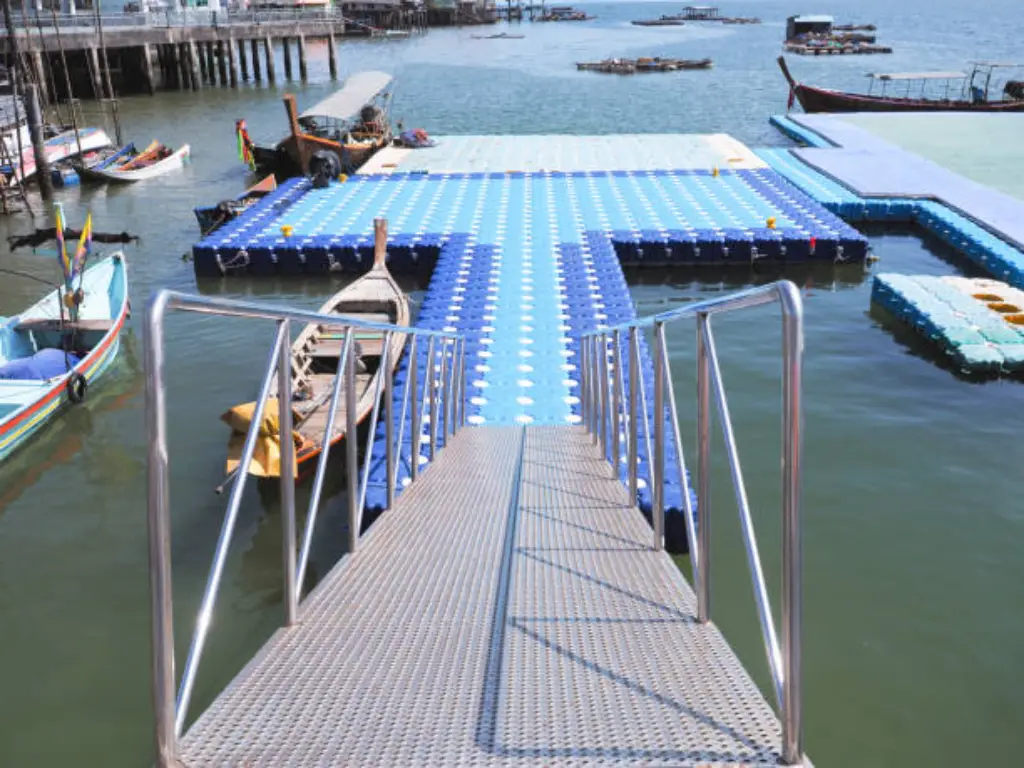
- Gangways and Ramps ($2,500 -5,000): A gangway is a required infrastructure expense that is necessary to bridge the shore to your dock. It provides safe access in any case of water level changes and is a fixed cost to most waterfront projects.
- Boat Lifts ($5,000 -15,000): This is the highest optional cost. Although the dock does not need to be floating, a lift is essential to ensure the safety of the hull of your boat. The addition of one will transform your project into a nice walkway to a high-quality maritime slip, which will increase the overall value considerably.
- Marine Utilities (Power and Water): The operation of electricity and water needs special marine grade materials and certified workforce. Since such systems need to be waterproof and corrosion-resistant, they add to your “Soft Costs” and may need extra technical permits.
With the early choice of accessories, you will be able to create a realistic budget that will make your dock both useful and affordable.
DIY or Professional Installation: How to Save Thousands?
The cost of labor usually consumes 30 to 50 percent of the total project value of a floating dock. A DIY approach will allow a property owner to save between 3,000 and 10,000 on a medium-sized project, which can be redirected to better materials or more surface area.
Choose DIY installation if:
- You are working with Modular HDPE Cubes: These systems are assembled in a plug-and-play manner, which offer incredible ease of installation. When the dock is made of plastic modules that are interlocked with simple manual tools, two individuals can usually install it within one weekend.
- The location is in Still, Lee Waters: DIY is best suited to inland lakes, ponds, or slow-moving canals where the wave energy is low and typical anchoring is adequate.
- You are employing Manual Anchoring: When you can easily use simple deadweights or slide poles that do not need barge-mounted equipment, a professional crew is not always necessary.
Employ a professional installation crew when:
- Structural Piling is necessary: When your location involves the use of steel or timber poles that must be driven into the seabed, the presence of specialized barge-mounted pile drivers makes the use of professional assistance essential.
- You are operating in a High-Energy Environment: Coastal or high-traffic channels with strong wake and tidal energy demand professional engineering to keep the anchoring system in place during storms.
- Complex Utilities are built in: Certified marine-grade electrical pedestals or pressurized water lines cannot be operated without technical skills to ensure compliance with safety standards and avoid accidents in a wet area.
When you select a modular HDPE system, you get the most out of DIY savings, because these systems are designed to be able to do without the costly specialized labor that conventional wood or concrete docks demand.
Maintenance and Lifespan Comparison: Initial Cost vs. True Cost
The first price in maritime finance is usually a fiscal illusion. The actual price of a dock is the longitudinal amount of the purchase price and the compounding cost of the annual maintenance.
| Matériau | Annual Tasks | Estimated Annual Cost |
| Bois | Pressure washing, sanding, staining, board replacement | $500 – $1,200 |
| Aluminium | Inspecting welds, cleaning | $100 – $200 |
| Béton | Crack inspection, cleaning | $100 – $300 |
| HDPE Plastic | Occasional rinse, connector check | $0 – $50 |
The data proves that the cost of maintenance is inseparably connected with material properties. Wood, which needs costly yearly sanding and staining to fight rot, is a recurrent financial burden. Aluminum and concrete are more durable but still require specialized labor in weld and crack inspection. Conversely, HDPE Plastic has a close to zero maintenance profile. HDPE offers the most effective lifecycle cost by removing the necessity of chemical treatment and structural repair, this efficiency allows owners to avoid the “maintenance tax” and ensures the residential warranty or commercial warranty remains a safeguard rather than a necessity.
The 50% Rule: When to Repair or Replace?
It is important to determine when a dock is an asset or a liability in order to manage property well. Although small hardware modifications are commonplace, systemic deterioration needs a stringent evaluation. We apply the 50% Rule: When the price of one major repair cycle is more than 50 percent of the price of a new, maintenance-free system, the building has entered its economic sunset.
The most logical financial plan at this point is to discard the unsuccessful structure and install an HDPE plastic floating dock. The conversion to HDPE at this point is a proactive investment- it will put the maintenance clock at zero and will remove future maintenance expenses. Not only does this action save your waterfront budget the additional sunk costs, but it also greatly increases the ROI and resale value of your property in the long-term.
Calculate Your Floating Dock Investment?
In order to come up with a realistic budget, follow this systematic process:
Step 1: Determine the Total Surface Area Cost
The initial one is to calculate the real footprint of the dock. In the case of a boat slip, the boat itself is not the only thing to measure, but the active space that needs to be safely docked. The most common formula used to calculate a functional slip is to multiply the beam (width) of the boat by 4 feet of clearance and then multiply the product by 80 percent of the total length of the boat.
Surface Area ( sq. ft.) = (Boat Beam + 4ft) x (Boat Length x 0.8)
In case you are incorporating a social or lounging space, add at least 100 sq. ft. to this amount. After getting the final square footage, you can multiply it with the unit price of the material that you have selected to get your base cost.
Base Material Cost = Price/ sq. ft. x Total Surface Area
Step 2: Compute the Infrastructure Requirements
Then you need to estimate the price of the hardware that attaches the dock to the shore and holds it. The most important variable in this case is the gangway. The 3:1 ratio should be used depending on the local water fluctuations to make sure that you have a safe walking slope.
Gangway Length required = 3 x Maximum Water Level Drop
Once you have decided on the access ramp length, include the cost of your anchoring units. In the case of the majority of modular systems, you can expect to spend one anchoring point (pile guide or anchor chain) per 20 linear feet of dock.
Infrastructure Cost = Gangway Price + (Number of Anchor Points x Unit Price)
Step 3: Final Budget Consolidation
The last estimation is the sum of your hardware expenses, labor costs, the logistics and a buffer to make the project fully funded. The cost of shipping large dock parts usually increases the material subtotal by 10-15 percent.
Lastly, add a 15 percent contingency buffer to the total amount. This margin will be necessary to absorb the soft costs like local permit fees, site-specific assembly tools or unforeseen underwater obstacles that may arise during the anchoring process.
Total Investment = 1.15×(Base Material Cost + Infrastructure Cost + Shipping)
5 Pro Tips to Reduce Your Floating Dock Costs without Compromising on Quality
You do not need to cut the cost of your project at the expense of quality. Through strategic choices at the planning stage, you will be able to reduce the overall investment and create a world-class waterfront. The five professional methods of maximizing your budget are as follows:
- Use Modular DIY Systems: Traditional docks may need professional marine crews and special barges, which will increase your bill by 30 to 50 percent. When you select a modular HDPE system, you are able to assemble the components on the shore with simple hand tools and place them in the water yourself. This saves you between 2,000 and 6,000 by eliminating professional labor and equipment mobilization charges.
- Use a Growing, Staged Design: You do not need to create your whole dream dock at the same time. Modular floating docks can be expanded non-destructively unlike fixed structures. Begin with a good quality main walkway this year and then add boat slips or jet ski ports in the following seasons. This distributes your CAPEX and at the same time the original structure is fully compatible with subsequent upgrades.
- Purchase in the Marine Off-Season: The marine business is very seasonal, and the season is at its highest point in spring. Buying in the winter season (late Q4 and early Q1) can usually give you discounts of 10-15 percent off the manufacturer. Also, freight companies are not as busy in these months and you can usually get lower shipping rates on large dock parts.
- Adhere to Rectangular Uniformity: Adhere to Rectangular Uniformity: Complexity is costly. L-shapes and U-shapes are nice, but they need more corner reinforcements that are costly and special connectors. The standard rectangular layout will give you the largest possible surface area and reduces material waste on the sides of dock to use compared to the hardware consumed, which will normally save you 15 to 20 percent of material waste.
- Take Advantage of Gravity Anchoring in Shallow Water: Pile-driving permanent piles needs a special pile-driving barge, which usually has a large mobilization fee regardless of the size of the project. When your water is less than 15 feet deep and covered, apply a Deadweight and Chain system. These gravity anchors are easy to install without the use of heavy machinery at a fraction of the cost of professional piling.
Smart budgeting will get you into the water, but the selection of the appropriate system will keep your costs at zero over decades. The modular HDPE technology developed by Hisea Dock is designed to make these cost-saving strategies a high-performance and maintenance-free reality.
Maximize Your ROI: Why Hisea Dock is the Most Intelligent Financial Solution?
The cheapest dock on the sticker price is not necessarily the most economical dock to invest in, but the cheapest to own. Hiseadock has been able to fill this gap since 2006 by using our 5,000-square-meter facility to provide high-performance systems at manufacturer-direct prices.
Our new-gen HDPE, which is impregnated with the latest UV stabilizers, has a life span of 20-30 years more than the other alternatives, which will effectively reduce your investment cost per year of usage. With a modular, DIY-friendly design, we do not require costly professional work and yearly maintenance costs. Whether you are inAmarillo Texasor a coastal region, We even cover the so-called hidden costs by filling your containers to the maximum during shipping, which directly saves your landed freight costs.
Reliability is our baseline. All Hiseadock modules are ISO-9001, CE, and SGS certified and tested to withstand a diagonal force of 14,389 N. This commercial grade power with a 5-year warranty will make sure that your waterfront is a profitable investment and not a liability.
No more guessing your budget, it is time to build accurately. Call Hiseadock today to get a custom quote that will give you the best ROI and fit your unique waterfront requirements.
Conclusion
Knowing your floating dock price is not just about getting the lowest price quote but it is about projecting the total cost of ownership correctly. With the addition of accurate calculation metrics, such as the 3:1 gangway ratio, the 15 percent contingency buffer, etc., you can turn a complicated budgeting process into a predictable high-value investment. You are not merely creating a platform when you put modular efficiency and maintenance-free materials ahead of short-term savings on a sticker price, but you are creating a platform that is resilient and has a high ROI that safeguards the long-term future of your waterfront.
FAQS
Q: What is the cost of installing a floating dock?
A: The overall cost of installation is usually between 1,500 and 15,000+ depending on the size and materials. A complete set up, including materials, anchoring, and professional labor, will cost you on average between 15 and 40 per square foot.
Q: Are floating docks costly as compared to fixed docks?
A: Generally, no. Although the initial material costs may be comparable, floating docks are cheaper in deep water or where the water level varies frequently. They do not need heavy piling equipment and have much lower long term maintenance costs than fixed wooden docks.
Q: How long will a floating dock last?
A: The material used determines the lifespan: HDPE modular docks have a lifespan of 20 to 30 years, aluminum docks have a lifespan of 30 to 50 years, and pressure-treated wood docks have a lifespan of 10 to 15 years.
Q: What is the price of a 200 sq. ft. dock?
A: The approximate cost of a typical 200 square foot floating dock is between 4000 and 8000 dollars. This cost depends on the type of decking material you want (plastic cubes or wood/aluminum) and the complexity of the anchoring system you need depending on your water conditions.

 English
  Thai
Thai  Spanish
  French
  German
  Dutch
Dutch  Italian