
Stop Torsional Tear: The Engineering Behind Durable Floating Dock Sections
An exhaustive technical masterclass on wave mechanics, wave energy dissipation, advanced material resilience, and optimizing total cost of ownership for commercial and residential waterfronts.
The Hidden Mechanics of Floating Dock Sections in Choppy Waters
When architects and marine contractors begin investing in waterfront infrastructure, the fundamental question they must address is not merely how does a floating dock work in theoretical calm conditions, but rather how it survives the chaotic, compounding forces of a severe marine environment. In a massive open bay or a large lake subject to extensive wind fetch, the surface water does not just rise and fall smoothly. It creates a complex matrix of kinetic energy.
Consider a scenario where you have a 7.3-meter (24-foot) commercial pontoon boat moored in a marina facing a 0.6-meter (2-foot) rolling swell with a short wave period. The primary threat to the infrastructure is not the static deadweight of the pedestrians or the boat. The catastrophic threat is dynamic torsional torque. As a wave crest lifts one quadrant of the marina while the adjacent trough violently drops the opposite side, the entire structure is subjected to immense, agonizing twisting forces. This multi-directional shear attempts to tear the modular components apart simultaneously in horizontal, vertical, and diagonal vectors.
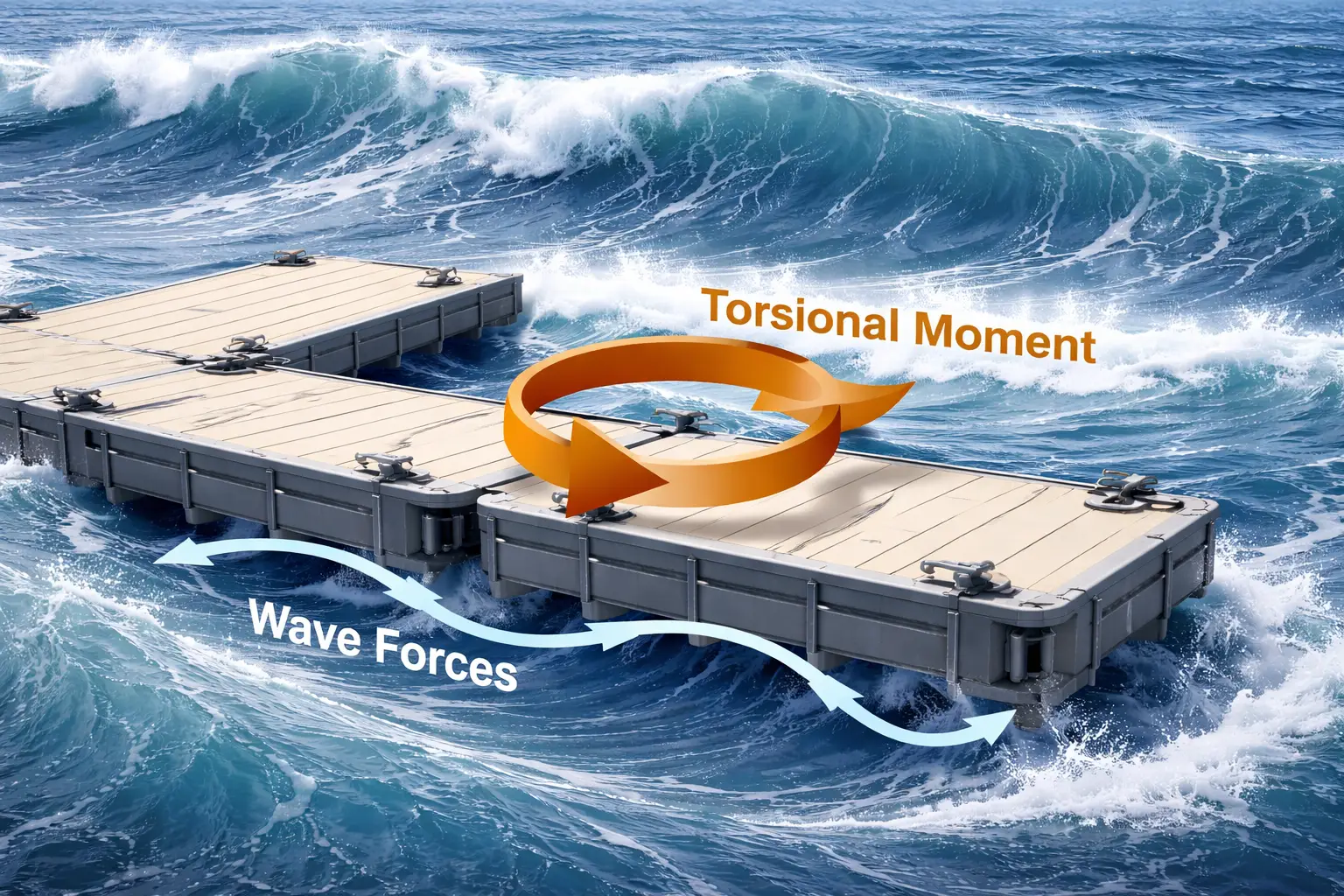
Understanding these stress factors is the first step in responsible marine engineering. Without addressing torsional fatigue, even the most visually appealing waterfront will slowly destroy itself over consecutive storm seasons. By dissecting these forces, we can establish a baseline for what true durability means in the context of commercial and high-end residential applications.
| Marine Stress Factor | Impact on Structural Integrity | Engineering Countermeasure |
|---|---|---|
| Static Vertical Load (Deadweight) | Constant downward pressure from accumulated equipment, commercial gangways, and concentrated pedestrian traffic. | Distributed buoyancy architecture maintaining a strict minimum capacity of 350 kg/mВ (71 lbs/sqft). |
| Dynamic Torsional Torque | Uneven wave lifting causing aggressive diagonal shear, leading to rapid material fatigue at connection seams. | Implementation of rigid 19mm connecting tabs paired with highly flexible elastomeric rubber pins. |
| Catenary Energy Absorption | Instantaneous rigid shock on the anchoring system during extreme tidal pull. | Implementation of Catenary Curve logic using the deadweight of heavy chains to buffer kinetic impact non-linearly. |
Core Materials Decoded: Energy Dissipation and the EPS Foam Logic
The operational longevity of any marine platform is inextricably tied to its foundational material chemistry and its energy dissipation efficiency. For decades, the industry relied heavily on wood and metal. However, traditional rigid structures, such as continuous wooden docks or rigid aluminum floating dock sections, possess inherent limitations regarding wave energy dissipation. When a powerful storm wave strikes a totally rigid aluminum frame, the kinetic energy must go somewhere; it is either transferred directly into the anchoring points (risking catastrophic pile failure) or it causes violent, uncomfortable jarring for the vessels moored alongside. In contrast, modern high-end polymer systems utilize decoupled energy dissipation. The wave energy is dynamically absorbed and dispersed across hundreds of individual articulating joints.
Hollow HDPE: The Economical but Vulnerable Choice
Standard hollow plastic floating dock sections represent the entry-level tier of the market. They are undeniably cost-effective and perfectly suitable for heavily protected, highly restricted shallow waters. However, they harbor a severe invisible vulnerability: internal thermal condensation. During rapid day-to-night temperature drops, the trapped air inside the hollow plastic module creates a vacuum effect, drawing in moisture. In freezing climates, this moisture accumulates, turns to ice, and expands, essentially puncturing the module from the inside out over multiple seasons.
High Molecular Weight HDPE & EPS Foam: The Unsinkable Standard
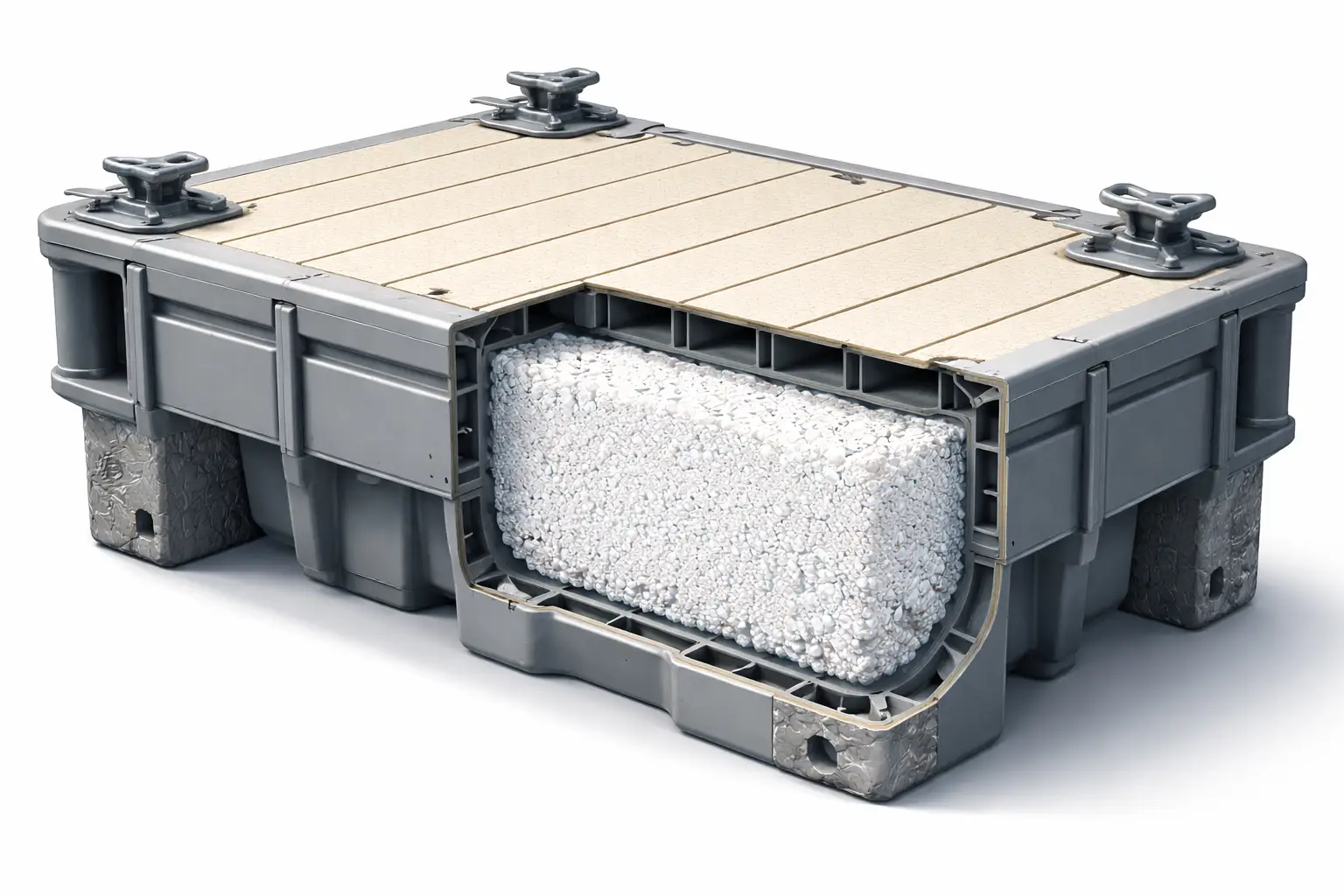
To achieve commercial-grade reliability, the internal voids of the modules must be eliminated. The global standard for premium floating dock specifications mandates the use of Expanded Polystyrene (EPS) foam filling encased within a blow-molded High Molecular Weight High-Density Polyethylene (HMW-HDPE) shell. The blow-molding process guarantees an incredibly uniform wall thickness (greater than 6mm), eliminating thin corners that are prone to puncture.
By injecting high-density EPS foam into these perfectly uniform shells, manufacturers create an unsinkable asset. Even if a careless boat captain drives a propeller directly through the outer plastic shell of the module, the closed-cell EPS foam will strictly prevent water ingress, maintaining 100% of the unit’s original buoyancy. Furthermore, premium manufacturers compound their HMW-HDPE with advanced UV inhibitors preventing ultraviolet degradation and surface embrittlement even under decades of blistering equatorial sun exposure.
Sizing Matrix: Engineering Stability, CAD Layouts, and Freeboard
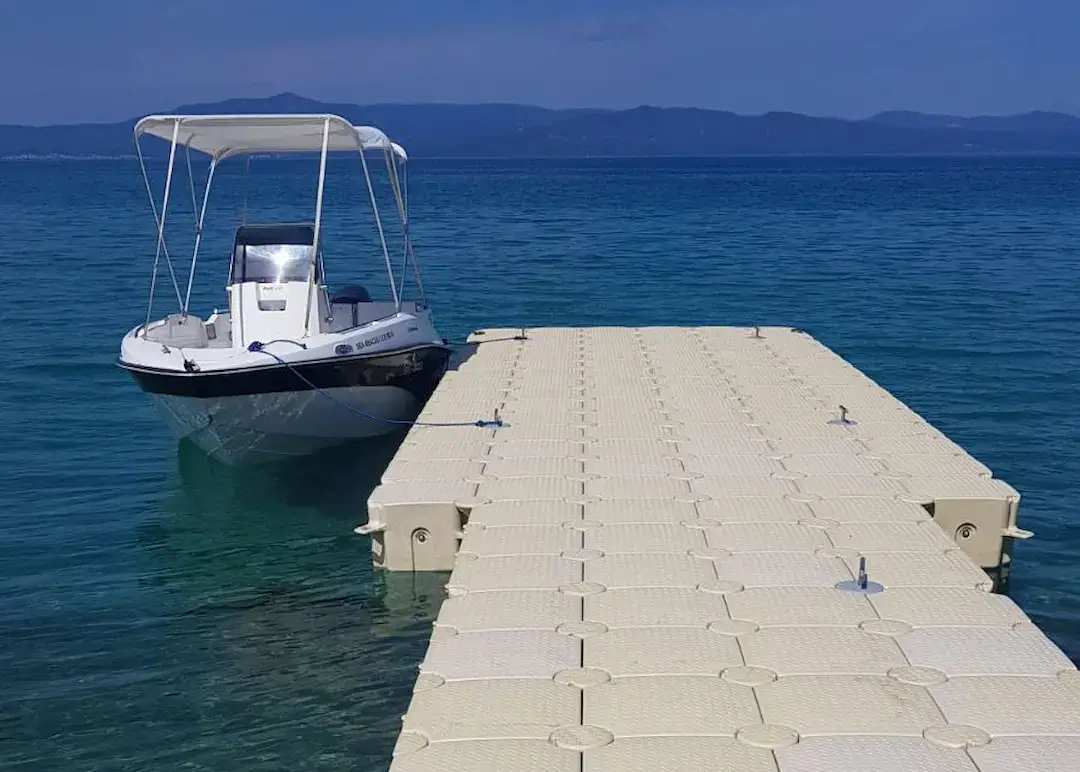
Navigating the various floating dock sections for sale requires a strict adherence to dimensional geometry. Stability is derived from accurate calculation. Choosing the correct section requires strictly matching the anticipated live load with the draft depth. Based on physical derivations, a standard HDPE module will sink approximately 1cm for every 10kg/mВ of added load. This metric is critical for maintaining ADA (Americans with Disabilities Act) compliance and ensuring safe passenger boarding.
| Module Dimensions (Length x Width) | Rated Safe Working Load (SWL) | Unloaded Freeboard Height | Primary Engineering Application |
|---|---|---|---|
| 3.0m x 1.0m (approx. 120″ x 40″) | 350 kg/mВ (71 lbs/sqft) | 35cm – 38cm | Private kayak launches, rowing club platforms, and narrow marina slip fingers. |
| 3.0m x 1.5m (approx. 120″ x 60″) | 350 kg/mВ (71 lbs/sqft) | 40cm – 42cm | The industry standard for residential main walkways and heavy-duty pontoon mooring. |
| 3.0m x 2.0m (approx. 120″ x 80″) | 500 kg/mВ (102 lbs/sqft) | 48cm – 52cm | Commercial ferry terminals, heavy public traffic zones, and massive event platforms. |
*Engineering Note: Immersion rate is estimated at 1cm per 10kg/mВ. Designs must reserve a minimum of 20cm safe freeboard under full SWL.
The Coupler Anatomy: Defining Rigidity vs. Flex in Articulation
The true genius of a modular marine system is entirely dependent upon the mechanics of its seams. When connecting floating dock sections, the hardware components must perform two seemingly contradictory tasks simultaneously: they must hold the massive platform together with unbreakable grip, while simultaneously allowing the platform to undulate with the waves.
Many novice buyers mistakenly believe that thicker plastic automatically equals a more “flexible” dock. This is a profound misunderstanding of polymer physics. The role of the heavy-duty 19mm connecting tab (the ear) on a premium dock is to provide absolute, unyielding Rigidity. While the industry average for these plastic tabs hovers around a flimsy 12mm, high-end engineering demands a 19mm thickness to prevent the plastic housing from stretching, deforming, or tearing under immense wave shear. The thick plastic tab is the anchor point; it is absolutely not meant to flex.
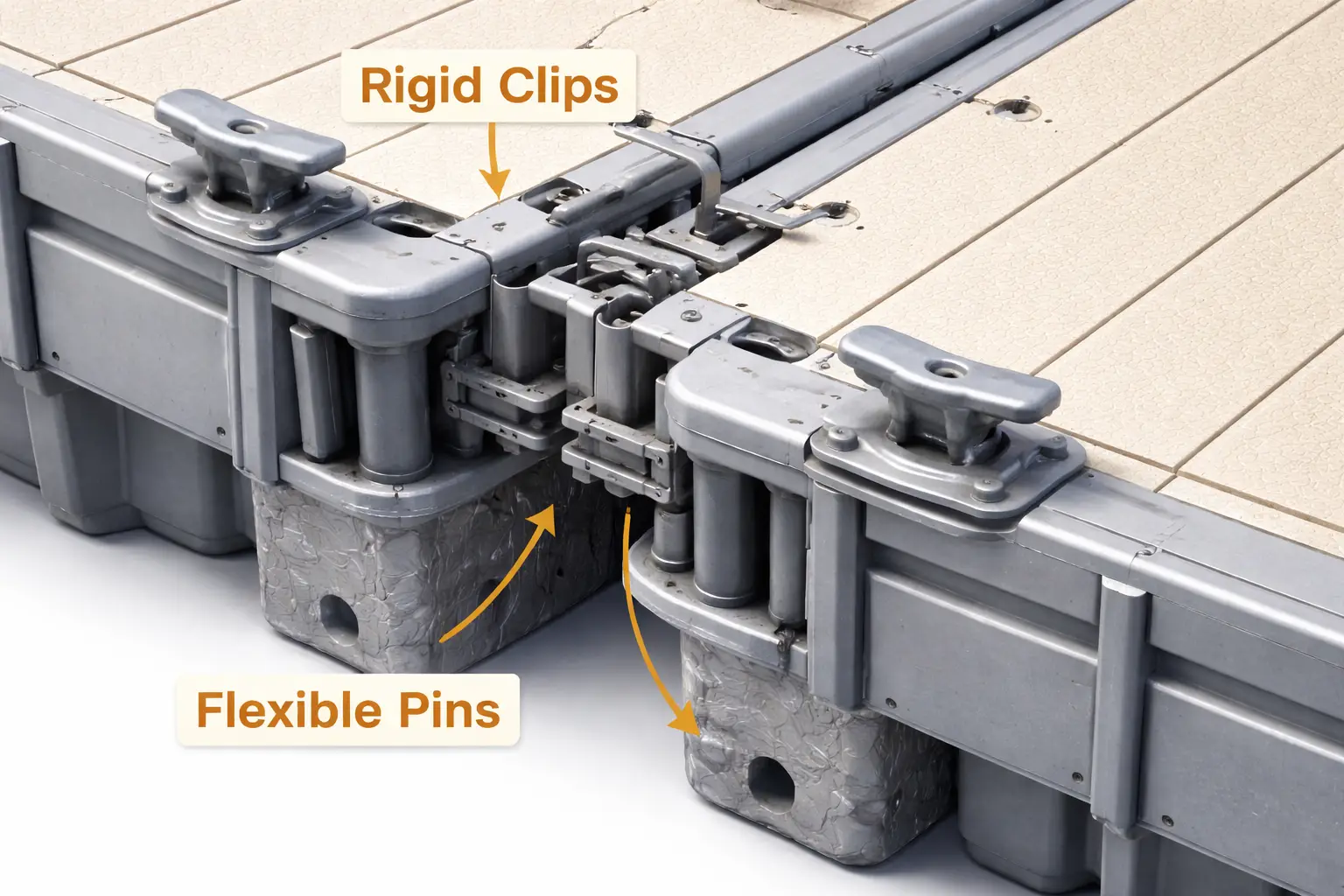
So, where does the crucial wave absorption come from? The Flex is entirely generated by the specialized floating dock parts accessories inserted into those tabs: the composite rubber dog-bone pins (or elastomeric couplers). These heavy-duty rubber connectors act as dynamic shock absorbers. When a wave violently lifts one module, the rubber pin flexes, stretches, and dissipates the kinetic energy, allowing the modules to articulate seamlessly. This intelligent division of labor – rigid plastic tabs holding onto flexible rubber pins – is what prevents torsional tearing and ensures the dock survives decade after decade.
Anchoring Solutions: Catenary Curves and Geological Compatibility
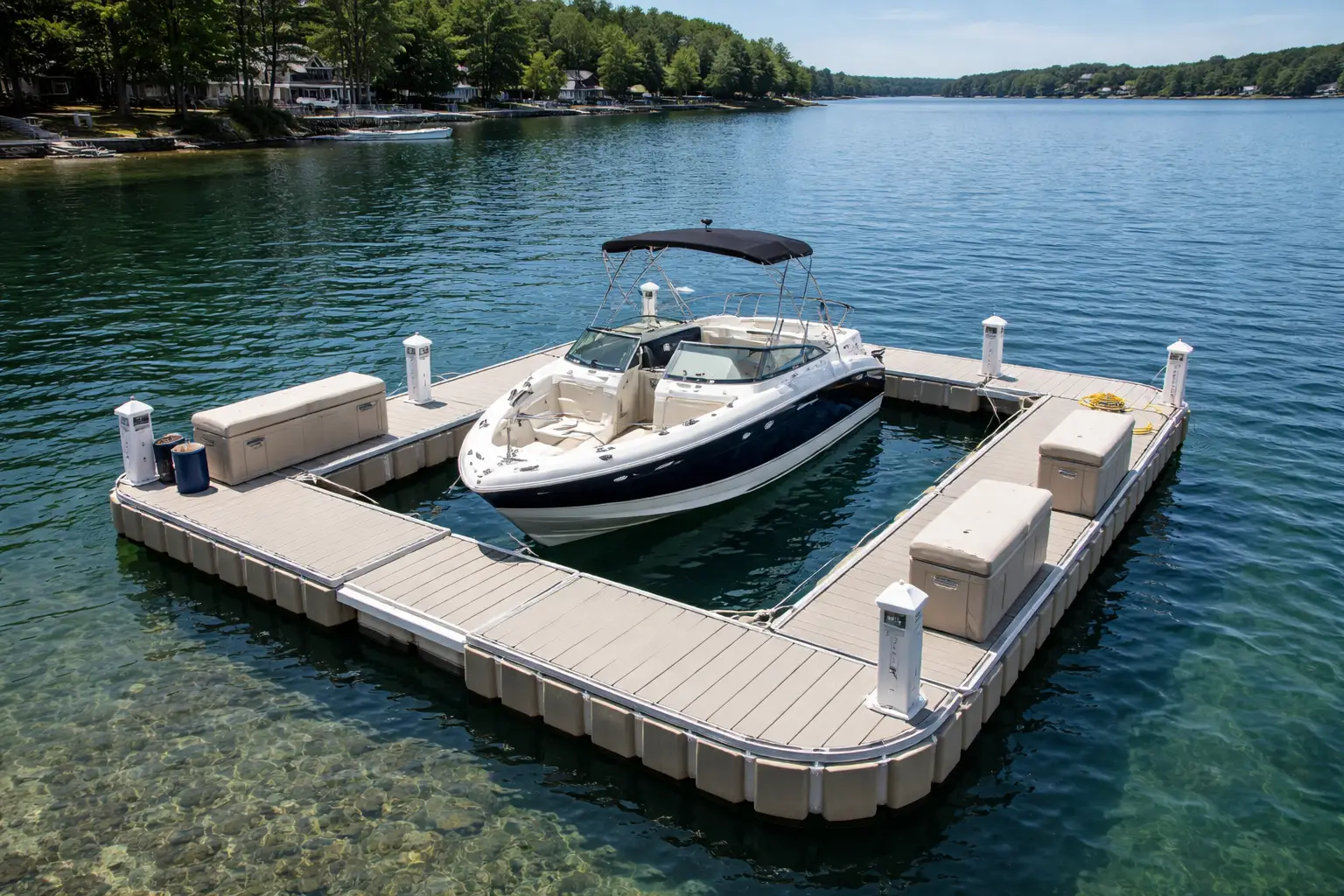
Regardless of how flawlessly engineered your floating dock parts are, an improper anchoring strategy will inevitably result in catastrophic failure. The anchoring system acts as the vital umbilical cord between the dynamic floating structure and the static seabed. Engineers must select from three distinct heavy-duty anchoring profiles based on the geology of the site:
- Pile Bracket Systems: The undisputed gold standard for tidal zones featuring relatively soft sandy or muddy benthic layers. Heavy-gauge galvanized steel piles (typically 114mm) are driven deep into the seabed. The dock glides smoothly up and down the pile via roller brackets, restricting all horizontal movement.
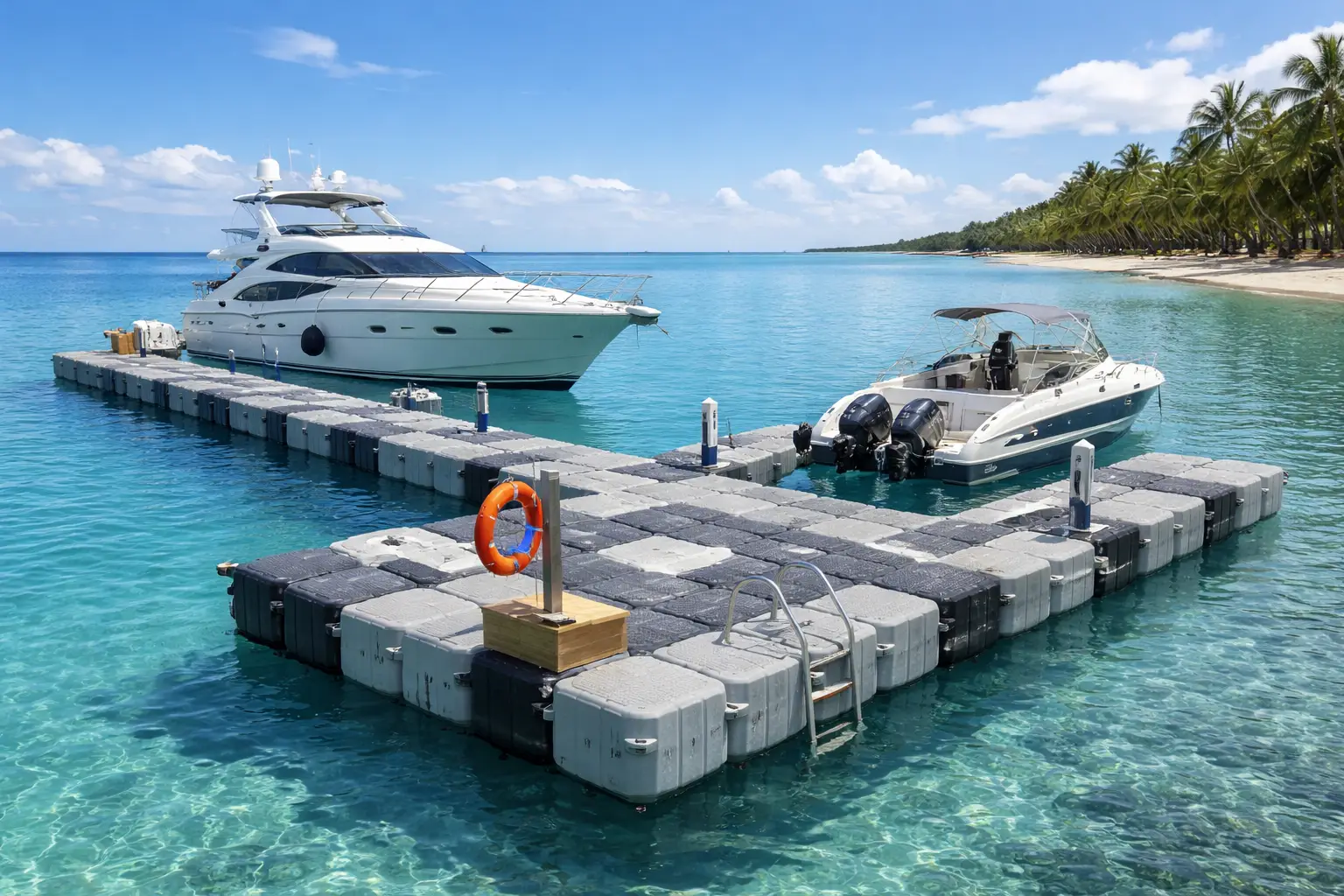
- Massive Deadweight & Catenary Chain: For extremely deep water (exceeding 10 meters) or solid rock seabeds where pile driving is physically impossible. This method utilizes massive 1000kg to 2000kg+ concrete mooring blocks. Crucially, the heavy-duty galvanized chains are arranged to form a Catenary Curve. This allows the immense deadweight of the chain itself to absorb the kinetic energy of the waves non-linearly, rather than relying on harsh, rigid tension that would snap connections.
- Helical Screw Anchors (Eco-Mooring): Specifically engineered for dense clay or deep mud (strictly excluding rock layers). These large steel shafts feature spiraled blades and are hydraulically screwed directly into the sub-surface strata. They offer immense, permanent holding power with a virtually zero-footprint environmental impact, providing unmatched tension resistance against violent lateral wind loads.
Winterizing Modular Docks: Navigating Static vs. Moving Ice Dynamics
For waterfront property owners in extreme northern latitudes, the transition into winter is a period of high anxiety. Can you truly leave your modular polymer dock in the water while the lake freezes solid? To answer this accurately, we must clearly distinguish between the physics of static ice formation and the destructive kinetic power of moving ice floes.
Static Ice Scenarios: In highly protected coves or small inland lakes where the water surface freezes uniformly in place, high-quality HMW-HDPE sections are specifically engineered to survive. Water expands by approximately 9% in volume as it freezes into ice, creating immense lateral crushing pressure. However, premium modules feature a carefully drafted, tapered hull design. When the expanding ice begins to squeeze the sides of the module, the angled walls act like a ramp. The lateral pressure is converted into vertical lift, “popping” the dock upward so it rests safely on top of the ice sheet, entirely unharmed.
Moving Ice Dynamics: Open rivers, tidal estuaries, and massive lakes are a completely different reality. Moving ice floes (ice breakups driven by currents or high winds) carry millions of tons of kinetic energy. No floating structure – regardless of material – can withstand the direct shear force of a moving ice field. In these high-risk environments, we strongly mandate the use of professional-grade sub-surface de-icers (bubbler systems) to maintain open water around the structure, or the seasonal removal of the dock altogether.
20-Year Lifespan: A Commitment Based on Professional Anchoring Blueprints
When executing a large-scale commercial marina development, focusing solely on the initial sticker price is a dangerous trap that inevitably leads to an inflated Total Cost of Ownership (TCO). Procuring cheap modules manufactured with thin 12mm tabs, lacking EPS foam, and devoid of UV stabilizers might save capital expenditure on day one. However, these inferior products require complete replacement every 4 to 6 years, effectively doubling or tripling your long-term operational expenditure.
Hiseadock’s ability to promise a 20-year operational lifespan is not merely a marketing slogan; it is a reality contingent entirely upon the professional anchoring blueprints we provide. A 5-year manufacturing warranty ensures flawless execution in our blow-molding facility, but surviving decades on the water requires bespoke engineering. By modeling your specific wind fetch, wave periods, seabed geology, and prevailing currents, our custom CAD layouts and anchoring strategies neutralize torsional tear before it begins.
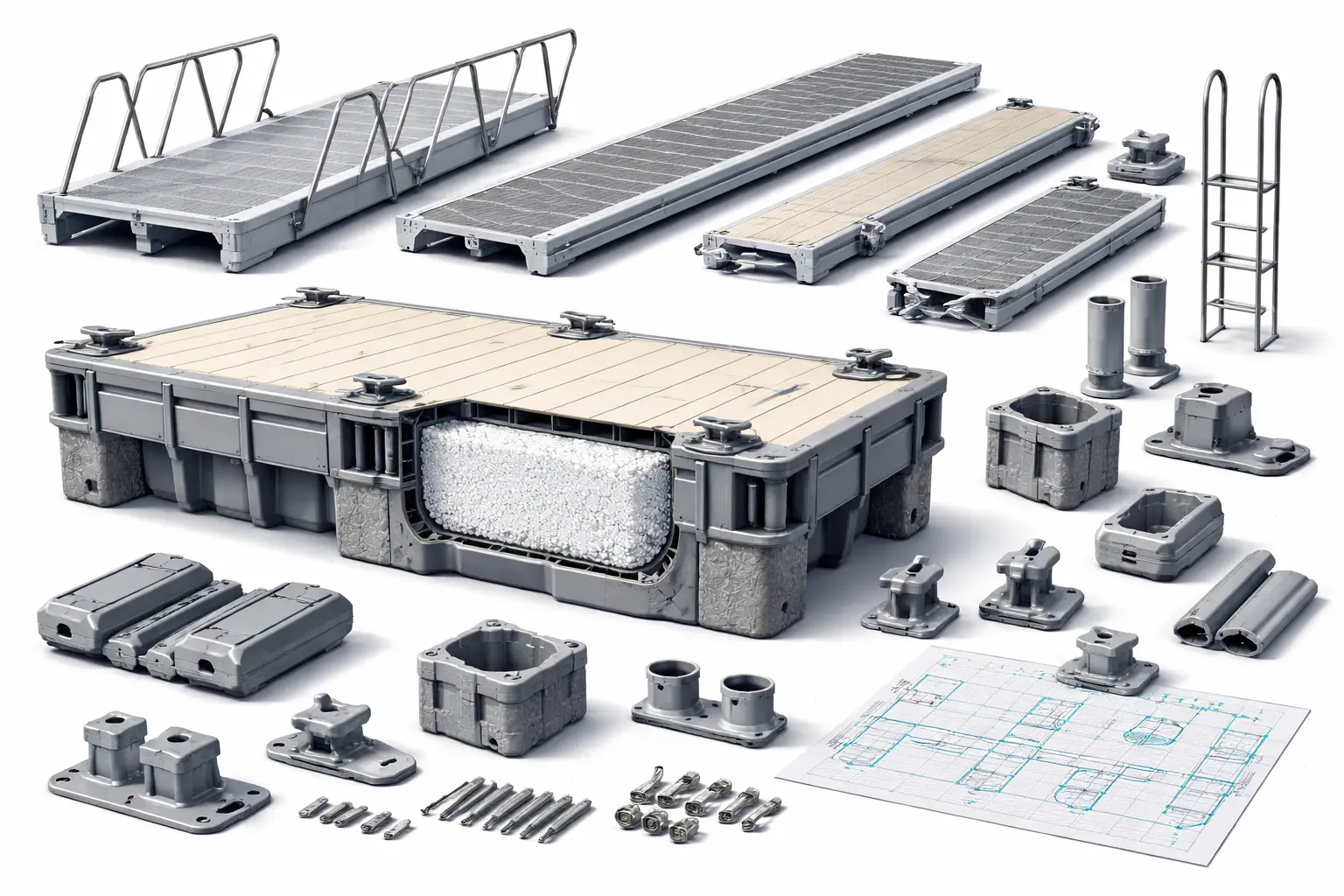
Partnering with a manufacturer boasting 16 years of expertise and a 1,120-piece daily capacity means you secure massive logistical advantages – including 4-in-1 packaging that slashes global freight by 25%. When you can trust a marine asset to remain maintenance-free for two decades because the engineering was flawless from the start, your infrastructure investment transitions from an ongoing expense to a permanent, high-yield asset.

 English
  Thai
Thai  Spanish
  French
  German
  Dutch
Dutch  Italian