
Boat Dock Safety – Six Kinds of Requirement, and Which Ones You Can Still Change
Most boat dock safety advice is a list of things not to do. Don’t run. Wear a life jacket. Keep the walkway clear. All of that is correct, and you’ll find it here — but it isn’t the whole picture, and the part it leaves out is the part you can’t fix later.
The reason is that “safety” is one word covering six kinds of requirement. They come from different sources, get checked in different ways, and they stop being changeable at different times. Two you can act on tomorrow. The rest are settled before the dock reaches the water.
The Hazards, Ordered by What Actually Happens
Ten mechanisms account for nearly everything that goes wrong on a dock: same-level falls, falls into the water, drowning, electric shock drowning, crushing and struck-by injuries, entanglement, fire and fuel, cold water shock, heat stress, and ergonomic injuries.
They are not equally likely, and they are not equally serious. Those are two different rankings, and the mismatch is where attention gets misallocated.
Same-level falls dominate by frequency. Workplace Safety & Prevention Services reports that falls from the same level make up 70% of all WSIB fall-related claims (WSPS, 2025). A slip on a wet float, a catch on a cleat, a trip over a coiled line: serious, common, mostly controllable through behavior and equipment.
The severe end is short and different. Electric shock drowning is rare, and it kills. A low-level AC current in fresh water can paralyse a swimmer’s skeletal muscles. The death is recorded as an ordinary drowning, and the autopsy typically shows no electrical injury at all (Electric Shock Drowning Prevention Association). The typical victim is a child swimming near a dock where electricity is present. The causes and fixes are covered here in Dock Electrical Safety. What matters for ordering your attention is that the most frequent hazard and the most fatal one demand completely different responses, and only one yields to behaving differently.
| Hazard | How common | How severe | Where it happens |
|---|---|---|---|
| Same-level fall (slip/trip) | Very common — 70% of fall claims | Moderate, occasionally fatal | Deck surface, cleats, lines, transitions |
| Fall into water | Common | High — depends on reboarding | Edges, gangways, unstable footing |
| Drowning | Follows a fall | Molto alto | Anywhere without a quick rescue |
| Electric shock drowning | Rare | Very high — usually fatal | Marinas and docks with shore power |
| Crushing / struck-by | Occasional | Alto | Boat-to-dock gap, moving vessels |
| Entanglement | Occasional | Alto | Lines, props, mooring gear |
| Fire and fuel | Rare | Molto alto | Fuel docks, shore power, stored fuel |
| Cold water shock | Follows a fall | Alto | Cold water, any season |
| Heat stress | Seasonal | Moderato | Open decks, summer, no shade |
| Ergonomic injury | Common | Low to moderate | Lifting, hauling, line handling |
Source: WSPS Working Near and On Water (2025); Electric Shock Drowning Prevention Association.
Two clarifications, since both get repeated wrong. A life jacket requirement on a dock is usually an advisory, not a statute. Boating law mandates them aboard vessels, so guidance that children under 12 wear one on the dock is good practice, not a legal obligation (Lake Lanier Association). Dock-injury threads produce a commonest reply: that anyone near docks should mitigate their own risk (r/boating). That reply is worth revisiting, because whether it’s fair depends on the state of the dock. Lighting, inspection and winter handling have their own guides here: Dock Lighting Requirements, Boat Dock Inspection.
The Two Layers You Can Still Change Tomorrow
Behavior and equipment are the two layers that respond to a decision you make today, and where every generic guide stops.
What’s worth saying is what this layer è: the only one that’s free to change, at any time, by anyone.
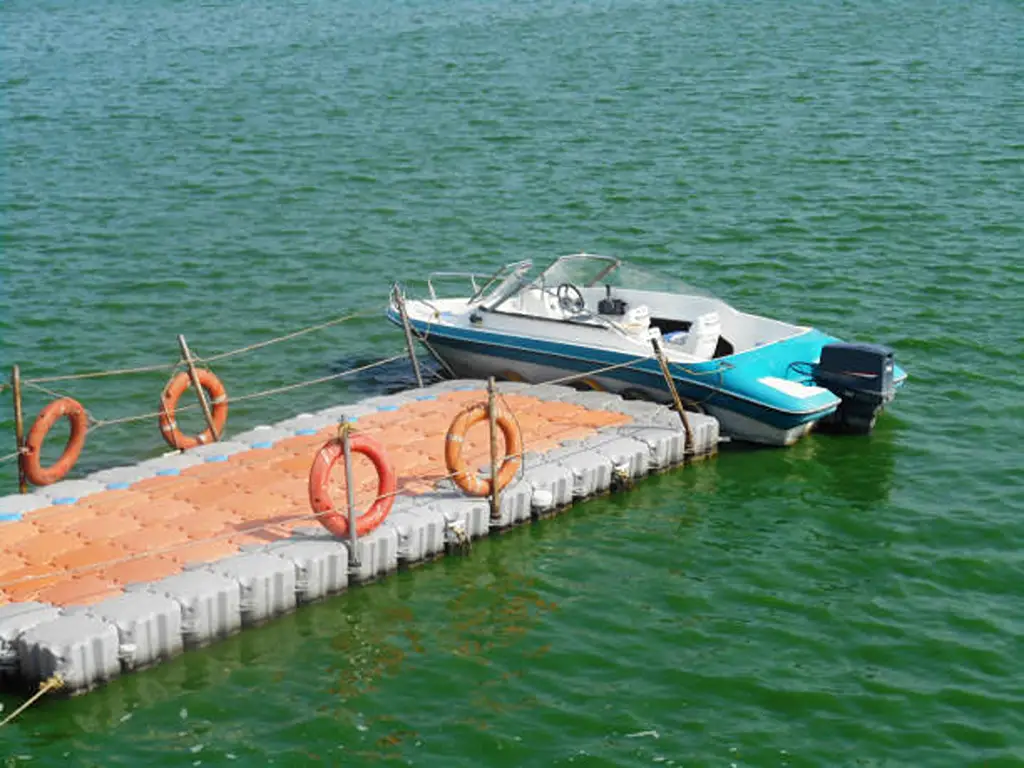
Equipment is what sits on the dock: life rings and throw ropes, a first aid kit, an extinguisher, non-slip mats, life jackets. Also changeable, but installing it and it being there are different things. Equipment you can’t find in the dark is not equipment. Risk concentrates where people are unfamiliar with the layout: fuel docks, gangways where the angle changes, unmarked T-heads, transient slips.
Both layers share a ceiling, and it’s a low one.
“Install non-slip surfaces” and “the deck surface is non-skid” are different things. One is a mat you lay down; the other is a property of the deck fixed when it was molded. “Install handrails” hits the same wall: a handrail attaches to something, and whether there’s a post to attach it to was decided at the factory, not the day you wanted one. Equipment can be added. Structure cannot.
When you can still act on each layer
Source: WSPS (2025).
What Changes When Someone Works on Your Dock
The moment someone is on your dock because you employ them, the obligation changes character. It stops being a duty of care toward family and guests and becomes a legal employer duty, and it doesn’t scale with headcount.
WSPS writes for marinas, hotels, yacht and sailing clubs, municipal waterfronts and summer camps. Their staff meet the same ten hazards as anyone else, but for hundreds or thousands of hours rather than a summer afternoon. Three duties follow.
A written PFD policy. WSPS recommends requiring staff to wear a personal flotation device at all times when on the dock within 2 metres of an unprotected edge, where water is deep enough for a PFD to work. Areas with no fall-into-water risk are exempt, such as workshops and offices, or where guardrails are fitted.
A written rescue plan, including non-entry rescue training (life rings and reaching devices) and clear parameters for calling emergency responders. WSPS is blunt about timing: in cool water, every minute raises the risk of a fatal outcome.
Rescue ladders, placed deliberately. WSPS calls for them at the ends of all finger docks and at regular intervals along other docks and walls. Being unable to reboard after falling in is listed among the leading causes of dock drowning.
One rule is easy to miss: swimming and boat movement don’t mix. WSPS directs marinas to prohibit swimming in docking areas outright.
And one limit on all of it. Training, PFDs and rescue plans rest on an assumption: the dock itself is sound. They cannot compensate for a structure with nowhere to mount a rescue ladder, no cleat to secure a line to, or a freeboard that makes reboarding harder than it needs to be. Duties cover behavior. They don’t reach structure.
The trigger is the employment relationship, not the size of the operation. One paid helper puts you inside the employer-duty framework just as surely as a fifty-slip marina does.
The Layer That Locks the Day It Ships
Structural requirements are where this stops being advice and becomes a specification. Three switches decide which rule sets reach your dock: what kind of water it sits in, whether it’s open to the public, and whether anyone is employed to work on it. Each opens a different set of requirements onto the same decking.
First, a distinction most published guidance blurs: dock regulation contains two distances, and they run in opposite directions.
Maximum distance from shore is a ceiling. LCRA caps how far a residential dock may sit from the Texas Highland Lakes shoreline, and the cap varies by lake: 150 feet on Lake Buchanan, 100 on Lake Travis, 50 on Lake LBJ, 35 on Inks Lake and Lake Marble Falls (LCRA). Wisconsin works from a different quantity: shoreline frontage and water depth. A pier there may extend to the three-foot water depth, unless a municipality has set a pierhead line, which it cannot cross (Wisconsin DNR).
Setback from a neighbouring property line is a floor, commonly cited at 10 to 25 feet, and often a civil matter between neighbours rather than something a regulator enforces.
One ceiling and one floor, in different units, judged by different bodies. Treat them as one rule and you’ll get one wrong. And safety requirements have been migrating from the operating phase to the purchasing phase: underwriters pricing coverage against dock condition, accessibility law attaching to public facilities, regulators issuing notices of violation rather than advice.
The deck surface and the edges
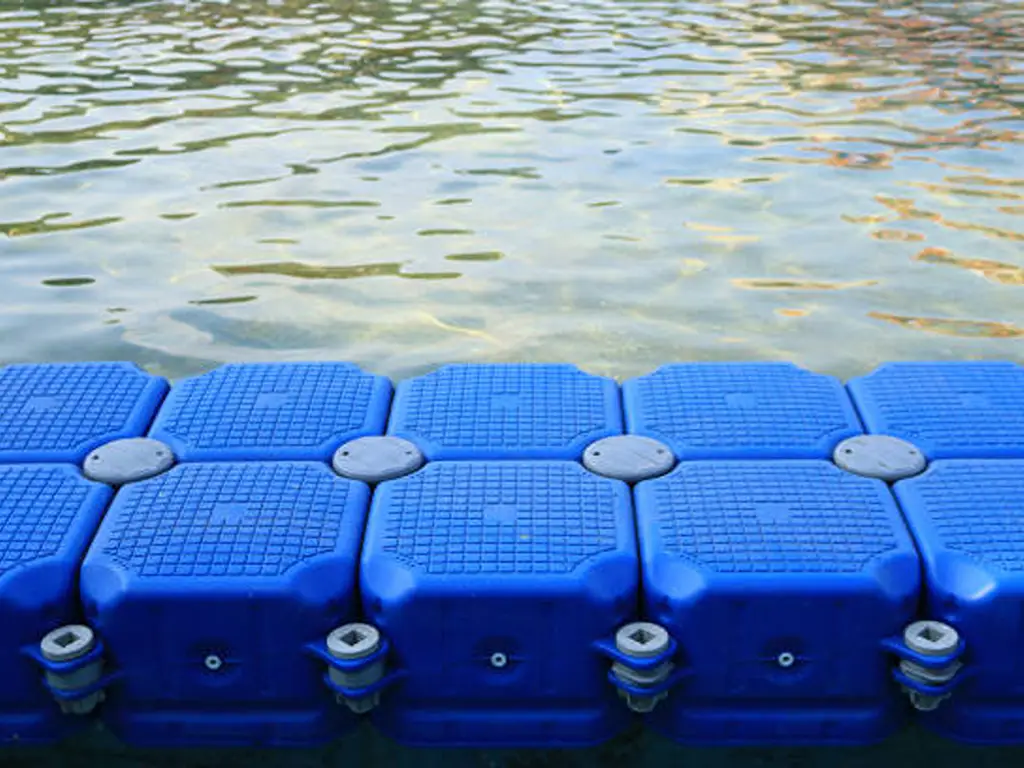
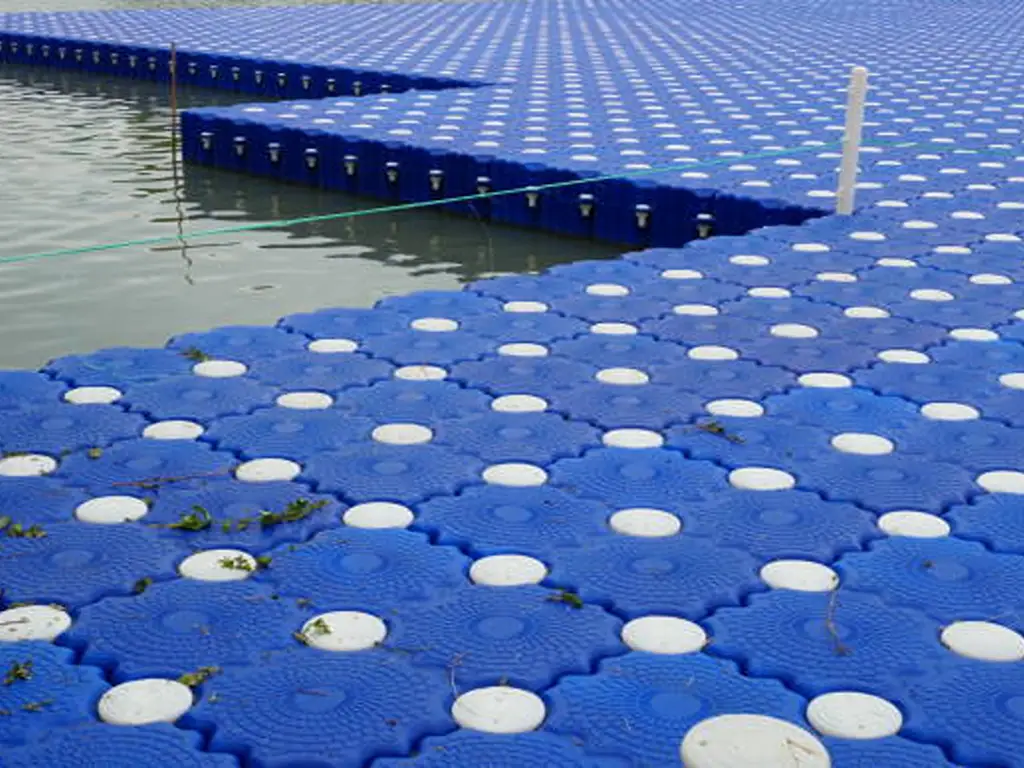
A textured, non-slip walking surface is a molding outcome, not an accessory. It’s produced, or it isn’t, when the part is made, and no mat fully closes the gap. Rounded corners work the same way, reducing the severity of a same-level fall rather than its likelihood. Neither solves ice or marine growth; those belong with the first two layers.
If the walking surface, the freeboard and the width are still open questions for your site, they are cheaper to settle now than after the floats are molded.
Check your configuration with usFreeboard, draft and height: the honest answer on stability
A workplace safety authority has written down something no floating dock manufacturer enjoys reading: “Where practical, choose docks that stand on adjustable legs, which are more stable, rather than floating docks which are less stable” (WSPS, 2025).
That’s a real trade-off, and it shouldn’t be waved away with a slogan, which is exactly what it will be measured against. Stability on a floating system isn’t a claim. It’s a set of numbers.
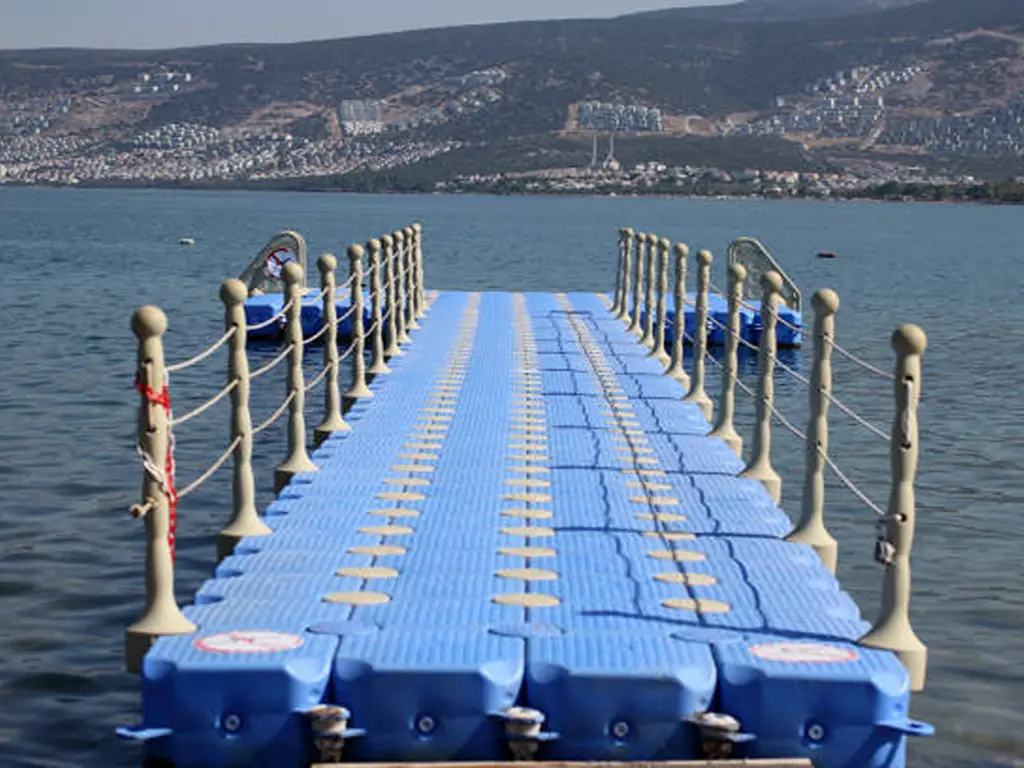
The parameters that answer it are draft, height grade and assembled width. A modular float drawing 2 to 4 inches of water with the craft off it sits low and resists roll; a 500 mm cube carries its deck higher above the waterplane than a 250 mm one. The one most often left out of the brochure is width: a modular walkway is specified as a stable walking platform only at a minimum of three floats across (FAQ). Below that you aren’t looking at a narrower version of the same thing. You’re looking at a different structure.
That is where the WSPS objection actually gets answered: not by disagreeing with it, but by replacing the assertion with values you can write into a specification. Draft, height grade, floats across the walking surface, and the area load the float is rated to carry, which across the modular range runs from 200 to 420 kg per square metre.
The boundary, stated precisely: low-freeboard types are entirely adequate in sheltered water and calm inland lakes. The same units in open water with regular boat wake are a different proposition, a question about the site rather than a defect in the product.
Connections, mounting points and anchoring
Mounting surfaces. Every safety item that hangs on something needs something to hang on. Vertical posts (the Φ110 × 1000 mm handrail and side baluster) are the attachment surfaces on a dock of this kind. Whether they were part of the original configuration decides whether you can add a rail later or whether you’re re-planning the structure.
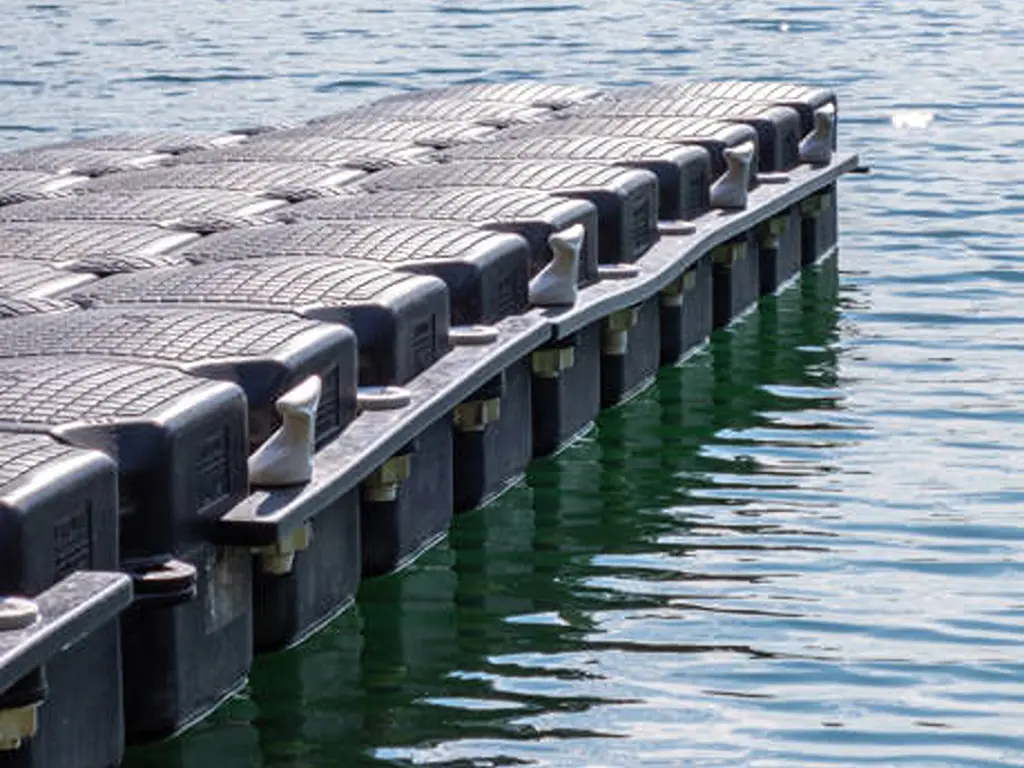
Connection integrity. The joint between floats è the structure: moulded connection lugs, grooves on four sides, reserved pin and bolt holes, threaded end caps, with fasteners indexed by corner. Washers are specified where corner 1 and 4 meet, thin washers where corner 1,3 or 2,4 come together (prodotti). Read that indexing for what it is: a statement about which corners a load path runs through.
Anchoring geometry is the most counterintuitive item here. LCRA’s guidance for docks facing floodwater is not “anchor as hard as you can.” A dock anchored on all four sides is more vulnerable, because it takes the force of moving water head-on. The recommended arrangement doubles cables on the shore side, anchors downstream nearest the shoreline, and leaves no anchors upstream, so the dock pivots toward shore when water comes (LCRA).
Encased flotation is required by LCRA, which reasons that loose foam breaks away and leaves a dock that can sink or turn over. The checkable version: is buoyancy sealed inside a rigid compartment, or present as detachable blocks?
| Structural property | Which hazard it governs | The value you can check | Where it stops holding |
|---|---|---|---|
| Deck surface texture | Same-level falls (slip) | Whether the walking surface is molded non-slip | Fails on ice and marine growth — those are maintenance |
| Corner and edge profile | Severity of a same-level fall | Rounded, concave corners | No practical downside; pure gain |
| Freeboard and draft | Falling in, reboarding, roll | Height grade (250/400/500 mm); draft 2–4 in | Low-freeboard types need re-checking in open water with wake |
| Assembled width | Walking stability | Minimum three floats across | Below three floats it is a different structure, not a narrower one |
| Flotation construction | Sinking, inversion | Buoyancy sealed in a rigid compartment | Detachable foam blocks fail once they break away |
| Connection integrity | Structural break-up | Moulded lugs; fasteners indexed by corner | Missing or mis-installed fasteners |
| Mounting surfaces | Reboarding, fall prevention | Pre-formed vertical post positions | No provision at build time = not addable later |
| Anchoring geometry | Breaking loose in flood or storm | Anchor direction and count; shore-side doubling | Four-sided anchoring fails in moving water |
Sources: LCRA Safety Standards for Residential Docks on the Highland Lakes; WSPS (2025); product specifications.
One discipline applies to every number in that table. The area load ratings (200, 220, 300, 350, 420 kg/m²) describe how much a square metre of float supports, not how much a single attachment point holds. There is no published per-point load rating for a mounting point on this system, and quoting an area load as one would inflate it by an order of magnitude (FAQ).
The parameters that answer it are draft, height grade and assembled width.
Draft, height grade and width can all be checked before an order is placed. The load figure is the one the supplier measures.
Hisea Dock builds the mounting surfaces and the anchoring scheme into the same configuration, and the anchoring part matters more than it sounds. The water decides how a dock wants to be held, so the anchoring options are matched to the site (pipes, deadweight anchors, piling brackets and stiff arms). Whichever arrangement the water calls for gets settled while the order is still open (anchoring options). The mounting surfaces work the same way. The Φ110 × 1000 mm vertical posts sit in pre-formed positions, so adding a rail in year three is a question of what was specified here, not whether it’s possible at all. The assembly is validated by a diagonal tensile test reaching a maximum force of 14,389 N (qualità).
When the Dock Has to Serve the Public
Accessibility is the clearest case of a layer settled at design time, and of a rule almost everyone states too simply.
The trigger isn’t the size of the dock; it’s whether the facility is open to the public. A private dock serving one household doesn’t trigger the ADA’s recreational boating facilities provisions. A marina, park, school, rowing club or public launch does. Settle that first: it’s a question of fact, not preference.
Once triggered, four values do most of the work. Accessible routes serving boat slips must be designed for a maximum running slope of 1:12 (8.33%), but you are never required to build a gangway longer than 80 feet to achieve it. Boat slips must provide clear pier space at least 60 inches wide, running at least as long as the slip. Gangways, transition plates and floating piers must not exceed a 2% (1:50) cross slope, measured in the static position. And the accessible slip count is keyed to total slips: 1–25 requires 1; 26–50 requires 2; 51–100 requires 3; 101–150 requires 4; 151–300 requires 5; 301–400 requires 6. Where slips aren’t marked by length, every 40 feet of boat slip edge counts as one slip.
Exceptions, and what they actually buy
Here’s the part that gets flattened into “1:12” and lost. The gangway provisions carry eight exceptions, and two matter for anyone specifying a dock (U.S. Access Board).
The 80-foot exception. Where the total length of a gangway or series of gangways on a required accessible route is 80 feet minimum, the gangway need not comply with the running-slope provision at all. The Board’s worked example: 10 feet of vertical distance between the landside connection and the pier at its lowest water level permits an 80-foot gangway. That is ten feet of rise over eighty of run, roughly 1:8.
The 25-slip exception. Where a facility contains fewer than 25 boat slips and total gangway length is 30 feet minimum, the running-slope provision again doesn’t apply.
Neither is a loophole. Both exist because a floating pier rises and falls with the water. A gangway held to 1:12 at every water level would have to be absurdly long at the low end, so the standard lets length substitute for slope. At low water the gangway will be steeper than 1:12; at high water, flatter than 1:20.
Is this dock covered, and by what
Source: U.S. Access Board, Chapter 10: Recreational Boating Facilities.
That boundary is where the misreading gets expensive: the exceptions cover gangways, not every sloped surface at a waterfront. A ramp connecting a fixed pier, or a switchback ramp, must meet the ordinary accessible-route provisions.
Who Carries It When Something Goes Wrong
Liability is the layer that turns the previous four into money. Responsibility runs along a chain (user, owner, operator, builder, supplier) rather than resting at a point. The same four defects recur in the case descriptions legal practices publish: broken or missing handrails, inadequate lighting for nighttime use, wet surfaces without proper traction, and structural defects (DHC Law, Roden Law). Every one is a layer-three or layer-five item. That’s the argument for deciding them at purchase rather than after, and the limit on the forum reply from earlier, since mitigate your own risk is defensible only when the facility itself is sound.
The price is visible in how marinas insure. Commercial waterfronts commonly require tenants to carry liability coverage, frequently cited between $500,000 and $1,000,000, and to name the marina as an additional insured. (Cruisers & Sailing Forums, America’s Great Loop community). Those sources describe practice rather than statute, but the direction is consistent: coverage is priced against the condition of the facility, and condition is a specification.
A dock that breaks loose in a flood isn’t bad luck. LCRA states plainly that owners are responsible for damage caused by docks that break loose, wash away or become a hazard to navigation, which puts anchoring geometry in the liability column. Evidence is part of the duty too. In one widely read account, a boat was struck in its slip overnight and the marina had no cameras, so the dispute stalled immediately (r/boating).
Liability waivers don’t reliably override actual fault. A disclaimer stating only that the tenant is liable for damage they cause is not a release (r/boating). For a supplier the same principle applies more quietly: verbal assurances create exposure. “It’ll be fine in a flood” is not a specification, and it isn’t defensible.
Where Safety Gets Decided in the Sale
Everything above converges on one shift in when the work happens. Behavior and equipment are the customer’s to manage, and they can change them any time. Structure, accessibility and the liability attaching to both are decided earlier, and once the floats are molded and the posts either exist or don’t, they aren’t revisitable. The professional conversation with a buyer therefore isn’t about safety in general. It’s about the handful of structural facts that will still be true in five years.
That reframes the job for a dealer or distributor. A buyer arrives with tips-level understanding and makes a decision whose irreversible parts they haven’t considered. The value added is asking the structural questions before the quote, while there’s still something to decide.
Before you quote, confirm
Two things not to do. Don’t answer a stability question with an assertion. “Floating docks are very stable” isn’t checkable and will be measured against a workplace safety authority’s published finding; answer with draft, height grade and assembled width instead. And don’t promise that a removable dock needs no permit; removable structures commonly still require approval, and the honest answer is that it depends on the local authority.
One category deserves a straight answer rather than a workaround. Swim ladders and boarding platforms aren’t part of the floating dock system range here, and shouldn’t be sold as if they were. But the question behind them is one this system can answer: whether the structure includes vertical posts giving a ladder or rail something to mount to.
If you’re working through a configuration and the structural questions are still open, tell us where the dock is going: water conditions, how the walkway will be used, and whether the public will be on it. Those three answers settle most of what’s above before anyone orders a float.
Set the safety-critical details before you order
Tell us about the water, intended use and public access. We will help you review the surface, freeboard, anchoring and mounting points before the configuration is fixed.
References
- U.S. Access Board. “Chapter 10: Recreational Boating Facilities.” https://www.access-board.gov/ada/guides/chapter-10-boating-facilities/
- U.S. Department of Justice. “2010 ADA Standards for Accessible Design.” https://www.ada.gov/law-and-regs/design-standards/2010-stds/
- Lower Colorado River Authority (LCRA). “Boat Dock Safety.” https://www.lcra.org/water/permits-contracts/docks-and-marinas/boat-dock-safety/
- Workplace Safety & Prevention Services (WSPS). “Working Near and On Water: Boat Dock Hazards Information Guide.” https://www.wsps.ca/resource-hub/guides/working-near-and-on-water-boat-dock-hazards-safety-information-guide
- Occupational Safety and Health Administration (OSHA). “Deck and Barge Safety.” https://www.osha.gov/sites/default/files/publications/3358deck-barge-safety.pdf
- Wisconsin Department of Natural Resources. “Pier FAQ — Waterway Protection.” https://dnr.wisconsin.gov/topic/Waterways/recreation/pier_FAQ/pier_FAQ.html
- Electric Shock Drowning Prevention Association. “ESD & FAQ.” https://www.electricshockdrowning.org/esd–faq.html
- ABC7 Chicago. “Deaths of Teen, 10-Year-Old Girl Prompt Warnings of Electric Shock Drowning.” https://abc7chicago.com/post/deaths-of-teen-10-year-old-girl-prompt-warnings-of-electric-shock-drowning/2118188/
- Lake Lanier Association. “Dock Safety.” https://lakelanier.org/our-work/safe-lake/safe-initiatives/dock-safety/
- DHC Law. “Boat Dock Accident Liability for Slip and Fall Injuries.” https://www.dhclaw.com/faqs/boat-dock-accident-liability-for-slip-and-fall-injuries.cfm
- Roden Law. “Dock and Marina Injury Lawyers in Georgia & South Carolina.” https://rodenlaw.com/boating-accident-lawyers/dock-marina-injury/
- Cruisers & Sailing Forums. “Dockaminiums?” https://www.cruisersforum.com/forums/f2/dockaminiums-199097.html
- America’s Great Loop (Facebook Group). “Discussion of Marina Insurance Requirements for Transient Boaters.” https://www.facebook.com/groups/americasgreatloop/posts/10160811406163630/
- r/boating. “My Sister Injured After Tripping Over a Dock Line Run Across a Walkway.” https://www.reddit.com/r/boating/comments/1k901ms/my_sister_injured_after_tripping_over_a_dock_line/
- r/boating. “New Boat Owners — Boat Hit in Slip.” https://www.reddit.com/r/boating/comments/1nmfd0s/new_boat_owners_boat_hit_in_slip/
- r/boating. “Marina Damages Boat, Was Repairing Without My Knowledge.” https://www.reddit.com/r/boating/comments/1tgb7qi/marina_damages_boat_was_repairing_without_my/
- Hisea Dock. “Frequently Asked Questions.” https://www.hiseadock.com/faq/
- Hisea Dock. “Products.” https://www.hiseadock.com/products/
- Hisea Dock. “Quality.” https://www.hiseadock.com/quality/
- Hisea Dock. “How to Anchor a Floating Dock — Tutorial.” https://www.hiseadock.com/how-to-anchor-a-floating-dock-tutorial/
- Hisea Dock. “Contact Us.” https://www.hiseadock.com/contact-us/

 English
  Thai
Thai  Spanish
  French
  German
  Dutch
Dutch  Italian