
Dock Lighting Ideas: Where You Put the Light Matters More Than Which Light You Buy
What Dock Lighting Is Actually For
Almost every dock lighting search starts in the wrong place: with the fixture. That is understandable, because the fixture is the part you can put in a cart. But a dock light only ever does one of five jobs. It lets you walk safely after dark. It lets you recognise your own dock from the water. It sets a mood, it supports work like fishing or loading, or it watches the dock when you are not there. A fixture that is perfect for one of those jobs is close to useless for another. So the useful question is not “which light is best,” but “what am I asking this light to do, and from where.”
A quick note on wording before going further. On a boat, docking lights means the bow-mounted lamps you switch on when pulling into a slip. That is a navigation and legal question, not a dock question. Loading dock lighting belongs to warehouses. This article is about neither. It is about the lights on the structure the boat ties up to.
What are you asking the light to do?
Safe passage. Light falls where you walk, so a step, a cleat or a wet edge does not surprise you.
Being found from the water. A piling cap is often the only part of a dock visible from any distance, which is what makes it the answer to “I want to spot my dock at night.”
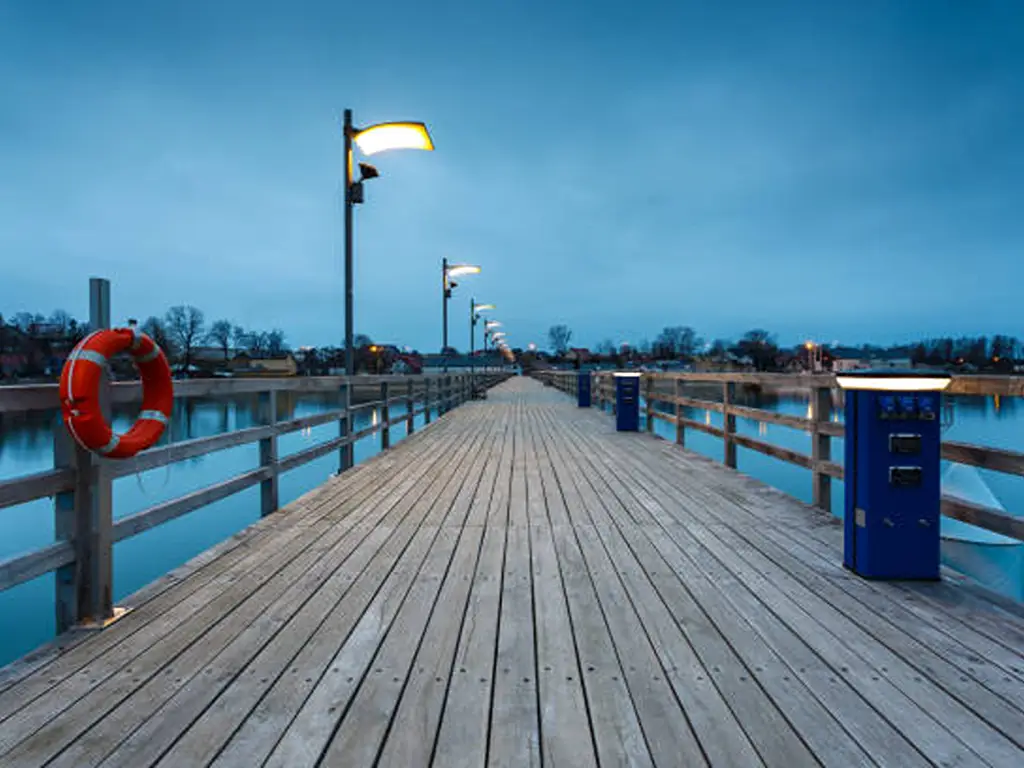
Ambience. The look in the photographs — and the job most easily overdone.
Working light. Fishing, loading, or tying up a boat after dark.
Watching the dock. You notice when somebody is on it.
Dock Lighting Ideas by Position: Where the Fixture Sits Decides Where the Light Goes
The reason two docks can install the same fixture and get completely different results is that a light’s position, not its wattage, determines what it actually illuminates. Read down this list the way you would read a plan, from the top of the structure to below the waterline.
Above the Deck: Piling, Post, Rail and Cleat Lights
Piling and post-cap lights are the most common choice on the market, and for a good reason. A piling is the highest point on most docks, so a cap light is the only thing that can be seen from the water at a distance. That makes it the natural answer to “I want to find my dock at night.” The practical snag is fit. Piling caps are sold by nominal inner diameter, stocked from roughly 5″ to 18″ in half-inch steps. Measure each piling at its widest point and round up. A cap sold as 8″ fits a piling measuring up to 8″.
Cap sizes are nominal inner diameters. Measure every piling at its widest point, then round up — a cap sold as 8″ is made for a piling measuring up to 8″.
Rail and baluster lights mount on the vertical posts of a handrail rather than the piling, which puts light along the walking surface instead of out across the water. Cleat lights do the opposite of what most people expect: they light the deck right where a line is tied, so you can work a cleat without a headlamp.
The one thing this whole group has in common is that it points outward. A fixture aimed away from the dock lights the water, not your feet. It is also the version your neighbours and passing boaters will notice first.
On the Deck: Flush, Edge and Step Lights
Flush and edge fixtures sit level with the deck, so nothing catches a foot or a line. They are the standard answer for walkways and steps, and they are the group most often spaced wrong. A workable rule from the trade is to place them 8 to 10 feet apart and put one between each dock post (Apex Lighting). Treat that as a starting point, not a code. Spacing depends on fixture output and how tall the mounting is.
Because these lights are walked on, the surface they sit in matters as much as the light itself. On a dock you can stand on, you want fixtures designed to be stood on.
At and Below the Waterline: Underwater, Floating and Decorative Lights
Underwater lights are the ones people buy for a reason other than seeing: they draw baitfish, and green is the traditional choice for that job. They are also the most exposed thing on the entire dock, permanently submerged, and, as the next section shows, the most likely to fail.
Floating and buoy lights mark an edge or a mooring rather than light a surface. Decorative string runs are the most flexible option and the most demanding. A low-voltage run along a railing gives you the look in the photographs, but every connection on it is a place water can get in.
| Position | Light lands on | Best at | Hard constraint |
|---|---|---|---|
| Piling cap / top | Water surface, long distance | Being found from the water | Piling diameter must be measured at the widest point |
| Piling side | Boat, water and hull | A modern look with less upward glare | Needs a clear mounting face on the piling |
| Rail / baluster post | Walking surface | Lighting the path, not the water | Post diameter must match the bracket |
| Cleat | Deck at the tie point | Working lines after dark | Positioned so a taut line cannot foul it |
| Flush / edge | Superficie del ponte | Steps and walkways with no trip hazard | Must be rated to be walked on |
| Underside of deck | Water below the dock | A hidden source with no glare | Routing must survive permanent damp |
| Sott'acqua | Water column | Fish and ambience | Continuous submersion rating |
| Floating / buoy | Water surface and markers | Marking an edge or a mooring | Moves with the water, so cabling must flex |
How the Power Reaches It: Solar, Low-Voltage or Shore Power
Once you have picked a position, the wiring question is mostly already answered. Two things decide it: how far your shore power is from the point where you want light, and whether that position has any route a cable can actually follow. There are only three paths, and they trade off against each other in the same way every time.
| Power path | Upfront cost | Can you do it yourself? | Output ceiling | Dove fallisce | Practical distance | Consumables |
|---|---|---|---|---|---|---|
| Solar | Lowest per fixture, rising steeply with output and build quality | Entirely | Low to moderate | Rechargeable cells and panels degrade; output sags in low-sun regions | Unlimited, because it is self-contained | Batteries, so treat it as a replacement item |
| Low-voltage DC + shore transformer | Transformer plus cable; fixture cost is modest | The low-voltage side only, not the shore connection | Moderate to high | Voltage drop over distance; every splice is an ingress point | Roughly 100 ft on 12-gauge at 100 W; move to 10-gauge past about 150 ft | Transformer, and the occasional fixture |
| Shore power (120V AC) | Highest: needs a licensed install and often conduit | No | Highest | Nuisance residual-current tripping on long runs, plus shock risk | Unlimited with conduit, but hazard scales with length | Essentially none |
No published figure exists for what each path costs on a typical dock, so the cost row stays qualitative on purpose. The only hard number available is what it costs to have the whole job done professionally. That runs from roughly $1,000 to $5,000 or more, depending on dock size and fixture choice (Simply Wired FL).
Solar: When There’s No Practical Way to Run Cable
Solar is the answer wherever running cable is genuinely impractical. It is also the only option that is fully self-contained, which matters if you are lighting a piling at the far end of a long dock. The honest caveat is that the market overstates it. One seller answers “Are solar dock lights bright enough?” with a flat “Yes!” (Lake Lite). Another lists output figures as low as an adjustable 80–180 lumens (SunTino), while another supplier recommends 1,600-lumen fixtures for a small dock (Lake Lite). That is a spread of nearly twenty times on the same question. Solar units are also a consumable, not an installation: the rechargeable cells get replaced.
Low-Voltage DC With a Shore Transformer: The Middle Path
This is the option most docks actually want. A transformer at the shore steps household current down, and low-voltage cable runs out along the dock. For 12V systems, 12-gauge wire carries roughly 100 ft at 100 W, and you move up to 10-gauge past about 150 ft (Dauer Manufacturing). Past that, the fix is not a bigger transformer. It is a loop layout or a shorter run, because voltage drop is a property of distance and load, not of the transformer.
The trade’s working practice is worth copying: transformer and GFCI at the shoreline, cable run along the underside of the dock, every splice sealed.
12V AC and 12V DC are not interchangeable. Landscape lighting in North America is often supplied as 12V AC, while many marine and dock fixtures are built for 12V DC. Matching the numbers is not enough; matching the type is what matters. This is one of the most common wiring mistakes homeowners make when replacing a transformer.
Shore Power at 120V: Why Most Docks Should Skip It
Full mains voltage at a dock is where the consequences stop being about money. Water and electricity share the space. The protection that makes that survivable is residual-current protection at the shore end, and it generates most of the nuisance faults people complain about. On long runs, adding that protection is what starts the tripping. A lakefront owner with a roughly 600–700 ft underground run reported that once the required GFCI was added, the circuit tripped constantly. Several electricians blamed the run length alone (r/SolarDIY).
Keep this short version of the rule: protection belongs at the shore, not out on the dock, and the wiring that goes into the water is not a homeowner job. If a fixture or a splice is going to be submerged, that part should be done by someone licensed to do it.
What Actually Fails on a Dock — and Why It’s Almost Never the Fixture
Here is the finding that should reshape how you read every dock lighting list, including this one. Across the pages that rank for this topic, real failure accounts are essentially absent. The warnings are all forward-looking (“cheap fixtures crack by the second season”) with no one reporting what actually broke. Step outside those pages, into owner forums and product reviews, and the failures appear immediately. Twelve of them, gathered for this article. Nine were not the light failing. They were the position or the power path failing.
The finding
real dock-light failures traced back to where the light was placed or how power reached it, not to the fixture itself.
The pattern is consistent. An underwater light began tripping its GFCI after two days. The likely cause was condensation inside the housing, not a bad breaker (r/electrical). A storm took out half a dock and left wiring floating in the water; not one breaker had tripped (r/AskElectricians). Submerged conduit failed and exposed degraded cable, which is how a dock becomes lethal (Mike Holt’s Forum). A coastal owner planning for occasional flooding concluded that IP65 and IP67 fixtures were not enough, because the strip could sit underwater for hours at a time (r/led).
That last one is worth unpacking, because it is a spec-reading trap. IP67 means protection against immersion in up to one metre of water for thirty minutes. IP68 is the rating for continuous submersion (K2 Lighting, DRSA). A fixture marked “waterproof” and rated IP67 is not lying. It is simply answering a different question than the one a flood asks.
The remaining three failures were the fixture itself. A six-pack of solar post caps lost half its units inside a month. One light quit after two weeks, and a solar string corroded its interconnect wire within a season.
The practical consequence is a diagnostic order. When a dock light misbehaves, check the seal and the cable before you replace the light, because the light is usually the last thing that went wrong.
When Your Site Rules a Lighting Idea Out
Every position and power choice above is conditional, and the conditions are set by where you are, not by what you like. This is the part that no single-answer guide can give you, because there is no single answer; there is only your row in the table below.
| Site condition | Positions that work | Power path that works | When to change the plan |
|---|---|---|---|
| Freshwater lake, seasonal use | Piling cap, rail, cleat, flush, underwater | Solar or low-voltage DC | When you want light at a position with no cable route |
| Saltwater, year-round | Piling side, rail, flush, underwater | Low-voltage DC, transformer ashore | When any fixture shows corrosion at the seal, not just the housing |
| Lake that freezes | Piling cap, rail (fixtures you can lift out) | Solar, or low-voltage removed before freeze-up | When the dock itself is being pulled or left in |
| Long shore run (hundreds of feet) | Flush, rail, keeping the run short | Solar, or low-voltage with a loop layout | When protection added at the shore starts tripping |
| Occasional flooding / surge | Anything above the expected high-water mark | Solar, or low-voltage with sealed splices | When a fixture could sit submerged for hours at a time |
| Multi-berth / commercial | Piling side, flush, bollard | Low-voltage DC with distribution and feeder protection | When berth count turns this into a maintenance-labour question |
The row that catches most people out is the freezing lake. Dock owners argue at length about winter. Should a floating dock be pulled before freeze-up, left in, or kept open with an aerator? What is missing from every one of those discussions is the lights. Nothing in the sources reviewed for this article addresses what a winter decision does to the fixtures on top of it. That is odd, because it is the same decision. Whatever your dock does in winter, your lights do too. If the answer is “it comes out,” the light and its cabling should be able to come out with it, in one piece.
Why Dock Lighting Gets Decided Before the Dock Ever Floats
Look back at what the last five sections actually had in common. Every one of them came down to the same three things. Can a position on the structure carry a fixture? Is there a route a cable can follow to that position? Can a piling be used as a fixed point without drilling the float? Those are not decisions you make while shopping for lights. They are properties of the dock, and they are fixed the moment it is assembled. A dock that arrives without a cable route does not get one later. That is the whole argument. The useful moment to think about lighting is while the dock is still being specified, not after it is in the water.
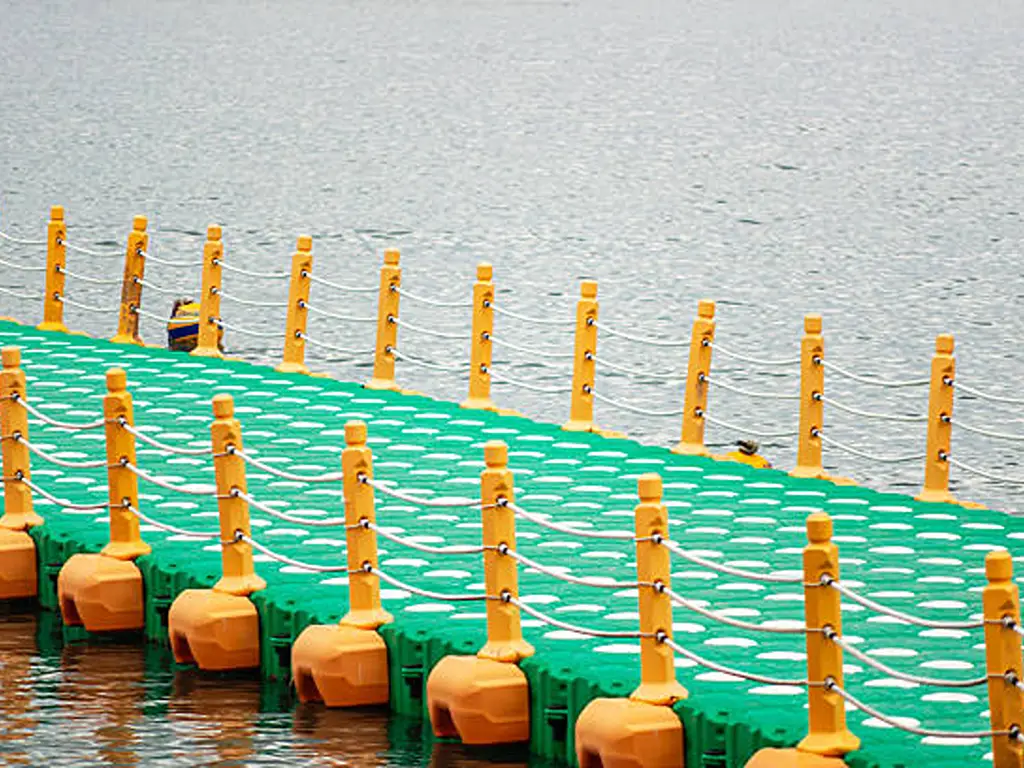
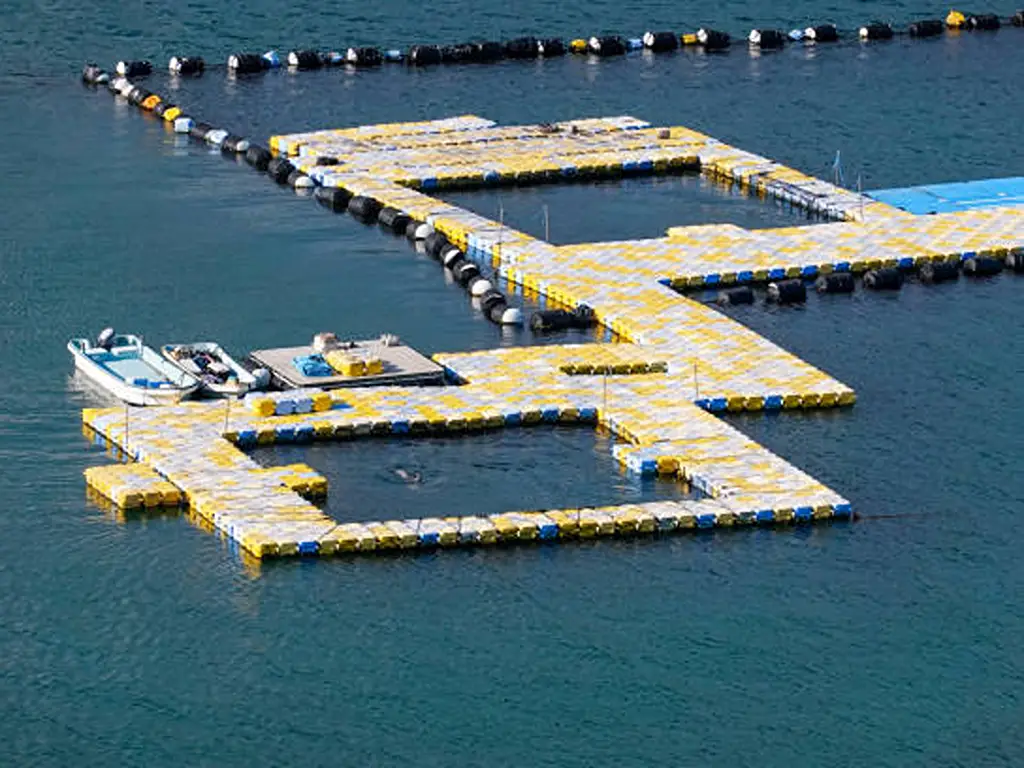
Hisea Dock makes floating docks, not lights — there is no lamp, no solar unit and no wiring in our catalogue. What we do decide is what a light will have to attach to. One float in the range is built for exactly this: the pipelined float carries a channel formed into it for water pipe and power cable, so a run never has to lie on the walking surface. The handrails, side balusters and pile guides we mould give a lighting plan something to attach to. There is a vertical post a fixture can clamp to, and a guide that lets a piling carry a light without the float taking the fasteners. That guide is sized for pilings up to 220 mm in diameter. Because float type, height and colour are made to order, that routing can be settled at the same time as the layout instead of after it.
Three things to confirm before you order, whether from us or anyone else. First, that the float range includes a route for cable. Second, that there is at least one vertical surface designed to carry a fixture. Third, that the piling hardware suits the piling diameter actually on your site. Ask those three at quotation stage and they cost almost nothing. Ask them after delivery and they are somebody’s retrofit.
Where a light can go is decided by the dock
Hisea Dock makes modular floating docks — the posts, pile guides and cable channels a fixture ends up attached to. We do not make lights. If a new or replacement dock is what you actually need, get in touch.
Contatto Hisea DockRiferimenti
- Apex Lighting. “How to Build a Complete Dock Lighting Setup on a Budget.” https://www.apexlighting.com/blog/how-to-build-a-complete-dock-lighting-setup-on-a-budget/
- Simply Wired FL. “What Is the Cost to Install Dock Lighting in South Florida?” https://simplywiredfl.com/what-is-the-cost-to-install-dock-lighting-in-south-florida/
- Lake Lite. “Dock Lighting Ideas.” https://lakelite.com/blogs/news/dock-lighting-ideas
- SunTino Solar Lights. “Creating a Magical Ambiance: Dock Lighting Ideas.” https://suntinosolarlights.com/blogs/news/creating-a-magical-ambiance-dock-lighting-ideas
- Dauer Manufacturing. “Low-Voltage Landscape Lighting Voltage Drop.” https://dauermanufacturing.com/blog/low-voltage-landscape-lighting-voltage-drop
- Reddit r/SolarDIY. “Boat Dock Solar Setup.” https://www.reddit.com/r/SolarDIY/comments/1cgf6yb/boat_dock_solar_setup/
- Reddit r/electrical. “Dock Light Trips Circuit After 48 Hours.” https://www.reddit.com/r/electrical/comments/1jmmx89/dock_light_trips_circuit_after_48_hours_thought/
- Reddit r/AskElectricians. “Dock Electrical Lines Broken but Breaker Didn’t Trip.” https://www.reddit.com/r/askanelectrician/comments/13cp29d/dock_electrical_lines_broken_but_breaker_didnt/
- Mike Holt Forum. “Electric Leakage at a Marina or Boat Dock.” https://forums.mikeholt.com/threads/electric-leakage-marina-boat-dock.127434/
- Reddit r/led. “LED Dock Lighting Ideas for Occasional Submersion.” https://www.reddit.com/r/led/comments/u8290d/led_dock_lighting_ideas_needs_to_be_occasionally/
- K2 Lighting. “Why IP Ratings Are Important in Marine LED Lighting.” https://k2lighting.com/blogs/news/why-ip-ratings-are-important-in-marine-led-lighting
- DRSA. “IP Ratings.” https://www.drsa.com/pages/ip-ratings
- Hisea Dock. “Pipelined Float.” https://www.hiseadock.com/product-item/pipelined-float/
- Hisea Dock. “Pile Guide.” https://www.hiseadock.com/product-item/pile-guide/
- Hisea Dock. “Accessori per pontili.” https://www.hiseadock.com/dock-accessories/
- Hisea Dock. “Contattaci.” https://www.hiseadock.com/contact-us/

 English
  Thai
Thai  Spanish
  French
  German
  Dutch
Dutch  Italian
  Arabic
  Indonesian
  Portuguese
  Turkish