
Come costruire una passerella su una zona umida: metodi di sostegno, costi e cause di cedimento
The ground at the edge of a wetland tells you its rules within three steps. Boot one sinks an inch into saturated peat. Boot two squelches water up around the ankle. By boot three, the surface gives way altogether, and the route you meant to walk is a route you now have to engineer. That is the gap between a garden path and a wetland boardwalk. On dry ground you lay material on top of soil. Over wetlands, the soil cannot carry the load, so the walkway has to be held up by something else entirely.
A wetland boardwalk is a raised or supported path across saturated or protected ground. The design starts with the route, wetland conditions, intended users, and approvals, then moves to support method, deck, construction access, and maintenance. The USDA Forest Service’s Wetland Trail Design and Construction manual compares several trail treatments for wet areas; it does not prescribe one system for every site.
Wetlands vary widely. Some soils are soft and organic; others support foundations at a practical depth. Moisture, changing water levels, flood debris, ice, and limited equipment access can all affect a boardwalk. Ecological constraints matter as much as structural ones: a path may shade vegetation or disturb soil even if the walking deck is elevated.
The support choice is important, but it follows a site survey and approval path. Compare a ground-level wet trail treatment, pile-supported boardwalk, top-down prefabricated construction, and floating walkway only where each is legally and physically feasible. A floating layout still needs shore access and anchors or guides; it is not automatically a no-impact crossing.
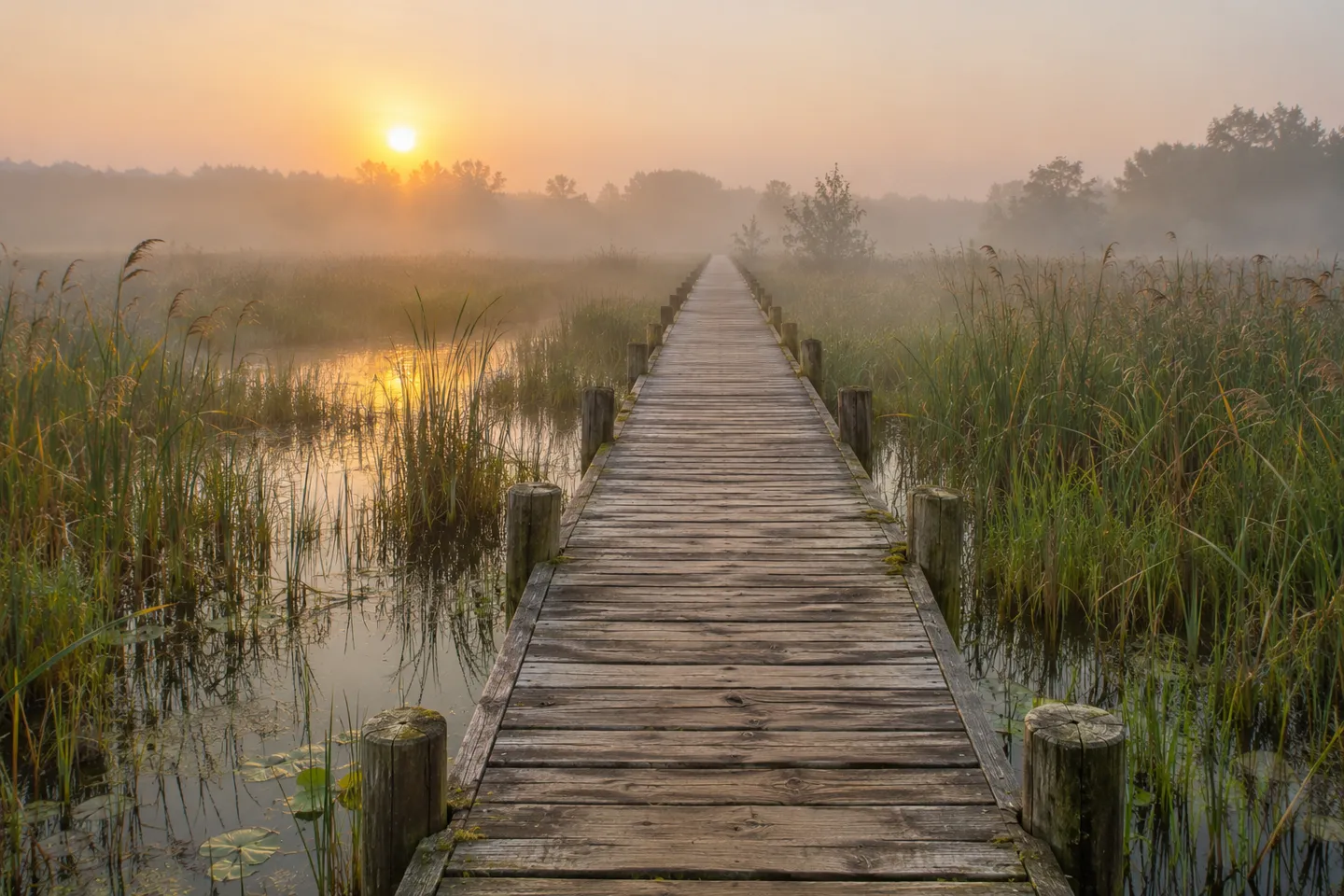
Four Ways to Support a Boardwalk Over Wet Ground
Start with the function and site conditions. The four options below describe possible approaches, not an official four-part classification. The Forest Service manual presents multiple techniques for wetland trails and emphasizes matching the treatment to the setting ( USDA Forest Service ).
Ground-Contact Paths ⭐
Where the route is only intermittently wet and disturbance is allowed, a low-profile trail treatment such as a stabilized tread, turnpike, or puncheon may be considered. A pile of fill or discarded pallets is not an appropriate default for a regulated wetland. Check drainage, vegetation, soil disturbance, and maintenance before selecting a ground-contact approach.
Standing water, frequent flooding, and soft organic soils can make a ground-contact route difficult to keep level and usable. Material placed directly on the soil may need replacement or may alter drainage. Ask the wetland authority and trail designer whether a raised system is needed and which construction methods are permitted.
Boundary check
Standing water for most of the year is past what ground contact can survive: the walkway belongs on a structure.
Fixed Pile Supports
A pile-supported boardwalk carries its deck on foundations installed into suitable ground. The designer sets pile type and depth from geotechnical conditions and the intended loads; a hand probe alone cannot size a foundation. Deck elevation must account for normal and high water, access, flood debris, and any accessibility requirements. The Forest Service manual discusses several elevated wetland trail solutions ( USDA Forest Service ).
Piles can work in soft ground when a geotechnical design identifies a suitable bearing or resistance mechanism, but deep peat can increase complexity and cost. Moving ice, flood flow, and scour also require site-specific checks. Do not conclude that piles will fail from a single probe depth; confirm the soil profile and environmental constraints before excluding them.
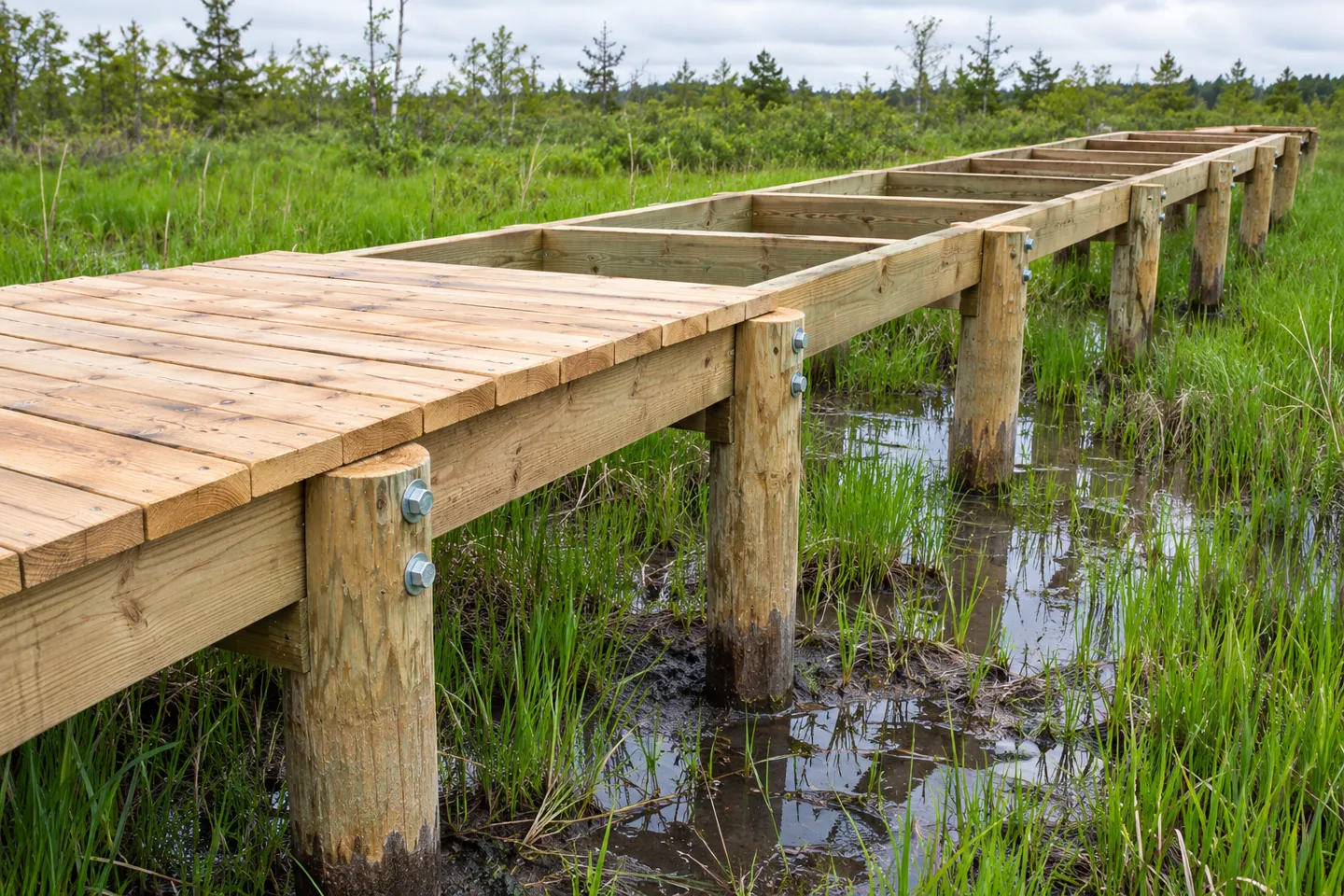
Top-Down Prefabricated Sections
Top-down construction can reduce the area disturbed by equipment: crews install the next section from an already completed or temporary work platform, subject to the approved method statement. It still requires foundations, access, lifting plans, and permits. The method may be useful where wetland disturbance must be minimized, but it is not automatically approved or economical for every public project.
Prefabricated components can shorten work inside a sensitive area when their spans, weights, and handling equipment suit the route. Span length and cost depend on design loads, foundations, delivery access, and the selected product. Request an engineered drawing and a construction sequence rather than assuming one typical pile spacing or lifespan.
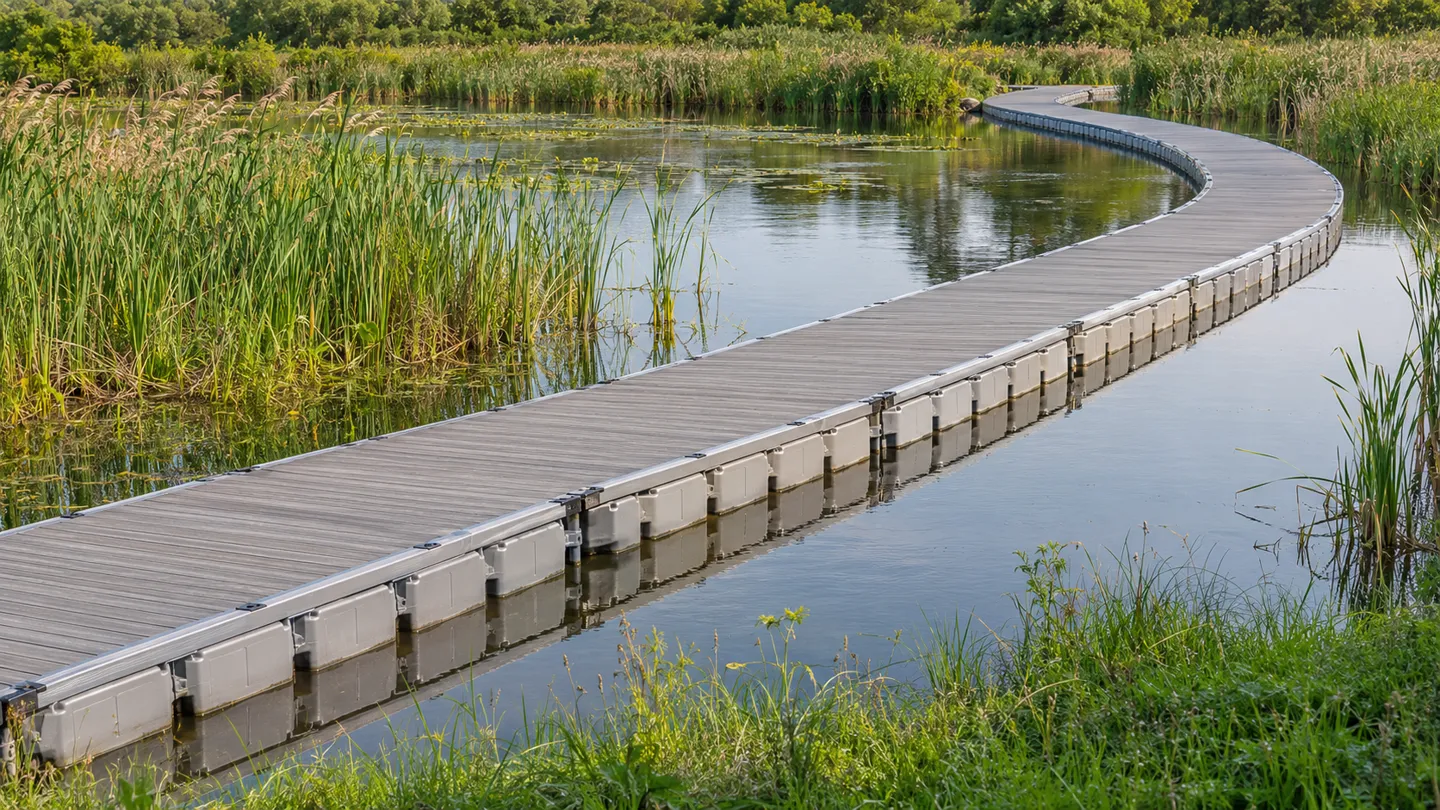
Floating Modular Walkways
A floating walkway follows water-level changes and may suit a wetland with sufficient continuous water depth. Modular HDPE floats are one product option, but buoyancy ratings vary by model. Shore connections, anchoring or guides, water-level range, wind, debris, and user loads must be designed as one system. HiSeaDock publishes specifications for individual modular float models; use the exact quoted model rather than a broad rating range ( Scheda tecnica del prodotto HiSeaDock ).
Floating is a possible solution where standing water and level changes make a fixed deck impractical. It is not a universal answer for deep peat, tidal flats, or protected beds: the structure still needs anchors, guides, shore access, and a suitable water depth at low level. Ask the permitting authority how each component and the installation method affect the wetland.
Four Support Methods at a Glance
| Support method | How it is built | Works where | Fails where | Cost level |
|---|---|---|---|---|
| Ground-contact path | Stone, chips or planks on improved ground | Occasionally wet, draining ground | Standing water, frost heave | Site-specific |
| Fixed piles | Driven or helical piles, frame, deck | Penetrable bed, stable water band | Deep muck, moving ice | Site-specific |
| Top-down prefab | Prefab beams set ahead from finished deck | Protected public projects | Tight budgets, small sites | Site-specific |
| Floating modular | HDPE floats, edge anchoring, two-person assembly | Deep muck, tidal flats, protected beds, flood zones | High wind fetch without anchoring, crushing ice designs | Site-specific |
Read the Site Before You Pick a Method
The four methods above are not a menu of equal choices; your site eliminates most of them before preference ever enters. Walk the route and answer four questions in order.
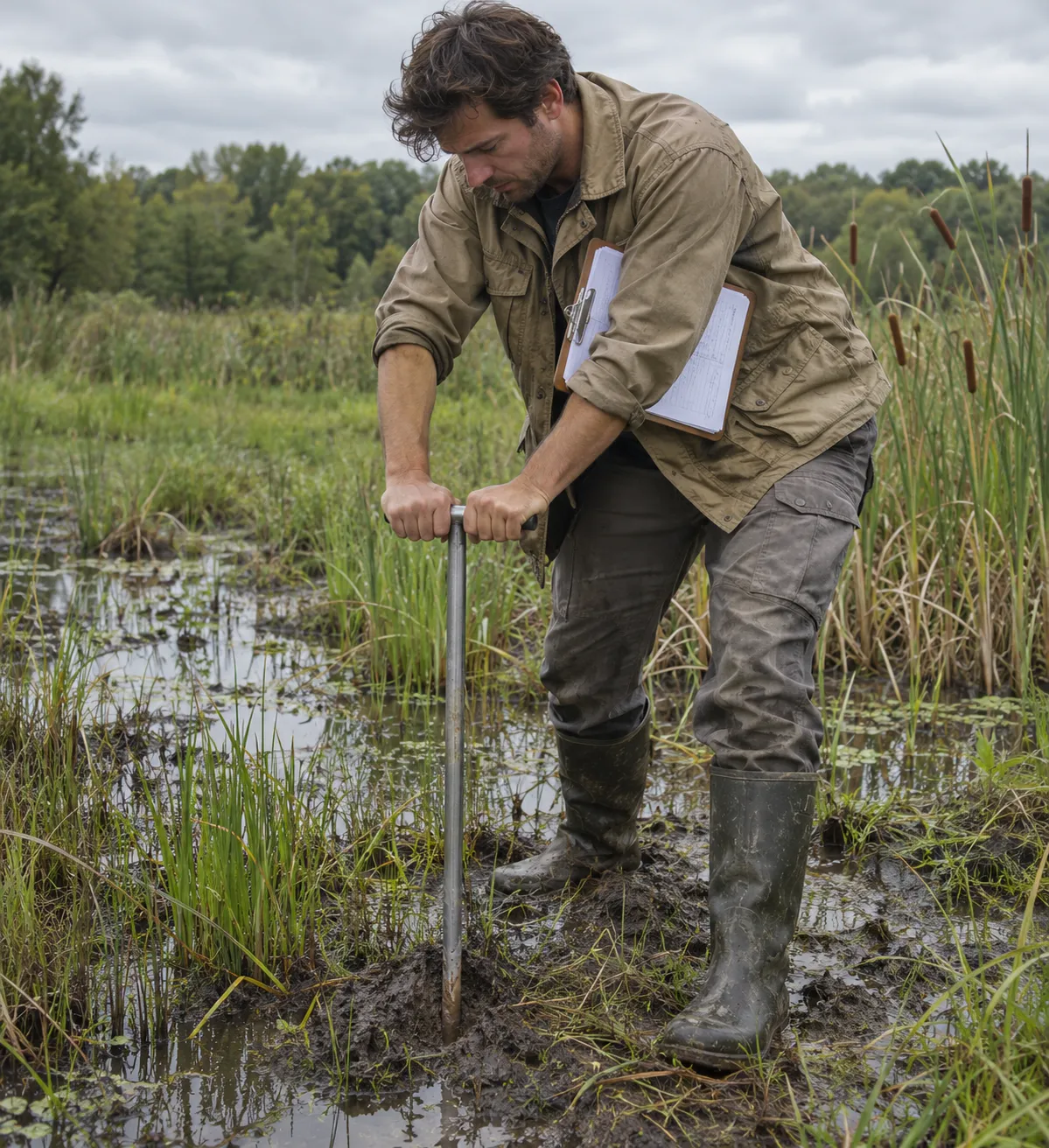
First, investigate the ground and water depth along the whole route. A hand probe can help identify variations and guide further testing, but it cannot establish a universal four-foot cutoff for pile foundations. Where soil is deep and soft, a qualified designer may compare deeper piles, alternative foundations, route changes, or a floating option if water and permits allow it.
Second, the water. Mark the normal level, then find evidence of the highest recent level: silt lines on vegetation, wrapped debris, or local flood records. The gap between those two numbers is what a fixed boardwalk must climb above. Where the gap is tidal or seasonal and large, a floating walkway that tracks the level often beats a fixed deck that has to tower over the worst case and look stranded the rest of the year.
Third, document freeze, heave, and breakup. Ice can act on piles, anchors, guides, floats, and shore connections. Wisconsin DNR warns that heaving ice may dislocate waterfront structures and recommends removal before freezing where practical ( DNR del Wisconsin ). A leave-in design requires product-specific and site-specific review.
Fourth, confirm the wetland boundary and permit path with the responsible authority. In the United States, a Corps Section 404 permit may be required for discharges of dredged or fill material into waters of the U.S., including wetlands; state and local requirements may also apply ( USACE permitting guidance ). Do not use one vegetation rule or a floating-versus-fixed label as a substitute for a jurisdictional determination.
Site check before choosing
- 1 Probe bottom depth and note what the rod returns (peat, muck, sand, gravel).
- 2 Mark normal water level and recent high-water evidence.
- 3 Ask whether spring ice melts in place or flows out.
- 4 Confirm jurisdictional status and ask how local rules treat floating vs fixed structures.
Decking, Specs and What It Really Costs
Once the support method is settled, the visible layer and the budget deserve the same honesty. Decking choice is usually argued as taste, but over wetlands it is a maintenance contract with a price schedule attached.
Decking Materials for Wetland Boardwalks
| Decking material | Typical lifespan | Manutenzione | Slip profile | Costo relativo |
|---|---|---|---|---|
| Pressure-treated timber | Confirm product and site conditions | Inspect and maintain per specification | Slippery when wet unless grooved | Compare installed lifecycle cost |
| Tropical hardwood | Confirm product and site conditions | Inspect and maintain per specification | Good natural grip | Compare installed lifecycle cost |
| Pavimentazione in composito | Confirm product and site conditions | Inspect and maintain per specification | Can be slick wet; choose embossed | Compare installed lifecycle cost |
| Precast concrete | Confirm product and site conditions | Inspect and maintain per specification | Textured surface holds grip | Compare installed lifecycle cost |
| GRP grating | Confirm product and site conditions | Inspect and maintain per specification | Excellent, engineered grip | Compare installed lifecycle cost |
| HDPE floats plus decking | Confirm product and site conditions | Inspect and maintain per specification | Non-skid molded surface | Compare installed lifecycle cost |
Compare material options using the same expected use, structural design, exposure, inspection schedule, and replacement assumptions. Product warranties and design life are different measures. A long-lived frame with a shorter-lived deck may be reasonable if the deck can be replaced without disturbing the wetland; include that access and labor in the lifecycle estimate.
Budget the complete crossing: survey, wetland delineation where needed, engineering, permits, foundations or anchors, deck, access ramps, transport, installation, restoration, and inspections. The route length alone cannot predict cost. Compare alternatives on identical assumptions and ask bidders to separate one-time construction from planned maintenance.
For a floating option, request the exact float and connector specifications, the proposed anchoring and shore transition, the finished walkway load assessment, and written warranty terms. Treat a product quotation as one input to the full wetland crossing design.
Get a Written QuoteChoosing a Supplier You Can Verify
The supplier landscape mirrors the four methods. Local carpentry and pile contractors serve ground-contact and fixed-pile builds. Precast concrete producers serve top-down public projects. Modular float manufacturers serve the floating category, usually shipping by sea container to a freight terminal near you.
Check each supplier’s documents against the specified product: material, load method, connection details, installation instructions, and applicable tests or certificates. A number from another connector or model is not evidence for the quoted system. Ask who is responsible for the final design, permits, and maintenance plan.
Ask for current stock, production lead time, freight, unloading requirements, and replacement-part availability in writing. Delivery windows vary by product and destination. For a sensitive site, also confirm whether the sections can be brought in along the approved access route and assembled without unpermitted disturbance.
How Boardwalks Fail on Wet Ground
Every wetland boardwalk fails in one of three ways, and all three are cheaper to prevent than to repair. The failure record also tells you something the sales pages will not: where each method’s warranty of good behavior ends.
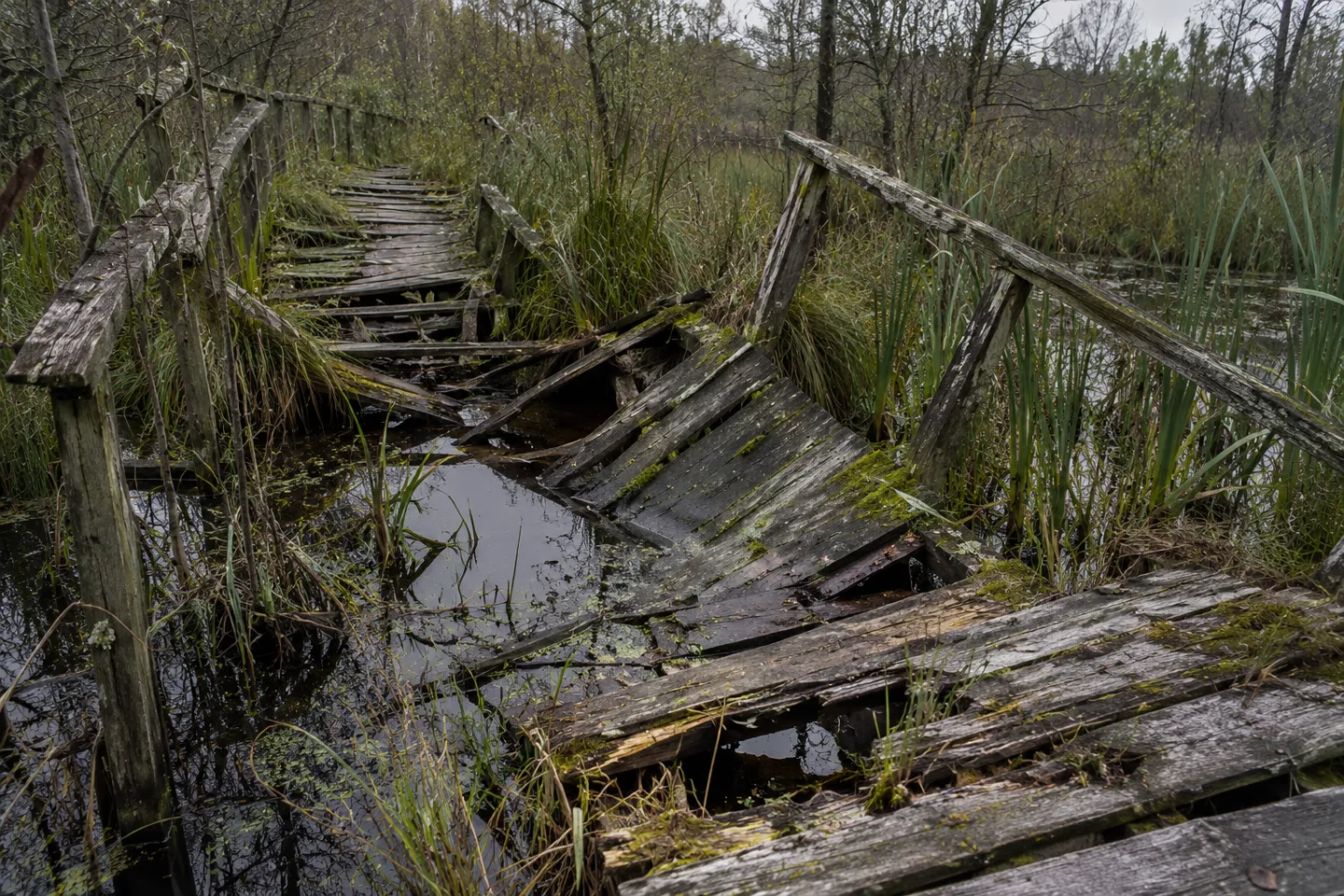
Rot and Material Lifespan
Timber can deteriorate under sustained moisture and use, but actual service life depends on species, treatment, detailing, exposure, and maintenance. Inspect boards, stringers, fasteners, and support connections on a documented schedule. Replace damaged parts before they compromise the walking route; do not treat one replacement age as universal.
Anchor Failure and Drift
Floating systems can move or drift if anchoring or shore connections are inadequate for water levels, wind, current, or debris. Inspect anchor positions, cable or guide condition, connector wear, and freeboard after major events. Damage may begin in a float, connection, anchor, or access ramp, so the full load path needs review.
Ice and Water Extremes
Ice and floods can damage either fixed or floating structures. A floating walkway does not automatically climb onto an ice sheet safely; ice may load the floats, guides, and anchors in ways the system was not designed to resist. Set a removal or leave-in plan based on local ice behavior, the exact product, and the responsible designer’s review ( DNR del Wisconsin ).
A read-through of the failure list above produces one compact decision tool: for any site condition, which method gives out first. The matrix below compresses the three failure modes into a single grid. Every cell that says “torn out” or “washes away” is a cell you are paying to rent, not to own.
Where each support method fails first
| Condizioni del sito | Ground path | Fixed piles | Top-down prefab | Floating modular |
|---|---|---|---|---|
| Deep muck or peat | May settle or alter drainage | Needs geotechnical design | Foundation and access need review | Needs adequate depth and anchoring |
| Tidal flats | Can flood or obstruct flow | Set elevation and check currents | Check span and flood clearance | Check low-water grounding and guides |
| Protected bed | Disturbance must be approved | Pile installation needs approval | Sequence can reduce equipment access | Anchors and shore access still affect site |
| Seasonal flood zone | May wash out | Check flood loads and clearance | Check foundations and debris | Check travel, anchors and reconnection |
| Moving ice in spring | Ground path may heave | Check piles and joints | Check supports and deck | Removal or leave-in design required |
| Open water, high wind fetch | Usually unsuitable | Check wave and foundation loads | Check whole structure | Engineer floats, connectors and mooring |
What This Means for Contractors and Dealers
Present the feasible methods for the actual site rather than quoting all four by default. Ground treatment, piles, top-down construction, and floating modules serve different water depths, access conditions, and permit constraints. A site plan and scope statement help the owner compare alternatives on the same basis.
The cost difference often lies in site access, foundation work, installation sequence, and future replacement. A floating proposal must include its anchors, shore transition, and low-water condition. A pile-supported proposal must include geotechnical design and construction access. Compare complete installed systems and their maintenance plans.
Dealers can help identify when a floating walkway is worth evaluating, but should avoid promising it will solve deep muck, tidal movement, or protected-habitat constraints without a survey and permit review. Ask for route dimensions, seasonal water levels, intended loads, and site photos before selecting modules.
HiSeaDock offers modular HDPE floating walkway components. Confirm the selected model, load information, connectors, anchoring options, warranty, and installation responsibilities for the project. A supplier’s product documents do not replace wetland permitting or a site-specific structural design.
For a floating walkway proposal, provide the route length and width, water-level range, site conditions, intended users, and any approval conditions. Request a configuration and documentation package for review.
Next step
Configure a Floating Walkway for Your Site
Share the route, water levels, intended loads, and approval conditions to discuss a suitable floating walkway configuration and the documents needed for review.
Request a Quote with Anchoring PlanRiferimenti
- USDA Forest Service. Wetland Trail Design and Construction .
- Rails to Trails Conservancy. Constructing Wetland Boardwalks and Trails .
- Corpo degli Ingegneri dell'Esercito degli Stati Uniti. Permitting Process and Procedures .
- Dipartimento delle Risorse Naturali del Wisconsin. Prevenire i danni causati dal ghiaccio alle strutture permanenti .
- Access Board degli Stati Uniti. Outdoor Developed Areas .

 English
 Thai
 Spanish
 French
 German
 Dutch
 Italian
 Arabic
 Indonesian
 Portuguese
 Turkish