
Best Decking for Docks: The Right Answer Changes With What’s Holding It Up
The Best Decking for Docks Depends on What Carries It
There is no single best decking for docks, and every serious comparison of the subject says so in its opening paragraph. Then it goes on to compare pressure-treated pine, cedar, composite, PVC and aluminum as though the answer were the same for every dock in the water. It isn’t.
Before you weigh a single board, answer one question: where does the weight of that walking surface end up? There are three possible answers, and they do not lead to the same material.
Piles to the bed. The walkway is a separate layer of boards on joists, and the joists sit on piles driven into the bottom. The decking’s weight is carried by the bed, through the piles. What constrains your choice here is span, fastening, wet grip and surface behaviour. The weight of the board is close to a non-issue.
Buoyancy to displaced water. Same construction on top: boards on joists, joists on a frame. But the frame sits on floats, and the whole assembly’s weight has to be held up by the volume of water those floats push aside. Every kilogram of decking comes out of the load your dock can otherwise carry.
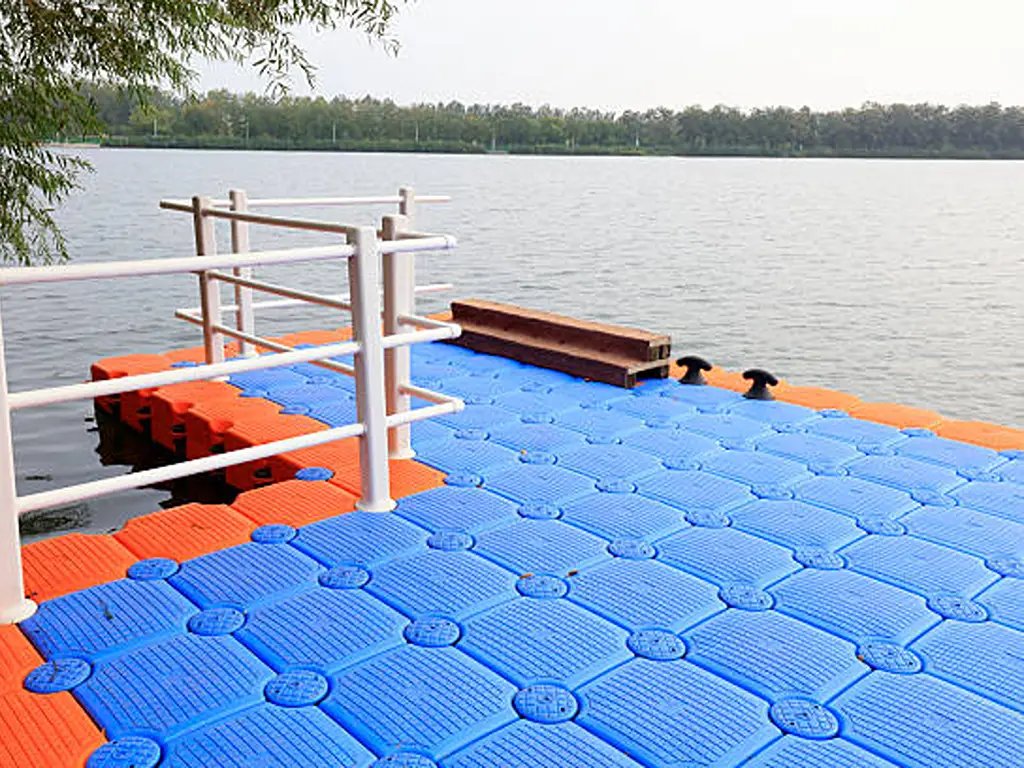
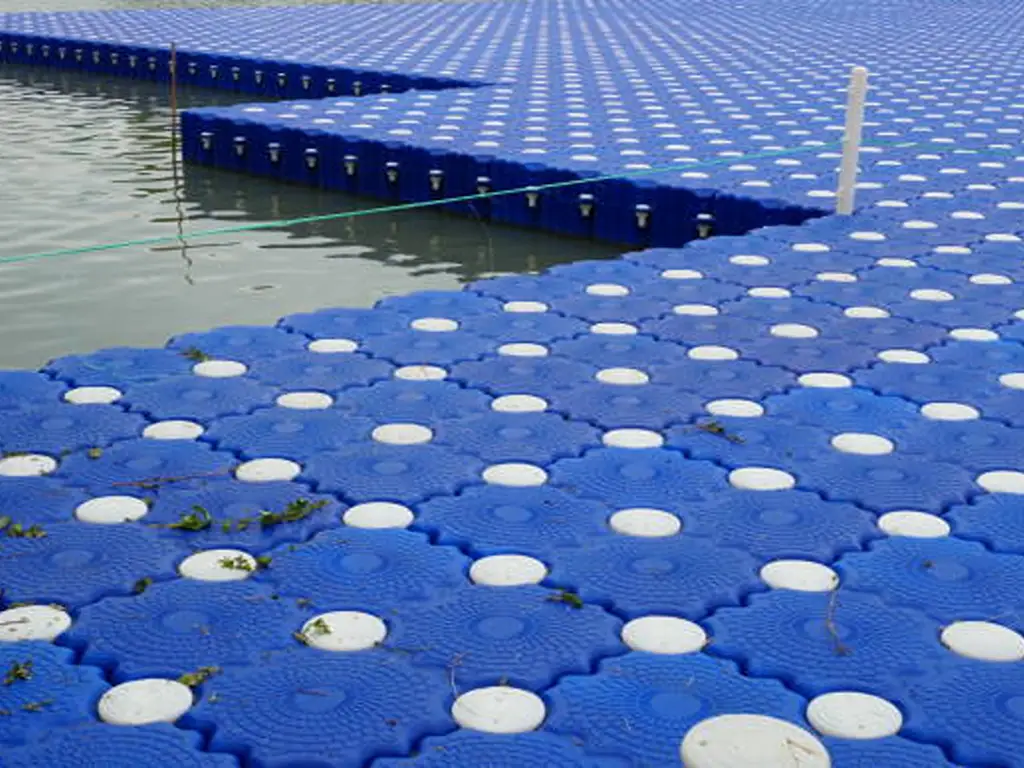
No separate layer. On a modular float system, the top of the float เป็น the walking surface, molded with an anti-skid pattern at the factory. There is no decking layer, and the question does not arise.
Where the Weight of Your Decking Goes
| Load path | What carries the decking | Does board weight matter |
|---|---|---|
| Driven piles to the bed | Piles and the bed beneath them | Almost no. Constraint is span and fastening. |
| Buoyancy to displaced water | The volume your floats displace | Yes. It comes straight out of payload. |
| No separate layer | Nothing, because there is no separate board | Not applicable. |
This is also why the same product gets described in opposite ways depending on who is writing. Composite decking is “comfortable underfoot” in one guide and “notoriously hot” in the next, “slip-resistant” in one table and “very slippery” in another. The writers are not all wrong. They are describing different docks.
Six Decking Materials, Sorted by What They Survive
Most material comparisons sort by appearance, price and upkeep. Those matter, but two questions decide outcomes faster. What water contact is this board rated for? And what does its weight do to the structure under it? Sorted that way, the field looks like this.
Six Decking Materials for Docks
| วัสดุ | Rated water contact | Weight consequence on a floating dock | Wet grip | Barefoot temperature | Upkeep | When it stops being a good choice |
|---|---|---|---|---|---|---|
| Pressure-treated wood | Ground contact, and immersion only at higher treatment levels | Heaviest of the common options | Good when new, degrades as surface fibres weather | Very hot in direct sun | Sealing or staining on a regular cycle | In permanent saltwater contact, or when the maintenance cycle is unrealistic |
| Naturally durable wood (cedar, redwood, cypress, ipe) | Varies by species; dense tropical hardwoods are the most resistant | Heavy; dense species are heavier still | Good, and improves as it weathers | ปานกลาง | Periodic oiling if you want to keep the colour | Where cost or long-term supply traceability matters |
| Modified wood | Treated to resist moisture uptake in the fibre | ปานกลาง | ดี | ปานกลาง | Cleaning only, no refinishing cycle | Where the long-term record in heavy public use is thin |
| Wood-plastic composite | Varies widely. Many brands are warranted for above-ground use only | Heaviest per unit of span; needs closer joist spacing | Textured surfaces grip well wet | Runs warm; colour-dependent | Soap and water, no sealing | If the board is not rated for water contact and you are installing it on a dock |
| PVC (all-plastic) | No organic content, so moisture is not the failure mode | Lighter than wood-plastic composite | Textured surfaces grip well wet | Runs warm; colour-dependent | Soap and water, no sealing | Where you need the board to look and work like timber |
| อลูมิเนียม | Unaffected by immersion | Lightest of the group | Good, and consistent when wet | Reflects rather than absorbs, but still heats in full sun | Essentially none | Where appearance, noise or upfront cost is the deciding factor |
A few things that table cannot carry:
Grip and temperature are properties of the surface, not the material family. Colour drives much of the temperature story, since darker surfaces absorb more solar radiation. Surface construction matters too, because a board that drains and ventilates behaves differently from a solid one. A light-coloured, deeply textured composite and a dark, smooth composite are different products that happen to share a category name. Anyone generalising “composite gets hot” or “aluminium stays cool” across a whole family is describing one sample.
Maintenance is a budget line, not a preference. Pressure-treated timber wants sealing on a regular cycle, and the cycle is what actually gets skipped. Modified wood and the plastics want cleaning. The difference between those two things, over twenty years, is larger than the difference in purchase price.
“Marine grade” is not a specification you can compare. More on that below.
Do You Need a Separate Decking Layer at All?
Every decking guide on the internet assumes you are going to install boards. That assumption is doing a lot of work, because on a large class of docks you don’t have to.
The Option the Guides Never List
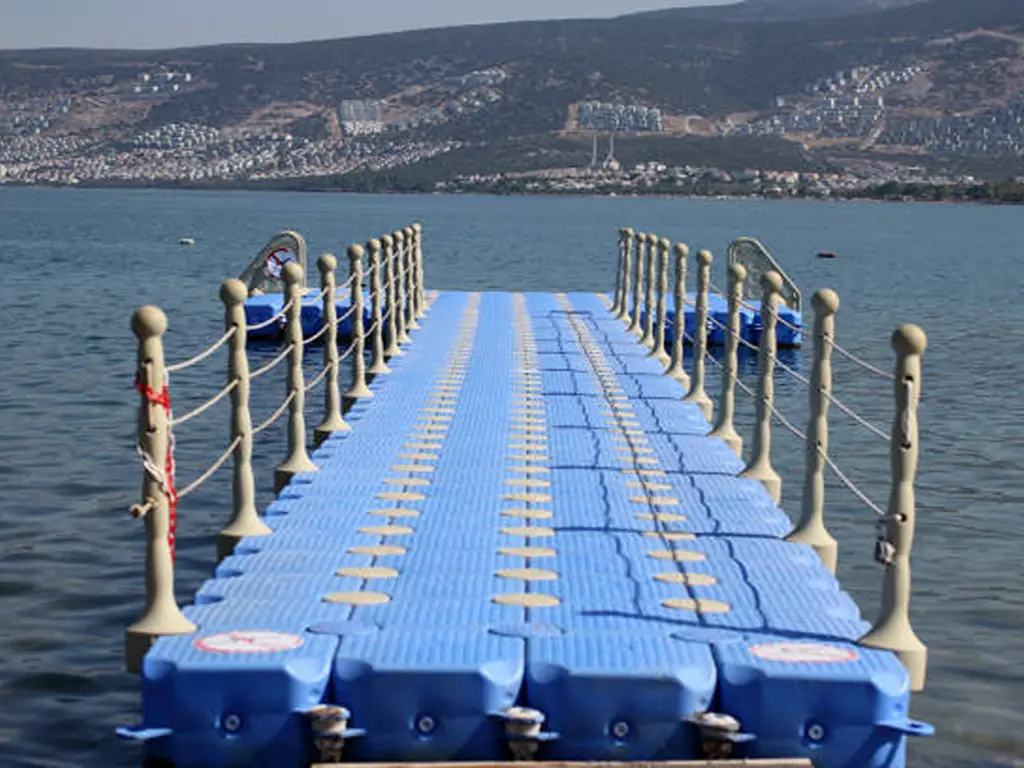
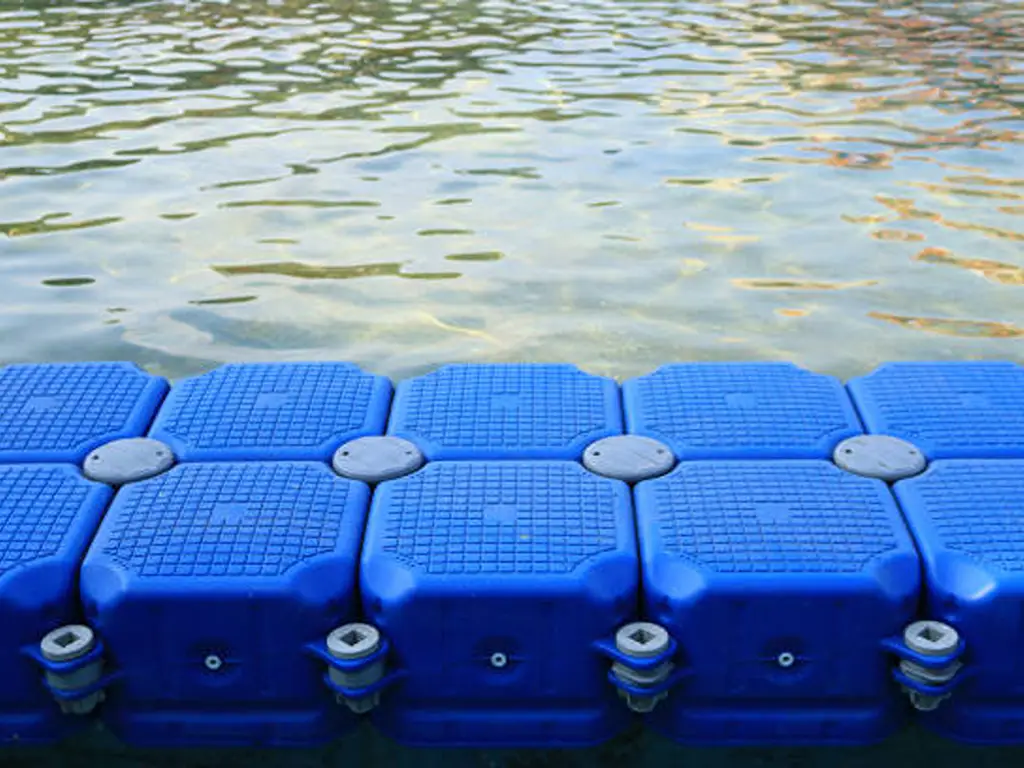
Modular float systems come out of the mold with the walking surface already on top of them. The anti-skid texture is part of the float shell, not a board screwed to it. Walk on it, and you have walked on the decking.
That construction removes three things at once, and they are exactly the three that generate maintenance on a board-based dock:
- No added dead load. No boards, no joists, no fasteners, no edge trim. The structure is the float and nothing else.
- No fasteners. Nothing to loosen, nothing to re-drive, no galvanic pairing between a stainless screw and whatever it is biting into.
- No edge to breach. A capped or encapsulated board is protected by its outer skin, and that skin is exactly what a screw or a saw cut interrupts. Remove the board and you remove the pathway.
What You Give Up
This is not a free upgrade, and the case against it is real. Four things move to the other side of the ledger.
The trade, item by item
Removed by dropping the decking layer
- Added dead load: no boards, no joists, no fasteners, no edge trim
- Fasteners: nothing to loosen or re-drive, no galvanic pairing
- A breachable edge: no skin for a screw or saw cut to open
Given up in exchange
- Colour and surface choice: molded floats come in the colours the tooling and compound allow
- Replacement granularity: a damaged board is one board; a damaged float is one unit
- Underfoot feel: molded anti-skid texture is not board texture
- Screw-down mounting: benches and cleats attach to the float’s own connection points, moving that question to the system supplier
Colour and surface choice. A molded float comes in the colours the tooling and the compound allow. You are not choosing a grain pattern or a stain.
Replacement granularity. If one board is damaged, you replace one board. If one float unit is damaged, you replace a float unit. That is a different repair economy, and it favours one approach or the other depending on how the dock is used.
Underfoot feel. Molded anti-skid texture and the surface of a timber or composite board are not the same experience, and some clients care about that a great deal.
How you attach things. There are no boards to screw a bench or a cleat into. Mounting happens on the float’s own connection points, which means the mounting question moves to the system supplier rather than staying with the carpenter.
Where the Specification Is Moving
This option deserves a place at the table because the people who buy dock infrastructure for a living are already moving toward it. They are moving for accounting reasons, not aesthetic ones.
Glass-reinforced polymer has moved from a specialist alternative to the default specification for new waterfront infrastructure across much of the UK marina sector. The specification decisions being made there now will define maintenance costs for the next forty to fifty years. The same source notes that maintaining a timber jetty over twenty years frequently costs more than the original structure did.
That is a specific and checkable pattern. As the cost model shifts from purchase price to whole-life cost, the specification shifts with it, away from “which board looks right” and toward contact rating, service life, and how few components the assembly can have. When a municipal marina specifies a 220-slip dock system and eliminates traditional timber outright, it is making that shift in public (Marina Dock Age, 2018).
The shift, in three markers
GRP
Now the default specification for new waterfront infrastructure across much of the UK marina sector.
20 yr
Maintaining a timber jetty over that period frequently costs more than the original structure did.
40–50 yr
The window the decisions being made now will define maintenance costs over — and a municipal marina has already specified a 220-slip system on that basis, dropping traditional timber outright.
The Buoyancy Budget: What Your Decking Choice Actually Costs
Here is the part that only applies to load path two, and the part that none of the standard comparisons recover.
Dead Load, Live Load, and the 40/60 Rule
A float has to hold up two categories of weight. Dead load is everything permanently attached: frame, decking, fasteners, utilities, fixed furniture. Live load is people, gear and movement. Industry practice is to design a floating structure to sit at roughly 40 percent submergence. The other 60 percent of the float’s capacity is there to carry the live load.
For residential docks built with lumber, the dead weight of the structure typically lands between 10 and 15 lbs per square foot. Your decking is inside that number, not on top of it. Whichever board you choose, its weight is spent before a single person steps on the dock.
The Multiplier the Trade Actually Uses
The floating dock trade already treats the decking choice as an input to flotation, not an afterthought. One published method assigns a buoyancy multiplier by framing type and decking type together:
| Framing | พื้นระเบียง | Multiplier |
|---|---|---|
| 2″ × 8″ pressure-treated | 5/4″ × 6″ pressure-treated | 28 |
| 2″ × 8″ pressure-treated | 5/4″ × 6″ wood-plastic composite | 31 |
| 2″ × 8″ pressure-treated | 2″ × 6″ pressure-treated | 31 |
| 2″ × 8″ pressure-treated | 2″ × 6″ wood-plastic composite | 35 |
The source’s own worked examples make the consequence concrete, and this is the number worth remembering. A 12′ × 12′ floating dock with 2″ × 8″ framing needs 4,032 lb of buoyancy under 5/4″ × 6″ pressure-treated decking. Under 5/4″ × 6″ composite of the same dimensions, it needs 4,464 lb. Same footprint, same frame, same board size. Swapping the material costs 432 lb of extra flotation.
Move to the heavier 2″ × 6″ board and the multiplier goes from 31 to 35, which is a larger jump again.
The number worth remembering
4,032 lb
4,464 lb
Same 12′ × 12′ dock, same 2″ × 8″ framing, same 5/4″ × 6″ board size. Only the board material changed.
Two caveats that matter. First, the published multiplier table is scoped to uncovered residential wooden docks; it is not a commercial engineering figure and should not be extrapolated to one. Second, if the frame has to change to suit the board, the frame’s own weight goes into the same budget. Adding a joist to support a board that needs tighter spacing adds dead load while you are solving dead load.
Where the Math Breaks Down
The table below is the decision tool. Read your own row.
Decking Decision by Load Path
| Load path | Does decking weight count | What changing the decking does | When this load path stops being the answer |
|---|---|---|---|
| Driven piles to the bed | No | A heavier board may need closer joists, but the bed carries it | When piles are infeasible: soft or deep bed, fluctuating water level, seasonal removal |
| Buoyancy to displaced water | Yes, directly | More board weight means more float, or a higher-rated float, or less payload | When the payload you need and the buoyancy you can afford stop meeting |
| No separate layer | Not applicable | Adding boards to a float system adds dead load that was not there | When appearance, repair granularity or underfoot feel becomes a requirement you cannot meet |
Contact Rating: When a Deck Board Stops Being Valid on a Dock
If you take one filter away from this article, take this one.
Decking is rated for the water contact it can tolerate. The three levels that matter are: above-ground only, ground contact, and contact with water, including immersion. A board’s rating is usually stated in its warranty terms rather than in its marketing copy, which is why it gets missed.
The rating that voids the warranty
Most wood-plastic composite brands are warranted for above-ground use only. A dock is not above ground. Installing an above-ground-rated board on a dock can void the warranty on the boards, and the person the owner will call about it is the seller, not the mill.
The failure mechanisms are specific and checkable:
- A breached cap. Capped and encapsulated boards protect their core with an outer skin. Cutting or screwing through that skin opens a path for moisture that the board was designed to keep out. Boards intended for ground or water contact are built with that path closed, to the core.
- Fastener corrosion. Stainless steel resists corrosion through a chromium-oxide passive layer, and chlorides locally break that layer down. Type 316 stainless adds molybdenum specifically to resist that attack. That is why it is the usual minimum specification for submerged marine hardware. It is also why mixing 304 and 316 in the same assembly is a bad idea: the weaker grade corrodes first and becomes a galvanic cell that takes the rest with it.
- Temperature and UV behaviour. Vinyl-based boards can become brittle in cold weather. Powder-coated aluminium chalks over time. Both are normal material behaviour, not defects, and both should be known before the board is bought.
And the term to retire is “marine grade”. For lumber there is no formal standard carrying that name. The framework that actually exists is the AWPA use-category system. UC3B covers above-ground use, UC4A general ground contact, UC4B heavy-duty ground contact and freshwater immersion, and UC5 permanent saltwater or brackish immersion, subdivided by marine borer activity (Pile Buck Magazine). For composite decking, “marine grade” is a manufacturer’s own designation rather than a third-party standard. Asking for “marine grade” gets you two different things depending on who is answering. Ask for the use category and the retention level instead, and ask for the warranty’s contact rating in writing.
The order of the questions matters. Check the contact rating first, then compare performance. Reverse the order, and a board that outperforms everything else in the catalogue ends up on a dock it was never warranted to sit on.
If You Specify, Supply, or Sell Floating Docks
One consequence of everything above lands on whoever is quoting the job.
The decking decision sets the float count, so it has to be made before the quote, not after. A float count priced against a walking surface the customer has not chosen yet is a quote with a hole in it. If the customer later picks a heavier board, the extra flotation is real cost that has to come from somewhere. Moving the surface decision upstream is not a nicety; it is what keeps the quote honest.
Choose the float rating from the board, not the board from the float. Surface-load ratings on modular floats span a wide range for a reason. Pairing a heavy walking surface with a float rated for a light one produces a dock that looks correct and behaves badly, and the complaint arrives years later.
Being able to do that arithmetic is the differentiator. A customer asking “can I put timber on this?” is asking a question with a number attached. A supplier who can answer with the number is doing something a catalogue cannot.
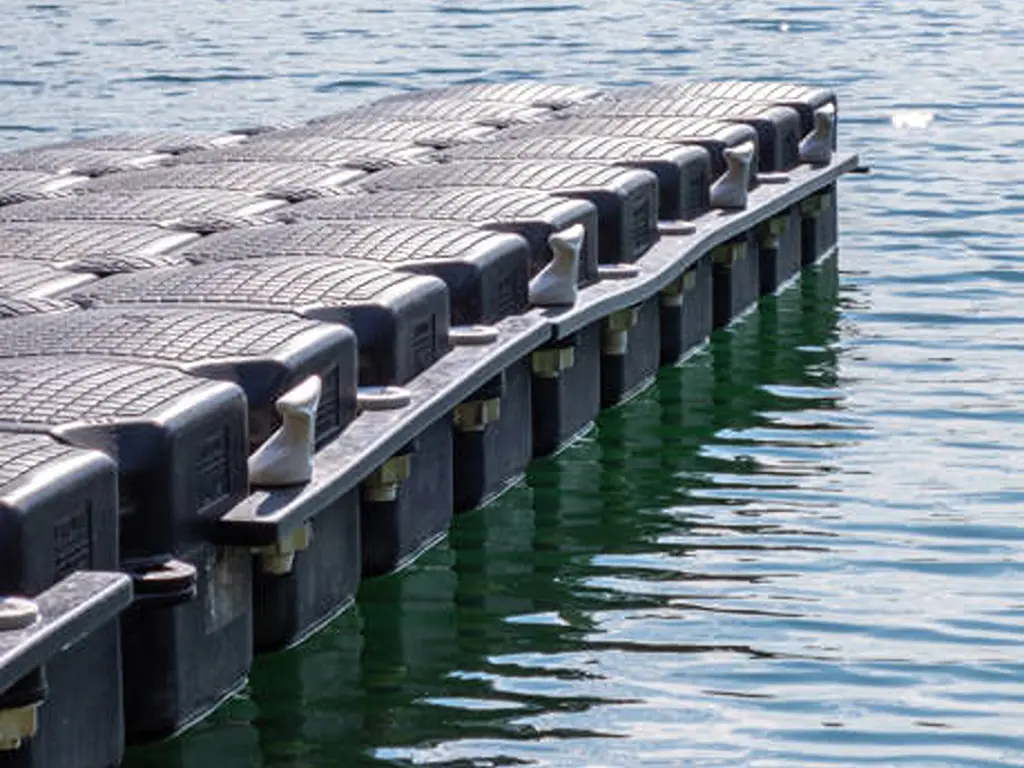
Hisea Dock builds the float side of that decision. Our modular floating dock cubes are rated by surface load, from 200 kgs/m² up through 420 kgs/m² across the range. That is the figure you need in hand when you work out what a given decking choice does to your float count. Those are area-load ratings for the cube surface; the single-cube figure is a separate specification and the two should not be substituted for each other. Higher-rated cubes are what let a project carry a heavier walking surface without buying more flotation. The per-model ratings are on our modular floating dock cubes page, and the full buoyancy range shows how the series is laid out.
And the last step is the one worth writing down: putting the “no separate layer” option in the standard quote rather than holding it back as an alternative. On a modular float system it is not a downgrade. It is the configuration that removes a whole category of dead load, fasteners and edge breaches before the project starts. It should be visible from the first version of the proposal, so the customer can weigh it against what it gives up.
We don’t make decking boards. That decision belongs to you and to your board supplier, and it should be made on the board’s contact rating and its weight, in that order. What we can give you with numbers is what the float side of that decision costs, and what we can configure to match it.
Work Out What the Walking Surface Costs You
We build the modular float systems the decking sits on. If that is part of a project you are working on, we are glad to talk it through.
ติดต่อ Hisea DockReferences
- Pile Buck Magazine. “Essential Guide to Saltwater-Resistant Timber: AWPA UC4B Retention Basics for Docks, Bulkheads, and Mats.” https://pilebuck.com/awpa-uc4b-timber-marine/
- Marina Dock Age. “Hot Dock: New Decking Options Confront Heat Issues for Composites.” https://www.marinadockage.com/hot-dock-new-decking-options-confront-heat-issues-composites/
- Hisea Dock. “Modular Floating Dock Cubes.” https://www.hiseadock.com/modular-floating-dock-cubes/
- Hisea Dock. “Products.” https://www.hiseadock.com/products/
- Hisea Dock. “Contact Us.” https://www.hiseadock.com/contact-us/

 English
  Thai
Thai  Spanish
  French
  German
  Dutch
Dutch  Italian