
Boat Dock Inspection: What the Standard Checklist Misses on Your Dock Type
Three things get called “dock,” and only one is a berth. A loading dock is the freight platform at a warehouse: levelers, wheel chocks, workplace safety rules. A อู่แห้งลอยน้ำ lifts vessels out of the water at a shipyard. A boat survey examines the vessel, not the structure it ties up to. This is about the berth.
The limit is not how carefully you look. It is what is in the field of view. Three layers:
- Above the deck surface. Walkways, railings, fasteners, shore connection. Visible, and within an owner’s reach.
- The waterline band. Pile immersion lines, pontoon draft lines, ice scars. Readable only when water level and clarity allow, which is why inspection has seasons.
- Below water and buried on shore. Piles underwater, anchors, deadmen, tie-backs. Not visible, and under most standards not part of the inspection.
That last layer is where the money is, and nobody can look at it directly. The reasoning runs one way. “The structural deficiencies of underwater portions of these structures may not be observed until such deficiencies have progressed to a point at which damage is visible to above-water components” (InterNACHI). By the time a symptom reaches the deck, the cause has usually been running a while.
What is in the field of view
The checklist most people find is not a general one. It was written for timber piles on a deck frame, moored by cables or stiff arms, and every line points there. A Corps of Engineers permit form asks whether walkway lumber is free of splits, decay and protruding nails. It asks whether deadman cables are attached to trees (they must not be). It asks whether the walkway is at least 3 feet wide with a handrail at least 42 inches high, and whether the anchorage holds against 50 mph winds (USACE). Every check is real. Every one assumes the same construction.
Boundary. A visual pass over deck, walkway, railings, fasteners and shore connection is something an owner can do on any dock type. Two things sit outside it: any judgment about a component you cannot see, and anything electrical. Dock electrical work is not a visual check. You de-energize, then you test: ground check with a meter, amp-clamp the feeders under no load to find leakage, verify GFCI, megger cables for insulation integrity (Mike Holt Forum). That is an electrician’s job, and how far the electrical rules follow you is its own question.
Steel and Concrete Docks: Where the Checklist Only Half Applies
If your dock is steel or concrete, about a third of that checklist survives and the rest has to be translated.
The translation is mechanical. Rot and marine borer attack become การกัดกร่อน; shrinkage and abrasion carry over. Timber’s early decay is discoloured, softened wood with a cotton-like texture. On concrete, the equivalent is rust staining on the surface. A later stage shows as cracks running parallel to the reinforcing steel, the bar expanding as it corrodes. On steel, the six to watch are corrosion, abrasion, loosening of structural connections, fatigue, overloading and loss of foundation material (Pile Buck / USACE manual).
Three items that change meaning
The failure zone collapses into a narrow band. On timber, any submerged section of pile can be rotting. On steel, the aggressive zone is the waterline band. That is the few feet where wet alternates with dry and oxygen stays plentiful. A checkable instruction: start there.
Some defects are invisible even to a careful eye. Anaerobic bacterial corrosion inside a steel pipe pile is hard to detect visually at all. On concrete, corrosion hidden below the surface shows up as a hollow sound when you tap it with a hammer. Sounding, not looking, is the primary concrete method.
Then comes the part a service page will not volunteer. This is where published standards stop. A standard inspection “will not predict the life expectancy of a structure or its components,” will not “identify the cause of observed deficiencies,” and will not “determine the load capacity” (InterNACHI). What you get back describes what is visible on the day. Where the threshold sits comes from elsewhere.
For prestressed concrete piling, one agency specification draws it at a width. Horizontal cracks greater than 1/16 inch are cause for rejection below ground or water level. Vertical or diagonal cracks are rejected in most cases. Hairline cracks under 0.006 inch that do not reach the nearest reinforcing steel need no repair (TxDOT). That is a bridge specification, not a dock rule. But it is a real number, and it shows what a threshold looks like when someone writes one down.
Boundary. Three checkable signals mark where more inspection stops paying. The same location entered the report twice in a year. The failure moved from one point to several. Or accumulated repair spend is approaching the cost of handling the whole structure at once.
Float Docks: When the Failure Mode Becomes Lost Buoyancy
The category changes here. A float dock is not holding itself up against gravity. It floats, and you are inspecting buoyancy, not material.
Buoyancy leaves by two routes, and neither is visible
Barrels and drums are hollow and take on water the moment they are punctured. Foam-filled units saturate, slowly and permanently, once water reaches the foam. Both routes run below the waterline, and neither announces itself with anything you can see from the deck.
So the method changes from looking ถึง reading posture. Three observations, all made from shore:
- Draft-line uniformity across the row. A row that used to sit level and now sits unevenly is telling you where buoyancy has gone.
- Individual units listing or sitting low. One unit riding lower than its neighbours has already lost buoyancy, whatever it looks like.
- How the dock responds underfoot. Rebound, sway and local dip are readings, not impressions.
Three readings from shore
What this means if you are buying or inheriting one
Legacy float docks (drums, barrels, foam blocks) are usually inherited rather than bought new, and tidied up before a sale. Decking gets replaced, hardware gets tightened, and the flotation is never touched. Buoyancy state is the one thing a coat of maintenance cannot fake and a buyer cannot check by looking.
Timber fails by วัสดุ loss, examinable section by section. A float dock fails by buoyancy loss, inferable only from the whole structure’s attitude. That needs a different habit: record the draft line every spring, so next year has something to compare against. A number you wrote down last spring beats any visual check this spring.
Boundary. Unit-by-unit replacement is right when one or two units have failed, the frame and connections are sound, and the rest of the row floats even. It stops being right when several units sit low at once. It also stops being right when frame and hardware are ageing on the same schedule, or when cumulative unit-swap costs are closing on the whole row.
Molded Modular Pontoons: Where the Checklist Stops Working
The buoyancy units drop out of the checklist entirely
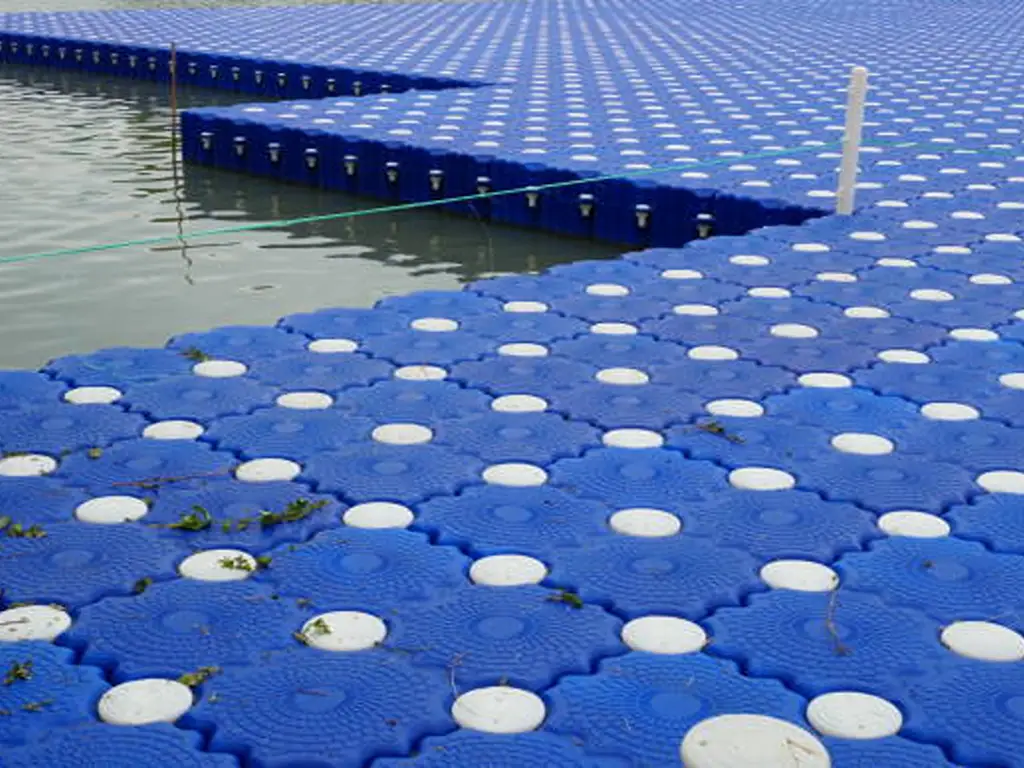
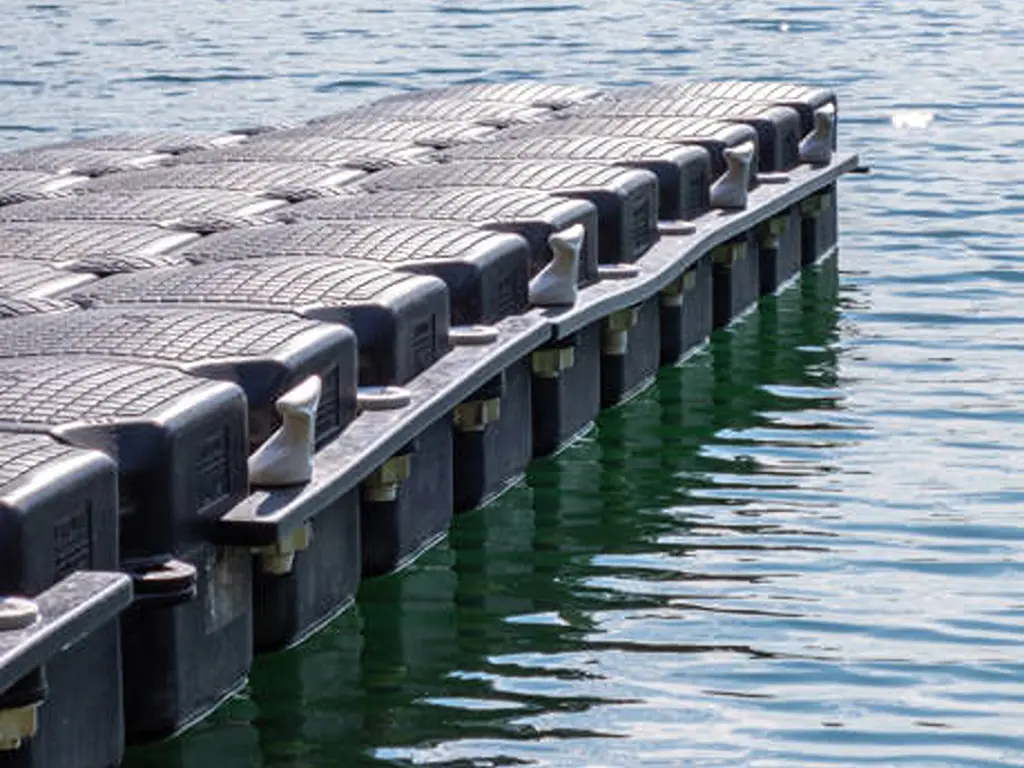
A rotomolded or blow-molded HDPE pontoon is neither a barrel nor a foam block. It is a sealed, air-filled hollow compartment: a rigid shell with a threaded end cap, a wall thickness of 6–8 mm, and nothing inside it that can absorb anything.
The consequence is blunt. A sealed air cavity does not waterlog, does not saturate, and does not sink when punctured. So a whole category of the standard checklist does not apply. “Check the flotation for water ingress” and “check the foam for saturation” are not items on which this dock type returns a good result. They are items that do not exist on this dock type.
That matters because it is where generic advice quietly misleads. A checklist that sends you looking for water in a pontoon sends you after a failure mode the structure was designed out of. You find nothing, and you draw the wrong conclusion from finding nothing.
A sealed air cavity does not waterlog, does not saturate, and does not sink when punctured.
On a molded pontoon dock, “check the flotation for water ingress” is not a check that passes. It is a check that does not exist.
The centre of gravity moves to the system components
With the buoyancy unit off the maintenance list, “what decides how long this dock lasts?” relocates. It moves to the parts holding the assembly together.
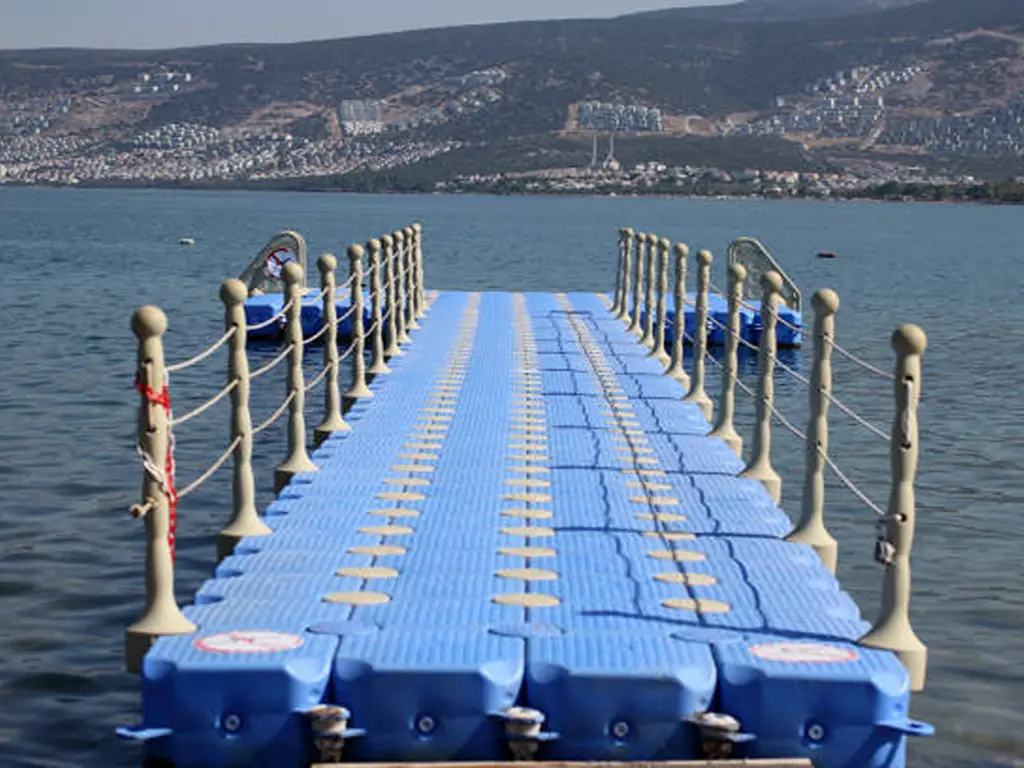
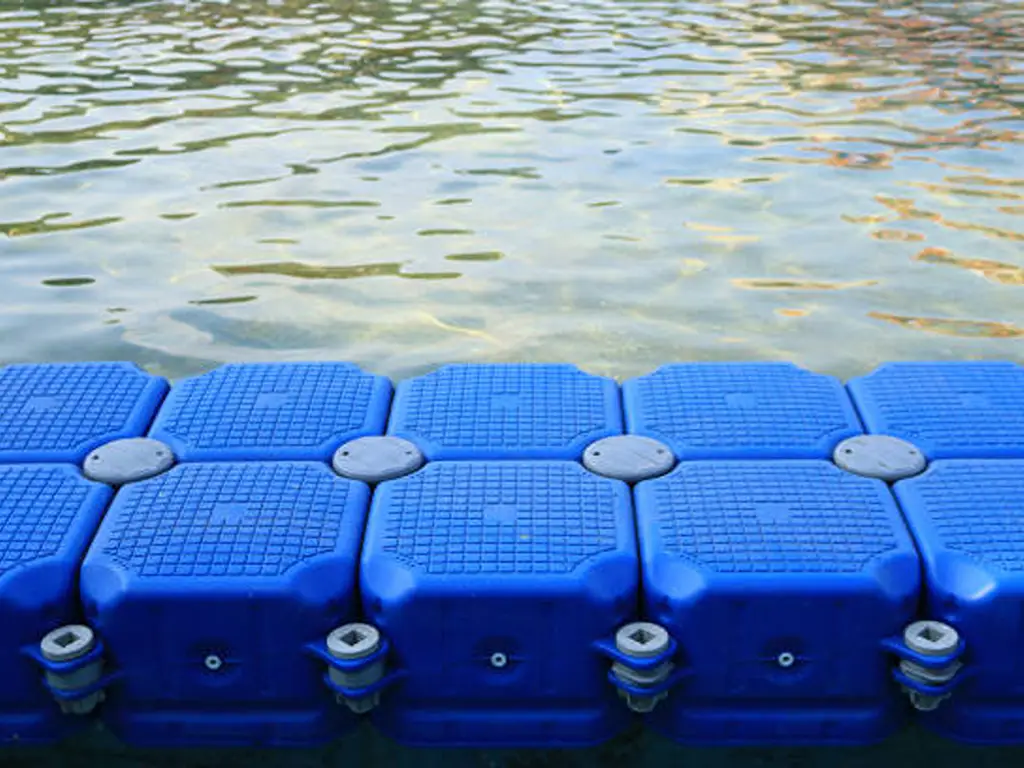
The connections between pontoons. Not generic bolts. Fasteners are specified by corner position: washers and cushions grouped for corners 1 and 4, thin washers for corners 1,3 or 2,4, with long pins and long bolts where two layers stack. Corner position and single-versus-double-layer tell you which fixings you are looking at, and where.
The mooring and pile-guide interface. A pile guide is sized for a pile diameter of up to 220 mm. It must let the dock rise and fall with the water without binding. Worn, cracked, or sized for the wrong pile, it is where a dock stops moving the way it should.
Shore access and the ramp hinge, the highest-stress joint on the structure. And railings, posts and fenders, the vertical and most exposed surfaces.
The connections are the ones you cannot see
Moving the inspection focus onto connections does not remove the visibility problem. It relocates it. The buoyancy units are above water and easy to look at. The connections between them sit at and below the waterline.
So the inspection becomes indirect. You are not looking at the fasteners. You are looking for their effects:
- displacement marks or movement traces where connections meet
- seams between pontoons opening up
- relative rotation or height difference between adjacent pontoons
- rust staining bleeding from a fastener location
- a walkway that has taken on a slope it did not have before
If any appear, the next step is a look at the connection itself. That is where an owner’s inspection ends and a contractor’s begins.
Which checklist items actually apply
Put the four construction types side by side and the reason the standard checklist keeps failing becomes visible.
| Checklist item | Timber fixed | Steel and concrete fixed | Barrel and foam float | Molded modular pontoon |
|---|---|---|---|---|
| Buoyancy units | No flotation to check | No flotation to check | Water ingress and foam saturation | Sealed air cavity, not applicable |
| Deck and walkway | Rot, splits, protruding fasteners | Cracking, spalling, drainage | Warping, algae, slippery surfaces | Non-skid surface, seam gaps, slope change |
| Connections and fasteners | Connector corrosion, loose hardware | Connection loosening, fatigue, hollow sound | Frame ageing alongside flotation | Primary item, indexed fixings by corner position |
| Mooring and anchoring | Cable fraying, deadman cables, stiff arms | Corrosion at and below the waterline | Anchor shift, chain wear | Pile-guide fit, binding, wear |
| Shore access and gangway | Width, handrail height, spring, deflection | Hinge corrosion, expansion gaps | Ramp security, walkway flotation | Ramp hinge, the highest-stress joint |
| Railings and fenders | Soundness, splinters | Corrosion, anchorage | UV brittleness, loose fixings | Post and rail anchorage, fenders |
| Electrical and conduit | GFCI, corrosion, licensed electrician | Same, plus bonding of metal structure | Same | Same, differs only in how cable is carried |
| Below water and buried | Not visible, read above-water symptoms | Not visible, waterline band is critical | Not visible, draft line and stability | Not visible, connections sit at and below the waterline |
A shorter checklist is not a lighter one. The list is genuinely shorter here. The material-decay and flotation-ingress rows are gone. But the rows that remain are systemic rather than sectional. One failed connection affects an area, not a point. There is no “replace that one board” equivalent to fall back on. Fewer rows, heavier rows. Schedule around that, not around the row count.
And on load, the units matter. This type is rated in face load per square metre: 200, 220, 300, 350 and 420 kgs/m² across the range, depending on the unit. Those are the figures published for Hisea Dock’s modular pontoon range (load ratings per float type). That is not the same unit as the per-float figure quoted elsewhere. A 500 × 500 mm single float rated at 350 kgs/m² carries roughly 90 kg across its own 0.25 m² footprint. Same dock, two ways of saying it. Ask a supplier which one they are quoting, because mixing the two changes the answer by a factor of four. Pile-guide sizing follows the same convention. The 220 mm figure is a pile diameter limit, not a clearance to estimate by eye (pile guide dimensions). The hardware range is specified the same way (อุปกรณ์ท่าเรือ).
The load figures above are quoted per unit and per square metre — and the fixings, pile guides and fenders behind them are specified to the same convention.
See the modular pontoon rangeWho Should Inspect, and How Often
“How often” has no single answer, and pretending otherwise is the most common mistake in this subject. Four positions are live:
- Weekly to fortnightly for a visual walk of electrical equipment: corroding receptacles, damaged wires, signs of a previous electrical fire (TESS LLC). Scope matters. That one is electrical, not structure.
- Daily walk-throughs, weekly dock checks, and a seasonal or annual comprehensive inspection. This is what marina operators are usually advised to run (Free Inspection Templates).
- รายปี, for dock electrical systems, as required by NFPA 303 and enforced on federal waterways by the Corps of Engineers (Mike Holt Forum).
- Never on a fixed annual cycle. That is the position of at least one working inspector, who called a mandatory yearly inspection pointless in his district.
The useful output is not picking a number. It is knowing what the number should derive from. Ask what you are inspecting, since structure, mooring and electrical fail at different rates. Then the water body, whether the public walks on it, whether you hold a federal waterway permit, and what you stand to lose.
Four published answers, no authority behind any of them
Two things are worth knowing before you hire anyone. There is no established certification for dock inspectors. One inspector asked a professional forum whether a certified dock electrical inspector exists. He got no answer. He had already found the internet offered “various things but nothing specific” (Mike Holt Forum).
And “dock inspection” on a quote can mean two different jobs. A standards-based home-inspection scope excludes anything underwater. It will not comment on cause, life expectancy or load capacity. A marine contractor’s scope may cover above-water, waterline และ below-water components. Same four words on the paperwork, an order of magnitude apart in what you receive. On cost, one published regional figure sits in the hundreds of dollars, report within 48 hours.
Boundary. Self-inspection is defensible for above-water items on a dock you own and use privately. Bring in someone else in three cases. The question needs a component you cannot see. It needs de-energizing and testing circuits. Or the dock carries a rental relationship or public access. In that last case, the record of having inspected is a document, not a habit.
The direction of travel is worth noting. Three things point one way. There are annual permit-renewal inspections on federal waterways. There is NFPA 303’s annual electrical requirement. And there is the legal duty language that owners “must regularly inspect” their docks. Together they mean “did you inspect it” is becoming as consequential as “how well.” For anyone operating a dock others use, the inspection record is starting to function as evidence.
After the Report: Repair or Replace
A useful report is graded, not just listed. The working convention sorts findings four ways: critical (safety hazard, immediate), significant (one to three months), การบำรุงรักษา (routine), and monitoring (watch it). The grading does more work than the ordering. It turns “should I spend money now” into a question with a stated threshold.
From there the path splits along the same line this article has followed. Where material can be replaced section by section, the finding leads to repair: swap the boards, replace the pile, re-coat the metal. Timber, steel and concrete all work that way. Where the buoyancy unit cannot be replaced section by section, the finding more often leads to system components or the whole assembly. There is no equivalent of “replace that one board” when the units are not the wearing part.
Can the wearing part be replaced on its own?
That single question decides which path a finding leads down.
That middle ground is narrow, and it matters most to anyone planning capital spend across a row of berths. Three signals point to replacement rather than another repair round, all checkable. The same location has appeared twice within a year. A failure has spread from one point to several. Or the running total of repairs is approaching the cost of one whole-structure decision.
Boundary. Repair is the wrong answer when the structure has reached the end of its service life, or when successive repairs have closed on a single whole-structure intervention. Replacement is the wrong answer when the failure is a single point, the frame and connections are sound, and the rest of the structure reads consistently. Both errors come from skipping one step: deciding which category the failure belongs to before pricing anything.
The Commercial Side: Where Inspection Findings Lead
For anyone whose business includes building or servicing waterfront structures, the pattern above has a commercial shape that is easy to miss.
The published checklists are general-purpose and were effectively written for one construction type. Inspection frequency has four competing answers and no authority behind any of them. Inspector credentials have no established certification. All three point the same direction. Whoever puts their inspection method in writing, split by construction type, holds the judgment that the findings depend on.
The money follows that judgment rather than the labour. Where material can be replaced section by section, a finding leads to repair hours and a materials list. Where buoyancy units cannot be replaced section by section, the same finding leads to system components or a whole-assembly decision. Those outcomes are priced completely differently, and the deciding question is the one nobody publishes a standard for: can this be repaired at all.
So stop working from the generic checklist and build the split version. One table per construction type, each stating which general items do not apply. Then quote against two structures instead of one, a repair path and a replacement path, rather than billing inspection by the hour. Clients arrive with a percentage of a dock already past repair. The businesses that can name that point with a written method define the scope that follows.
Inspection findings only mean something once you know which construction type produced them. On a molded pontoon dock, the checks that matter are the connections, the mooring interface and the shore connection, not the flotation. We build HDPE modular pontoon systems rated from 200 to 420 kgs/m² face load, with the indexed fixings, pile guides and accessories that hold them together. Our modular pontoon systems are specified the same way we ask you to inspect them: by component, with dimensions stated.
Get the pontoon system and component specs
Load ratings by unit, indexed fixings, pile guides and the accessory range, with dimensions stated for each.
References
- InterNACHI. “Standards of Practice for Inspecting Waterfront Protective Structures and Docking Facilities.” https://www.nachi.org/sop-dock.htm
- U.S. Army Corps of Engineers. “Boat Dock Inspection.” https://www.spa.usace.army.mil/Portals/16/docs/civilworks/recreation/BoatDockInspection.pdf
- Texas Department of Transportation. “Section 4: Prestressed Concrete Piling — Damage Assessment and Repair Types.” https://www.txdot.gov/manuals/brg/crm/chapter-2–damage-assessment-and-repair-types/section-4–prestressed-concrete-piling.html
- Pile Buck. “Waterfront Facility Inspection Part III — Timber, Concrete, and Steel Structures.” https://pilebuck.com/waterfront-facility-inspection-part-iii-timber-concrete-steel-structures/
- TESS LLC. “Fast and Easy Inspections to Perform Regularly on Marine Electrical Equipment.” https://www.tessllc.us/fast-easy-inspections-to-perform-regularly-on-marine-electrical-equipment/
- Free Inspection Templates. “Marina Inspection Checklist: Keeping Waterfront Facilities Safe and Compliant.” https://freeinspectiontemplates.com/articles/marina-inspection-checklist/
- Marine Law / DHC Law. “Boat Dock Accident Liability for Slip and Fall Injuries.” https://www.dhclaw.com/faqs/boat-dock-accident-liability-for-slip-and-fall-injuries.cfm
- Mike Holt Forum. “Inspecting Boat Docks.” https://forums.mikeholt.com/threads/inspecting-boat-docks.41352/
- InterNACHI Forum. “Boat Dock — General Inspection Discussion.” https://forum.nachi.org/t/boat-dock/89389
- Hisea Dock. “Modular Floating Dock Cubes.” https://www.hiseadock.com/modular-floating-dock-cubes/
- Hisea Dock. “Boat Dock.” https://www.hiseadock.com/waterfront_solutions/boat-dock/
- Hisea Dock. “Floating Bridge Inspections Guide.” https://www.hiseadock.com/floating-bridge-inspections-guide/
- Hisea Dock. “Floating Dock Maintenance.” https://www.hiseadock.com/floating-dock-maintenance/
- Hisea Dock. “Floating Dock Repair.” https://www.hiseadock.com/floating-dock-repair/
- Hisea Dock. “Dock Accessories.” https://www.hiseadock.com/dock-accessories/
- Hisea Dock. “Pile Guide.” https://www.hiseadock.com/product-item/pile-guide/
- Hisea Dock. “Single Float.” https://www.hiseadock.com/product-item/single-float/
- Hisea Dock. “Hisea Dock.” https://www.hiseadock.com/

 English
  Thai
Thai  Spanish
  French
  German
  Dutch
Dutch  Italian