
Jet Dock Price Exposed: Avoid Dealer Markups with Direct Manufacturer Solutions
A technical deep-dive into floating dock budgeting: From raw material baselines to long-term TCO and factory-direct procurement strategies.
The Reality of Jet Dock Pricing: Baseline Costs and Investment Expectations
If you are searching for the true jet dock price, you have likely encountered a frustrating wall of “call for quote” buttons. Dealerships often mask the true cost of modular drive-on systems behind complex configurations. To make a sound financial decision, you must first understand the “Ex-Works” baseline – the cost of raw materials before freight, local taxes, and marine assembly markups are applied.
The core concept is simple: you are counteracting the wet weight of your vessel with the displacement capacity of high-density polyethylene (HDPE). The heavier your craft, the more displacement you need. Below is a transparent baseline cost matrix to anchor your expectations.
| Watercraft Type | Average Size & Weight | Estimated Baseline Price (Ex-Works) |
|---|---|---|
| Personal Watercraft (PWC) | 1-3 Seater / 400 – 900 lbs | $1,200 – $2,500 |
| Small Skiffs & Ribs | 12′ – 16′ / 1,000 – 1,800 lbs | $3,500 – $6,000 |
| Center Console & Pontoon | 18′ – 25′ / 2,500 – 5,000 lbs | $8,000 – $15,000+ |
Price Breakdown by Watercraft Type and Weight Capacity
Calculating Footprint for Personal Watercraft (PWC)
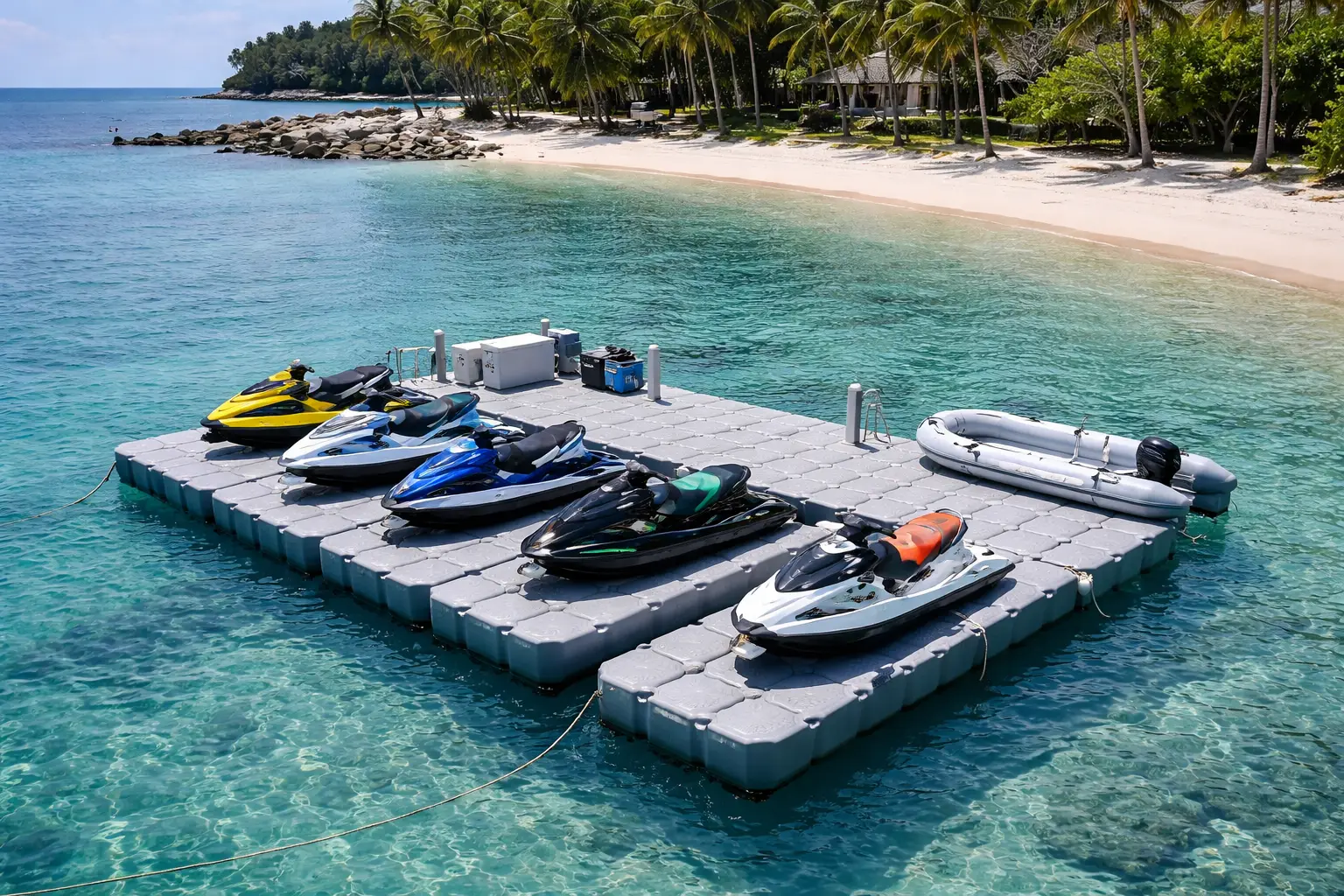
For standard PWCs, the required modular footprint is determined by the machine’s beam width and hull length. A professional jet ski dock price estimate starts with space measurement rather than just component counting. Most 3-seater PWCs require a platform approximately 5ft x 12ft. To ensure safe dry-docking, the configuration must include a specialized central V-hull channel and enough surrounding buoyancy to keep the intake grate completely clear of water, preventing marine growth and hull blistering.
Buoyancy Dynamics for Small Skiffs & Ribs (12′-16′)
Moving up from a PWC to a small skiff or Rigid Inflatable Boat (RIB) requires a shift in module density. The challenge here is uneven weight distribution – most of the mass is concentrated at the transom due to the heavy outboard motor. Therefore, the docking footprint (typically 7ft x 16ft) cannot simply be a uniform rectangle of standard cubes. It demands high-density U-shaped stern modules to provide extra lift at the rear. This engineering ensures the engine skeg clears the waterline without creating an excessively steep drive-on angle at the bow.
Center Console and Pontoon Boat Module Logic
When transitioning to a 22-foot center console or pontoon boat, the jet dock cost is driven by a strict engineering formula rather than guesswork. B2B infrastructure standards dictate that your dock must account for structural redundancies. This significantly expands the footprint (often to 10ft x 25ft or more) compared to standard recreational setups.
Important: The B2B Buoyancy Calculation Standard
Required Buoyancy = (Live Load + 30% Safety Redundancy) / 350kg/m2
*Live Load = Vessel Dry Weight + Full Fuel/Water Tanks + Max Passenger CapacityDecoding the Quote: Core Components That Drive Up Your Bill
Advanced HDPE Engineering and Structural Physics
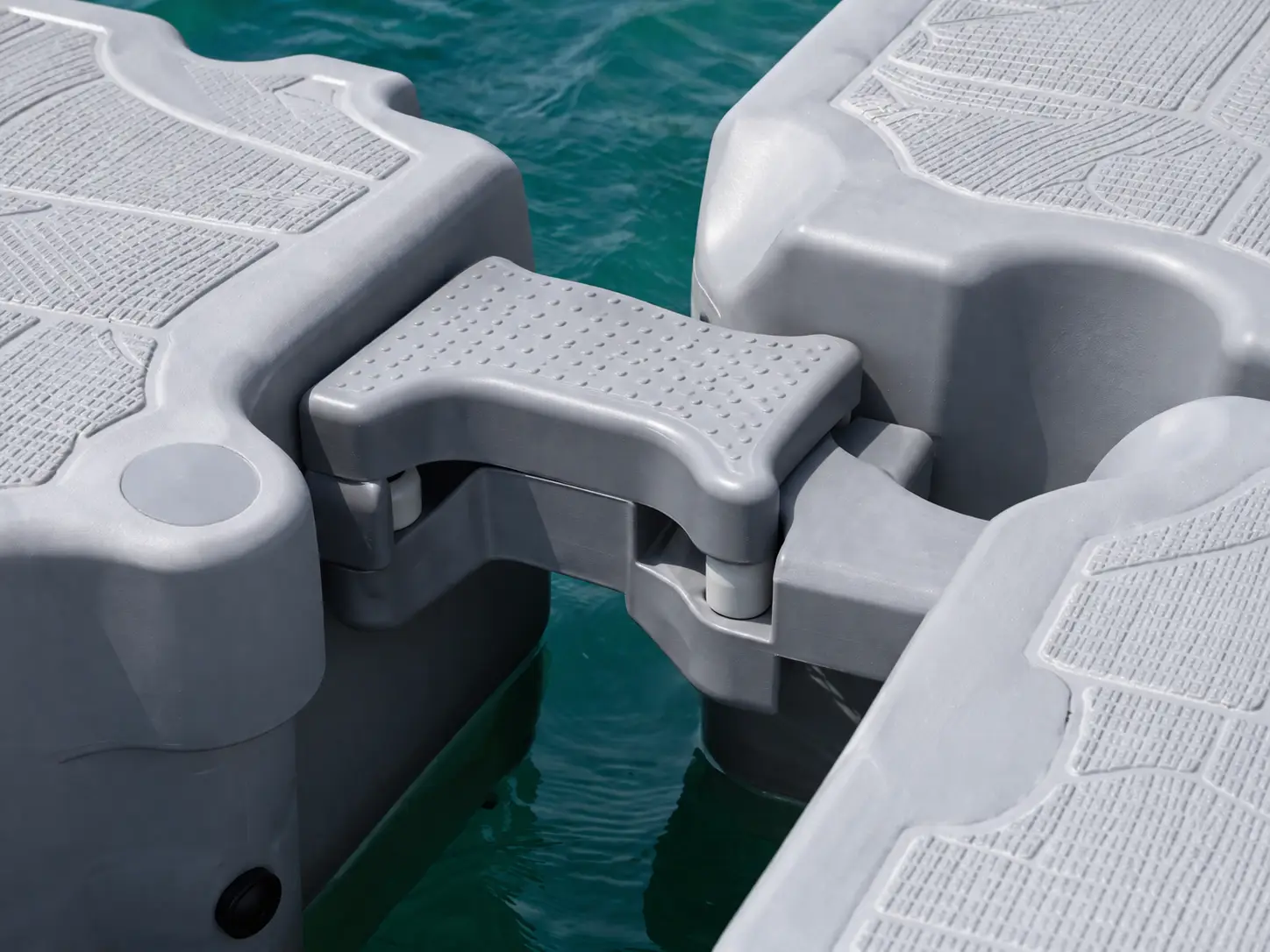
Why do modular cubes command such a premium? The secret lies in High Molecular Weight HDPE. Unlike cheap consumer-grade plastics, premium industrial modules utilize advanced large-scale blow molding technology to achieve a consistent and robust wall thickness distribution across the entire cube. This is critical for maintaining structural integrity under the extreme stress of driving a multi-ton boat onto the platform.
When evaluating quotes, scrutinize the connection lugs. Standard cubes might snap under tidal stress, but premium cubes feature lugs up to 19mm thick – 40% thicker than the industry average. These modules are engineered to withstand extreme temperature tolerances from -60°C to 80°C, ensuring a maintenance-free lifespan of 15 to 20 years.
Mooring Solutions and Marine Variables
The largest variable in any marine quote – often left out of preliminary estimates – is the anchoring system. A dock in a stagnant lake uses standard, inexpensive anchoring. However, installations in tidal zones or deep saltwater require marine-grade deep-water piling systems and tide managers. These specialized hardware components prevent structural failure during storm surges but can drastically shift the final baseline price.
| Water Condition | Required Anchoring System | Estimated Cost Multiplier |
|---|---|---|
| Still Lakes / No Tide | Standard Stiff-arm or Galvanized Steel Pipes (with PVC Sleeves) | 1.0x (Baseline) |
| Moderate River Currents | Heavy-Duty Galvanized Steel Poles & Brackets | 1.3x – 1.5x |
| Deep Saltwater / Tidal Variance | Marine-grade Piling & Tide Managers | 1.8x – 2.5x+ |
Essential Accessories and Boarding Hardware
To achieve a 100% comprehensive quote, you must account for the final 5% to 10% of your budget dedicated to functional finishing touches. Marine-grade mooring cleats, impact-absorbing perimeter fenders, and aluminum gangways for shoreline access are rarely included in base cube counts, but they are mandatory for a safe, turnkey docking experience.
The “Hidden” Expenses: Freight and Professional Marine Labor
When asking how much do docks cost, many buyers are blindsided by logistics and labor. Modular cubes are high-volume items; LTL (Less-Than-Truckload) freight for a full-sized boat dock can easily reach four figures. Furthermore, while manufacturers claim “DIY-friendly” setups, professional watercraft docking for large vessels often requires a professional marine contractor. In North American and European markets, the mobilization fee for a work barge or specialized assembly crew typically starts at $1,500 and can easily exceed $3,000+ for complex, deep-water installations.
Quantifying Long-Term ROI: Floating Docks vs. Mechanical Lifts
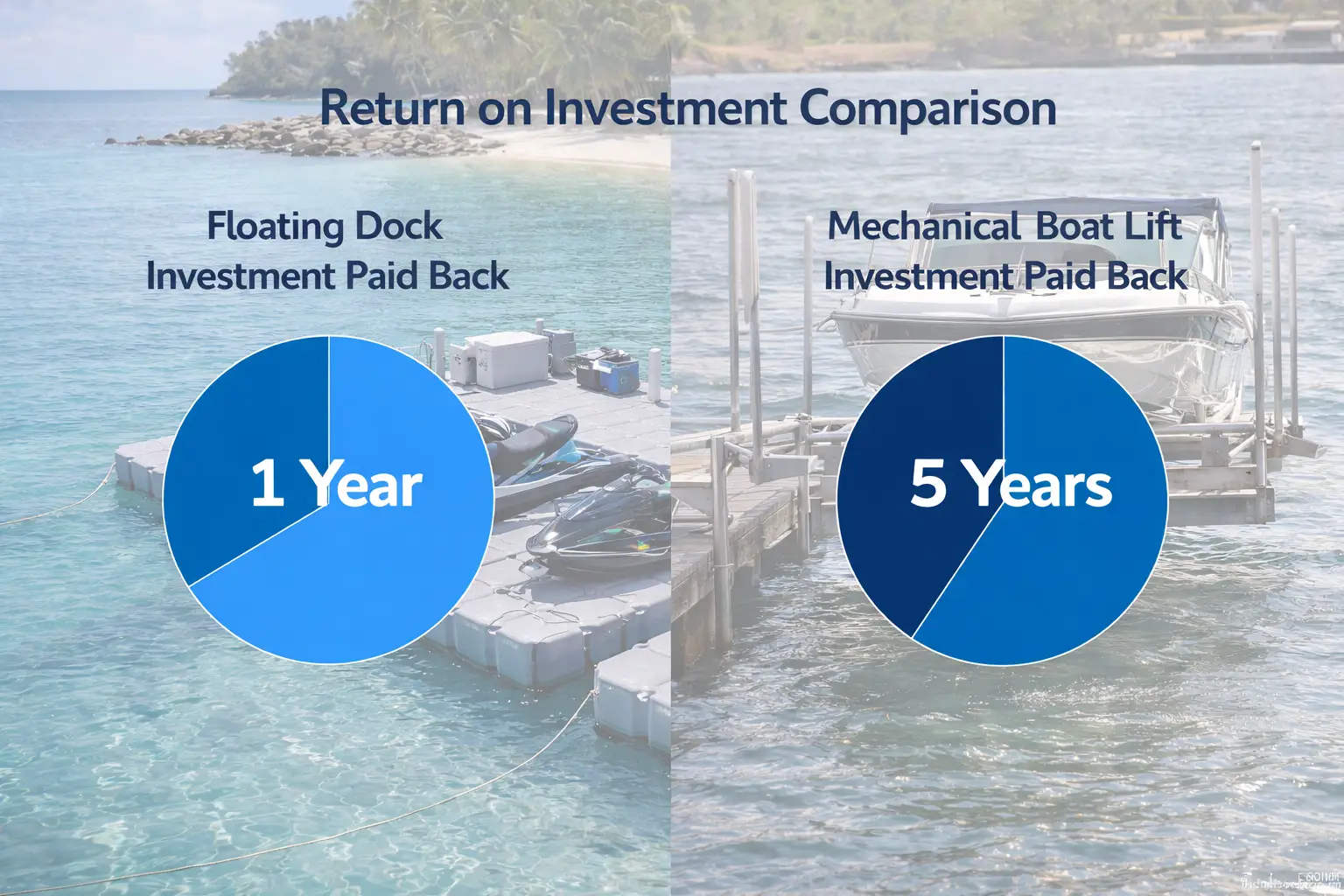
To justify the initial capital, compare the TCO (Total Cost of Ownership) against traditional aluminum mechanical boat lifts for sale. Mechanical lifts suffer from frayed cables, hydraulic fluid leaks, and motor corrosion. A floating drive-on system, however, completely removes the boat hull from the water. By eliminating the need for annual bottom cleaning and anti-fouling maintenance – which costs $1,200 to $1,800 annually for a 25ft boat – a premium HDPE dock typically achieves full payback within 6 to 8 years.
Beyond standard maintenance savings, floating systems offer unparalleled storm resilience. Unlike fixed mechanical lifts that can fail or submerge vessels during storm surges, modular docks rise and fall with the extreme tides, absorbing wave impact and preventing catastrophic hull damage against rigid pilings. This risk mitigation preserves your vessel’s pristine condition and protects your core asset’s resale value.
Market Alternatives: Evaluating Top Competitors and the Used Market
The Risks of Second-Hand Floating Systems
Searching for a used shoreport jet ski dock price or wave armor jet ski dock price is tempting but risky. Ten-year-old plastic may suffer from invisible UV degradation. More importantly, used docks rarely include the specific anchoring hardware needed for your shoreline. By the time you purchase replacement pins, custom V-floats, and a new mooring system, your “budget” used dock will closely rival the price of a brand-new system without any warranty protection.
Premium Brands vs. Direct-to-Manufacturer (OEM) Solutions
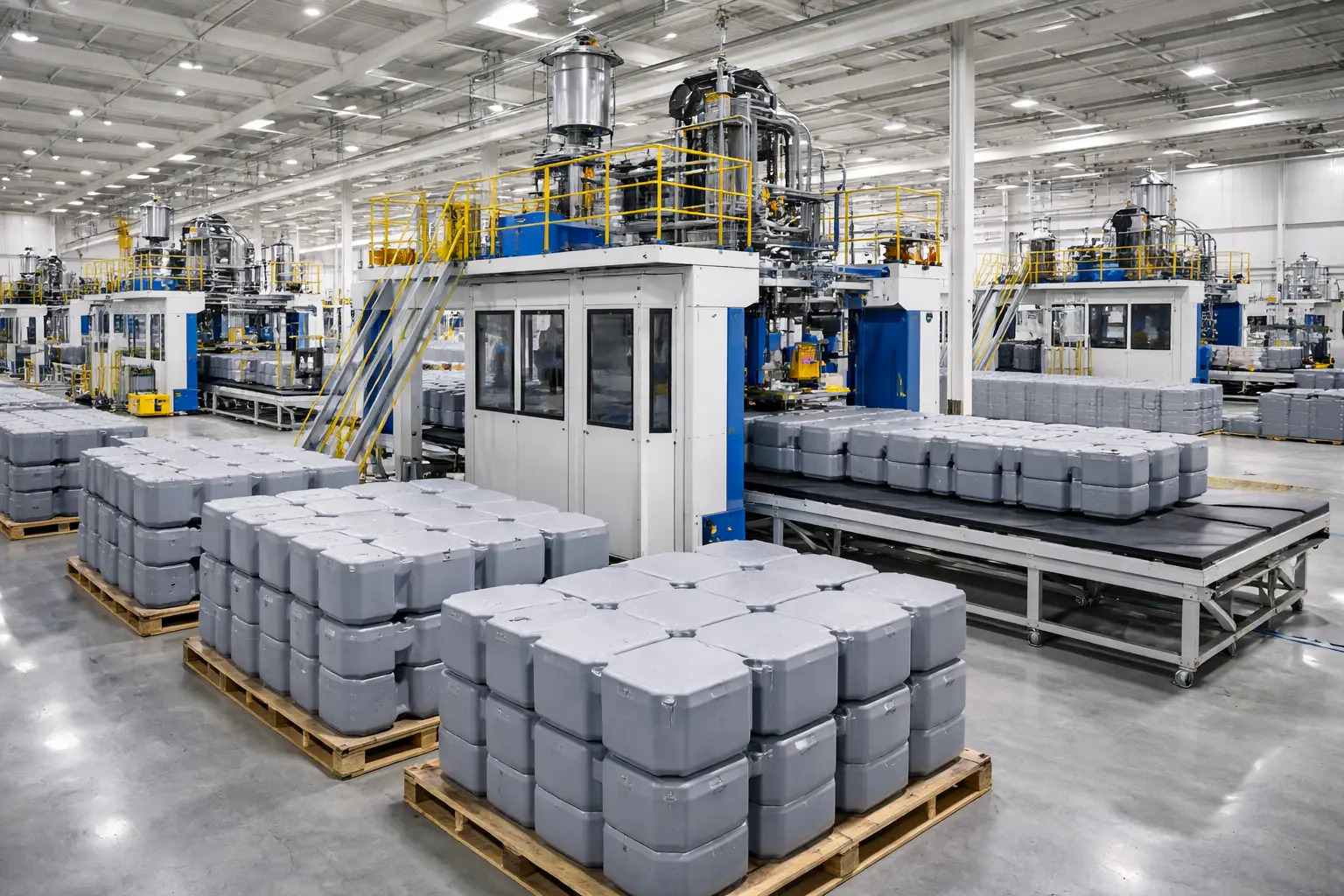
Savvy marina managers and boat owners are increasingly bypassing dealer markups. Sourcing directly from a global manufacturer like Hiseadock – with 16 years of expertise and international certifications (ISO-9001, CE, SGS) – allows you to access industrial-grade engineering at factory pricing. With a 5,000+ m2 facility producing 1,120 pieces daily, Hiseadock utilizes advanced CBM (Cubic Meter) optimization and high-density container loading strategies to drastically cut international shipping costs.
To counteract the exorbitant local marine contractor fees mentioned earlier, Hiseadock provides a complete closed-loop solution. Every order is delivered with contractor-grade engineering blueprints and comprehensive step-by-step video tutorials. This empowering technical support allows standard local dock builders – or even capable DIY owners – to execute the assembly efficiently, effectively eliminating unpredictable local labor markups while securing a solid 5-year warranty.
Quick Start: Simply tell us your boat model and average water depth, and our engineering team will handle the complex math.
Request My Custom 3D Layout & Landed Cost Estimate

 English
  Thai
Thai  Spanish
  French
  German
  Dutch
Dutch  Italian
  Arabic
  Indonesian
  Portuguese
  Turkish