
Floating Dock Sizes: Why Height, Not Footprint, Decides What Your Dock Carries
Most of the floating dock sizes you’ll find quoted online are assembled footprints measured in feet. The familiar bands look like this. A small dock runs about 6 × 12 to 6 × 16 feet and suits kayaks, paddleboards, and a place to sit. A medium dock runs 8 to 10 feet wide by 20 feet long and takes a motorboat plus a couple of chairs. A large dock starts around 12 × 24 feet and is really an outdoor room built over water.
Common Floating Dock Size Bands
| Band | Typical Footprint | What It’s Used For |
|---|---|---|
| Small | 6 × 12 to 6 × 16 ft | Kayaks, paddleboards, fishing, a few people |
| Medium | 8–10 ft × 20 ft | One motorboat, seating, swimming access |
| Large | 12 × 24 ft and up | Entertaining, multiple craft, lounge furniture |
Source: Published dock-builder sizing guides
The other number buyers reach for is length, and it’s derived from the boat rather than from the water. Published guidance puts a dock at roughly two-thirds of your vessel’s length. A 15-foot boat pairs with a dock of at least 10 feet. It scales from there: 25 feet pairs with 17, 35 with 24, 45 with 30, and 55 with 37. One widely repeated figure states the industry consensus minimum for a stable floating dock at 6 × 20 feet with a combined weight of at least 1,000 lb.
Here is where you should slow down. Those bands are not as settled as they look. Three sources, all current and all from companies that build docks for a living, define “small” three different ways. One puts it at 6 × 12 or 6 × 16 feet. Another sets a minimum of 6 × 20 feet. A third, describing a small personal platform, says 4 to 5 feet wide by 8 feet long. The smallest of those is less than half the area of the largest. If the category labels don’t agree, the labels aren’t the specification. Something underneath them is doing the actual work, and it isn’t the length or the width.
Turning a Footprint Into Blocks: The Modular Grid
If you’re buying a modular dock, the unit you order is not measured in feet at all. It’s a block, and the block has a fixed footprint. In the metric modular systems that dominate international supply, that block is 500 × 500 mm. That’s 19.685 inches, or 1.64 feet, on a side, covering 0.25 m² (about 2.69 square feet) per block.
So the first real conversion is this: your target width is not an order quantity. Your block count is.
Reading Your Target Width as a Block Count
Divide your target width in metres by 0.5, then round to whole blocks. Because 500 mm is a little under 20 inches, the blocks don’t land on round imperial numbers. The count you need is almost always one more than a quick estimate suggests.
Target Width to Block Count (500 mm grid)
| Target Width | Blocks Needed | Actual Grid Width |
|---|---|---|
| 3 ft | 2 blocks | 1.00 m = 39.37 in |
| 4 ft | 3 blocks | 1.50 m = 59.06 in |
| 6 ft | 4 blocks | 2.00 m = 78.74 in |
| 8 ft | 5 blocks | 2.50 m = 98.43 in |
| 10 ft | 6 blocks | 3.00 m = 118.11 in |
| 12 ft | 8 blocks | 4.00 m = 157.48 in |
Source: Unit footprint 500 × 500 mm; conversions computed
Read the last column carefully, because the rounding cuts both ways. A 12-foot target built from 8 blocks comes out at 13.12 feet, so you’ve bought about 9% more dock than you asked for. A 10-foot target built from 6 blocks comes out at 9.84 feet, which is under. Being over costs money. Being under costs freeboard, and freeboard is the margin you can’t get back without ordering another row.
The Minimum Width Rule — and Where It Comes From
Width has a floor. A walking platform needs at least three blocks across. On a 500 mm grid that’s 1.5 metres, or 59.06 inches. That’s comfortably above the 36-inch minimum clear width the ADA requires for an accessible route serving recreational boating facilities (U.S. Access Board, Chapter 10: Recreational Boating Facilities). Note the distinction that trips people up. The 36 inches is the accessibility floor. The 48 to 60 inches is the width facilities commonly choose so two people can pass, which is a practice, not a rule. Three blocks lands at the top of that practice range. Two blocks (39.37 inches) clears the legal minimum and nothing more.
For comparison, residential sizing guides put comfortable at 6 feet, or four blocks. Three blocks is what you can walk on; four is what you want to walk on with something in your hands.
Three steps from a width to an order
Measure the width
Take your target width in metres, not feet.
Divide by 0.5
One block per 500 mm of width.
Round up, not down
The under side has no margin left in it.
Why Height, Not Footprint, Decides What a Floating Dock Carries
Here is the part the footprint conversation quietly skips. Two docks can have identical length and width and carry nearly twice different loads, because the variable that sets carrying capacity is the block’s height. And height almost never appears in a sizing guide.
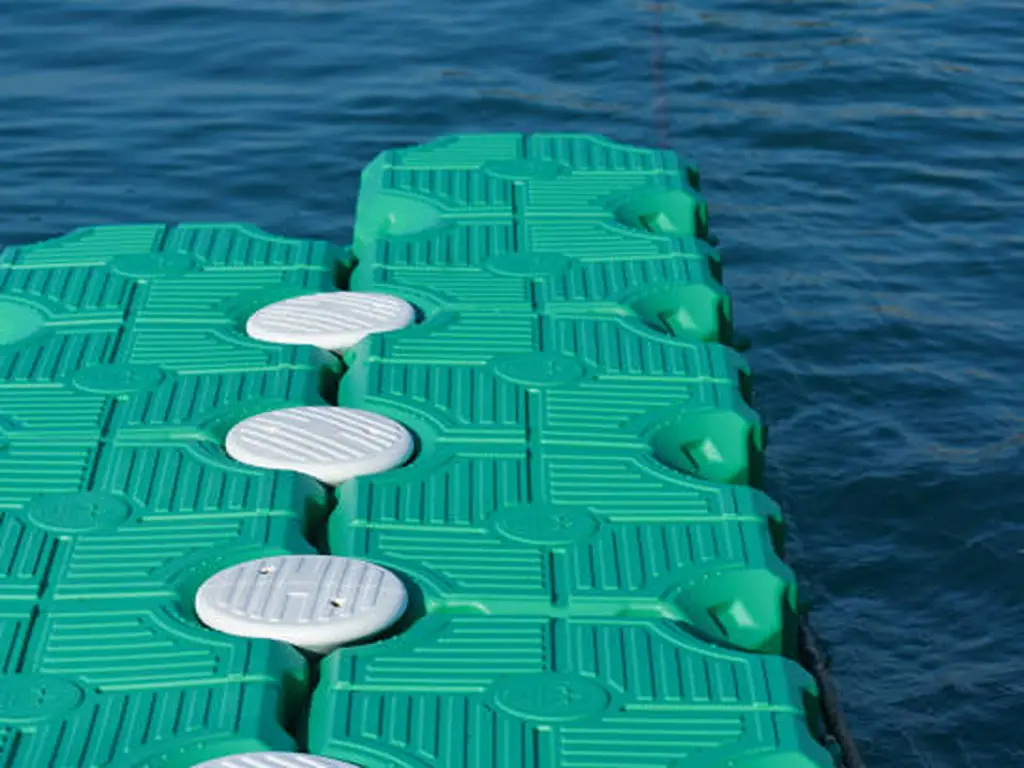
Modular cube systems are sold in height tiers, and each tier is rated separately. A 500 × 500 × 250 mm block is rated 220 kg/m². The 500 × 500 × 400 mm block is rated 350 kg/m². The 500 × 500 × 500 mm strengthened block is rated 420 kg/m². Same footprint on all three. Same number of blocks in the same grid.
Three Heights, Three Load Ratings
Converted to imperial, the spread is 45.1, 71.7, and 86.0 lb/ft². That’s a range of 1.91×, decided entirely by which height you specified and not at all by how big you made the dock.
Same footprint, three different load ratings
1.91× — same footprint, same block count.
Source: Published unit ratings; freeboard computed from the published 2–4 in light-load draft.
That 1.91× figure is the one to carry with you. It is the difference between a dock that feels solid under four adults and one that puts your feet near the water. It lives entirely in a number most buyers never ask about.
Freeboard: What the Height Leaves Above Water
Freeboard is the distance from the waterline to the top of the deck. It is what you actually feel when you step on. Published targets for residential docks run 12 to 14 inches in one guide and 12 to 18 inches in another. Marinas run 18–24 inches, and commercial work 24 inches and above.
Subtract the light-load draft of 2 to 4 inches from each height tier and the alignment becomes obvious. The 400 mm block lands inside the residential band. The 250 mm block sits below it as a deliberately low-profile option. The 500 mm block sits at the band’s upper edge, where commercial and marina work begins. The height you choose is the freeboard you get, and the failure mode is always the same direction. On a boating forum thread that ran for two years, one builder put it plainly after finishing his dock. It sits close to the water. Looking back, he’d have used larger drums so the deck sat higher. Another learned it the hard way with foam-core floats that took on water. The tops started about six inches above the surface and ended level with it.
If you want the height tier to be a specification rather than a guess, Hisea Dock builds to three standard heights: 250, 400, and 500 mm. Height is one of the dimensions we can set per project.
Rated Buoyancy vs. Usable Load: The Freeboard Discount
The buoyancy number on a float’s datasheet is a rating at full submersion: the float completely underwater, deck at the waterline. That is a reference figure, not a working one. Every float manufacturer’s number works this way.
The same thread that produced the builder’s regret produced the correction: a float “only supports that much when it is completely submerged. 1/2 way under water each drum will only hold up 125 lbs” (Alaska Outdoors Forums, Building a floating boat dock).
The same six floats, two very different numbers
The same six floats. The same dock. Two numbers that look nothing alike.
So the chain runs: total the dead load and the live load, add a safety margin of 10–20%, divide by the per-block rating. Then stop, because that answer describes a dock that is nearly underwater. Derate it for the freeboard you actually want. Only then is the number usable.
Two more things belong in that calculation. Load is not always spread evenly. Three people standing on one side put their weight on that side’s blocks alone, which is why width and block count matter as much as total area. And the live load you’re designing for is a local decision, not a universal one. Published figures range from 20 psf in one federal guidance document to 100 psf in a resilient-marina guidebook and in public gangway specifications. One state building code puts private piers at 40 psf. Those aren’t competing answers to the same question. They’re different jurisdictions asking different things. Confirm the number your local authority names before you size anything.
The rated buoyancy on a float or block is a fully-submerged figure. At a residential freeboard of 12–18 in, usable capacity can be roughly one third of it. Never carry the rating straight into a purchase decision.
Buying and Specifying by Load Class Instead of Square Feet
Put the three findings together and the practical conclusion falls out.
The same footprint carries 1.91× more or less depending only on block height. The published rating that buyers compare is a fully-submerged figure that overstates usable capacity by roughly 3×. And the market’s own vocabulary for footprint (small, medium, large) doesn’t agree with itself across three credible sources.
That leaves “how many square feet” as a poor anchor for a purchase. A quote written in square feet collapses three different load classes into a single number. Buyers then either over-order or under-order. Over-ordering means paying for capacity nobody asked for, and comparing badly on price against a quote that quietly specified the low tier. Under-ordering shows up as wet feet on a dock that sits too deep.
The fix is not complicated. Organise the choice by load class first, then let footprint follow as a second column. Start from what the dock has to hold, not from how long it is.
That’s the order we build our own range around. Hisea Dock manufactures modular HMW-HDPE floating dock cubes in three heights, and each cube carries real structural specification rather than a marketing line. That means 19 mm connection lugs, grooves on all four sides, reserved pin and bolt holes, sealed threaded end caps, and a moulded anti-skid surface. There’s a diagonal tensile test at a maximum force of 14,389 N recorded for the material (how the cubes are built). A standard 500 × 500 mm cube is a 7 kg block rated 350 kgs/m² in the 400 mm height. Because load class is the axis buyers actually need, we size projects that way too. We back the result with a 5-year warranty against damage and 24/7 after-sales support. Anchoring options cover pipes, deadweight anchors, piling brackets, and stiff arms, with installation guidance and full spares supply behind them.
If you’re comparing quotes that all say “6 × 12” and none of them say what height, that’s the gap to close first. Tell us what you’re docking and how you board, and how many people you expect on deck at once. We’ll build the specification from the load class up.
Before you order
- Local design live load, which varies 20–100 psf by jurisdiction
- Target freeboard for your use: 12–18 in residential, 18–24 in marina
- Block height tier that delivers it
- Block count for your target width, rounded up not down
- One-sided and concentrated loads, not just total weight
Size your dock from the load class up
Tell us the boat, the boarding, and how many people you expect on deck. We’ll come back with the block count and the height tier that fits.
Request a sized specificationReferences
- U.S. Access Board. “Chapter 10: Recreational Boating Facilities.” https://www.access-board.gov/ada/guides/chapter-10-boating-facilities/
- U.S. Coast Guard. “Assumed Average Weight per Person (AAWPP).” https://www.dco.uscg.mil/aawpp/
- Federal Register. “Passenger Weight and Inspected Vessel Stability Requirements.” https://www.federalregister.gov/documents/2010/12/14/2010-30391/passenger-weight-and-inspected-vessel-stability-requirements
- National Oceanic and Atmospheric Administration. “Floating Dock Design Guidance.” https://repository.library.noaa.gov/view/noaa/35452
- North Carolina Office of the State Fire Marshal. “NCBC Section 3608 — Piers and Docks.” https://www.ncosfm.gov/b-2-2024-ncbc-section-3608/open
- Mississippi Department of Marine Resources. “Resilient Marina Guidebook, Volume II.” https://dmr.ms.gov/wp-content/uploads/2021/12/Clean-Resilient-Marina-Guidebook-Volume-II-reduced.pdf
- Alaska Outdoors Forums. “Building a Floating Boat Dock.” https://forums.outdoorsdirectory.com/threads/building-a-floating-boat-dock.95173/
- Hisea Dock. “Floats, Accessories, Tools.” https://www.hiseadock.com/products/
- Hisea Dock. “Modular Floating Dock Cubes.” https://www.hiseadock.com/modular-floating-dock-cubes/
- Hisea Dock. “Single Float.” https://www.hiseadock.com/product-item/single-float/
- Hisea Dock. “Hisea Dock.” https://www.hiseadock.com/

 English
  Thai
Thai  Spanish
  French
  German
  Dutch
Dutch  Italian
  Arabic
  Indonesian
  Portuguese
  Turkish