
HDPE UV Resistance: Why the Same Material Lasts 3 Years in One Place and 50 in Another
Search for HDPE UV resistance and you will find two answers that cannot both be true. One says unstabilized high-density polyethylene degrades within a year or two in direct sun. Another says the same polymer, properly formulated, is rated for fifty years outdoors. Both are talking about HDPE. Neither is lying.
The difference is not in the material’s name. It is in how much of that material sits behind the surface the sun actually reaches. Almost no page about HDPE UV resistance puts that fact near the top.
What Actually Makes HDPE UV-Resistant
Ultraviolet radiation is only about 4.6% of the sunlight spectrum. But it lands in the 290–400 nm band, and that is energetic enough to break the C–H and C–C bonds in a polyethylene chain (Plastics Pipe Institute, 2024). Polyethylene is most sensitive at 300–310 nm and again at 340 nm. Once a photon starts that reaction, it becomes self-propagating. A broken bond creates a free radical. The free radical forms a peroxy radical, then a hydroperoxide, and the hydroperoxide splits into two more chain fragments. Molecular weight falls, and the plastic goes from flexible to brittle.
HDPE on its own has essentially no defense against this. What defends it is an additive package, and the package comes in three families:
- UV absorbers: the workhorse for HDPE is carbon black, which absorbs and scatters UV across the full 290–400 nm band and converts the energy to heat
- Quenchers: nickel compounds, common in agricultural film
- Hindered amine light stabilizers (HALS): these continuously regenerate themselves as they clear free radicals
Carbon black earns its place because it works through overlapping mechanisms at once. It screens incoming radiation, and it scavenges the radicals that get through. Surface groups on the particle also break down the hydroperoxides that would otherwise drive a second wave.
Where does that leave HDPE among plastics? It degrades more slowly than PVC at equivalent exposure, but it is not in the same class as a stabilized polycarbonate or acrylic in an optical application. The honest position is that the ranking moves with the conditions. That is the whole problem with a ranking.
So why do two credible sources disagree by a factor of twenty? Because they are describing two different amounts of material.
Why Thickness Decides the Answer: Two Different UV Regimes
Put the two numbers side by side. An unstabilized HDPE sample in a fluorescent UV weatherometer loses roughly 98% of its toughness in 300 hours, with elongation at break collapsing from over 1,200% to about 21% (Legacy HDPE). Load 2–3% well-dispersed carbon black into the same resin, and ASTM D2513 treats the compound as stabilized against UV deterioration for not less than 10 years. The Plastics Pipe Institute notes that studies on 2% carbon black indicate 20 years and up to 50 (PPI TN-47, 2024).
Nothing about the polymer changed. What changed is how far the sun has to travel before it runs out of material to attack.
The surface is the only part the sun reaches
UV exposure affects the surface layer of a polyethylene part. Published figures put the exposed depth at roughly the outer 0.1 mm (International Equipments, 2025). Everything behind that layer is shielded not by an additive decision but by geometry.
That single fact reorganizes the entire question. “How UV-resistant is HDPE?” is the wrong question. The right one is: how much material sits behind the surface, and is that material stabilized all the way through? A part whose wall is thinner than the exposure depth is degraded across its whole section. A part with a thick wall has a sacrificed outer skin and an intact core. The two behave nothing alike.
Three bands, three stabilizer strategies
The division is not arbitrary; it follows the ratio of surface area to volume.
| Band | Typical form | What UV does | Stabilizer strategy | Order-of-magnitude life |
|---|---|---|---|---|
| Thin-wall | Monofilament, film, thin tubing | The entire cross-section IS surface | Carbon black screening is not enough — needs HALS free-radical cycling. Professional grades run 2.5–3% HALS; budget grades at 1% go brittle in 1–2 seasons | 1–3 years |
| Mid-wall | Sheet, pressure pipe, geomembrane (0.75–3.0 mm) | A defined surface layer degrades; the core stays protected | Carbon black is the workhorse: 2–3% by weight. IS 4984 specifies 2.5 ± 0.5%; absorption efficiency plateaus at 2.0–2.5%, and above 3.0% adds agglomeration risk without adding protection | 20–50 years |
| Thick-wall | Rotationally molded parts (6–8 mm and up) | Slow surface degradation, with a long buffer before structural consequences | Carbon black distributed through the full wall; stabilizer DISTRIBUTION matters more than the headline percentage | Set by thickness and duty, not by the additive alone |
Source: PPI TN-47 (2024); IS 4984; GRI-GM13 Rev 19; EyouAgro
The carbon black versus HALS argument you will find elsewhere is not a real controversy. It is a question about form. Thin sections cannot screen their way out of the problem because there is no “behind” to hide in, so they need a chemistry that works at the surface. Thick sections can. Choosing a material and choosing a wall thickness are the same decision. Making them separately is how a specification ends up with a stabilizer package that does not match the part.
UV only consumes the surface. How much material sits behind it is the denominator of service life.
What Raises the Requirement: Site, Temperature, and Color
A year is not the same length everywhere. Continuous outdoor irradiation runs about 220 kcal/cm²/year in Sudan against 70 in Sweden (PPI TN-47, 2024), more than a threefold spread before anything about the product changes.
That is why accelerated weathering hours mean nothing until you anchor them to a location. Roughly 2,000 hours of xenon arc exposure equals one year outdoors in Florida; 1,250 hours equals a year in Southern California; 1,000 hours equals a year in Southern Canada. The identical test report describes three different products depending on where the part is installed. Temperature compounds it: degradation accelerates above 40°C, which makes Mediterranean and tropical sites harsher than their latitude alone suggests, and altitude adds another step on top of that.
One test report, three different products
Source: PPI TN-47, 2024
Color carries a bigger penalty than most buyers expect. Under ASTM D2513, black compound containing 2–3% carbon black (Code C) is treated as stabilized for not less than 10 years of unprotected UV exposure. Colored compound (Code E) is stabilized for not less than 3 years. Staying with a brand color is not a pigment substitution. It is a drop of more than one certification tier, unless the formulation carries a higher-cost HALS or absorber package to compensate. The practical move is to confirm whether the color must be non-black. If it must, ask for the additive package and its supporting test data, not for reassurance.
How to Verify a “UV-Stabilized” Claim Before You Order
“UV-stabilized” is a label, not a measurement. Three numbers make it checkable, and each has a published test method behind it.
Step 1: Ask for carbon black content. ASTM D1603 determines it by combustion under nitrogen at 550–600°C. The polymer burns away, the carbon black remains, and the residue is weighed. Accept the 2.5 ± 0.5% range.
Step 2: Ask for dispersion grade. Content tells you how much carbon black is present. It says nothing about whether the carbon black is spread evenly. ISO 11420 grades dispersion from 1 to 5 by microscopy, and the acceptance line is Grade 3 or better. This is where a batch can pass the content test and still be unfit for service.
Step 3: Ask for weathering data. ASTM D4329, D2565 and G155, or ISO 4892-2 and 4892-3, with the result expressed as percent retention of elongation at break. Fifty percent retention is the industry pass line, and ASTM D3350 requires the unexposed compound to start above 400%. GRI-GM13 applies the same logic to HDPE sheet, requiring 50% retention after 1,600 hours under ASTM D7238.
Then the part most buyers miss. Content and dispersion are two independent requirements that do not compensate for each other. A batch measuring 2.5% carbon black with Grade 4 dispersion must be rejected, and a batch with excellent dispersion at 1.5% content is not rescued by it. There is no averaging between the two tests. One more condition applies. The thickness of the test specimen decides what the result can be extrapolated to. A weathering result generated on a thin plaque does not transfer to a part whose wall is an order of magnitude thicker.
Four questions to put in your quotation request
- Carbon black content, by ASTM D1603 — target 2.5 ± 0.5%
- Carbon black dispersion, by ISO 11420 — Grade 3 or better
- Weathering hours and retained elongation, by ASTM D4329 / D2565 / G155 or ISO 4892
- The wall thickness the weathering result was generated on
Source: PPI TN-47; GRI-GM13 Rev 19; International Equipments
UV Aging on a Thick, Half-Submerged Part: Chalk Is Not Failure
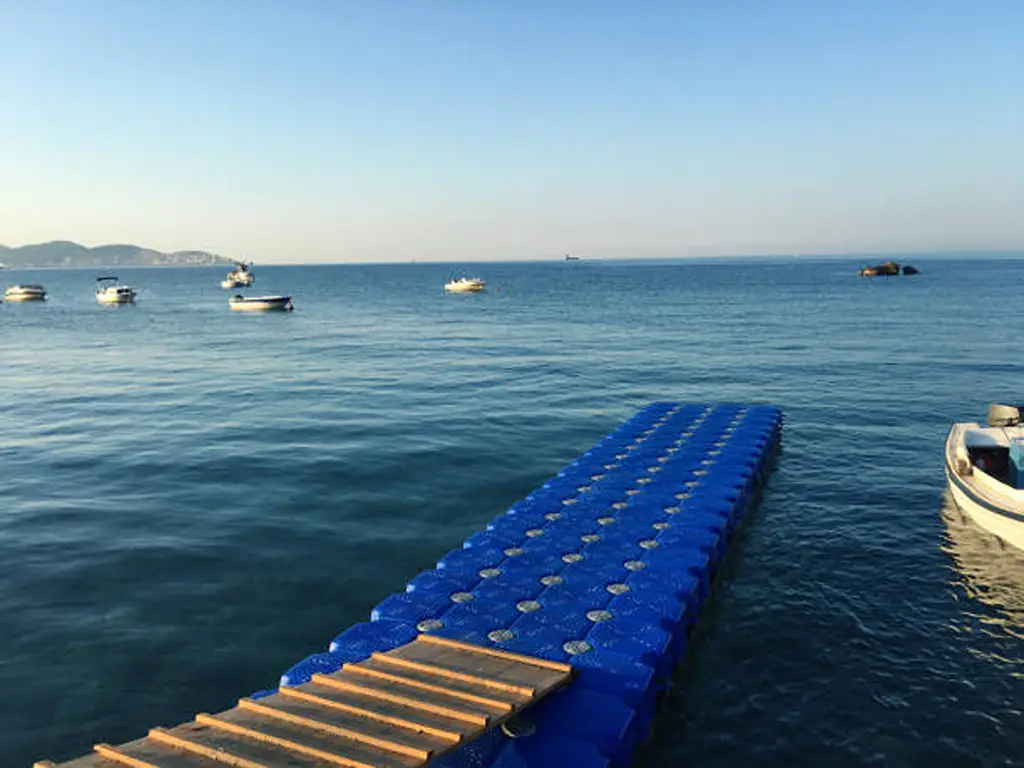
Now bring all of that to a floating dock pontoon. The cube is rotationally molded HDPE with a wall in the 6–8 mm range, half in the water and half in the sun. It is expected to hold load for fifteen to twenty years.
Two regimes on one part
A pontoon lives in two environments at once, and they are not the same environment. The sun-exposed face takes UV plus heat plus the wet-dry cycling of every wave and rain event. The submerged face takes water, dissolved oxygen, and marine growth, an entirely different set of stressors that no UV specification addresses.
Treating “aging” as one phenomenon collapses them. Inspecting for UV damage on a surface that has spent a decade underwater is looking in the wrong place, and a submerged-face problem will not show up as chalking.
Reading the surface: chalk, then what
On a thick, through-colored part, the surface sequence runs fading → chalking → microcracking → crack growth. The first three stages remain surface events. The transition from microcracking to crack growth is the point of practical interest, because that is where appearance stops tracking structural condition.
Here is the property that separates this from a coated system. Carbon black is compounded into the resin before molding, so it is distributed through the full wall section, not applied on top. A scratch or an abrasion on such a part exposes more stabilized material. A scratch on a gelcoat or a painted surface exposes substrate that was never formulated to see the sun. For a thick-walled part, the protection is the material itself. Damage stays local instead of becoming systemic.
That yields a decision tool rather than a rule of thumb:
| Application / exposure regime | Dominant degradation path | Parameters to confirm before ordering | Signal that warrants replacement |
|---|---|---|---|
| Freshwater lake or river, seasonal sun (may freeze) | Freeze-thaw and mechanical impact ahead of UV | Wall thickness; low-temperature impact behavior; stated ice assumptions | Water ingress or seam separation — not surface color |
| Seawater or tidal, permanently immersed with strong reflected UV | UV and immersion alternating; salt accelerating surface aging | Carbon black content and dispersion; through-wall stabilization | Continuous cracking beneath the chalked layer |
| High-altitude or tropical sites | UV intensity and temperature amplified together | Weathering hours plus the geographic basis for the conversion | Evaluate before the locally corrected service life elapses |
| Platforms and swim floats, intermittent immersion | Wet-dry cycling plus live load | Load basis stated as area load (kg/m²) versus single-pontoon rating — the two are not interchangeable; anti-skid surface wear | Change in load behavior rather than appearance |
| White accessory parts (posts, balusters) | Cannot rely on carbon black screening at all | Stabilizer system for that part, with supporting test data | Chalking accompanied by loss of surface strength |
Source: PPI TN-47; GRI-GM13; field reports
And the finding that reframes the whole picture: on a dock, UV is usually not the direct cause of failure — it is the condition that makes other failures possible. Replaced pontoons most often fail mechanically. One marina manager left docks in year-round through three feet of ice. The pattern was consistent: a few floats replaced each year, mostly because a muskrat had chewed through or the seam on top had cracked and taken on water (iBoats forum, 2020). Neither is an ultraviolet failure. But both are easier on material that has spent a decade being weathered. A hole in one section also transfers additional stress to the surrounding wall, which a discussion of the same failure describes as “already aging plastic” (r/boating).
That is the whole reason chalking and load capacity are separate questions. A chalked surface is a surface observation. Whether the part still carries its rated load is a structural one. Answering the first as if it answered the second is how a serviceable dock gets condemned, or a failing one gets signed off.
Chalking is a surface reading, not a structural verdict. Tell us the age of the dock, the water it sits in and how it is moored, and we will tell you which of the two you are looking at.
Ask us to review your exposure regimeWhat This Means for the Dock Trade
Everything above points at one commercial fact: in floating docks today, UV performance is sold as a warranty year, not as a material specification. Retailers differentiate on the term. Neither publishes carbon black content, dispersion grade, or weathering hours, because in this trade there is no established expectation that they should.
Compare that with pipe and geosynthetics, where the same questions have had mandatory, public answers for years: content by ASTM D1603, dispersion by ISO 11420, and retained elongation after a defined weathering cycle. In those industries, the two tests are explicitly not allowed to average each other out.
For a dealer or distributor, that gap is a position, not a problem. A warranty year is unfalsifiable. It is a promise about the future, priced into the product and proven only when it fails. A carbon black percentage and a dispersion grade are checkable before the container ships. Moving the conversation from the first to the second changes what a buyer is doing: no longer deciding whom to believe, but deciding what to require. A distributor can act on that. An end customer, buying one dock, cannot.
What the two ways of selling UV performance actually tell you
It also changes the service conversation. When a customer points at a white, chalky pontoon and asks whether it is finished, the answer is that chalking is a surface event and the load question is separate. Because the stabilizer runs through the whole wall, damage is local and the affected section is replaceable. That is a materially different answer than “it’s still under warranty,” and it is one the customer can verify rather than trust.
The three numbers to put in the next quotation request are carbon black content, dispersion grade, and weathering hours with the thickness they were generated on. Suppliers who can answer will not mind being asked. Suppliers who cannot have just told you something useful.
Hisea Dock builds modular floating dock systems from UV-stabilized high-molecular-weight HDPE. If you want the material specification behind a quotation, or a read on the exposure regime at your site, send us your site conditions or start with our quality page.
Ask us for the three numbers behind the UV claim
Carbon black content by ASTM D1603, dispersion grade by ISO 11420, and weathering hours with the specimen thickness they were measured on.
Send us your site conditionsReferences
- Plastics Pipe Institute. “PPI TN-47: Polyethylene Resin Testing Requirements to Support ASTM D2513 UV Exposure Limits of Polyethylene Compound.” 2024 edition, revised October 30, 2024. https://plasticpipe.org/TN-47
- Geosynthetic Institute. “GRI-GM13 Standard Specification for Test Methods, Test Properties and Testing Frequency for High Density Polyethylene Smooth and Textured Geomembranes.” Revision 19, June 11, 2025. https://geosynthetic-institute.org/grispecs/gm13r.pdf
- International Equipments. “Carbon Black in HDPE Pipes: Why 2–3% Matters and How to Test It.” May 19, 2025. https://www.internationalequipments.com/blog/carbon-black-hdpe-pipes.html
- Legacy HDPE. “HDPE UV Resistance: How Carbon Black Protects Polyethylene.” https://legacyhdpe.com/hdpe-uv-resistance/
- EyouAgro. “Is HDPE UV Resistant? What UV Stabilizers Actually Do.” June 9, 2026. https://eyouagro.com/faqs/is-hdpe-uv-resistant/
- IFAN. “Does HDPE Resist UV Degradation?” November 24, 2025. https://ifanpro.com/does-hdpe-resist-uv-degradation/
- iBoats Forum. “Opinion on culvert/corrugated pipe style floating dock.” June 2020. https://forums.iboats.com/threads/opinion-on-culvert-corrugated-pipe-style-floating-dock.734045/
- r/boating. “Floating dock cracks in float.” https://www.reddit.com/r/boating/comments/1dfvken/floating_dock_cracks_in_float/
- Hisea Dock. “Quality.” https://www.hiseadock.com/quality/
- Hisea Dock. “Contact Us.” https://www.hiseadock.com/contact-us/
- Hisea Dock. “Hisea Dock.” https://www.hiseadock.com/

 English
  Thai
Thai  Spanish
  French
  German
  Dutch
Dutch  Italian
  Arabic
  Indonesian
  Portuguese
  Turkish