
How to Install a Dock Ladder on a Floating Dock: Where the Load Actually Lands
What You’re Actually Installing When You Install a Dock Ladder
A dock ladder looks like the subject of the job. It isn’t. It’s the first link in a chain. That chain runs from the bottom rung through the rails, the bracket, the fasteners and the decking, into the dock structure, and ends in the water. The chain breaks at its weakest link. When you’re hanging off the bottom rung with wet hands, the difference between “the ladder failed” and “the dock failed” is not one you care about.
One clarification first, because it saves a purchase. Dock ladders and boat ladders are not interchangeable. Dock ladders attach horizontally to the dock edge, so someone in the water can climb out onto the deck. Boat ladders mount vertically and grip a gunwale or transom. This is about getting out of the water onto a dock.
Three numbers decide whether a person can do that. Rungs about 12 inches apart. The top surface of the lowest step at least 22 inches below the waterline. That figure is borrowed from ABYC H-41, Reboarding Means, Ladders, Handholds, Rails and Lifelines, which is a boat standard rather than a dock requirement. And field practice runs more generous still: people who have watched someone struggle say the ladder should reach at least 2 feet into the water.
Three numbers that decide whether someone gets out of the water
12 in
spacing between rungs
22 in
minimum depth of the lowest step below the waterline (ABYC H-41, a boat standard)
2 ft
the working field consensus for how far a ladder should reach into the water
The failure this prevents is specific. Read enough accounts from people who have tried to reboard and the same pair of problems arrives together. The bottom rung is too high for a swimmer’s feet, and there is not enough above the water to grab as the load increases. A step floating two feet above the water gives you nothing to push against. A ladder with no handhold gives you nothing to pull on.
Siting, Levelling, Drilling, Fastening
The next stretch is the one every guide covers, and the procedure itself is well served. What follows is the sequence, plus the places where standard advice and field evidence stop agreeing.
Choosing the spot comes first, and the useful question is not “where is convenient” but “what is behind the decking here.” Bolt into something structural, whether that is a post, a pile or an edge beam, rather than into a flat panel that happens to be in the right place. Fenders and bumper floats compete for the same edge segments, and the ladder has to be where a swimmer can reach it.
Tools are unremarkable: a drill, a wrench, stainless fasteners and washers, backing material if the substrate calls for it. Stainless matters more than it looks, because a fastener that corrodes loses section and then pulls out.
Then level it, mark the holes through the ladder’s own mounting holes, and drill through. On a floating dock levelling is worth more than on a fixed one, for a reason that matters later. The deck-to-waterline distance stays constant, so a setting you get right once tends to stay right.
Fastening is where the sources you’ll find online stop agreeing. One tells you to drill bolt holes and fasten with lag bolts, in the same sentence, which is a category error: those are not the same fastener. One says lag screws or bolts in wood, anchors in cement. One specifies 3/8-inch hex bolts. One says composite decking needs pressure-treated 2×4 backing plates underneath or the fasteners will tear straight through. Four answers, none explaining what changes between them.
If you are building the ladder rather than buying one, the same sequence applies with one difference running through every step. Nobody has published a bracket, a hole pattern or a load figure for the thing you are making. You choose the substrate, the fastener and the reinforcement yourself. That is a reason to read the next two sections more closely than someone with a boxed product would.
The five steps, in order
Site it — into a post, pile or edge beam, clear of the fenders, reachable from the water.
Assemble tools — drill, wrench, stainless fasteners and washers, backing material, the ladder and handrail.
Level and mark — using the ladder’s own mounting holes; on a floating dock this setting holds.
Drill through.
Fasten — see the substrate table below before you pick the hardware.
How the Load Travels Down
Past the fastener, the ladder industry goes quiet. No manufacturer publishes a pull-out force, a torque specification or a bearing-area figure for its mounting hardware. The acceptance test in installation guides is a person standing on the rung to see whether it wobbles. That is not a criticism of any one maker. It is the state of the category. But from here down the chain you reason from first principles.
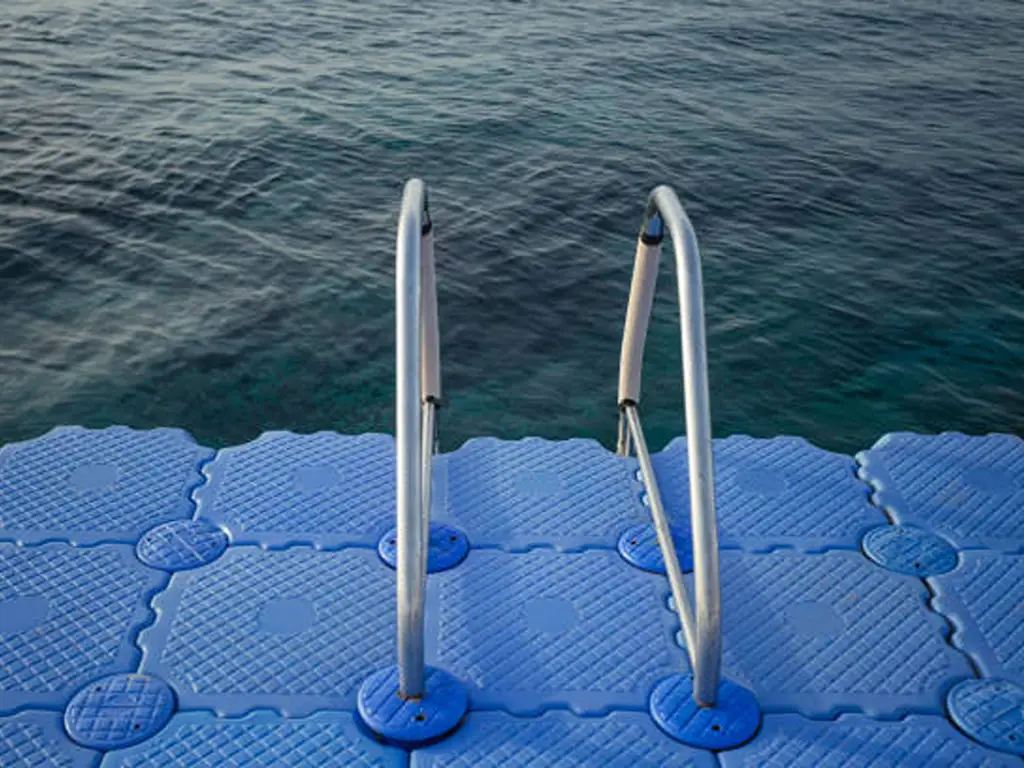
Shear or Pull-Out: Two Forces That Are Not Equivalent
A fastener can be loaded two ways, and the difference is not academic. A bolt passing through a panel with a nut and washer on the far side resists load in shear: the panel must be torn or crushed for the bolt to move. A lag screw driven into a panel resists load in pull-out. It holds only through the grip of its threads, and it is being asked to do the thing a screw is worst at.
The clearest account of this failing comes from a boat owner describing what happened when a 230-pound friend climbed his ladder: “I was swimming with friends off the back when my buddy who is 230#s tried to come up the ladder and it gave way.” Another member of the same forum diagnosed the design rather than the fastener: “loading hardware in a manner that is pulling on it, is bound to rip itself out.” The thread’s repair consensus was to drill oversize, epoxy, re-drill, and add a backing plate with through-bolts.
The detail that should stop you: the installation that failed was built the way the top-ranking how-to guides tell you to build it. None of them mentions backing plates or through-bolts.
Pull-out vs shear.
A lag screw into decking holds by thread grip and is loaded in the direction it is weakest. A through-bolt with a backing plate puts the panel in shear and spreads the load over area. Same hole, same location, different order of magnitude. If your fastener is being pulled rather than sheared, no amount of extra torque fixes the design.
Backing Plates: Spreading One Person’s Weight
A backing plate takes a load delivered at a few square centimetres and spreads it across a much larger area. On composite decking the failure without one is documented plainly, in fasteners that “can tear right through over time,” and the same source points to a pressure-treated 2×4 underneath as the remedy. For anyone building their own, it is the cheapest and most frequently skipped step. A piece of lumber and five minutes buys a load spread across a plate rather than concentrated at the edge of a hole.
Wood, Composite, Concrete: Three Different Ways to Fail
The four contradictory instructions above are not really contradictions. They are different failure mechanisms, described by people who did not say which one they meant.
Substrate, failure mode, and the action that follows
| Substrate | How it fails | What to check first |
|---|---|---|
| Wood | Not by tearing — the fastener corrodes, loses section, and then withdraws. Treated lumber accelerates this: zinc-plated fasteners in pressure-treated wood are widely reported to last only a few years. | Confirm the fastener grade suits treated timber, or step up to ceramic-coated or stainless. |
| Composite decking | Tearing — the panel is thin and the fastener pulls a plug of material out around the hole. | Confirm a backing plate is fitted before anything else. |
| Concrete | The anchor, not the panel: holding depends on embedment depth and the strength of what it is set into. | Confirm the anchor type is rated for the base material and the load direction. |
| Aluminium | Galvanic corrosion where dissimilar metals meet. | Confirm isolation washers or a dielectric barrier between ladder and dock. |
Put the four instructions beside the four failure mechanisms and one thing becomes clear. The advice disagrees because nobody has published the number that would settle it. Every installer is pattern-matching someone else’s installation rather than working against a specification. That is the same gap, one level down, that the next section is about.
Where the numbers stop
Every figure above stops at the fastener. If you are specifying the dock itself, we can send the connection rules and the load figure for each float cube, in writing.
Ask for the float load figuresWhere the Load Finally Lands
The last link in the chain is the dock itself, and it is the least documented of all, not because the information is hidden but because the published criteria answer a different question.
The Standard Draws a Line One Foot From the Edge
Both reference documents governing floating dock live loads qualify their point-load criterion by distance from the edge.
UFC 4-152-07, Piers and Wharves, Figure 6-3, read from the primary document, gives a floating pedestrian dock a concentrated point load of “400 lbs at any point on the dock at least 1 ft from the dock edge.” ASCE’s Planning and Design Guidelines for Small Craft Harbors (Manuals and Reports on Engineering Practice No. 50, third edition) carries the same qualifier: the load is to be placed “no closer than 300 mm (1 ft) from any edge of the dock.” Two documents, the same one-foot line.
And a ladder is climbed from the edge. Not near it: at it, because the entire point of a dock ladder is to be at the edge, where the water is.
1 ft
from the edge
Where both published floating-dock point-load criteria say a concentrated load should be placed. The load from a swimmer hauling out on a ladder arrives on the other side of that line.
What the codes do with edge loading instead is instructive. They regulate it as tilt, not as force. North Carolina caps floating dock tilt at 5 degrees under a concentrated load applied within 12 inches of any side. UFC 4-152-01 caps it at 6. The British and Danish criteria recorded by PIANC cap it at 6 and 10. The published concern with an eccentric edge load is that the dock will list, not that anything will break.
Two caveats, for anyone who checks. The ASCE edge qualifier appears on the restricted-access row rather than every row, and both documents present these as freeboard and live-load criteria rather than a structural design standard for ladder brackets. What survives is the plain fact: the numbers you would size a mount against stop one foot short of the edge, and a ladder load does not.
Four Kinds of “Capacity”, Four Units, No Conversion
“Capacity” is doing at least four different jobs in this industry. Some makers quote a live load in pounds per square foot. Some quote pounds per float cube or pylon. Some quote pounds per section. Some quote pounds per flotation drum. None publishes a conversion to the others. And a uniformly distributed load and a concentrated point load are different design cases anyway, as UFC 4-152-07 says: “both cases should be checked to identify the governing case for design.”
The clearest illustration comes from one manufacturer publishing two figures on the same page: a uniform live load of 30 pounds per square foot, and a concentrated limit of 150 pounds at any particular point on the deck. Read together, they answer the question a ladder asks, at a much lower number than the uniform figure suggests. ABYC asks a boat’s reboarding ladder to withstand 400 pounds at the most critical location. A capacity claim written for people standing on a deck is not a claim about people hauling themselves out of the water on one edge of it.
One further confusion, which the industry has started warning about itself: freeboard gets read as a proxy for how much a dock can carry. A leading dock manufacturer addresses this in its technical writing. Freeboard specifications should communicate the height of the dock for user comfort in mooring and accessibility, not act as a statement of live load capacity.
Where the Mount Can Land
Five options exist in practice, and they behave differently enough that the choice matters more than the hardware.
Mount options, when each applies, and what to confirm first
| What the ladder attaches to | When it makes sense | Confirm this before you drill |
|---|---|---|
| Deck panel | Light ladder, composite decking, minimal drilling | That there is structure behind the panel — and fit a backing plate regardless. |
| Edge structure | The conventional solution, usually the strongest | Ask what the point-load criterion is for that specific edge location, and whether it is qualified by distance from the edge. |
| Post or handrail post | A post is already there and the ladder can be bracketed to it | That the post is rigidly mounted — a post that does not move is not the same as a post whose base does not move. |
| Pile | You want a reference that does not rise and fall with the water | Whether the pile is structural or a guide. On a floating dock a pile is often a travel guide, not a support. |
| Float cube | Modular floating docks, where the deck is the flotation | The connection rules and the load figure for the cube you are drilling into. |
That last row is where modular floating docks differ. On a timber dock the structure and the walking surface are separate: you fasten to one and stand on the other. On a modular floating dock they are the same object. The cube is deck, flotation and structural member at once. The mounting position becomes a choice rather than a condition you inherit.
The Conditions That Void All of It
On a floating dock, geometry is on your side, once. The deck-to-waterline distance stays essentially constant, because the dock rises and falls with the water rather than the water moving against a fixed structure. On a fixed dock in tidal water, the same calculation has to work at both high and low water, a range a single fixed-length ladder usually cannot span.
But that advantage has a lifespan. Freeboard is consumed over the years by marine growth and by water absorption in the flotation. The industry’s working tolerances reflect it: within about 25 mm of the specified freeboard on delivery, no more than another 25 mm lost in year one, no more than 50 mm in total by year five. Measure the actual freeboard before sizing the ladder. The spec sheet describes a new dock.
Fouling and emergency access are in direct opposition, and both sides are right. A ladder that stays in the water grows algae on its rungs, and slippery rungs are how people get hurt on the way down as well as up. That is why flip-up and retractable ladders are recommended so widely. Our own guide to the parts of a dock advises flip-up models precisely so the rungs do not get slippery with algae or covered with barnacles.
ASCE’s guidance points the other way, and does not soften it. Retractable or flip ladders, it notes, “can be difficult for a swimmer to reach and pull down in case of an emergency.” Anyone who has tried to deploy a hinged ladder from the water knows the feeling. Both concerns are real, and a ladder solving only one has traded a maintenance problem for a safety problem.
Rung condition and emergency deployment
Algae makes the rungs slippery
Fouled rungs are where people lose their footing.
A swimmer has to deploy it
The person who needs the ladder is the one in the water.
The resolution is mechanical and cheap. Keep the ladder out of the water, and make the deployment reachable from in it. The field solution people arrive at independently is a line or lanyard on the lowest rung: pull it from the water and the ladder drops. One forum reply puts the stakes where they belong: “In case nobody on board it’s a killer not to be able to get the ladder down.”
Ice, and one regulatory trend worth tracking. Non-fixed hardware such as flip-up ladders should come off before the first freeze. And the rules around water access are tightening, not loosening. Alaska passed legislation in 2024 requiring safety ladders in harbour projects receiving state harbour facility grant funding, after a case in which a worker could not climb back onto a dock. The sponsor put the bulk cost at roughly $210 per ladder. Spacing standards are stricter than the widely-quoted 400 feet, too. One Maryland county requires ladders every 100 feet, staggered on alternating sides. That works out to coverage roughly every 50 feet. The ILO and PIANC work to a 50-metre interval.
Check these before you drill, not after.
Is the freeboard measured, or assumed from a spec sheet?
Does the lowest rung reach at least 2 ft into the water at low water?
Can someone in the water reach the ladder and deploy it unaided?
Is anything — a fender, a bumper float — already occupying that edge segment?
Do you know what is behind the panel?
Is the fastener loaded in shear or in pull-out?
What This Looks Like From the Dealer’s Side
The chain from the rung to the water has exactly one link with no published specification, and it is the last one. Ladder geometry is documented, however imperfectly, and fastener practice is at least discussed. But the dock structure, the thing the whole load ends up in, has its point-load criteria qualified by a one-foot standoff from the edge. Its capacity claims are spread across four units that do not convert into each other. A dealer selling a modular floating dock sells the platform every ladder, handrail and fender will be bolted to, and does so without a figure to hand over.
That is solvable, and the solution is a question asked at the right time. Three questions belong in a specification or supplier enquiry, alongside the usual ones about flotation and delivery:
- On this float system, where are attachment points permitted, and by what rule are they identified?
- Capacity is quoted in which terms: distributed load, per cube, per section, or per point?
- What is the criterion when a concentrated load arrives at the edge rather than the middle of the deck?
None of those requires new engineering. A buyer’s first act on a new dock is to bolt things to its edge. When a mount fails, the chain of questions runs back through whoever specified the mount to whoever sold the dock. Hand over a set of transcribable figures: which corners take the bolts, whether a connection is single or double layer, what each cube carries. That replaces an unclear responsibility with a specification that can go into a plan, a quotation or a contract annex.
It also separates suppliers rather than levelling them. When a customer asks whether a ladder can go on a dock, an answer that quotes the attachment rule and the load figure lands differently from “it should be fine.”
Settling the mounting question early
Get the mounting points into the dock specification
Tell us your layout, and what you plan to bolt to the edge. We will confirm which cubes take the load and put the connection rules and the load figures in writing before the container is packed.
Send us your dock layoutWe’re Hisea Dock, and we don’t make ladders. What we make is the platform a ladder ends up bolted to, and we publish the two things any mount ultimately depends on. The first is how the cubes join: which corners take the bolts, and which connections are single layer rather than double. The second is what each cube is rated to carry, from 350 kg/m² on the standard 500×500×400 cube to 420 kg/m² on the strengthened high cube. If you’re specifying a dock and need those figures in writing, they’re on our modular floating dock cubes page.
References
- US Department of Defense. “UFC 4-152-07: Piers and Wharves.” Figure 6-3, Vertical Live Loads on Berthing Systems; 14 July 2009, Change 1, 1 September 2012. https://www.wbdg.org/FFC/DOD/UFC/ufc_4_152_07_2009_c1.pdf
- American Society of Civil Engineers. “Planning and Design Guidelines for Small Craft Harbors.” Manuals and Reports on Engineering Practice No. 50, third edition; Tables 3-4 and 3-5; errata effective 1 December 2017. https://ascelibrary.org/doi/book/10.1061/9780784411988
- North Carolina Building Code. “§3604.3: Floating Docks — Live Loads and Tilt.” https://up.codes/s/minimum-design-loads
- Permanent International Association of Navigation Congresses (PIANC). “Review of Selected Standards for Floating Dock Design.” Bulletin 93. https://construcaoereparacaonaval.files.wordpress.com/2017/07/review-of-selected-standards-for-floating-dock-design-pianc.pdf
- California Department of Industrial Relations. “Cal/OSHA Title 8, §4405: Working Over Water.” Emergency ladders on waterfront docks. https://www.dir.ca.gov/title8/4405.html
- Washington State Legislature. “WAC 296-56-60115(8): Longshore, Stevedore and Waterfront.” Dock ladders. https://app.leg.wa.gov/wac/default.aspx?cite=296-56-60115
- Anne Arundel County Code. “§18-7-108: Ladders and Flotation Devices.” https://codelibrary.amlegal.com/codes/annearundel/latest/annearundelco_md/0-0-0-170046
- BoatUS. “Boarding Ladder.” ABYC H-41 reboarding requirements. https://www.boatus.com/expert-advice/expert-advice-archive/2026/february/boarding-ladder/
- Robson Forensic. “Marina Drowning Incidents: Expert Witness.” Analysis of 107 marina drowning deaths, 2008–2017. https://www.robsonforensic.com/articles/marina-drowning-expert-witness
- Alaska Beacon. “After Several Deadly Drownings, Alaska Legislature Votes to Require Harbor Safety Ladders.” 2024. https://alaskabeacon.com/briefs/after-several-deadly-drownings-alaska-legislature-votes-to-require-harbor-safety-ladders/
- Chubb. “Marine Facilities Recommendations Log.” Marinas and yacht clubs: egress ladders and life rings; Form 04-01-0142, June 2020. https://www.chubb.com/content/dam/chubb-sites/chubb-com/us-en/business-insurance/marine-insights/documents/pdf/2020-06.17-04-01-0142-marine-facilities-recommendations.pdf
- iBoats Forums. “Ladder Screws Pulled Out!” Thread 594092, July 2013. https://forums.iboats.com/threads/ladder-screws-pulled-out.594092/
- iBoats Forums. “Ladders to Get Back in the Boat.” Thread 154147. https://forums.iboats.com/threads/ladders-to-get-back-in-the-boat.154147/
- YBW Forums. “Trouble Getting Back On-Board After a Swim.” Thread 368274. https://forums.ybw.com/threads/trouble-getting-back-on-board-after-a-swim.368274/
- Hisea Dock. “Modular Floating Dock Cubes.” https://www.hiseadock.com/modular-floating-dock-cubes/
- Hisea Dock. “Products.” https://www.hiseadock.com/products/
- Hisea Dock. “Dock Accessories.” https://www.hiseadock.com/dock-accessories/
- Hisea Dock. “Parts of a Dock.” https://www.hiseadock.com/parts-of-a-dock/
- Hisea Dock. “FAQ.” https://www.hiseadock.com/faq/
- Hisea Dock. “How to Prepare Floating Docks in Winter.” https://www.hiseadock.com/how-to-prepare-floating-docks-in-winter/
- Hisea Dock. “How to Anchor a Floating Dock — Tutorial.” https://www.hiseadock.com/how-to-anchor-a-floating-dock-tutorial/
- Hisea Dock. “Floating Dock Installation Guide.” https://www.hiseadock.com/floating-dock-installation-guide/
- Hisea Dock. “Accessories for Your Drive-On Boat Dock.” https://www.hiseadock.com/accessories-for-your-drive-on-boat-dock/
- Hisea Dock. “Hisea Dock.” https://www.hiseadock.com/

 English
  Thai
Thai  Spanish
  French
  German
  Dutch
Dutch  Italian
  Arabic
  Indonesian
  Portuguese
  Turkish