
An engineering-first guide to choosing waterfront infrastructure that survives water fluctuations, avoids maintenance traps, and meets strict environmental codes.
For lakefront property owners, the shoreline is a dynamic boundary. Choosing between a fixed pile system and a floating platform isn’t just an aesthetic choice—it is a long-term engineering decision. While many ask “what is a floating dock” from a recreational perspective, professional investors view it as a solution to the three main killers of waterfront assets: structural fatigue, wood rot, and water level instability.
Floating vs. Stationary: Is a Floating Dock Right for Your Lake?
The fundamental error in dock planning is ignoring the lake’s hydrography. Stationary docks are rigid monuments; they perform best in shallow, stable waters where the lakebed is solid. However, if your water depth exceeds 10 feet or your lake experiences seasonal surges, a fixed dock becomes a liability—either submerged during floods or dangerously high during droughts.
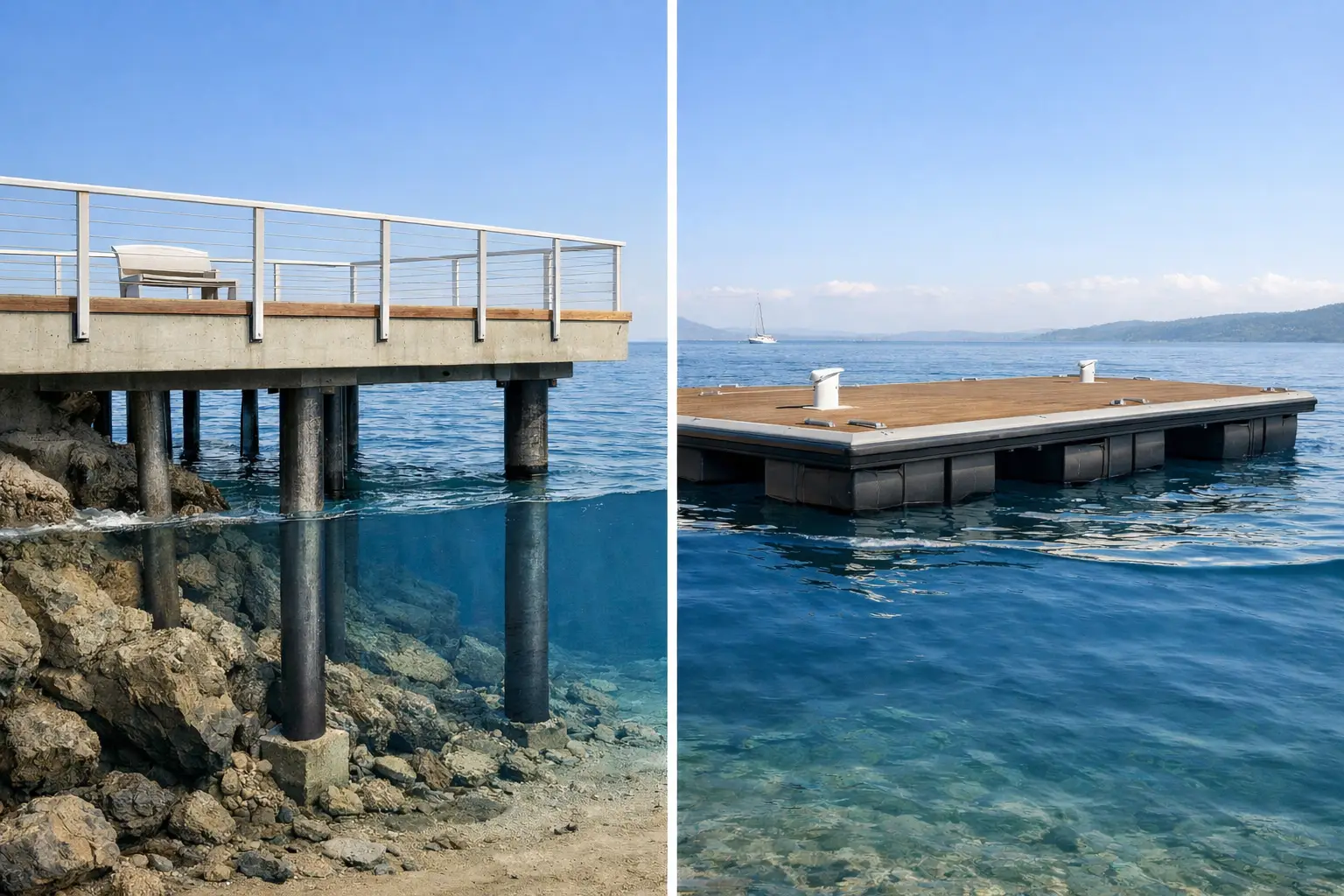
A floating dock for lake environments solves this by decoupled buoyancy. It maintains a constant relationship with your boat’s gunwale regardless of the water’s height. In modern lakefront development, the floating system is no longer a “temporary” alternative but the primary choice for deep-water and high-fluctuation zones where traditional pilings fail to provide safe access.
Anatomy of a Premium Floating Dock: Deciphering Core Materials
To avoid cognitive confusion, property owners must categorize systems into two distinct engineering schools: Integrated Modular Systems and Frame-Based Assemblies.
Integrated Modular Systems (The HDPE Revolution)
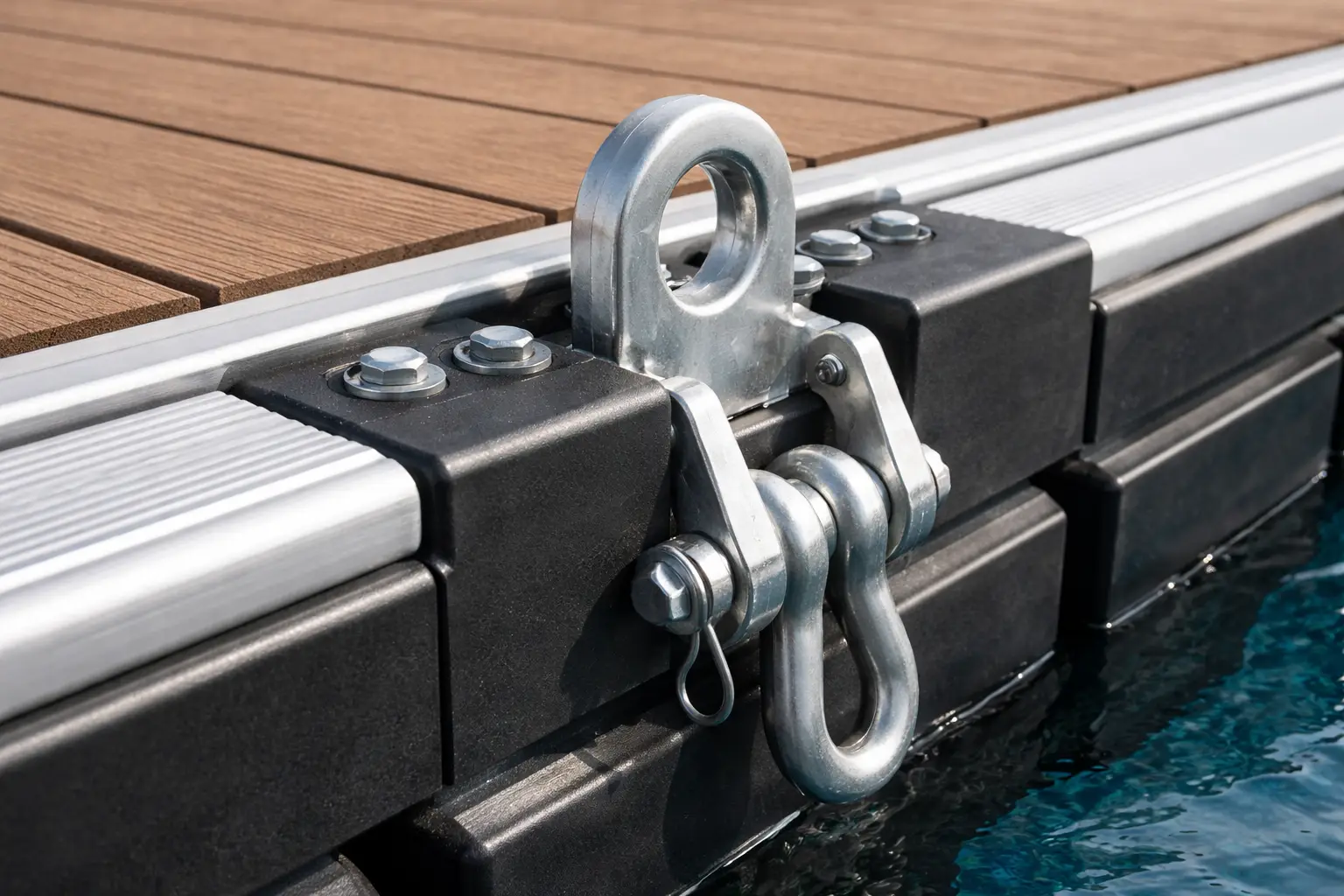
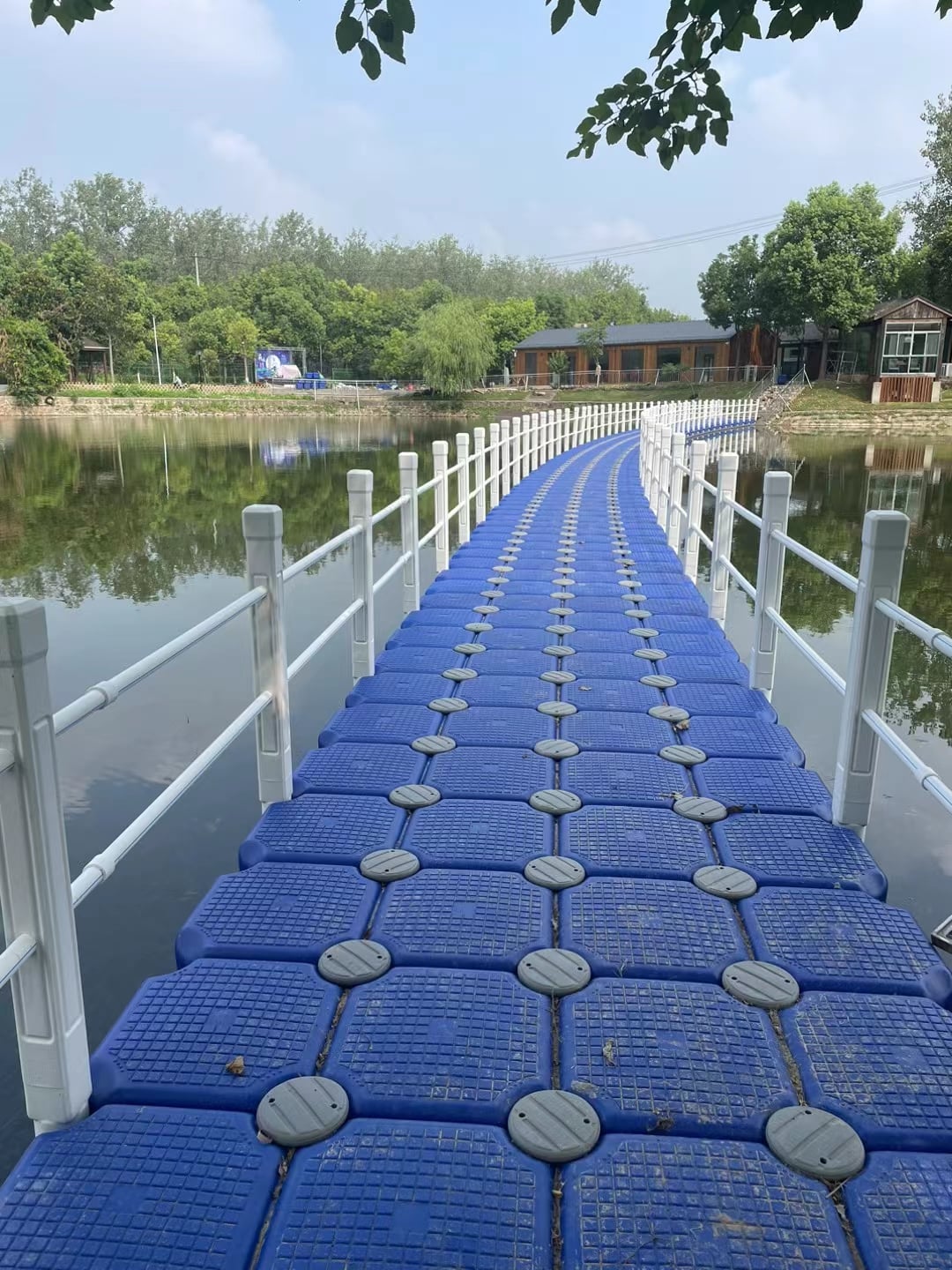
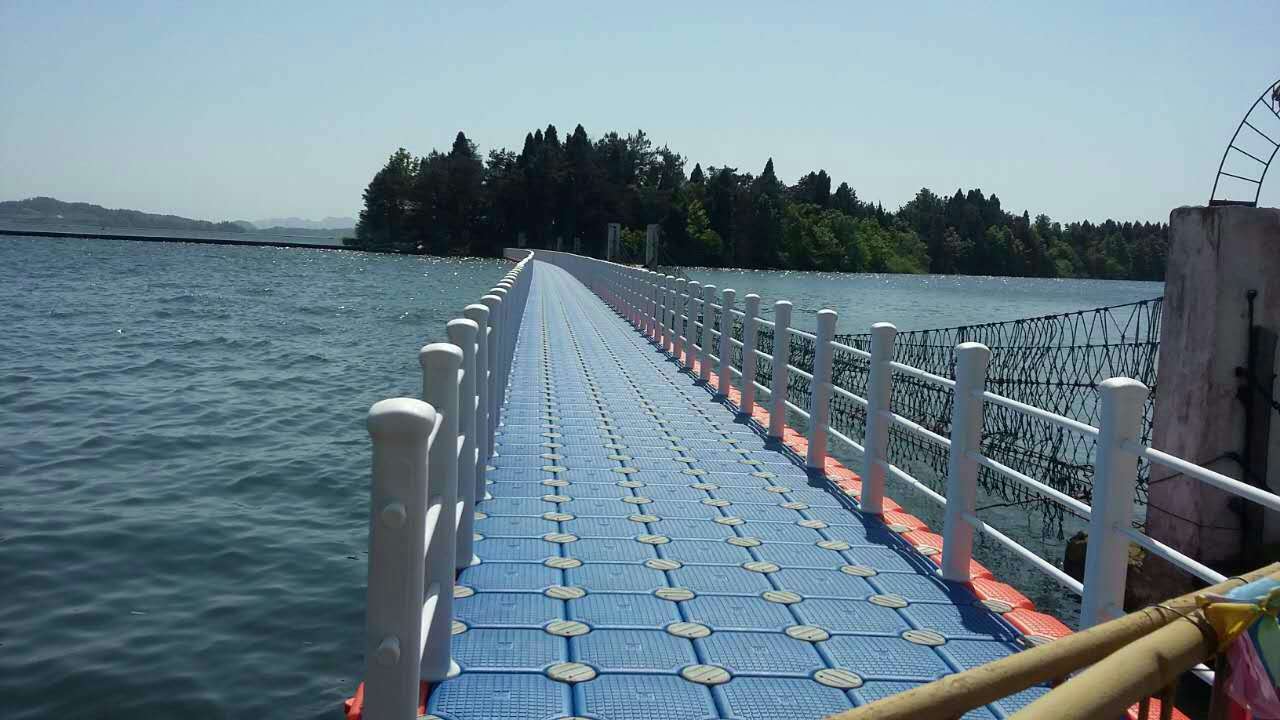
This category, championed by Hiseadock, treats the entire dock as a unified buoyancy engine. Using High Molecular Weight HDPE and advanced blow-molding, these systems eliminate the “weakest link”—the fasteners. By creating a monolithic structure with 19mm reinforced connecting lugs (40% thicker than industry standards), these docks absorb wave energy through the material itself rather than mechanical joints.
Frame-Based Assemblies (Traditional Metal & Wood)
Traditional designs rely on a rigid frame (Aluminum or Treated Wood) bolted to independent flotation barrels. While these offer a familiar “deck” look, they introduce multiple failure points. In frame-based systems, the stress of the lake’s movement is concentrated on the bolts and brackets, which are prone to shearing in heavy wind zones.
The Economics of Ownership: A 10-Year TCO Analysis
The “maintenance-free” claim is often used loosely. To find the best floating dock for lake projects, you must look at the Total Cost of Ownership (TCO). While wood has the lowest entry price, its degradation curve is steep.
| Cost & Maintenance Factor | Treated Wood Frame | HMW HDPE Modular (Hiseadock) |
|---|---|---|
| Initial Purchase Cost | $15 – $25 per sq.ft | $35 – $50 per sq.ft |
| Annual Maintenance | Staining, Sealing & Board Replacement | None (Self-cleaning surface) |
| 10-Year Estimated TCO | 2.5x Initial Investment | 1.0x Initial Investment |
| Asset Lifespan | 5-8 Years in freshwater | 15-20+ Years |
The Physics of Flotation: Calculating Stability
Stability is a product of displacement, waterplane area, and a low center of gravity. A premium system should offer a live load capacity of at least 350 kg/㎡. This ensures that even when multiple guests congregate on one side of the platform, the dock maintains its horizontal equilibrium without “tipping” or taking on water.
Submerged Security: Correcting Anchoring Common Sense
How a dock is secured determines if it will still be there after a storm. The strategy must change based on the depth of the water column.
Deep-Water Chains and Deadweights
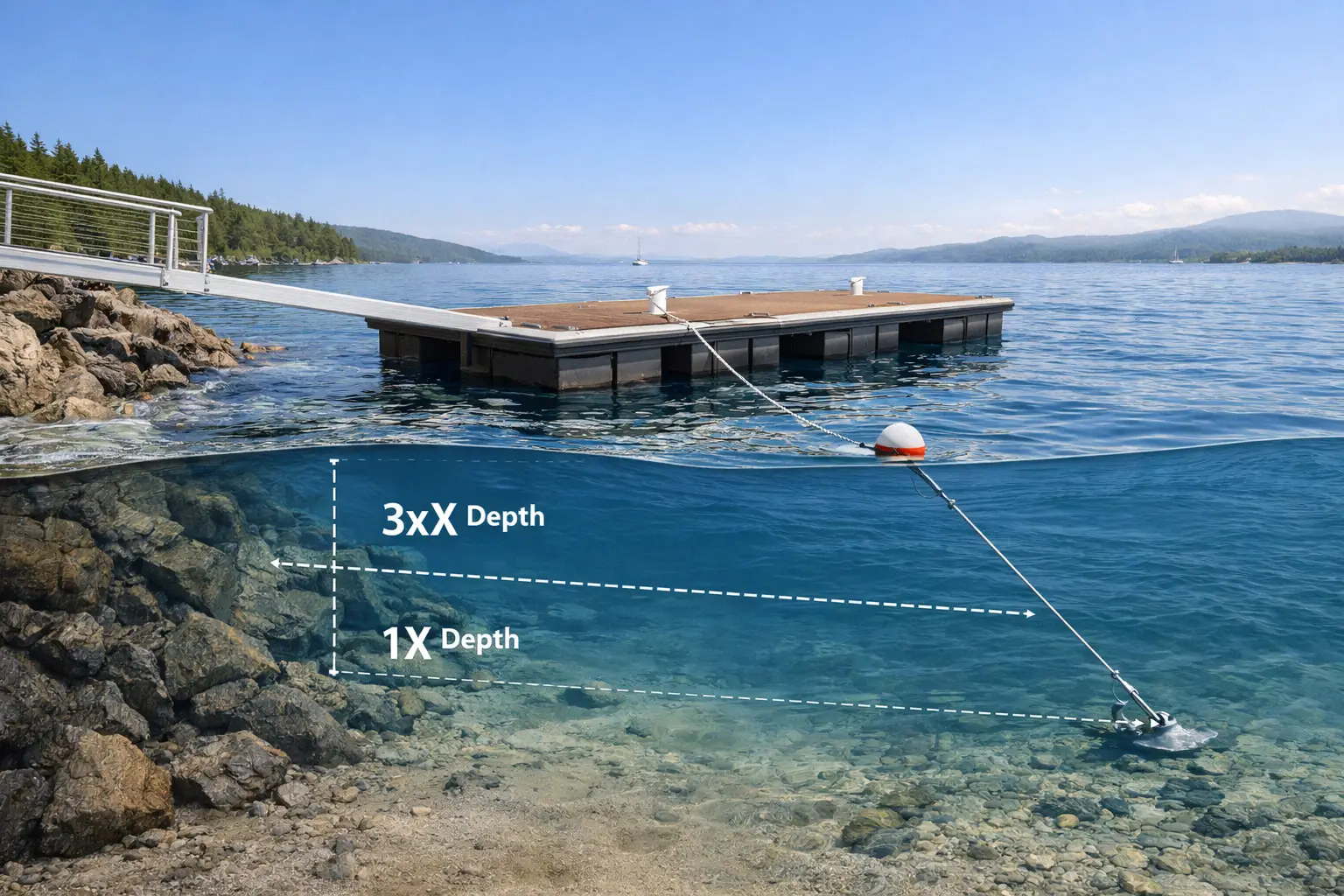
For deep-water anchoring using deadweights, the most critical parameter is the “Scope Ratio.” An engineering-grade installation requires a ratio between 3:1 and 5:1 (meaning for every 10 feet of depth, you need 30 to 50 feet of chain). This ensures the pull remains horizontal, preventing the dock from lifting the anchors during heavy wave surges.
Winch-and-Cable and Stiff-Arm Systems
For shorelines featuring steep drop-offs, deep water, or massive fluctuations where pilings are structurally impossible, stiff-arm and winch-and-cable systems provide lateral stability. These systems anchor directly to a sturdy shoreline retaining wall or landside abutment, creating an unyielding geometric triangle that pushes the dock out while holding it securely in place.
Piling Solutions: The Shallow Water Standard
Piling systems are excellent for shallow to moderate depths where the lakebed is firm. By using pile hoops or roller brackets, the dock remains perfectly centered while gliding up and down with the water level.
Winter Survival Guide: Triggers for Protection
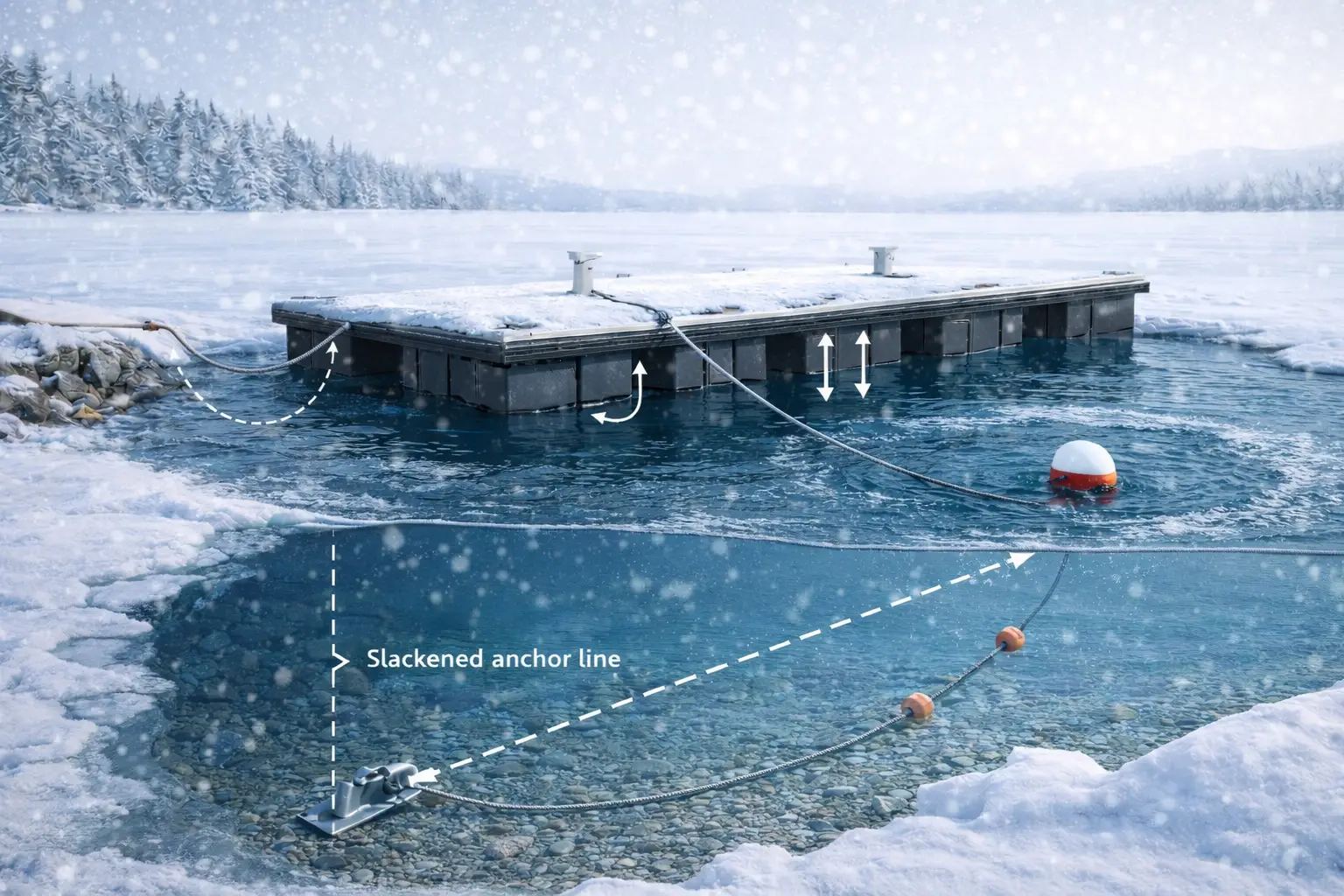
The ideal floating dock systems for lakes in northern regions must survive “Ice Jacking.” Your winter strategy depends on three specific environmental triggers:
- Bubbler Systems: Best if you have reliable shore power and a minimum water depth of 4-5 feet. It creates an open-water zone to prevent ice from gripping the dock.
- Seasonal Removal: Mandatory if the lake freezes solid to the bottom or if shore power is unavailable. Modular HDPE systems excel here as they can be dismantled and dry-docked in hours.
- De-icers: Ideal for high-flow areas where moving water can be leveraged to prevent surface ice formation.
Navigating Permits: The Expert Approval Checklist
HOA and DNR (Department of Natural Resources) approvals often stall waterfront projects. To move your project forward, ensure your submission package includes these three expert-level documents:
- Material Environmental Certification: Proof that your HDPE is non-toxic and recyclable (SGS/TUV certs are gold).
- Light Penetration Specifications: Local regulations often dictate strict light transmission rules to protect sub-aquatic vegetation. While standard solid HDPE modules are suitable for deep or less sensitive waters, ensure you specify grated decking (Thru-Flow designs) if installing over sensitive, shallow-water habitats to meet the mandatory 60%+ sunlight penetration codes.
- Site-Specific Anchoring Plan: A CAD drawing showing the scope ratio and anchor weight to prove storm safety.
Every lake is different. Don’t risk your investment with a one-size-fits-all solution.
Request a Free Waterfront Site Evaluation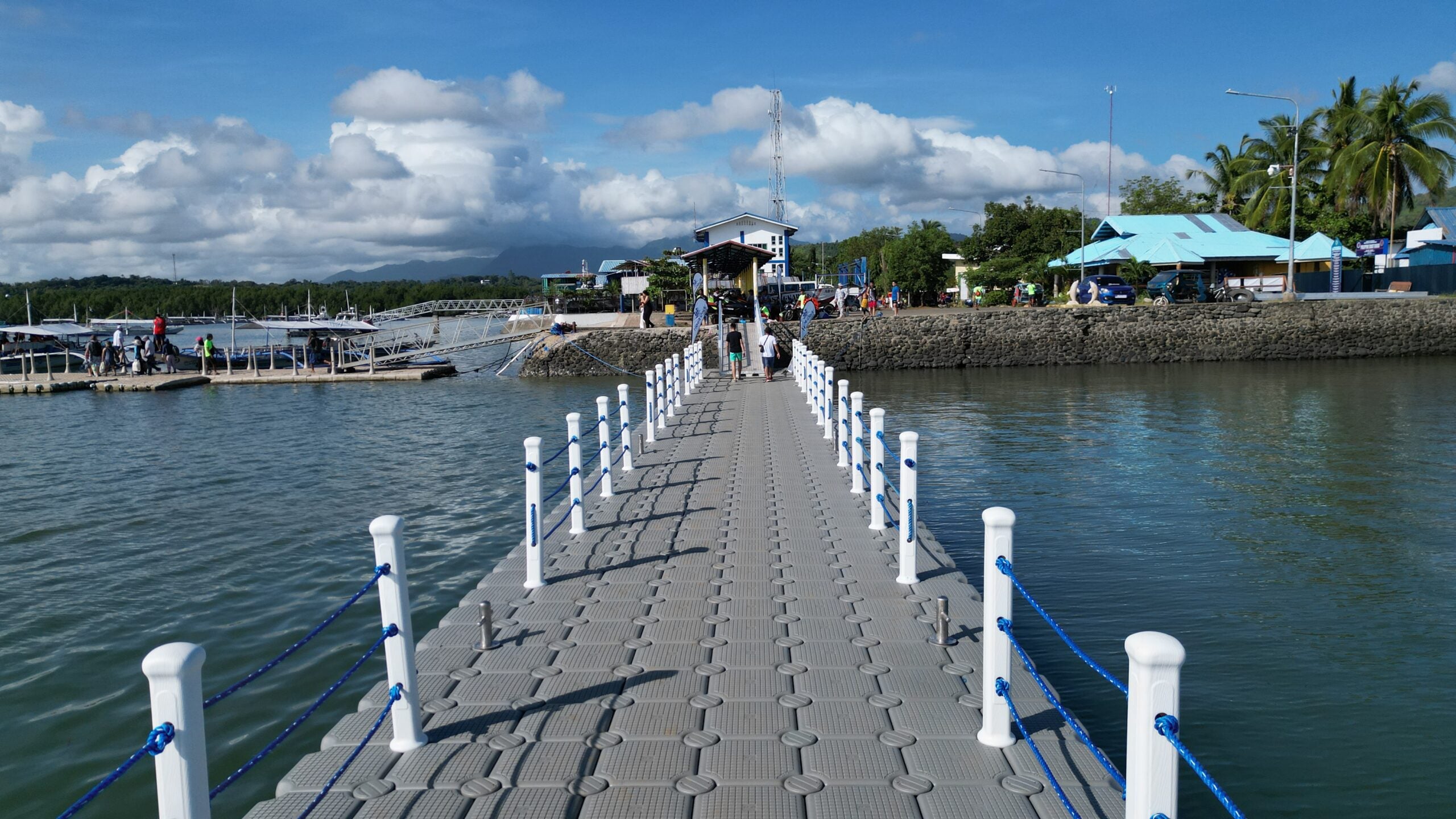

 English
  Thai
Thai  Spanish
  French
  German
  Dutch
Dutch  Italian
  Arabic
  Indonesian
  Portuguese
  Turkish