
The Ultimate Guide: Cheapest Way to Build a Floating Dock Without It Sinking
Discover cost-effective materials, essential buoyancy math, and when to upgrade to commercial-grade HDPE systems for a durable waterfront solution.
Finding the cheapest way to build a floating dock is the ultimate goal for many lakefront homeowners. However, true cost-efficiency isn’t just about saving money at the hardware store; it’s about building a structure that won’t sink under pressure, rot in the water, or drift away during a storm. If you are looking for practical advice on how to build a floating boat dock or a simple recreation platform, this guide will walk you through the math, the precise materials, and the hidden pitfalls of waterfront construction.
Flotation Materials Showdown: What is the Cheapest Way to Float a Dock?
Before buying lumber, you need to solve the buoyancy problem. A successful diy dock relies entirely on the quality and capacity of its flotation devices.
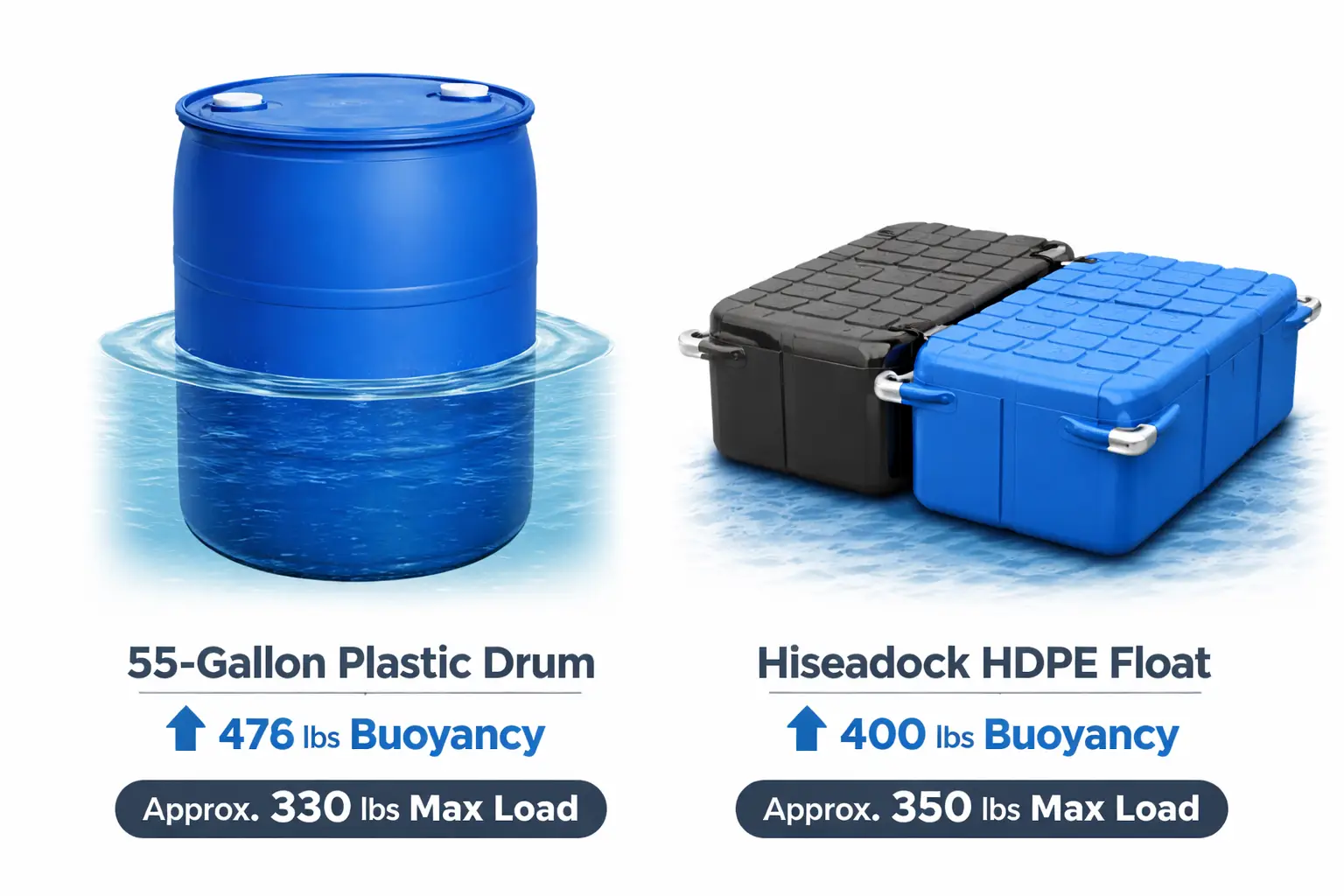
The 55-Gallon Plastic Drum (The Undisputed King of DIY)
For decades, 55-gallon closed-head plastic drums have been the go-to solution for budget floating dock construction. They are incredibly affordable—often found for $15 to $25 each from car washes or soda syrup suppliers. However, there are two strict rules:
- First, you must only use “Food-Grade” barrels marked with an HDPE 2 recycling symbol. Never use drums that previously contained toxic chemicals.
- Second (and a step often missed by amateurs): you must seal the bung holes with marine-grade silicone. If you don’t, temperature changes will create a vacuum inside the barrel, sucking water in through the threads and eventually sinking your dock.

EPS Foam Billets & IBC Totes (The Alternative Options)
While EPS foam blocks are easy to cut and attach, unencapsulated closed-cell foam is prone to “waterlogging”—absorbing water over time until your dock slowly sinks. It’s also a target for muskrats. IBC totes (275 gallons) provide massive lift but are notoriously difficult to secure flush against a wooden frame.
The Non-Negotiable Math: Calculating Buoyancy and Load Capacity
The most common reason a diy floating dock fails is a lack of engineering math. If you want to know how to build a floating dock that can safely hold your family and a grill, you must understand Archimedes’ principle and live load targets.
For residential waterfront platforms, marine engineers recommend a live load calculation of $Area \times 15\text{ psf}$ (pounds per square foot). For an 8×8 ft dock ($64\text{ sq ft}$), you need to support at least 960 lbs of people and gear, on top of the dock’s own weight.
A standard 55-gallon drum displaces about 450 lbs of water. However, applying the “50% Submersion Rule” is critical to prevent the dock from feeling “tippy.” Therefore, the safe effective buoyancy per barrel is only 225 lbs. By combining the dead load (wood frame) and your target live load, an 8×8 platform requires at least 6 barrels to meet the load, and 8 to ensure symmetrical weight distribution and perfect stability.
The Exact 8×8 DIY Floating Dock Bill of Materials (BOM)
To control your budget, here is a precise, piece-by-piece shopping list for an 8×8 platform built on a sturdy two-tier frame. We have eliminated weak house hardware and replaced it with marine-grade solutions.
| Item / Component | Precise Quantity & Specification | Estimated Cost |
|---|---|---|
| Flotation Barrels | 6x to 8x 55-Gallon Food-Grade HDPE 2 Drums | $90 – $160 |
| Frame Lumber | 14 pieces of 2″x8″x8′ Ground Contact Pressure-Treated Wood (For outer skirt & double-tier joists) | $200 – $260 |
| Decking Boards | 17 pieces of 5/4″x6″x8′ Pressure-Treated Decking Boards | $120 – $160 |
| Fasteners & Hardware | 1/2″ Hot-Dipped Galv. Carriage Bolts, Marine-grade Corner Brackets & 305/316 Stainless Steel Decking Screws | $110 – $160 |
| Strapping & Protection | Heavy-Duty UV-Resistant Ratchet Straps + Rubber padding strips | $40 – $60 |
The Hidden Tool Budget (Rent, Don’t Buy)
Before you start, assess your garage. You will need a miter saw, an impact driver, a socket set, and a tape measure. If you don’t own these, do not buy them just for one project. Head to Home Depot or your local hardware store and rent large equipment like a miter saw or a high-pressure water pump (for anchoring). Buying specialized tools can quickly erase the money you saved on a DIY build.
Step-by-Step Construction: Resolving the Framing Conflict
Proper floating dock installation requires resolving a major physical conflict: A standard drum is 23.5 inches in diameter. If you place standard deck joists 16 inches apart, the barrels won’t fit between them.
The Two-Tier Framing System
The solution is separating the load. Build a heavy outer skirt with transverse main beams (spaced 24 inches apart) strictly to cradle the barrels. Then, run your deck joists perpendicularly across the top of this sub-frame to support the decking boards.
Crucial upgrade: Discard standard “Joist Hangers.” Constant multi-directional wave action will shear them off. Instead, use through-bolted Marine-grade Corner Brackets to lock the wood together.
The Catamaran-Style Layout: To achieve maximum lateral stability, arrange your 8 barrels into two parallel rows of 4. Position these rows at the extreme left and right edges of the frame. This “catamaran” geometry prevents the dock from tipping when someone stands on the edge, providing a much steadier platform than a clustered center arrangement.
The Anti-Abrasion “X-Strap” Method
To lock the barrels, use the “X-Strap” technique with ratchet straps. Before ratcheting, chamfer (round off) the sharp inner edges of your wooden beams and insert rubber padding strips between the strap and the plastic. This prevents friction from wearing a hole through your drum over the years.
Laying the Deck Boards (The Gap Rule)
When laying your 5/4″x6″ pressure-treated decking, never butt the boards tightly against each other. You must leave a 1/8 to 1/4-inch expansion and drainage gap between every board. Wood swells when wet; without this gap, the expanding wood will buckle upwards and literally tear your frame apart from the sheer pressure.
Cheap but Bulletproof Anchoring Systems
For shallow, calm lakes (under 8 feet), the Pipe-and-Sleeve Method is ideal. Instead of exhausting yourself swinging a sledgehammer, use the Water Jetting Method—attaching a water pump to a PVC pipe to blast the sand away, allowing the galvanized pipes to sink effortlessly deep into the lakebed. Attach auger brackets to the dock. For deep water, use the Deadweight & Chains method, ensuring your cross-chaining has a 3:1 to 5:1 scope to prevent the dock from being dragged underwater during sudden water level fluctuations.
Environmental & Legal Blind Spots (How to Avoid DNR Fines)
The cheapest way to build a floating dock can become a financial nightmare if you ignore local regulations. The EPA and local DNR strictly prohibit toxic drums; discovery of chemical leached from “free” recycled barrels can result in environmental fines exceeding $1,000+ per day until the structure is removed and the site is remediated.
The “True Cost” Reality Check: 10 to 15-Year TCO Comparison
While building a wooden dock seems cheaper on day one, the Total Cost of Ownership (TCO) over a decade tells a different story. Between replacing rusted hardware, restaining wood, and winterizing, the hidden compounding costs completely destroy the DIY value proposition.
| Cost Factor (10 to 15-Year Projection) | DIY Wood & Barrel Dock | Hiseadock Modular HDPE System |
|---|---|---|
| Initial Material Cost | ~$560 – $800 | Factory-Direct Investment |
| Winterizing Effort | Annual grueling 1-day task moving 1,000+ lbs of waterlogged wood with heavy machinery. | Ice-resistant or simple modular disassembly by hand. |
| Maintenance | ~$500+ (Stain, rust treatment, strap checks) | Minimal (Pressure wash only) |
| Rebuild Risk | YEAR 5/6: Mandatory full teardown & total rebuild due to structural rot. | 15-20 Years (Eliminate Rebuild Risk) |
If your weekends are more valuable than lumber, upgrading to a commercial-grade modular system is a game-changer. As one of the premier floating dock manufacturers globally, Hiseadock offers an unparalleled alternative.
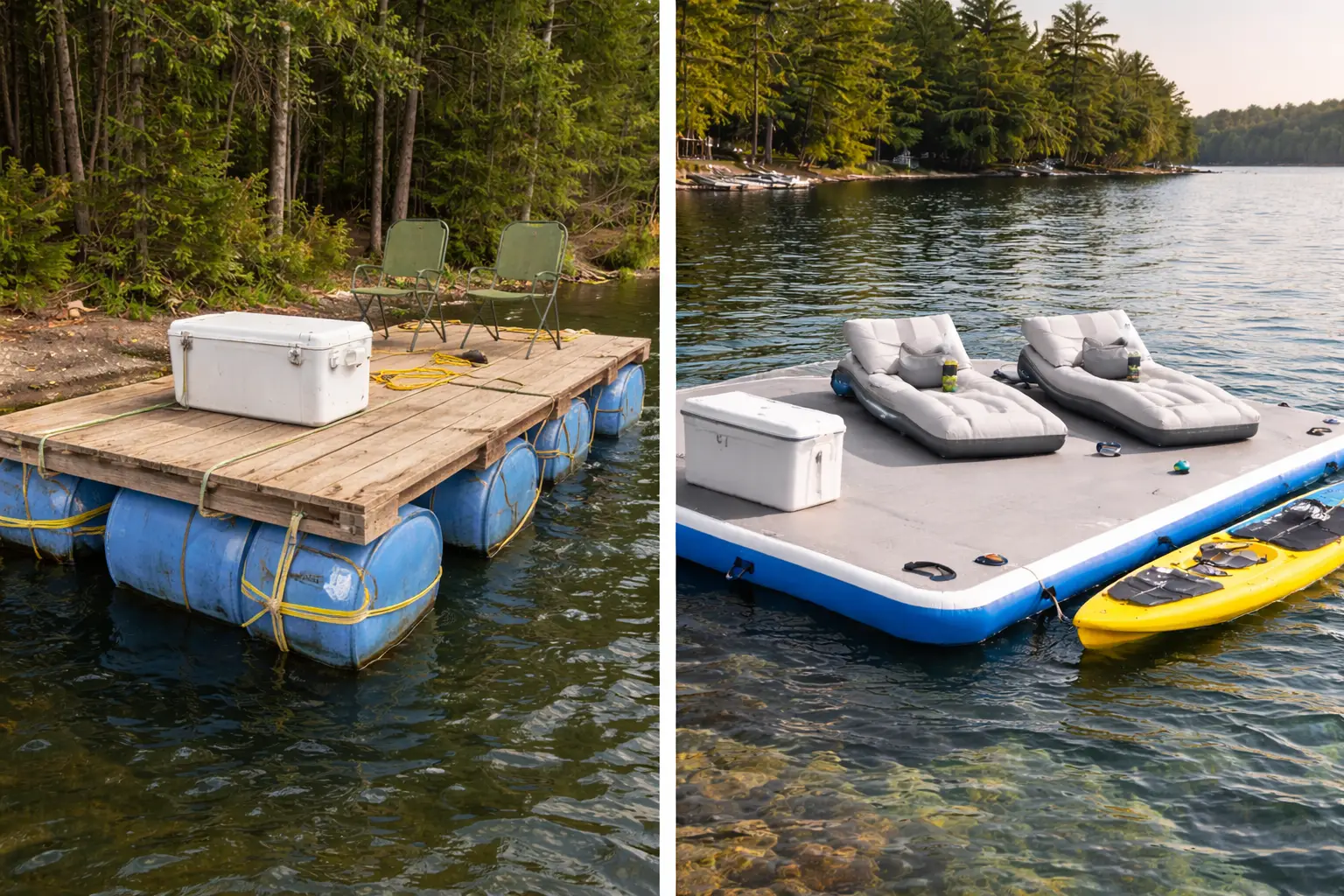
Why Hiseadock Outperforms Traditional DIY:
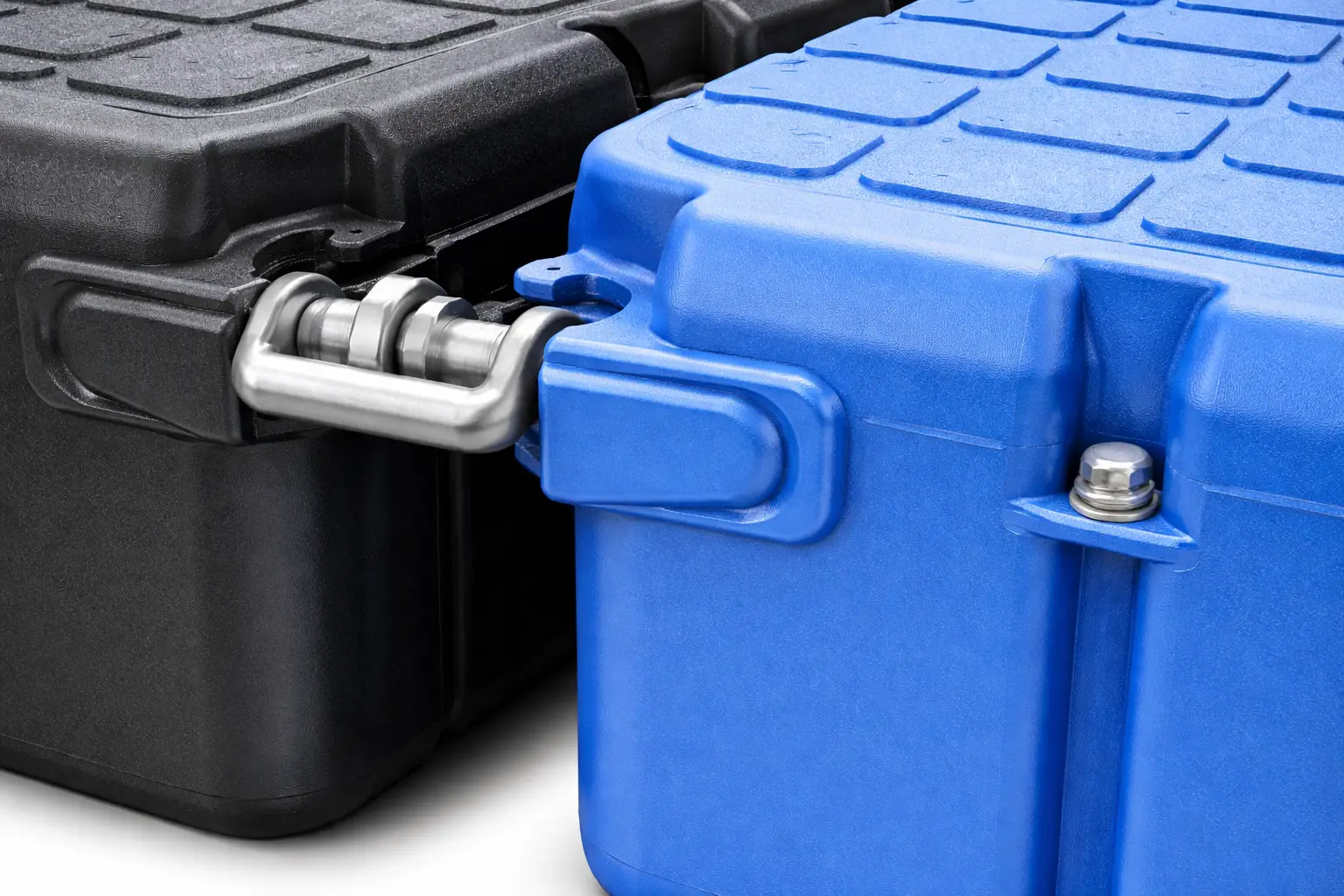
- Unmatched Durability & Safety: Made from Eco-friendly High Molecular Weight HDPE, these floats feature an anti-skid surface and are highly resistant to UV, climate change, impact, and tidal fluctuations. They offer a massive bearing capacity of 350 kg/㎡.
- Built to Last: With connecting ears up to 19mm thick (40% above the industry average), the structural integrity prevents the shear-breakage common in DIY wood docks.
- Factory-Direct Pricing & Zero Rebuild Risk: By buying direct, you skip retail markups and invest in a system that eliminates the “rebuild trap.” Why spend money twice on a failing DIY project when you can secure a professional-grade, permanent solution from day one?
- Global Trust & Rapid Delivery: Certified by ISO-9001, CE, SGS, and TUV. Enjoy fast 3-10 day lead times for in-stock items, and an optimized 4-in-1 packaging design that drastically cuts shipping costs right to your door.
Easy for assembly and disassembly, these eco-friendly modules save you hours of grueling labor while guaranteeing a perfectly stable platform.

 English
  Thai
Thai  Spanish
  French
  German
  Dutch
Dutch  Italian