
Types of Boat Lifts: Four Load Paths That Decide What You Can Actually Install
Start With Where the Weight Goes, Not What the Lift Is Called
Search “types of boat lifts” and the first result gives you a tidy list. The third gives you a different one. Before long you have several clean answers that contradict each other, and no way to tell which describes your dock. Nothing is hidden from you. The question is just being answered from different directions at once.
The reframe that makes it tractable is this. Every boat lift has to put your boat’s weight somewhere, and there are only four places it can go. Down into the lakebed, into pilings or an overhead structure that already exists, up a ramp onto the bank, or into the water itself through buoyancy. Motors, cables, bunks and hydraulics describe how a machine moves a boat. They do not describe where the load ends up.
So “types of boat lifts” is not one list. It is four answers to one question, and your shoreline picked one of them before you started shopping. The useful first move is therefore not comparing models. It is finding out which of the four your site can physically support. Two or three will be eliminated outright, and you can do that elimination yourself with a tape measure and a walk along the bank.
Two clarifications, because both cause real confusion. In North America a boat lift raises a boat out of the water at a dock. In parts of the Commonwealth the same words mean a canal boat lift, a civil structure that moves vessels between water levels. This article covers only the first. A floating dock is also not automatically a floating boat lift. A pontoon walkway is not engineered to take a boat’s displacement; a drive-on platform is. The difference is buoyancy per unit of area, and it decides everything in the fourth load path below.
Why Every List of Boat Lift Types You’ll Find Disagrees
These lists are not competitors. They are answers to different questions, and none of them says which question it is answering.
Published “boat lift type” lists, and the axis each one actually uses
| Source type (publisher) | The list it publishes | The axis it is really sorting by |
|---|---|---|
| Boat lift manufacturer guide (Hurricane Boat Lifts) | cradle · elevator · platform · beamless · yacht | Motion path + hull contact + capacity class |
| Waterfront manufacturer blog (Barletta Pontoon Boats) | 4-post · elevator · hydraulic · floating · cantilever | Structure form, mixed with drive train |
| Dealer explainer (Econolift) | front mount · side mount · shallow water · PWC | Mounting position only |
| Consumer brand blog (LakeLite) | overhead · boathouse · bridge | Overhead support structure |
| Industry association guide (NMMA / Discover Boating) | bottom-standing · piling-mounted · floating · shore-mounted | How the load reaches the ground |
Every one of those axes is set by how the manufacturer builds the machine. Motion path, drive train, mounting position, hull contact, capacity class: these are factory design choices, largely independent of one another. A lift can be vertical and cable-drawn and piling-mounted and fitted with bunks.
There is no mystery here. When two manufacturers sort one category by two orthogonal properties, their lists cannot agree. No amount of reading reconciles them, because they were never answering the same question. Owners feel it. In a forum thread, a buyer describes a firm consensus at his campground he could not get a reason for: “I’m on a campground with a bunch of old man and they’re all against vertical lifts claiming that cantilever is better. But no one can tell me exactly why.” Then comes the line that captures the problem: “The reseller told me that vertical lifts are very good lifts. But he’s the reseller so…” He is not short of information. He is short of an axis.
The way out is the one axis manufacturers do not get to choose: the one your shoreline sets. Three industry sources already use it when they need to be exhaustive rather than promotional. The National Marine Manufacturers Association’s consumer guide divides the category into bottom-standing, piling-mounted, floating and shore-mounted lifts. A major floating-lift manufacturer’s buying guide uses bottom-standing, floating and suspended. An aluminium lift maker’s depth guide states plainly that “there are three main designs of boat lift: floating, bottom standing, and suspended.” Those are load paths. That is the axis worth building on.
The Four Load Paths Behind Every Boat Lift Type
Water depth is where most buying advice starts, but depth alone eliminates nothing. A bottom-standing lift can work in nine feet of water. So can a suspended one. What separates the four load paths is what each one requires to exist before the lift arrives. Which is where sites start dropping out.
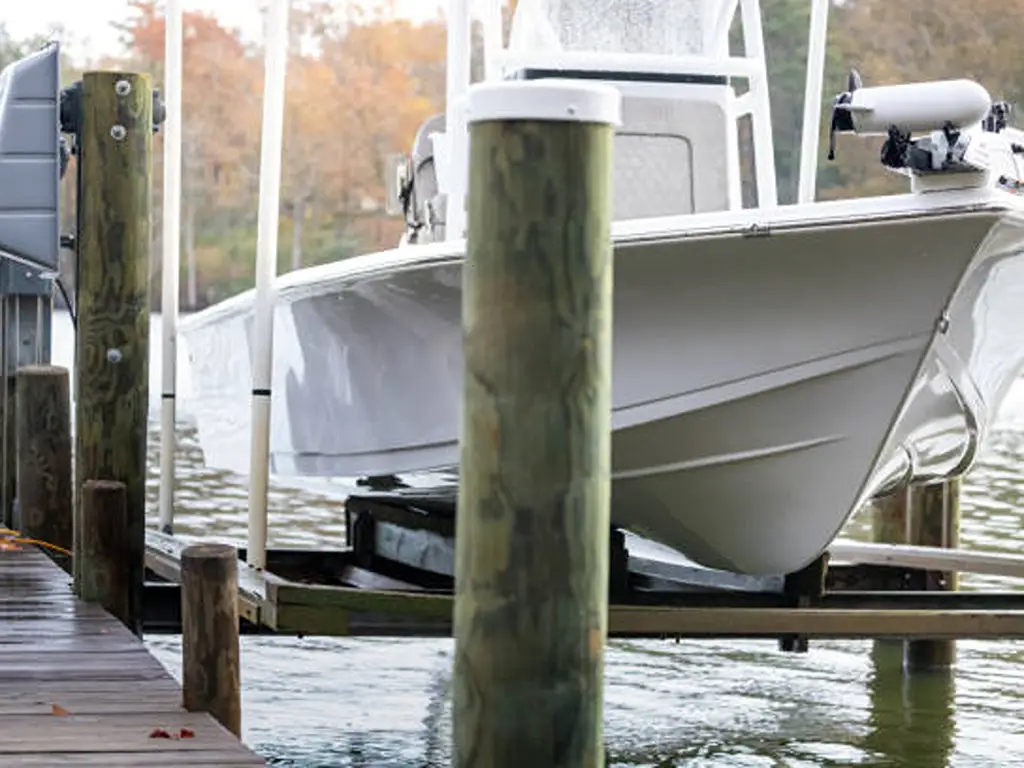
Bottom-Standing: Legs on the Lakebed
A bottom-standing lift rests on legs or a frame sitting on the lakebed. It needs no pilings, bulkhead or overhead structure. What it does need is a bottom that can hold it.
The NMMA’s consumer guide puts the working range at roughly two to nine feet, over a bottom that is firm and reasonably level. Two failure conditions recur. Soft or silty bottoms cannot support leg-based structures at all. One manufacturer’s shallow-water guide describes the result as “uneven settling, structural instability, and long-term frame damage.” The second follows from the design. Because the frame is fixed relative to the bottom, falling water does not lower the lift with it. The unit must be set deeper or it stops working. In cold climates these lifts are also pulled for winter and reinstalled in spring. That means storage space, and a second installation every year.
Piling-Mounted and Suspended: Load Into Existing Structure
This path hangs the boat from something already there: pilings, a seawall, a boathouse beam, a dock roof. It is the only path that mostly escapes the others’ constraints. Depth matters less, and a soft or uneven bottom stops mattering, because the lakebed is never asked to carry anything. An aluminium lift maker’s depth guide notes that beyond nine feet, “legs and pilings don’t hold up nearly as well.” Which is where hanging from a structure becomes the practical answer.
What it asks in return is a structure that can take the load. The boat’s full weight, plus the lift, transfers into the piling, seawall or dock frame. If the existing pilings are not rated for it, new pilings go in. That is a separate project with its own cost. It is also why this path is worth checking first. The question is not whether the lift works, but whether the thing you are hanging it from does.
Shore-Mounted: Load Into the Bank
A shore-mounted lift runs a ramp or rail from the shoreline into the water and winches the boat onto dry land. It is mechanically the simplest of the four and needs almost nothing in the water. Which is why it survives where nothing else fits.
The precondition is the bank: a gradual slope down to the water. A steep bank or vertical seawall has nowhere to put the ramp. This path is also the most likely to meet a permitting process. A structure crossing the shoreline into the water is exactly what regulators review, and that review carries a cost of its own.
Floating: Load Into the Water Itself
The fourth path pushes against nothing. It floats, and the boat’s weight is carried by buoyancy. Water displaced by air-filled chambers, or by a solid pontoon platform, does the lifting.
This single property removes the constraints the other three are built around. There is effectively no minimum depth, because nothing needs to reach the bottom. The unit also rises and falls with the water level automatically. Drawdown and tidal range become normal operation rather than maintenance events. Under nine feet of water or over it, soft bottom or hard, the floating path keeps working. The same depth guide calls floating lifts essential beyond nine feet.
Then it splits in two, and this is where most buying advice stops being useful.
- Air-chamber lifts flood their tanks to sink and pump air back in to rise, taking the boat up with them. They still need a pump or blower. Which means power at the dock, plus valves and seals to maintain.
- Drive-on platform docks have no mechanism at all. The boat rests on a stable buoyant platform at water level. Nothing lifts, nothing pumps, nothing wears.
Floating is not free. A boat on a platform still sits at the waterline, so hull cleaning is harder than on a lift that dries the boat in the air. Buoyant structures depend on their mooring. One owner puts it bluntly: “a floating anything unless it’s chained down tight can bust loose and take off.” Flotation also has a service life. A forty-year-old floating dock does not age gracefully, and one owner reported repairs he described as starting at $8,000.
Load path vs. site condition: what survives your shoreline
| Your site condition | Bottom-standing | Piling-mounted / Suspended | Shore-mounted | Floating |
|---|---|---|---|---|
| Water shallower than 3 ft (0.9 m) | Fails — needs ~2-9 ft | Conditional — confirm pilings exist and are rated | Conditional — needs a sloped bank | Works — no minimum depth |
| Water level swings more than a foot or two | Fails — fixed elevation; set deeper or move it | Conditional — check the structure tolerates the range | Fails on steep banks; ramp angle shifts with level | Works — rises and falls with the water |
| Soft or silty bottom | Fails — legs settle unevenly | Works — load goes into the structure, not the bed | Works — ramp rests on the bank | Works |
| Sloping or rocky bottom | Fails | Works | Conditional — needs a workable ramp footprint | Works |
| No pilings, and none can be added | Works | Fails | Works | Works |
| Steep bank or vertical seawall | Conditional | Works | Fails — nowhere to land the ramp | Works |
| No electrical service at the dock | Fails — needs power | Fails — needs power | Fails — needs power | Conditional — only the air-chamber type needs power |
Read down the last row and the shape of the problem appears. Three of the four load paths require electrical service at the water. One does not. Read the rows together and a shallow shoreline, a swinging water level, a bottom too soft to hold legs, pilings you cannot trust and no power at the dock is not an exotic combination. It describes a great many inland coves and tidal creeks. In that combination the first three paths are all eliminated. That is not a sales argument. It is arithmetic.
Four load paths. One difference decides between them.
Three of these need a site precondition and a supply at the water’s edge. The fourth needs neither — which is why it is the one left standing on the shorelines where the other three are out.
What Each Load Path Costs You After the Purchase
Purchase price is the number everyone compares and the least predictive number in the category. What you live with is the cost of the path you chose: what it needs to run, what wears out, and what you are allowed to build.
The Power Question Nobody Answers
Buyers ask about electrical service constantly. “How much power does a 10,000 lb boat lift need” is among the most repeated questions around this topic, and most buying guides answer thinly. The reason is structural. Bottom-standing, piling-mounted, suspended and shore-mounted lifts all use a motor, and every motor needs a supply at the water’s edge. Whether that supply exists is a fact about your property, not about the lift. It belongs in the first conversation rather than the last. A manufacturer’s own pre-purchase checklist includes a line for “Electrical Access (distance, voltage).” That line is often the single most expensive item on the project. This is also where the fourth path diverges from itself. Air-chamber lifts need power for the pump. Drive-on platform docks need none at all.
What Wears Out, and When
If the lift has moving parts in the water, those parts set your maintenance calendar. Vertical cable lifts carry the boat’s entire weight on cables at all times. The consequences are predictable. Cables stretch and need periodic adjustment to keep the carriage level. The carriage should stay within about two inches of level across the four corners, or it binds against the frame and wears cables faster. Most manufacturers call for cable replacement every two to five years, and the front cable goes first because it does most of the lifting. Vertical lifts also have more pulleys, and more places for weeds to collect.
By drive type, the wear points differ. Cable-drawn lifts wear at winch gears, pulleys and cables. Watch for rust, fraying and tension loss. Hydraulic lifts wear at reservoirs, hoses, valves and actuator seals. Watch for leaks. Floating lifts have no cables and no hydraulic fluid. What needs watching is the flotation itself, the valves if it is air-chamber type, and the mooring.
What wears out, by drive type
Cable-drawn
Winch gears, pulleys and cables. Watch for rust, fraying and tension loss.
Hydraulic
Reservoirs, hoses, valves and actuator seals. Watch for leaks.
Floating
No cables and no hydraulic fluid. Watch the flotation itself, the valves if it is air-chamber type, and the mooring.
Capacity, Price and Permission
Capacity should be measured in wet weight, not dry weight. Wet weight is the boat as it sits in the water, with fuel, water and gear aboard. The rule of thumb is to size the system at 20–25% above that figure. Sizing off the brochure dry weight is the most common way people overload a lift.
Cost, in the current US market, runs from roughly $4,300 for a small manual lift to upwards of $28,000 for high-capacity systems with customisation. Above 20,000 lb the hardware shifts from four posts to six or eight.
Permission is the cost that appears in no quote. Florida installations can require state environmental review, Army Corps of Engineers approval and municipal zoning sign-off, and may involve a submerged-land lease. Other states enforce seasonal restrictions and shoreline setbacks. Electrical work at a dock is covered by the National Electrical Code.
One boundary is worth remembering. A lift’s cables reach a replacement window. The pilings you would hang from may have uncertain load ratings or age. The shoreline may be steep, shallow and without power. When any of those is true, the right move is not a better lift. It is a different load path.
The four numbers worth carrying into any conversation
Cable replacement interval on a vertical lift. The front cable goes first.
Capacity buffer above wet weight, with fuel, water and gear aboard.
Current US market range, small manual lift to high-capacity custom.
Florida permit stack: state environmental review, Army Corps, municipal zoning.
When those numbers do not fit your site, the answer is a different load path, not a better lift.
Matching the Load Path to Your Site: A Self-Check
The order below matters as much as the steps. The first six are free and they eliminate options. The last two are the ones that cost money. Doing them in this order means you never pay to investigate a path your site already ruled out.
Eight steps, in this order
Two of these steps are yours to take and two are not. Measuring depth, fluctuation, bottom and bank is an afternoon’s work. It will usually leave you with one or two viable load paths rather than four. Confirming that pilings can take a given load, and confirming what your jurisdiction will permit, are both jobs for someone qualified. A marine contractor handles the structure; your local permitting authority handles the rest. A self-check narrows the field. It does not replace a structural assessment.
What This Changes for Dealers and Distributors
The first question most buyers ask is “which type should I get.” That question has no good answer, which is why it produces a set of lists and a price comparison instead of a decision. Three questions do have answers, and they are worth asking first. How deep is the water, and how much does it move? What are the bottom and the bank like? Is there power at the dock? Those three do the eliminating. What is left is a short list, and short lists are hard to shop on price alone.
The site conditions that eliminate the first three load paths are common in inland coves and tidal creeks. Shallow water, large fluctuation, soft bottom, no trustworthy pilings, no electrical service. Those are exactly the conditions in which a mechanical lift has nothing to offer. A catalogue built only around mechanical lifts has no answer for those customers. Not a hard sell, but no product.
Make the three questions the first thing your team asks. Hand the customer the self-check above as a document they can complete before the call. Then treat the buoyancy-borne layer as a full product line, with range and configuration of its own, rather than as accessories bolted onto a lift catalogue.
That is the layer Hisea Dock builds in. Our modular HDPE pontoon systems cover the configurations this path actually needs. U-shaped floats form a boat slide for drive-on access at 300 kgs/m², and V-shaped ramp floats serve personal watercraft at 200 kgs/m². Single, double and high-cube units run from 220 to 420 kgs/m² depending on the module, and draft is 2–4 inches. Sizes, shapes, heights and colours are configurable, with heights at 250, 400 and 500 mm and standard colours blue, orange, grey and black. That lets a dock be matched to the site rather than the site to the dock. You can see how the drive-on and U-float configurations assemble on the product pages.
Start with the site conditions
Find the boat-access setup your shoreline can support
Tell us the water depth, seasonal movement, shore access and boat type. We will help you establish whether a modular floating dock or drive-on configuration fits the site before you specify a lift.
Talk to us about your shorelineReferences
- Discover Boating (National Marine Manufacturers Association). “Boat Lifts: How to Choose the Right Type.” Updated August 2026. https://www.discoverboating.com/resources/boat-lifts
- LOTO Lift. “Shallow Water Boat Lifts: What’s the Best Choice?” https://lotolift.com/best-boat-lifts-for-shallow-water/
- Hurricane Boat Lifts. “Types of Boat Lifts: A Complete Guide to Choosing the Right.” https://www.hurricaneboatlifts.com/types-of-boat-lifts-and-what-you-should-know-about-each/
- Barletta Pontoon Boats. “How to Choose the Right Boat Lift (5 Top Choices).” https://www.barlettapontoonboats.com/blog/how-to-choose-the-right-boat-lift
- Econolift. “How Does a Boat Lift Work?” October 20, 2022. https://www.econolift.com/how-does-a-boat-lift-work/
- LakeLite. “Boat Lift Basics: Exploring All the Major Types.” July 1, 2025. https://lakelite.com/blogs/news/boat-lift-types
- iBoats Forums. “Boat lift: Cantilever vs Vertical.” https://forums.iboats.com/threads/boat-lift-cantilever-vs-vertical.380958/
- Hisea Dock. “Drive-on Boat Dock.” https://www.hiseadock.com/waterfront_solutions/drive-on-boat-dock/
- Hisea Dock. “Modular Floating Dock Cubes.” https://www.hiseadock.com/modular-floating-dock-cubes/
- Hisea Dock. “Products.” https://www.hiseadock.com/products/
- Hisea Dock. “FAQ.” https://www.hiseadock.com/faq/
- Hisea Dock. “Hisea Dock.” https://www.hiseadock.com/

 English
  Thai
Thai  Spanish
  French
  German
  Dutch
Dutch  Italian
  Arabic
  Indonesian
  Portuguese
  Turkish