
HDPE Chemical Resistance: What the Chart Says, and What It Never Tested
You have a chemical, a working temperature, and a part made of HDPE. Somewhere there is a chart that will tell you yes or no.
That chart is real, and it is useful. It is also narrower than almost everyone using it assumes. This article covers what it actually answers, and the four variables it was never built to test. Those four variables decide whether your part is still intact in year fifteen.
What HDPE Resists and What It Doesn’t
HDPE’s resistance comes from two structural facts. Its backbone is non-polar and saturated, so there are no ester or amide linkages for water and acids to attack. And it is highly crystalline, roughly 70-80% by industry references against 40-50% for LDPE, leaving few amorphous pathways for a chemical to work into. There is no metal to corrode.
The result is a material that handles a wide, boring range of chemistry extremely well, and a short, specific list very badly.
The table below uses the rating system from the INEOS HDPE Chemical Resistance Guide, the reference most commonly cited on this topic. It grades at two temperatures, and the second one is where most people stop reading too early.
| Chemical (concentration) | 70°F (21°C) | 140°F (60°C) | Typical service |
|---|---|---|---|
| Hydrochloric acid (35%) | Satisfactory | Satisfactory | Pickling, pH control, water treatment |
| Sulfuric acid (0-50%) | Satisfactory | Satisfactory | Mining, effluent neutralisation |
| Sulfuric acid (70%) | Satisfactory | Some attack | Concentrated acid service — check the real temperature first |
| Sodium hydroxide (concentrated) | Satisfactory | Satisfactory | Caustic dosing, CIP circuits, aquaculture |
| Sodium hypochlorite | Satisfactory | Satisfactory | Disinfection, pool water, water treatment |
| Calcium hypochlorite bleach solution | Satisfactory | Satisfactory | Sanitation, shock dosing |
| Seawater | Satisfactory | Satisfactory | Marine and coastal structures |
| Brine (saturated) | Satisfactory | Satisfactory | Salt storage, desalination, produced water |
| Ammonium hydroxide | Satisfactory | Satisfactory | Fertiliser and aquaculture systems |
| Urea | Satisfactory | Satisfactory | Agricultural runoff, aquaculture |
| Synthetic detergents | Satisfactory | Satisfactory | Washdown, kitchens, floating food service |
| Ethylene glycol | Satisfactory | Satisfactory | Cooling loops, de-icing runoff |
| Fuel oil | Satisfactory | Unsatisfactory | Fuel docks, bilge, engine service |
| Gasoline | Satisfactory | Unsatisfactory | Marinas and fuel berths |
| Acetone | Satisfactory | Satisfactory | Solvent wipe-down — disputed across published charts |
| Benzene | Some attack | Unsatisfactory | Aromatics — do not specify HDPE |
| Toluene | Unsatisfactory | Unsatisfactory | Aromatics — do not specify HDPE |
| Xylene | Unsatisfactory | Unsatisfactory | Aromatics — do not specify HDPE |
| Methylene chloride | Unsatisfactory | Unsatisfactory | Chlorinated solvents — do not specify HDPE |
| Nitric acid (95-98%) | Unsatisfactory | Unsatisfactory | Strong oxidising acid — change material, not grade |
| Sulphuric acid (fuming) | Unsatisfactory | Unsatisfactory | Strong oxidising acid — change material, not grade |
Read the two middle columns together. Fuel oil, gasoline and mineral oils all sit at Satisfactory at 21°C and Unsatisfactory at 60°C. Nothing about the chemical changed. Only the temperature did. A rating quoted without its temperature is not a rating.
The charts also disagree with each other’s housekeeping. INEOS uses S / O / U across two fixed temperature steps. Other widely circulated charts use R / C / N with quantitative definitions: swelling under 3%, weight loss under 0.5%. Some use numbered footnotes tied to their own thresholds. Others use plain sentences like “little or no damage after 30 days”. Those systems do not translate cleanly into one another. Two engineers can quote two reputable charts, reach opposite conclusions about the same chemical, and both be reading a correct document.
What Chemical Attack Looks Like Before the Leak
Plastic is not chemically bulletproof. “HDPE resists chemicals” has a longer version: HDPE resists certain families of chemicals, at a given temperature, for a given length of time.
Attack rarely announces itself. It shows up as one of five things, and which one you are looking at decides what you do. The fixes are not interchangeable.
Five things you will actually see
Getting these confused is expensive. Oxidation is answered by a different stabiliser package or a lower service temperature. Swelling is answered by a different material. Stress cracking is answered by changing the geometry, the load, or the medium. Treat all three as one problem and you will replace the part twice before you replace the right thing.
One caution before moving on. These symptoms tell you that something failed, not why. Cracking is not proof that the chemical was aggressive. As the next section shows, it can happen in a medium your chart rates as fully satisfactory.
Why “Satisfactory” Is a 42-Day Opinion
Here is the question that changes how you read every chart: under what conditions was that “S” awarded?
Published ratings commonly rest on immersion tests measured in hundreds of hours rather than years. One industry reference describes the basis plainly: ratings in published standards “typically reflect 1,000-hour immersion tests”, about six weeks of contact (Coastal Resource Group). A dock float, a process line or a storage tank is expected to hold for decades. A practitioner on eng-tips, working through a real sodium hypochlorite injection problem, compressed the gap into a sentence worth remembering: “30 days vs 3000 days may make a difference” (eng-tips).
That is not a rounding error. It is a category difference. The chart answers a question about weeks, and you are asking one about years.
“30 days vs 3000 days may make a difference”
A practising engineer on eng-tips, working a live sodium hypochlorite injection problem
Oxidation: the Antioxidant Package Is a Consumable
Polyethylene does not resist oxidation on its own. It is protected by an antioxidant package compounded into the resin, and that package is consumed as it works. Once it runs low, the polymer itself begins to oxidise: embrittlement followed by cracking, in material that still looked fine.
The same eng-tips thread contains a line that belongs on every resistance chart’s cover: “the resistance of the HDPE may well depend on what antioxidant package you use because they protect the pipe from oxidation which leads to cracks and failure.” The chart grades the polymer. What keeps the polymer alive for twenty years is an additive the chart does not mention.
The field evidence backs it. In the same discussion, engineers describe failures in heavy-wall sodium hypochlorite storage tanks at three to eight years, varying with the concentration held and how often the tank was refilled. The published tables rate sodium hypochlorite Satisfactory at both temperature steps. Both are true. They measure different things.
Swelling and Permeation: Absorbed, Not Dissolved
Aromatics, chlorinated solvents and many hydrocarbons do not dissolve polyethylene. They do something subtler: they migrate into it. The wall swells, softens, changes dimension. Separately, the fluid can pass straight through.
Permeation and chemical attack are two different problems, and a good rating on one tells you nothing about the other. A hydrocarbon can cross a PE wall without degrading it measurably, so if your service involves hydrocarbon contact or contaminated ground, permeation needs its own assessment.
This is also where the system’s weakest part usually sits, and it is often not the polyethylene. Gaskets, O-rings, flange seals and elastomeric components are made of EPDM, NBR, Viton and similar materials. Each has its own compatibility profile, and they routinely fail before the PE body does. On a moulded float, the equivalents are the threaded end caps, the pin-and-bolt connections and the lugs. Check them against the same chemical, at the same temperature.
Environmental Stress Cracking: When the Chemical Isn’t the Problem
Environmental stress cracking (ESCR) breaks people’s mental model of what a rating means.
Surfactants and detergents, in contact with polyethylene under sustained tensile stress, will propagate a slow crack through material that is chemically unchanged. No corrosion, no measurable attack, no swelling. Just a crack growing from a stress point in a medium the chart rates as satisfactory.
Which explains an apparent contradiction in the table above. Synthetic detergents is graded Satisfactory at both temperature steps, and detergents are also the textbook trigger for environmental stress cracking. Both are correct, because they describe different tests: one measures chemical attack, the other measures what happens when you add stress. High stress plus concentrated surfactant runs the clock fastest.
ESCR matters more than the other two mechanisms for a practical reason: stress is the one variable on this list you control yourself. It concentrates at corners, holes, threaded ports and fastening points. It builds from sustained load, thermal cycling and flexing. That is a geometry and installation question, which means it is a question you can answer before you buy.
“Since other factors such as permeation, ESCR and container design are involved, full compatibility testing is recommended.”
The closing note of the INEOS HDPE Chemical Resistance Guide — the chart itself names the three things it does not cover.
The Four Variables the Chart Never Tested
Line the six variables up and the shape of the problem is obvious. A resistance chart covers the chemical and its concentration, and temperature. It leaves four more unmeasured: exposure duration, mechanical stress, whether the medium is a mixture, and how your part is actually made.
Duration and stress are the previous section. These are the remaining two.
When the Medium Is a Mixture, Not a Chemical
Every rating table lists one chemical at a time. Service conditions almost never do.
Seawater is dissolved salts plus hydrocarbons plus treatment chemicals. Water at a marina is diesel plus washdown detergent plus antifouling residue plus biofouling. An aquaculture site is ammonia nitrogen plus feed oils plus disinfectant. A pool deck is hypochlorite plus stabiliser plus pH correction. Mixtures can interact: a combination can attack where neither component does alone.
The consequence is a change of method, not of chart. Where the medium is mixed, a list of chemicals is the wrong input. What you need is a stated assessment of the actual combination, at the actual concentration and temperature.
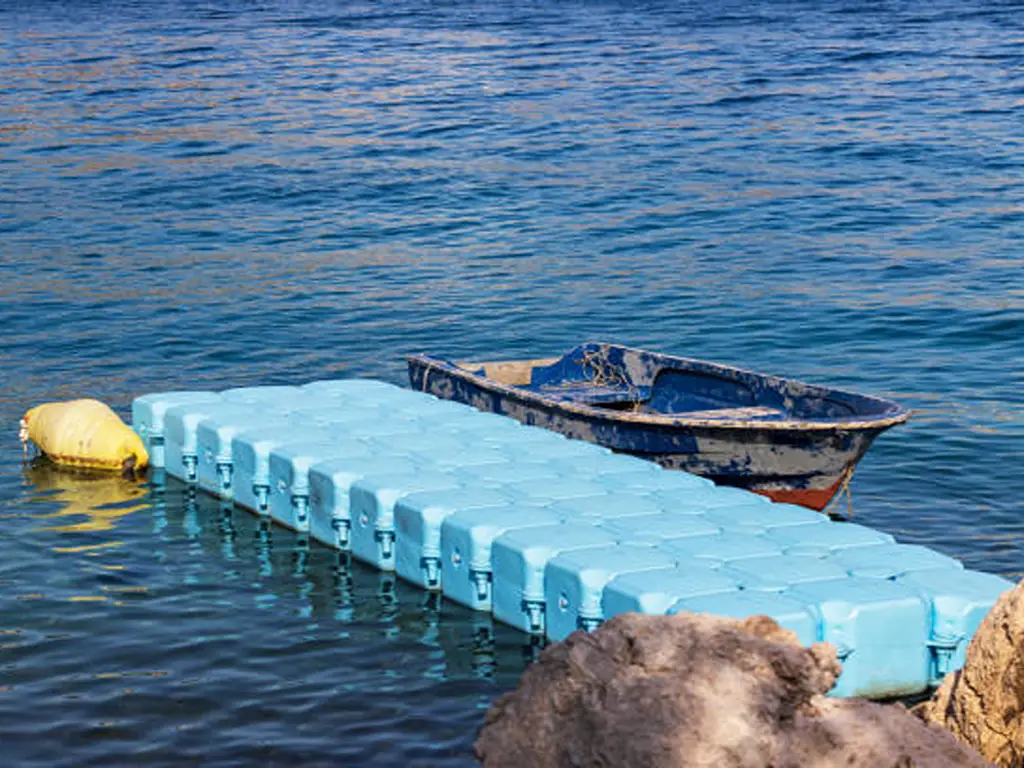
When Your Part Isn’t a Pipe
This is the largest blind spot in the material, and it is structural rather than technical.
Nearly every public HDPE resistance chart is written for piping. The governing standard makes it explicit. ISO/TR 10358:2021, the reference collection of thermoplastics chemical-resistance data, is titled Plastics pipes and fittings for industrial applications (published June 2021, ISO), and it covers PE grades with a minimum density of 0.935 g/cm³, the PE63, PE80, PE100, PE100-RC pipe family. Pipe.
Now consider how much HDPE in the world is not pipe. Extruded pipe is a continuous melt pushed through a die. A moulded float, a blow-moulded tank or an injection-moulded fitting is formed differently, and that changes the crystallinity, the internal stress locked into the wall, the consistency of wall thickness, and how the sealing features are made. The resin may be the same family. The part is not the same object.
So the same grade, formed a different way, does not inherit the chart’s verdict. A float with a threaded end cap, a hollow sealed interior and load-bearing lugs has stress concentrations a straight pipe section does not.
The same caution applies sideways, to the grade. A chart headed “polypropylene” or “LDPE” is not your answer. Density, crystallinity and molecular weight distribution all move the result. Match the table to the resin and the forming method, both.
Which leaves a short, unglamorous rule that replaces a long argument: any conclusion taken from a chart written for a different form is not a conclusion. It is a hypothesis.
| Service scenario | What the chart says | What the chart does not tell you | What to confirm before specifying |
|---|---|---|---|
| Hypochlorite / bleach (disinfection, pool water) | Satisfactory at both steps | Concentrated long-term contact has documented failures at 3-8 years; the stabiliser package is being consumed | Working concentration, maximum liquid temperature, whether contact is continuous, and the antioxidant / UV stabiliser grade |
| Diesel / gasoline (fuel docks, fuel storage) | Satisfactory at 21°C, Unsatisfactory at 60°C | Hydrocarbon swelling and permeation, which is a separate mechanism from attack | Maximum liquid temperature, whether a barrier layer is needed, and whether seal and fitting materials are assessed on the same basis |
| Seawater / brine / brackish water | Satisfactory at both steps | Chloride effects on metal fittings; biofouling and scale build-up | The material of the fixings, brackets and fasteners — the PE is usually not the part that fails |
| Kitchen fats and cleaning agents (floating food service, washdown) | Detergents Satisfactory at both steps | Environmental stress cracking — surfactant plus sustained stress, in material that is chemically unaffected | Where the sustained tension sits in the structure, and the type and concentration of cleaning agents actually used |
| Ammonia, urea, feed oils (aquaculture) | Ammonium hydroxide, urea and ammonium sulfate all Satisfactory | Mixture interactions; local chemistry under biofilm | The real concentration combination rather than a single design figure, plus the cleaning and disinfection routine |
| Strong oxidising acids (concentrated nitric, hot concentrated sulfuric, fuming sulfuric) | Unsatisfactory | Nothing further — the chart is decisive here | Change the material: lined steel, PVDF or FRP. Do not try to solve this by changing grades |
| Aromatics and chlorinated solvents (benzene, toluene, xylene, methylene chloride) | Unsatisfactory | Nothing further — the chart is decisive here | Change the material. No additive package rescues this family, so treat it as a material-selection answer, not a formulation one |
| Sulfuric acid between 50% and 70% | 70% rated Satisfactory at 21°C and Some attack at 60°C | The intermediate concentration band has no clean verdict in any published chart | The exact concentration and the exact maximum temperature. Do not let “satisfactory up to 50%” stand in for 60% |
How to Specify HDPE for a Real Service Condition
Six steps, in this order. The order matters, because each one can invalidate the ones before it.
- Fix the chemical and its concentration. Use the real figure, not an approximation. List every component, including cleaning agents, treatment chemicals and biocides. These are the most commonly omitted items, and frequently the aggressive ones.
- Fix the maximum working temperature. Read that column. Not the ambient column, not the one your supplier quoted.
- Fix the exposure duration. Intermittent splash and continuous immersion are different specifications. State which one you have, in writing.
- Fix the stress state. Is there sustained tension? Where does it concentrate? Stress is the variable you control, and the one the chart has no column for.
- Decide whether the medium is a mixture. If it is, assess it as one rather than checking each chemical off a list.
- Match the table to the form and the grade. A chart for pipe is a starting hypothesis for a moulded part, not an answer.
Then take the same six items to the supplier and ask for them back in writing:
- A written suitability statement for your medium combination, at your stated concentration and maximum temperature
- The grade or specification of the antioxidant and UV stabiliser system, not just “UV stabilised”
- Resistance and stress-cracking data for your part’s forming method, not for pipe
- Separate compatibility confirmation for seals, gaskets, end caps and fixings
- Whether the warranty covers chemical failure, and under what stated conditions
Know when to stop specifying and change material. Strong oxidising acids, aromatics and chlorinated solvents are charted as unsatisfactory at every temperature, and service above the material’s temperature range disqualifies it regardless of chemistry. Those are not formulation problems, and treating them as formulation problems is how projects lose a year.
A boundary written into the specification prevents more failures than a parameter written into the specification. The parameter tells the supplier what you expect. The boundary tells everyone what the material was never claimed to do.
Ask any supplier for the stabiliser system, the forming-method data and the warranty scope before you compare prices — those three decide whether a twenty-year claim survives contact with your water.
Request those three in writingWhat This Means on the Waterfront
Anyone selling a floating structure, whether a dock, a pontoon, a walkway or a platform, is selling something that will sit in water for fifteen to twenty years. Not a component. A duration. And the only document they can hand a client in support of that duration is a resistance chart covering two of the six variables that decide it.
The gap is not hidden. It is printed, in the chart’s own footnote, and it is visible in tanks that failed in three to eight years against a “satisfactory” rating. What that means for anyone on the selling side is uncomfortable but useful. “Our floats are made of HDPE” is technically accurate and commercially empty. HDPE is the industry’s shared material, every competitor can say it, and it is not a differentiator. It is a category description.
The differentiator sits in the four variables the chart didn’t test. A dealer or distributor who can answer the awkward questions, what stabiliser system, what data for this forming method, what happens in this particular water, is selling something that cannot be pulled off a catalogue page. It depends on having asked the question first.
Practically, that becomes three things worth obtaining from whoever manufactures your product, and keeping on file: the stabiliser and UV specification of the resin, resistance data for the actual forming method rather than for pipe, and a written boundary statement for the specific water the structure will sit in. Put those three in a quote and the conversation changes. The customer stops comparing floats by price per square metre and starts comparing who can back a twenty-year claim with something on paper.
The chart was never the promise. It was the beginning of the question.
Every float Hisea Dock moulds starts as high-molecular-weight HDPE, specified for UV and climate resistance rather than density alone (how we specify the HDPE we mould). If the water your dock will sit in is chemically awkward, whether a fuel berth, a chlorinated pool deck or a farm pond, tell us what is in it before you ask us for a price. We would rather answer the awkward question first.
Ask us for the five data points
Stabiliser system, forming-method resistance data, seal compatibility, warranty scope, and a written boundary for your water.
Send us your service conditionsReferences
- INEOS Olefins & Polymers USA. “HDPE Chemical Resistance Guide.” https://www.ineos.com/globalassets/ineos-group/businesses/ineos-olefins-and-polymers-usa/products/technical-information–patents/ineos-hdpe-chemical-resistance-guide.pdf
- International Organization for Standardization. “ISO/TR 10358:2021 — Plastics Pipes and Fittings for Industrial Applications: Collection of Data on Combined Chemical Resistance.” https://www.iso.org/standard/77005.html
- Coastal Resource Group. “HDPE Chemical Resistance Chart — Acids, Bases & Solvents.” https://www.coastalrgp.com/blog/hdpe-chemical-resistance/
- Primepoly. “HDPE Pipe Chemical Resistance Guide: What PE100 Can (and Can’t) Handle.” https://hdpepipefactory.com/blog/hdpe-pipe-chemical-resistance
- Silver-Line Plastics. “HDPE Chemical Resistance Guide.” https://www.slpipe.com/wp-content/uploads/2016/07/HDPE-Chemical-Resistance-Guide.pdf
- Piedmont Plastics. “Best Plastics for Docks and Marina Equipment.” https://www.piedmontplastics.com/blog/marina-plastics
- eng-tips. “HDPE.” https://www.eng-tips.com/threads/hdpe.270867/
- Hisea Dock. “Modular Floating Dock Cubes.” https://www.hiseadock.com/modular-floating-dock-cubes/
- Hisea Dock. “Quality.” https://www.hiseadock.com/quality/
- Hisea Dock. “Production Process.” https://www.hiseadock.com/production-process/
- Hisea Dock. “Contact Us.” https://www.hiseadock.com/contact-us/
- Hisea Dock. “Hisea Dock.” https://www.hiseadock.com/



 English
  Thai
Thai  Spanish
  French
  German
  Dutch
Dutch  Italian
  Arabic
  Indonesian
  Portuguese
  Turkish