
Solar Dock Lighting Ideas: Start With Your Dock, Not the Light
Your Dock Decides Which Lights Will Fit
Most solar dock lighting advice starts with the light. Lumens, IP ratings, hours of runtime, color options. Those numbers matter, but they don’t answer the question that decides whether your project works.
The question is: what does your dock give a light to attach to?
A solar dock light is not a universal part. It’s built for one surface: a cap on top of a pile, a clamp around a post, a flat deck, a dock edge, a piling shaft underwater. A fixture cut for a 2×2 post cap will not go on a rail. A flush-mount deck light will not clamp to a piling.
The six places a dock light can live
| Mounting point | Where it exists | How to spot it on your dock |
|---|---|---|
| Pile top / post cap | Fixed (piled) docks; any dock standing on vertical piles | Something with a cap on top, sitting proud of the deck. |
| Rail / vertical post | Docks with railings, light posts or balusters | Anything standing up vertically that you could put a hand around. |
| Deck surface / under-deck | Docks with a deck you can fasten through | The surface under your feet is a board — wood, composite or aluminium. |
| Edge and corner markers | Any dock | The outer rim, where hulls and fenders arrive. |
| Underwater | Any dock, with or without shore power | Below the waterline, on the piling or the float. |
| Float body / reserved holes | Modular floating dock systems | The surface under your feet is the top of a sealed float. |
Look at that table again. Piling lights, post cap lights, dock dots, flush-mount lights, under-deck lights. These are not five different products. They’re six positions on one axis: where the light attaches. You can change the fixture. You generally cannot change the attachment point without rebuilding the dock.
Whatever you answered, that answer came before every product decision you’re about to make.
Four Ways a Light Attaches — and How Each One Fails
Each of those positions fails differently. Not “quality varies” differently — mechanically differently. Here is what goes wrong at each one, and the check that catches it before you buy.
Failure signature by mounting point
| Mounting point | Failure signature | When it shows up | Check before you buy |
|---|---|---|---|
| Cap-mount | It doesn’t fit | Immediately | Measure the cap and ask for an adapter. |
| Clamp-mount | It won’t hold, or it holds and drifts | Months to a season | Confirm post diameter is inside the clamp’s stated range. |
| Surface-mount | Water gets in where you drilled | First hard rain | Find out what’s under the deck — board or sealed cavity. |
| Edge / corner | Knocked off | First busy weekend | Treat them as consumables and buy spares. |
| Underwater | Growth and seal failure | One to two seasons | Plan a cleaning cycle, not just an install. |
| Float body | You modified the buoyancy | At the first leak | Confirm the fastening point already exists. |
Cap-mount — pile tops and post caps
Failure signature: it doesn’t fit.
This is the easiest install on the list: drop the light on the cap and walk away. It’s also the most easily foreclosed, because cap dimensions are proprietary. A leading US dockmaker sells solar dock lights that mount directly into its own dock leg caps. “Tool-free installation” is true, on its own cap.
There’s a second trap here, and it’s specific to floating docks. Piles belong to fixed docks. A floating dock doesn’t rest on its piles; it slides up and down them, held in place by a pile guide — a ring, not a cap. There may well be a cap on top of the pile. But that cap belongs to the pile, not to your dock. Fasten a light to it and the light stays where it is while the dock rises and falls underneath. On a four-foot tide range, you’ve built a light that sits six feet above the deck at high water and at eye level at low water.
Before buying a cap-mount light: measure the outside dimension of your cap, and ask the seller directly whether the fixture ships with an adapter for it. If the answer is “it fits standard caps”, ask what standard means — there isn’t one.
Clamp-mount — rails and vertical posts
Failure signature: it won’t hold, or it holds and drifts.
A clamp needs two things: a post, and a diameter match. Adjustable clamps cover a range, so diameter is usually solvable. The part people don’t anticipate is that you are clamping to something that moves.
On a floating dock the whole structure rises and falls with the water, rolls with waves, and flexes between modules. A clamp that holds a light rock-steady on a fixed timber rail will slowly walk on a smooth polyethylene post. And when the clamp walks, the beam walks with it.
That isn’t a defect in the light. It’s a mount behaving the way mounts behave on a moving surface — which is why the fix is in the mount, not the fixture.
Confirm two things: that your post diameter falls inside the clamp’s stated range, and that the lamp head locks independently of the clamp. On a floating structure, prefer a mount that indexes to a hole or a bolt over one that relies on friction alone.
Surface-mount — decks, deck undersides and edges
Failure signature: the hole you drilled.
On a timber deck, fastening a light through the decking is routine. On a floating dock, it isn’t. A rotomolded float is an air-filled, rigid hollow compartment with a wall around 6–8mm thick, and its buoyancy depends on that compartment staying sealed. Drill through it for a light and you’ve traded an unspecified amount of buoyancy for a mounting point. That isn’t automatically the wrong call — but it has to be a decision, not a surprise.
Edge and corner markers live in the same family and have their own signature: they get knocked off. The dock edge is exactly where hulls and fenders arrive. They are also the least glare-prone option on the entire list, because they sit low and throw almost no light upward. If they’re the right choice for your site, buy them as consumables rather than fixtures.
Before fastening anything through a deck, establish what is underneath: a solid board, or a sealed cavity. If it’s a cavity, ask what happens to buoyancy and to any warranty, in writing, before the drill comes out.
Nothing to mount to — underwater, and the float body itself
Failure signature: growth, and seals that let go.
Underwater lights fail gradually rather than suddenly. Debris and marine growth collect on the lens, load the watertight seal, and the seal loosens over weeks rather than failing in one event. That’s a maintenance characteristic, not a manufacturing defect — so the honest way to plan underwater lighting is around a cleaning cycle, not around an installation.
The last position matters most on a modular float dock, because it’s what people reach for when nothing else is available. If your dock has no cap, no post and no deck board, look at what holds the modules together. The connection lugs and the pin-and-bolt holes are the only attachment points that were designed in. That isn’t a better way to mount a light; it’s the way that exists. Which changes the question from “which light fits a float” to “does the fastening point I’m about to use already exist, or am I creating it?“
The hinge of this article
A dock light isn’t a universal part. The best-selling ones are cut to one brand’s cap — 2×2 inches, leg post flush with the deck.
“Tool-free installation” means tool-free on the mount it was designed for. Everywhere else, the mount is the variable — and the mount was decided when the dock was built, not when you went shopping for a light.
Why the Dock, Not the Light, Sets the Rules
Four structural facts sit behind every failure above.
There’s no fixed place to plug in. A floating dock moves with the water, so a cable from shore is a cable that has to move, flex and survive the same motion. This is why solar isn’t the green option here — it’s the default one.
The structure moves. Modular floats dissipate wave energy at short intervals and roll with the swell rather than resisting it. Any rigid connection spanning two modules gets worked back and forth, indefinitely.
A float is a sealed air chamber. Its buoyancy comes from not being punctured. That’s the whole mechanism.
The lamp is rated shorter than the dock. An LED dock light is commonly rated around 25,000 hours — which one major supplier converts to “≈2.85 years”. Worth reading that conversion closely: 2.85 years is 24 hours a day. A dusk-to-dawn dock light runs closer to 12 hours a night, so the same rating corresponds to roughly 5–6 years. Solar lithium packs are typically rated 5+ years. A floating dock is rated 15–20 years.
Three service lives, one dock
5–6 years
Lamp (25,000 h LED rating, 12 h/night)
5+ years
Solar lithium pack
15–20 years
Floating dock
You will replace the light three or four times across the dock’s life.
Which turns the buying question into a different one. The better question is what happens in five or six years, when the fixture needs replacing. Will the attachment point still be there, and will you still be able to buy the same interface?
Bright Enough, Not Blinding: Output, Glare and Local Rules
How bright — and why the published numbers don’t agree
Two credible sources give different answers.
Two published brightness recommendations
| Source | Recommendation | Unit |
|---|---|---|
| Apex Lighting (dock lighting guide) | 5–10 lumens per square foot of dock area; ~1,600 lumens for a small dock | Per area |
| DRSA (marine lighting manufacturer) | 50–100 lumens per linear foot of dock; 1,000–2,000 lumens for residential docks | Per length, and per dock |
The units don’t convert, and the magnitudes don’t reconcile. The reason isn’t that two of them are wrong. They’re answering different questions — one is sizing a walking surface and one is sizing a marker line. A single number can’t serve both.
There’s a similar split on waterproofing. One marine source says to look for IP67 or higher; another states that IP68 is the minimum acceptable standard. Practically: IP67 covers protection against temporary immersion (around 3.2 feet); IP68 covers continuous immersion at a stated depth (around 9.8 feet). A piling light that sees rain and spray lives in the IP67 conversation. Anything intended to sit below the waterline belongs in the IP68 one.
IP67
Temporary immersion, around 3.2 ft
Where it belongs: piling lights and post lights that see rain and spray but never sit under the waterline.
IP68
Continuous immersion at a stated depth, around 9.8 ft
Where it belongs: anything intended to sit below the waterline, where the seal is under load every hour of the day.
The workable procedure starts with what you’re lighting: a walking surface, an edge marking, or ambience. Reverse-engineer the quantity from that area, then leave yourself headroom with a dimmable or multi-mode fixture. Dimming is how you settle a number disagreement you can’t adjudicate from a spec sheet.
Glare is the failure everyone else pays for
The risk with dock lighting is almost never too little light. It’s a light that meets an approaching boat at eye level. Uplight is what makes a fixture blinding at distance, and it’s the thing cheap fixtures emit most freely. Low, downward-facing, shielded fixtures produce almost none. That’s why edge markers and downward-aimed post lights are the safest choices on a shared waterway, and why broad floodlights aimed at the horizon are the worst.
This isn’t hypothetical. Boaters report it directly: docking lights that interfere with the display of navigation lights and present a hazard to approaching traffic. Whether or not your area has a rule about it, a neighbour who can’t see the channel past your dock has a real complaint.
Glare self-check: after dark, stand at water level and look back at your dock from about 30 metres. If you can see the light source itself rather than only its pool of light, add a shield, re-aim it downward, or lower the output. Do this from the water, not from the shore — the shore view almost always looks fine.
What the rules actually say
Occasionally there is a rule, and it’s worth knowing the shape of it.
Oneida County, Wisconsin, states it plainly. Its shoreland lighting provisions read: “Lighting installed on, or intended to illuminate, seasonally-used berthing structures shall be turned off when not required for safety or security.” Not dimmed. Off. In that jurisdiction, “leave the dock lights on all night” is not a default you’re entitled to.
California’s 2019 Energy Code takes a different angle on the same concern, for nonresidential outdoor lighting. Fixtures mounted 24 feet or less above grade must have controls capable of cutting power across roughly the 40–90% band. Low-wattage fixtures are exempt: pole-mounted up to 75 W, non-pole-mounted up to 30 W. A great many dock lights sit under those thresholds.
Two things follow. First, most jurisdictions have no dock-specific lighting rule at all. The search is for a shoreland, waterfront or navigation ordinance, not a lighting code. It’s a five-minute check, and much cheaper than a complaint. Second, be careful which standards you borrow. OSHA’s general illumination requirements address work areas and walkways; they do not mention dock lights explicitly, and they were written for industrial sites. Treating them as governing a residential dock sends you shopping for a fixture nobody needs.
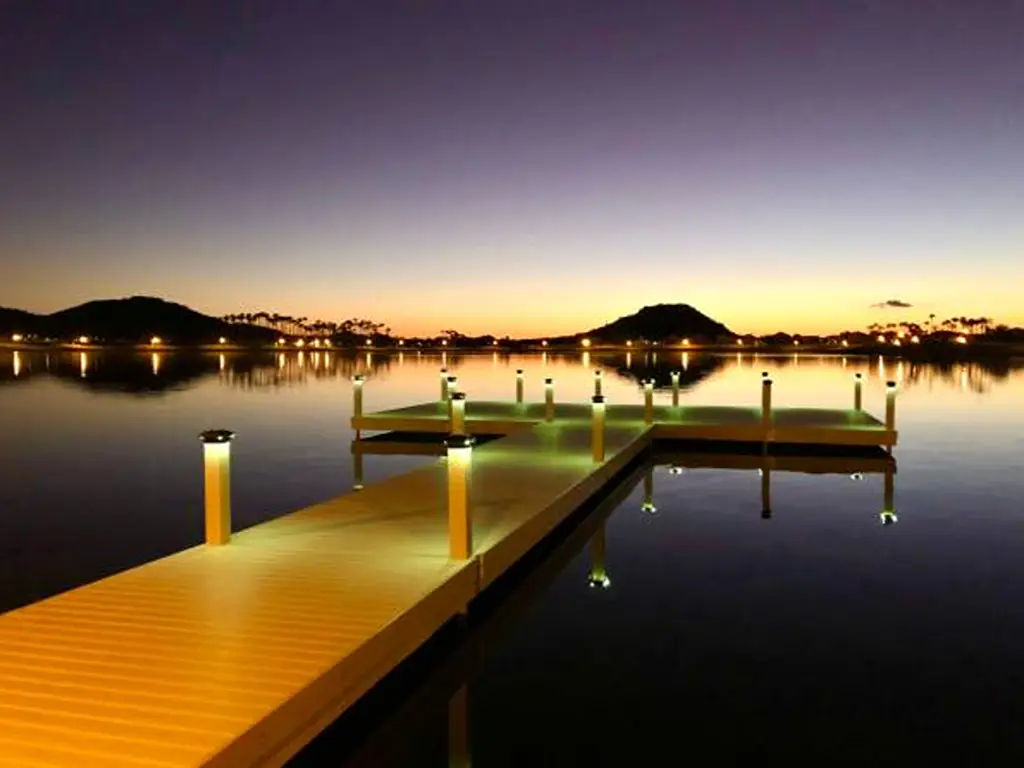
Matching a Light to the Dock You Already Have
Here is the whole thing on one sheet.
Dock type, mounting point and what to confirm
| Dock type | Mounting points available | Best-fit lighting | Must confirm before ordering |
|---|---|---|---|
| Fixed (piled) or pipe dock | Pile tops and caps; pile shafts; any rail | Post-cap lights, piling lights, underwater piling lights | Cap dimensions; whether shore power reaches the dock. |
| Floating dock | Rail or baluster posts; deck and float surface; edge; pile guide ring if piled | Downward rail clamps, low edge markers, floats’ existing fastening points | Post diameter; whether the fastening point already exists; what’s under the deck surface. |
| Sectional dock | Deck surface, edge, proprietary accessory track | Track-mounted or surface lights built for that system | Whether the system has an accessory track, and what fits it. |
| Roll-in dock | Deck surface and frame, seasonally removed | Portable or quick-release fixtures you can take off with the dock | How the dock is removed — anything hard-wired has to come off too. |
| Cantilever dock | Structure and frame above water | Clamp or bracket mounts to the frame | Load limits on the cantilever arm. |
Notice that a floating dock occupies exactly one row. Most dock owners reading this have a fixed, pipe or sectional dock, and their first question — is there something to cap or clamp? — has a straightforward answer.
The rest of the specification is comparatively settled. Color is fixed on most solar fixtures, so pick for the view the light is aimed at rather than for variety. Price runs from about $15 for a simple marker to $199 and up for finished fixtures, with marine-grade suppliers clustering around $38–$180. LED versus incandescent is no longer a decision, since LED is roughly 80% more efficient and lasts an order of magnitude longer. Photocells are standard, so the fixtures switch themselves on at dusk without wiring. The one item people underestimate is cleaning: spray-borne salt and debris load the seals, and mild detergent with a soft cloth is the whole programme, because solvents degrade the lens.
Lighting more than one berth changes the goal. Uniformity beats brightness: a dock evenly lit at a moderate level is safer than one with bright pools and dark gaps, because the gaps are where people misjudge an edge.
Uniformity beats brightness. A dock with an even, moderate light level is safer than one with bright pools and dark gaps — the gaps are where people misjudge an edge.
What It Means If You Specify Docks for a Living
Everything above has one commercial consequence, and it’s short.
The mounting point is fixed when the dock is built, and cannot be added painlessly afterward. Retrofitting means confronting the fact that a float is a sealed air chamber a few millimetres thick. The lamp, meanwhile, is rated for a fraction of the dock’s life, so a dock will see three or four lighting replacements before one replacement of itself. And the fixtures that sell best aren’t universal: they’re engineered to one dock’s cap, one dock’s track, one dock’s post.
So lighting isn’t an accessory decision. It’s a specification decision that gets made, or gets skipped, on the sheet where the dock itself is specified.
The practical version: put the mountable interfaces on the quotation. Raise lighting as an option while the customer is still choosing a dock, not after they’ve chosen a light. Not because lights are good business on their own. A customer who buys a light elsewhere, finds it won’t fasten properly, and comes back to ask why is not making a lighting complaint. They’re making a dock complaint, about a specification nobody raised.
Hisea Dock manufactures modular HDPE floating dock systems. Its cubes carry 19mm connection lugs, grooves on all four sides, reserved pin-and-bolt holes and threaded end caps: the fastening points a lighting plan has to work with. Cube sizes run from 500×500×250mm up to 1000×1000×400mm, with a 500×500×500mm strengthened cube above that, and published buoyancy figures for each. The accessory range includes handrail and baluster posts at Φ110mm and pile guides taking piles up to Φ220mm — see the dock accessories range and the floating dock cubes. We don’t sell lights. What we can tell you before you order is which mounting points your dock will arrive with.
A dock outlives its lights. That’s the whole reason lighting deserves one line on the dock’s specification, not a paragraph in its brochure.
A solar light still needs something to bolt to
Hisea Dock makes modular floating docks — rail posts, pile guides and reserved fastening points. We don’t sell lights. If the dock is what you’re after, we’re glad to hear from you.
Contact Hisea DockReferences
- Oneida County, Wisconsin. “County Board Meeting Minutes, 18 August 2020 — Shoreland Lighting Provisions.” 2020. https://www.oneidacountywi.gov/wp-content/uploads/meetings/Minutes-8-18-2020.pdf
- Friends of the Chain o’ Lakes (FCAL-WI). “Shoreland Lighting: A Special Concern.” 2021. https://fcal-wis.org/shoreland-lighting-a-special-concern/
- California Energy Commission. “2019 Building Energy Efficiency Standards — Nonresidential Outdoor Lighting.” 2020. https://www.energy.ca.gov/sites/default/files/2020-06/2019_EnergyCode-Nonresidential_Outdoor_Lighting_ada.pdf
- Apex Lighting. “Exploring Dock Light Fixtures: Top 40 FAQs Answered.” 2023. https://www.apexlighting.com/blog/exploring-dock-light-top-faqs-answered/
- DRSA Marine Lighting. “Dock Lighting Guide.” 2026. https://www.drsa.com/pages/dock-lighting
- Hisea Dock. “Dock Accessories.” https://www.hiseadock.com/dock-accessories/
- Hisea Dock. “Single Floating Dock.” https://www.hiseadock.com/product-item/single-float/
- Hisea Dock. “FAQ.” https://www.hiseadock.com/faq/
- Hisea Dock. “Production Process.” https://www.hiseadock.com/production-process/
- Hisea Dock. “Quality.” https://www.hiseadock.com/quality/
- Hisea Dock. “Boat Dock.” https://www.hiseadock.com/waterfront_solutions/boat-dock/
- Hisea Dock. “Contact Us.” https://www.hiseadock.com/contact-us/
- Hisea Dock. “Hisea Dock.” https://www.hiseadock.com/

 English
  Thai
Thai  Spanish
  French
  German
  Dutch
Dutch  Italian
  Arabic
  Indonesian
  Portuguese
  Turkish