
Water Park Design: What Changes When Your Site Is Water, Not Land
What Water Park Design Decides Before You Pick a Single Slide
Two kinds of noise sit on top of this search term: isometric map templates, and a simulator game. Both are fine hobbies. Neither is what follows. What follows is about designs that get built, with a budget, a permit file, and a contractor who has to stand behind the work.
Strip the branding away and a water park is a set of zones. A slide complex. A wave pool or a lazy river for the guests who want volume without adrenaline. A children’s splash area, because parents stay longer when the youngest child has somewhere to go. Shade, seating, and food and beverage placed where people already walk rather than where the site plan had room.
The ride mix matters as much as any headline attraction. A park built only around thrill slides loses the grandparents, the four-year-olds, and everyone who wants to spend the whole day. WhiteWater’s design team describes the goal as “a mixture of rides that will cater towards different kinds of people,” with the calm choices carrying the same weight as the tall ones (WhiteWater West).
Here is the part those guides tend to skip. Slides need towers, towers need foundations, and ticket queues need deck. Where that “something” comes from, land or water, is decided earlier than the ride mix. It quietly sets the budget, the permit path, the season length, and what you can add in year three.
The substrate comes before the slides.
Three Substrates: Land, Inflatable Float, and Rigid Modular Float
There are three ways to give a water park a floor, and they are not variations on a theme. They are three different businesses with the same name.
Land and a Concrete Basin
This is what most people picture: an outdoor park on a graded site, water held in a concrete basin, slides rising from a structural foundation. The design sequence is well documented: feasibility study, master plan, zoning, construction. The money is dominated by things you never see: land, terrain work, utilities, and the treatment plant.
A standalone destination park typically runs $30M–$200M+; a hotel-integrated park starts around $5M–$30M (Fluidra). Water infrastructure is the line item most often under-planned, because filtration, disinfection, and recirculation must be sized at master-plan stage and are expensive to retrofit. Zoning does the commercial work: thrill attractions pull guests to the back of the site, and food, retail, and premium seating intercept them on the way past.
Inflatable Floating Parks
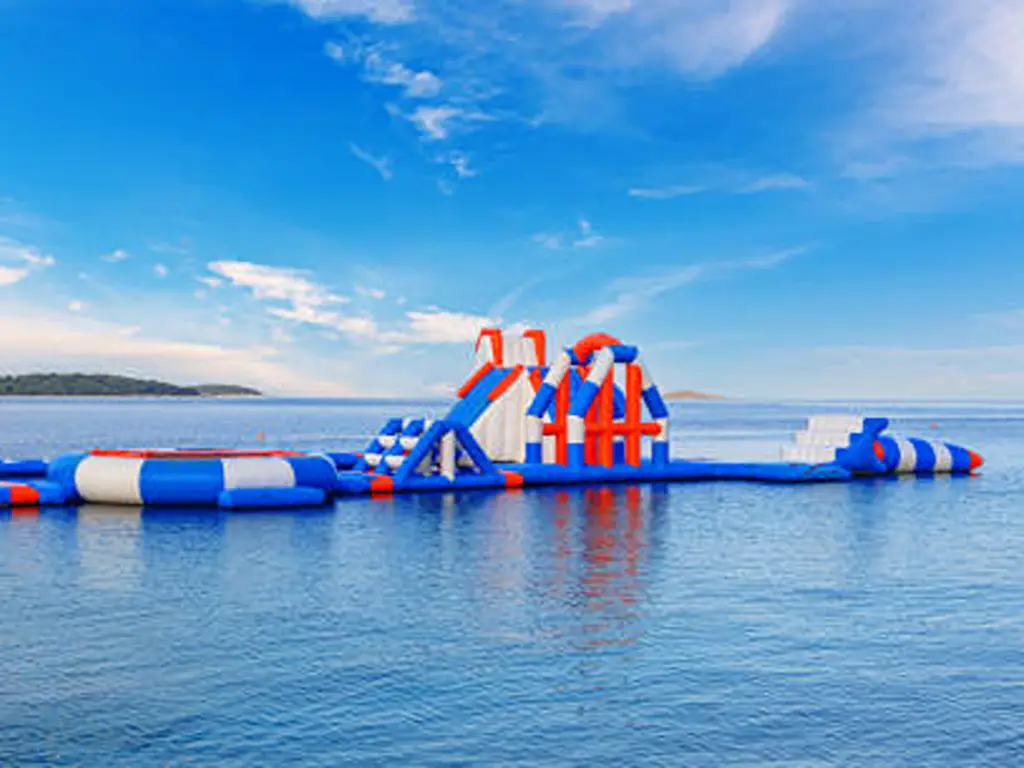
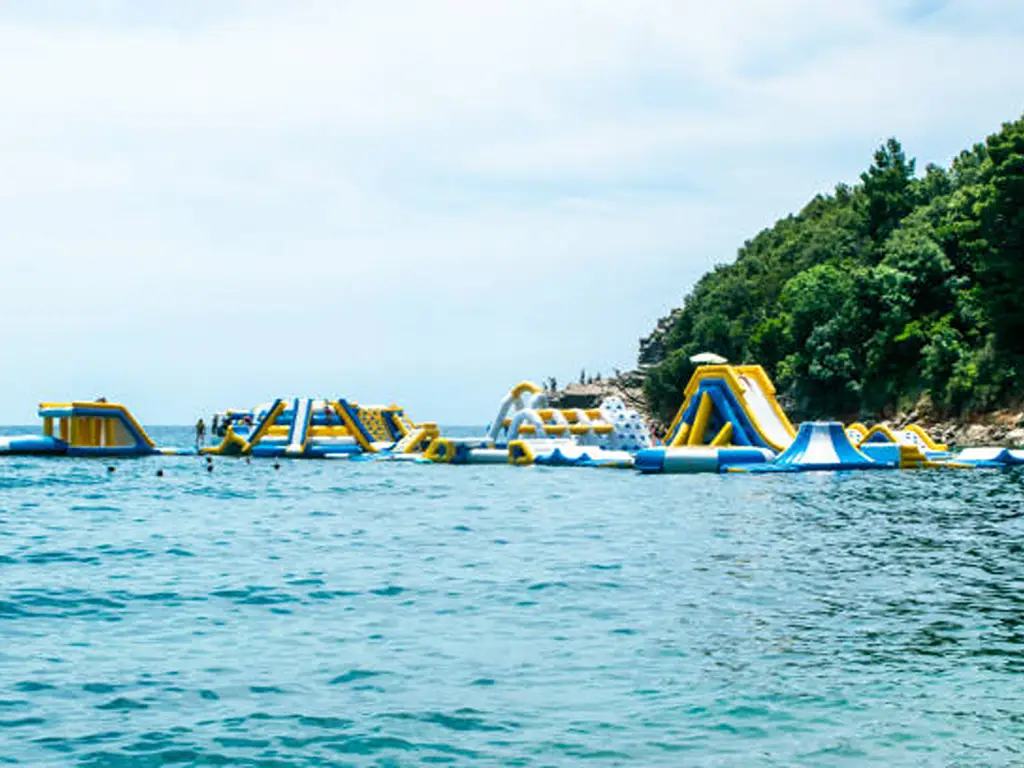
The second option puts the park on the water rather than beside it. Buoyancy comes from inflatable modules: obstacle runs, trampolines, towers, slides, all anchored in place. The appeal is real. They are light, removable, and scalable, and they generally permit as a temporary structure rather than a permanent one. That is why coastal towns and summer camps adopt them so quickly.
The trade is a short working life and a seasonal rhythm. Equipment must be inspected for punctures before each operating day, cleaned and dried before storage, and stored dry off-season (Bouncia). A dealer catalog prices complete park packages from roughly $30,000 to $112,000, depending on how many elements you string together (CRS4Rec / Wibit). Vendors in this segment put useful equipment life at around five years before replacement cycles begin (Quora discussion).
Rigid Modular Floating Platforms
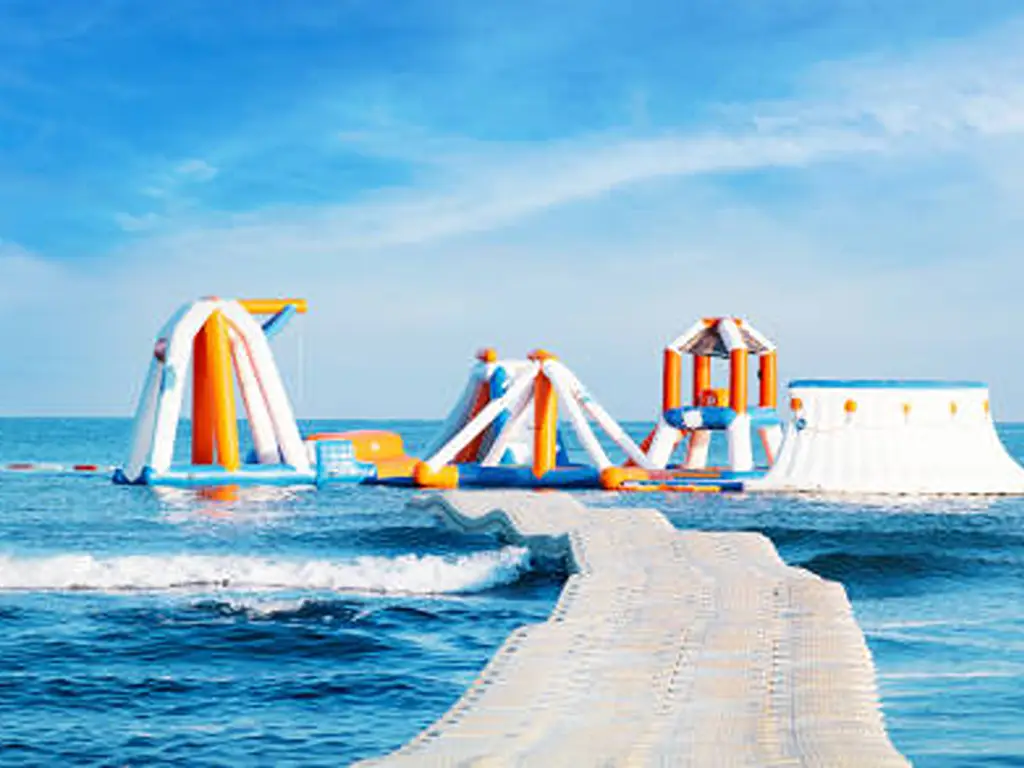
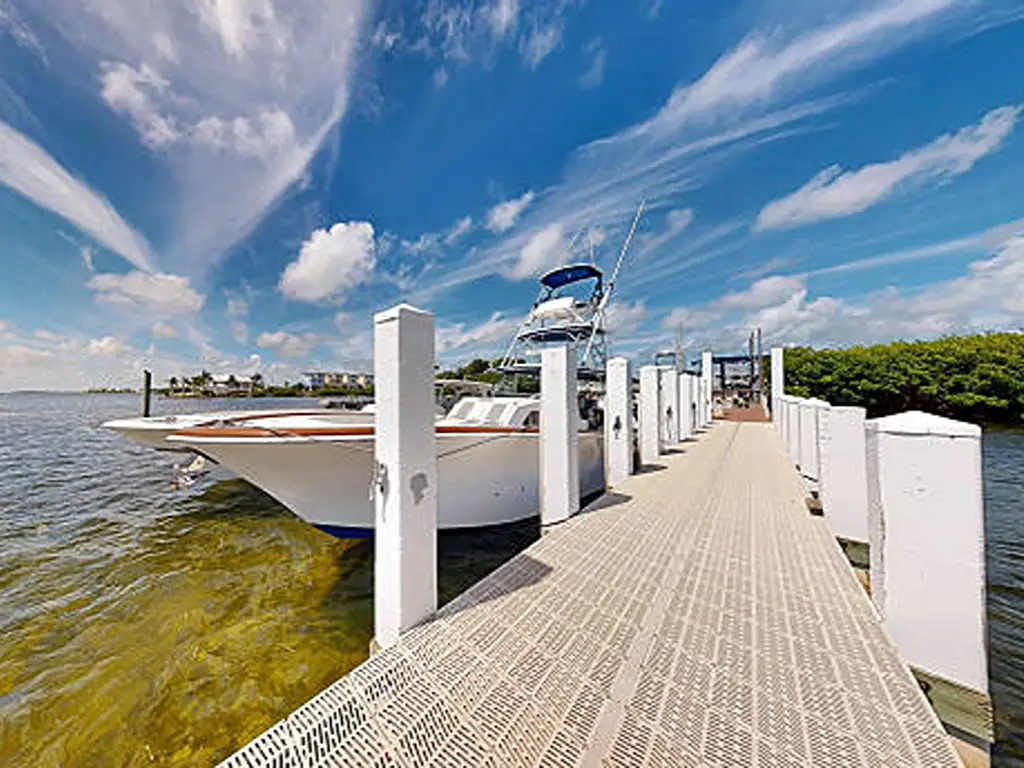
The third option also floats, but the float is structural rather than pneumatic: hollow, air-filled modules bolted together into a platform that carries load as a deck. The distinction is not aesthetic. A rigid platform can stay in the water year-round. It takes a walkway and a railing, holds a cabana or a service counter, and can be extended next season by adding modules to the edge.
This is where waterfront destinations are quietly moving. Marina Dock Age’s waterfront column describes operators adding floating obstacle parks, floating towers, and floating cabanas as revenue beyond slip fees. It notes that the structures behind them “must be securely anchored while still accommodating fluctuations in water levels,” sometimes needing “floating substructures” in their own right (Marina Dock Age / MSA). That sentence is the whole article in miniature. The industry treats the floating structure as an engineering input, while almost all the content written for buyers treats it as a shopping cart.
Three Substrates at a Glance
| Substrate | Typical fit | Where it stops working | What to confirm before committing | Lifecycle |
|---|---|---|---|---|
| Land + concrete basin | destination parks, resort anchors, year-round revenue | no available or affordable land; no utility access | land cost, site plan, filtration sizing | 20–30 years (facility); water infrastructure retrofits are the main risk |
| Inflatable floating park | seasonal lake, quarry, or beach operations; fast launch and easy relocation | year-round operation; needs fixed walkways, railings, or carrying structures | minimum water depth, anchoring type, off-season storage | ~5 years of useful equipment life before replacement cycles |
| Rigid modular floating platform | lake and reservoir amenities, resort and marina extensions, permanent deck area | site with heavy moving ice; no anchoring plan for the water-level range | area load rating, walkway width rule, anchoring path for the site’s water-level swing | 15–20 years on published figures |
Source: CRS4Rec/Wibit catalog; Fluidra; Bouncia; Marina Dock Age; hiseadock.com/faq
Zoning and ride mix still matter on water. The difference is that you are no longer shaping terrain. You are arranging modules on a surface that moves.
When the Site Is Water: Depth, Anchoring, and Capacity
Once the site is water, three questions decide everything else, and each one has a different answer depending on who you ask.
Depth first, and here the published numbers do not agree. One set-up guide puts it at two meters minimum (Water Warrior Services); another says 2.4 m (Bouncia); a third asks for 2.5–4 m for high-capacity attractions such as large slides and bag jumps (AquaPlayParks); the largest inflatable supplier specifies 2–3.5 m even at low tide (Wibit Sports); and one operator guide lands at 2.5–5 m (Bouncia). Five sources, five numbers, none of them wrong.
Published Minimum Water Depth by Source
| Source | Figure | What it appears to govern |
|---|---|---|
| Water Warrior Services | at least 2.0 m | generic inflatable setup |
| Bouncia (lake guide) | 2.4 m minimum | inflatable obstacle course on a lake |
| AquaPlayParks | 2.5–4 m | high-capacity attractions (large slides, bag jumps) |
| Wibit Sports | 2–3.5 m even at low tide | large inflatable park, tide-tolerant siting |
| Bouncia (23-step guide) | 2.5–5 m | commercial floating park siting |
Source: Water Warrior Services; Bouncia; AquaPlayParks 2026; Wibit Sports; Bouncia 23-step guide
The reason is that depth is not a property of the lake. It is the sum of two requirements. Above the surface sits the clearance the activity needs, and jumping or diving needs far more water underneath than a walkway does. Below it sits the space the anchoring system needs to hold position. Ask what the depth requirement is for before you compare quotes. Otherwise you are comparing a jumping clearance against a mooring allowance.
Second, water level: the load case nobody plans for. Coastal design conversations revolve around tide, but lakes and reservoirs move further, and on a schedule set by someone else’s operations. Published drawdown figures vary widely. A regulated Wyoming lake moves 3–4 m a year (University of Wyoming). Nam Ngum Reservoir in Laos averages around 10 m, with a 16 m maximum. The Three Gorges reservoir ranges 15–30 m over the year (Probe International). Earlier this year a Kazakh reservoir recorded within-day swings of about 1 m from hydropower scheduling (MDPI).
For a floating amenity this is not a footnote. A mooring that looks correct at commissioning can be slack at low water and shock-loaded at high water. The structure does not care that the level change was scheduled months in advance. Confirm the site’s annual range and its worst short-term swing before anyone prices an anchor.
Before anyone prices an anchor
Annual water-level range at your site
Worst short-term swing: a day, or a storm cycle
Both are site measurements, not a lake average. Neither is printed on an equipment datasheet.
Third, capacity. You need two numbers, not one. A park has an in-park capacity, meaning how many people it holds at one moment, and a daily attendance, which runs about 1.2 to 1.4 times the in-park figure as guests come and go (ADG). On water, the in-park figure is limited by more than equipment count. It is limited by the area of floating deck, the width of the routes people walk, and the number of access points.
Specifying a Floating Platform: Load Ratings, Walkways, Connections
Load Ratings: Area Load, Not Point Load
Floating decks are specified by area load: weight per square meter or per square foot, spread across the surface. Public guidance and code practice put typical deck live loads across a range. The low end is 20 psf for private floating docks. From there it runs through 25 psf in US military design guidance and 30 psf for public floating docks, up to 50 psf for commercial docks with landings and ramps (NOAA; MIL-HDBK-1025/5; Fort Worth Code §7-62; USCG pier specification).
Notably, every one of those documents pairs the uniform area load with a separate concentrated-load check. That check is usually 300 lb on any 2 ft × 2 ft area, or a 400–500 lb point load anywhere on the deck. Those checks come with freeboard and tilt limits, so the flotation is not pushed under.
That pairing is the most useful habit you can copy. Area load tells you whether the platform carries a crowd; the concentrated check tells you whether it carries a tower leg. On modular floating cubes, published capacity depends on model and height and runs 200, 220, 300, 350, and 420 kgs/m². That converts to roughly 41 to 86 psf, spanning the range above (our floating dock cube range). Those are area figures.
So when a structure lands on the platform, whether that is a climbing tower, a slide transfer step, a service counter, or a mooring post, that is a different question. Put it in writing to your supplier rather than deriving it from the area number. Ask for the point-load allowance, the edge-distance rule, and the connection detail. If a vendor cannot answer, you have learned something about the vendor.
Three things to get in writing
- The point-load allowance
- The edge-distance rule
- The connection detail
Walkways, Railings, and Access
The walking surface is where a floating amenity succeeds or fails in daily use, and it is specified in whole modules rather than in inches. The published rule of thumb is that an available walking platform must be at least three cubes wide. On a 500 mm module grid, that is 1.5 m (hiseadock.com/faq). Below that, the platform stops behaving as a walking surface and starts behaving as a balance beam.
For comparison, land-side accessible routes are regulated at 36 in (0.91 m) minimum clear width under US accessibility standards. That is a different number answering a different question, since it governs a pedestrian route rather than the stability of a floating deck. Both can be true at once; they are not interchangeable.
Railings follow the same logic. Vertical posts and side balusters turn a platform edge into a supervised boundary, and they are the reason a floating amenity can host children and evening events. Plan access points deliberately: one boarding edge, one service edge, and a clear path from land.
Send us the water area and what has to stand on it, and we will come back with the module layout and the area-load rating that fit.
Send us your water areaConnections and Anchoring
Modules join through reserved pin and bolt holes at defined corners, with different fastener sets for single-layer and double-layer connections. That corner logic is worth understanding. It decides how a future extension attaches, and it means a platform’s strength is a lattice property rather than a property of any single cube.
Anchoring is where the site re-enters the design. Published paths include pipes, deadweight anchors, piling brackets, and stiff arms (hiseadock.com/faq). The choice should be dictated by the water-level range you established earlier, not by price. A pile fixes the platform vertically and lets it ride; a deadweight holds position on the bed; a stiff arm ties it to a shore structure. Choose the mechanism that tolerates the site’s worst-case swing.
Hisea Dock builds that layer: the floating platform, its connections, and its anchoring options. We publish specifications rather than adjectives. Those include the area-load ratings for our floating dock cubes, the four anchoring paths, and the module grid behind the three-cube walking rule. In Ningguo, Anhui, that layer took the form of a 1,850 m² floating water park platform, built from modular pontoons with aluminium keels and wood-plastic deck panels, fitted with pontoon railings and safety fittings (Hisea Dock case study). The rides on top came from specialists. The surface that holds them is ours.
Specification checklist for a water-based amenity
- Area load rating, with the model and height it applies to.
- Point-load allowance for any structure landing on the deck.
- Walking platform width in modules, not inches.
- Anchoring path matched to the site’s annual water-level range and worst short-term swing.
- Railing and access-point positions.
- Extension logic: how the next phase bolts to the corner pattern.
- Off-season plan: leave in place or remove.
What Goes Wrong on Water, and What to Inspect
Failure on water is rarely dramatic. It is cumulative, and it usually traces back to something that was not specified.
Biological growth is the constant. In saline water, barnacle build-up on undersides is common enough that operator guides advise scheduling divers roughly monthly to clear it with non-sharp tools. The wrong tool scars the surface it is protecting (Bouncia). If it is your water body, this is a recurring line item, not a one-off.
Punctures belong to the inflatable category and are managed by daily inspection rather than by engineering. Water level belongs to everyone: every structure moored in a lake with a seasonal drawdown is loaded and unloaded once a year whether anyone planned for it or not.
Winter is where the two floating approaches separate most sharply. Inflatable equipment is cleaned, dried, and stored off-season. A rigid modular platform can be left in, and the published guidance is specific about the boundary. The system is designed to be left in the ice, and the module shape lets the platform rise on top of it as it forms. What it is not rated for is moving ice. “Large blocks of heavy flow ice moving around” will damage a stationary dock, and that risk is a property of the water body, not the platform (hiseadock.com/faq).
One honest gap explains a lot of this: no single standard covers the class of structure. The standard practice for commercial inflatable amusement devices, ASTM F2374, states that devices “designed primarily as floating devices to be installed in or on bodies of water” are outside its scope (ASTM F2374-24 (ANSI Webstore)). The standard that does cover floating leisure articles, ISO 25649, carves out devices made from rigid materials and devices held in shape by permanent air flow (ISO 25649-1:2024). A rigid modular platform falls outside both. That is why the documents that govern its deck are structural ones, like the NOAA guidance and the USCG specification cited above, and why no universal inspection criteria exist to inherit. The practical move is to ask your supplier for the inspection points that matter on their product, and write them into the operating plan before opening day.
The number that decides your operating model
Inflatable aqua park equipment
~5 yrs
Cycles at around 5 years of useful life, with off-season removal and storage every one of those years.
Rigid modular floating platform
15–20 yrs
Published at 15–20 years, and can be left in the water, subject to the ice boundary above.
Same search, same phrase, two different asset classes.
Source: Quora vendor discussion; hiseadock.com/faq
The Operator’s Math: Asset or Consumable
If you operate a waterfront property, the three substrates are not three price points. They are three relationships with your capital.
Equipment is a consumable rhythm. Inflatable elements are replaced on a multi-year cycle, and the wider water park sector has a related problem: rides get boring, and operators are pushed to refresh attractions every few years to defend attendance. The facility around them is planned for decades (Fluidra). Those two clocks were never meant to run together, and on a floating amenity you can choose which one your platform belongs to.
For a resort, lakeside scenic area, or marina, the platform is the part that behaves like a building. It stays, it can be extended, and it carries the walkways, cabanas, and service points that generate revenue beyond the ticket. Premium cabana seating is reported to produce 3–5 times the revenue per guest of standard seating. Those are exactly the elements that need a fixed, load-rated deck under them rather than an inflatable mattress.
Which is why the recommendation for this category is unusually simple. Put the platform and its anchoring in your concept-phase budget as a line of its own, not inside an equipment purchase order. Ask for its area-load rating, its point-load allowance, and the anchoring path that matches your water-level range. Then join the two clocks back together at the moment they belong: the equipment renews on its own cycle, while the platform stays and keeps compounding.
Tell us about your water area, and we will tell you what the platform under it needs to be: hiseadock.com/contact-us
Get a platform spec for your water area
A module layout, an area-load rating, and the anchoring path for your water-level range — prepared against your site, not a catalogue page.
Request a platform specReferences
- WhiteWater West. “How to Create a Successful Water Park.” https://www.whitewaterwest.com/resource/how-to-create-a-successful-water-park/
- Fluidra. “Water Theme Park Design.” https://www.fluidra.com/commercial-solutions/inspiration/blog/water-theme-park-design/
- Bouncia. “Start a Floating Water Park in 23 Steps.” https://bounciasports.com/start-floating-water-park-in-23-steps/
- CRS4Rec / Wibit. “Aqua Park Inflatables.” https://crs4rec.com/product-category/water-based-fun/aqua-park-inflatables/
- Quora. “How Much Do I Need to Start a Water Park?” https://www.quora.com/How-much-do-I-need-to-start-a-water-park
- Marina Dock Age / MSA Professional Services. “Fun-ding Your Marina: How to Turn Your Waterfront into a Can’t-Miss Destination.” https://www.msa-ps.com/fun-ding-your-marina-how-to-turn-your-waterfront-into-a-cant-miss-destination/
- Water Warrior Services. “Inflate a Mobile Floating Water Park.” https://waterwarriorservices.com/inflate-a-mobile-floating-water-park/
- Bouncia. “Inflatable Water Park for Lake.” https://bounciasports.com/inflatable-water-park-for-lake/
- Aqua Play Parks. “The Ultimate Checklist to Buy Commercial Water Park Equipment in 2026.” https://blog.aquaplayparks.com/the-ultimate-checklist-to-buy-commercial-water-park-equipment-in-2026/
- Wibit Sports. “Wibit Sports.” https://www.facebook.com/wibitsports/
- University of Wyoming. “Published Water-Level Data.” https://journals.uwyo.edu/index.php/uwnpsrc/article/view/2995
- Probe International. “Three Gorges Reservoir Environmental Material.” http://probeinternational.org/library/wp-content/uploads/2012/04/vol820Enviro20part201.pdf
- MDPI. “Sustainability, 16(23), 10348.” https://www.mdpi.com/2071-1050/16/23/10348
- Aquatic Design Group. “An Inside Look into the Real Cost of Building a Waterpark.” https://www.aquaticgroup.com/news/123/An-Inside-Look-into-the-Real-Cost-of-Building-a-Waterpark/
- National Oceanic and Atmospheric Administration. “Floating Dock Design Guidance.” https://repository.library.noaa.gov/view/noaa/35452/noaa_35452_DS1.pdf
- U.S. Department of Defense. “MIL-HDBK-1025/5.” https://www.ufgscriteria.tpub.com/4_152_07/4_152_070040.htm
- City of Fort Worth. “Code §7-62.” https://codelibrary.amlegal.com/codes/ftworth/latest/ftworth_tx/0-0-0-8141
- U.S. Coast Guard. “Pier Replacement Specification.” https://www.dhs.gov/sites/default/files/2025-09/25_0827_cpo_USCG-Contract-70Z0G124CSLIS0004-Pier-Replacement.pdf
- ASTM International. “ASTM F2374-24.” https://webstore.ansi.org/standards/astm/ASTMF237424
- International Organization for Standardization. “ISO 25649-1:2024.” https://www.iso.org/es/sites/isoorg/contents/data/standard/07/96/79651.html?browse=ics
- Hisea Dock. “Products.” https://www.hiseadock.com/products/
- Hisea Dock. “Frequently Asked Questions.” https://www.hiseadock.com/faq/
- Hisea Dock. “Modular Floating Dock Cubes.” https://www.hiseadock.com/modular-floating-dock-cubes/
- Hisea Dock. “Floating Water Park Project in Ningguo City, Anhui Province.” https://www.hiseadock.com/case/case-study-the-floating-water-park-project-in-ningguo-city-anhui-province/
- Hisea Dock. “Contact Us.” https://www.hiseadock.com/contact-us/
- Hisea Dock. “Hisea Dock.” https://www.hiseadock.com/

 English
  Thai
Thai  Spanish
  French
  German
  Dutch
Dutch  Italian
  Arabic
  Indonesian
  Portuguese
  Turkish