
Water Park Ideas: Five Bases You Can Build On, From a Backyard to Open Water
Search “water park ideas” and you get lists of things: slides, splash pads, lazy rivers, obstacle courses, lazy rivers again. They are accurate and almost useless, because a list of things skips the decision that comes first. Every one of those things has to sit on something. What it sits on decides how deep the water must be, whether you need a permit, what it costs, and, for the floating versions, which safety standard even applies.
So this is a list of bases instead. Five of them, from a lawn to open water. Read until you find yours.
The Five Bases a Water Park Can Sit On
| Base | What it looks like | What it takes | Who it fits |
|---|---|---|---|
| Ground | Lawn, gravel, paving, sprinklers, splash pads, slip-and-slides | Nothing permanent: water arrives from a hose and leaves the same way | Backyards, playgrounds, event lawns |
| Water on a hard surface | A basin such as a pool, a paddling tank or a deck-level water feature | A container, which makes it a structure rather than a toy | Yards with an existing pool, small commercial splash areas |
| Water surface, light load | A floating swim platform, a dock you swim off | Buoyancy plus mooring, the first time “structure” enters the conversation | Lakefront homes, camps, paddle-sport venues |
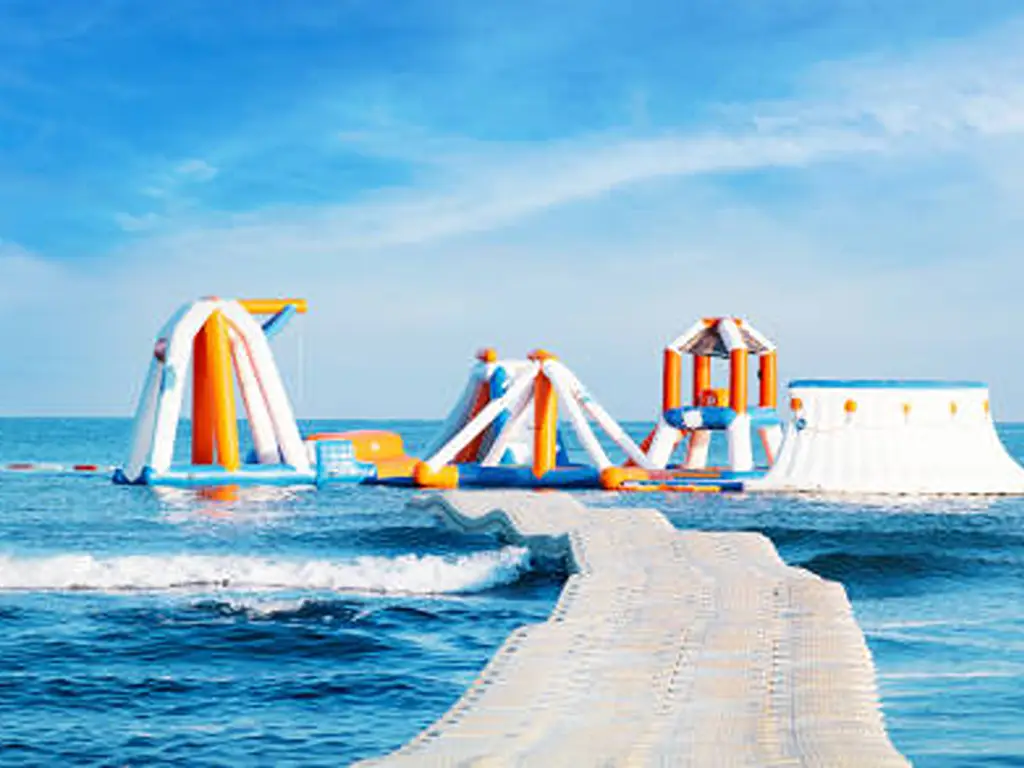
| Water surface, whole park | A modular floating platform carrying entry, circulation, rest and play zones | A structure that becomes the floor | Resorts, scenic areas, waterfront attractions |
| Hull | A yacht slide or stern platform | You already own the vessel | Boat owners |
What Does a Water Park Actually Sit On?
On ground, water never has to be held. It runs out of a hose, crosses a tarp, and drains away. Because nothing is stored, nothing is constructed: no basin, no liner, no pump house, no inspection. The whole category works on a single principle: water in motion, not water at rest.
That principle is why a ground-level water park is cheap, fast and completely removable, and why its safety questions are different from everywhere else on this list. With no standing water, drowning is not the primary risk; slips and supervision are. Check drainage and surface first: a soft lawn under continuous water becomes mud, and a hard surface without texture becomes a slide you did not design.
There is a fifth base most lists never reach: the hull of a boat, which is not a base you choose so much as one you already own.
The Bases That Stay on Land
The moment water has to stay, long enough to swim in and long enough to slide into, you need a container, and a container is a structure. That jump is bigger than it looks.
A basin changes three things at once. It introduces depth, which introduces swimming. It introduces an edge, which is where injuries happen and where handrails and non-slip surfacing stop being optional. And it turns summer equipment into a permanent structure, which is the item people forget to price.
Storing water makes it a structure, not a toy
Before you choose a basin, confirm three things with your local authority: whether a water-holding structure needs approval, whether it counts as a fixed improvement on the property, and whether it can be removed or must be decommissioned in place. The answers differ by jurisdiction and cannot be assumed.
If your property already has water on it, though, neither of the first two bases is where you end up.
The First Time It Has to Float
If you have a lake, a pond, a sheltered river or a lagoon, you have a base that costs nothing to build: the water is already there. What you don’t have is a floor. Anything you put out there has to hold itself up, stay put, and survive the season.
What Changes the Moment It Floats
Buoyancy does one thing a basin cannot: it separates the surface from the bottom. A pool’s floor is the ground; a floating platform’s floor is the platform. That is why a floating water park can go where a pool cannot, and why it lands in a different rulebook.
The practical consequence is that you stop specifying a product and start specifying a structure. Three numbers govern everything: how deep the water is, what the bottom is made of, and what holds the thing down.
How Deep Does the Water Have to Be?
Not by visitor capacity. Depth is set by how tall the tallest thing you’re standing on is. What it really governs is how far a body travels after a fall. Commercial inflatable suppliers publish the working formula as:
Minimum water depth = (height of the tallest structure + 1.8 m average human height) ÷ 2
Run it through the equipment categories:
The one number that decides whether a site works
Minimum depth is set by what you stand on
Four equipment heights, four thresholds, one body of water. A rigid modular float platform is specified on a different quantity altogether: its draft under light load is measured in inches, and a draft is not a depth requirement. The two are not interchangeable.
So the vague “you need about three metres” advice floating around the web is really a number for one specific equipment height. A climbing wall needs 2.4 m; a six-metre jump tower needs 3.9 m. The requirement scales with the equipment, not with the crowd.
Which is why the same water can be a viable site or a dead one depending purely on what you plan to stand on it. The alternative is a rigid modular float platform, held up by displaced volume rather than air pressure. It does not ask for metres at all: unloaded, it sits a few inches into the water. That figure is a draft, not a depth requirement, and the two are not interchangeable. But it is the reason a platform-led layout can use water that an inflatable layout cannot.
How much water your site needs beneath the park is set by the base you choose, not by how many people will visit. That single number decides whether the site can host a water park at all.
How Do You Stop It From Drifting?
Whatever floats has to be held. Two systems cover most commercial installations, and the choice is driven almost entirely by the bottom:
- Concrete block anchoring: the most widely used system worldwide, rated excellent on mud, sand and gravel and good on rock. It needs lifting equipment and working boats, and costs more to transport and install.
- Helical (screw) anchors: rotated into the bed. They are excellent on sand, good on soft mud, only fair on gravel, and not suitable for solid rock, where drilling or custom solutions are required.
Two field conditions matter more than the anchor choice itself. Soft mud: an excessively soft layer lets blocks and anchors sink, so check mud thickness and bearing capacity before design. And wind exposure. On open water the stability of the connection system can matter more than the anchors’ holding power, because a large footprint acts as a sail. Measure at the right time, too: what matters is the lowest water level during your operating season, not the depth on installation day.
When the Water Becomes the Floor
Now the whole park is on the water: entry, circulation, rest areas, service points, play zones. The platform stops being something you stand on and becomes the ground the park is laid out on.
The Two Ways a Floating Park Can Float
Almost everything marketed as a floating water park is one of two structural systems. They behave differently enough that the choice is really about what your site can do.
Two Ways a Floating Water Park Can Float
| Inflatable (air-supported) | Rigid modular float (displacement) | |
|---|---|---|
| Holds itself up by | Air pressure in flexible fabric | Displaced water volume in sealed cells |
| Walkable floor | Soft, moving surface where you clamber rather than walk | Rigid, stable surface you can walk on |
| Depth required | Metres, set by structure height (1.4–3.9 m) | Draft measured in inches under light load |
| Non-play functions (entry, rest zones, service) | Supplied separately, and the industry lists floating dock blocks as its own product category | Carried by the platform itself |
| Season handling | Deflated and removed | Can remain in place |
| Failure mode | Anchoring and connection fatigue under wind load | Connection and anchoring at the perimeter |
| Regulatory path | Pushed to floating-leisure-article standards, not inflatable-amusement standards | Structural and marine construction route |
That regulatory row is the one most buyers never see. The US standard for inflatable amusement devices, ASTM F2374-22, covers land-based inflatables. Its scope states that it does not apply to devices “designed primarily as floating devices to be installed in or on bodies of water.” The sibling standard for water slide systems, ASTM F2376-22, also excludes inflatable water slides floating on a body of water and points to EN/ISO 25649 instead. So the moment the equipment floats, the inflatable-amusement rulebook stops applying.
This is not a footnote. It is the depth table’s principle in regulatory language: the base you choose determines which standard your project is judged against.
Zoning and Flow: the Rules the Industry Already Agrees On
A floating park is a floor plan, and the industry has converged on a layout logic for it. Zones are functional: a thrill zone for high-activity modules, a family zone in shallower or near-shore water for easier supervision, and a rest zone of platforms where people stop. Circulation runs entrance → thrill → rest → family, with the entry near shore and return passages around the outside.
Three operating numbers come with it:
- Buffer distances below large elements: around 3 m for general products, 5 m for small and medium slides, 8–12 m for large slides and launcher systems.
- Capacity discount: operate at roughly 70% of the manufacturer’s stated maximum, dropping to about 50% at peak. The published maximum is not an operating capacity.
- Entry difficulty: easiest obstacles nearest the entrance, ramping up toward the centre, so people build confidence before they are committed.
Note where the non-play functions land. Entry platforms, re-entry ramps, connecting walkways and evacuation bridges are all specified separately from the play equipment; the inflatable industry sells them as a distinct product line. On a rigid platform, the floor plan and the structure are the same object.
What to Ask a Supplier For
Whether you are buying or reselling, these questions separate a quote you can build from one you can’t:
- Surface load or point load? Ask for the rating in kgs/m², and state the load case. They are different figures with different meanings.
- How does the hardware index? Ask how connection points are numbered and whether the system distinguishes single-layer from double-layer joins.
- Where does the power go? Lighting, pumps and ticket booths need a route. Ask whether the platform itself provides a duct.
- What holds it, and who decides that? Establish whether the supplier specifies the anchorage or leaves it to you.
- What happens at the end of the season? Removal and re-installation is labour, and it should be in the price.
Here is what those answers look like when they are concrete. Hisea Dock publishes its ratings as surface loads, split by float height rather than given as a single headline figure: 220, 350 and 420 kgs/m² across the three heights. That is the load case you actually need for a floor plan. Connection hardware is indexed by corner position and distinguishes single-layer from double-layer joins, so extending a layout does not mean re-engineering the seam. The pipelined float carries a duct for water pipe and power cable, which is where a park’s lighting and pumps get their route to the water. Floats are customisable on four axes: size, colour, shape and height. The height options run 250, 400 and 500 mm, which is what lets a layout follow a shoreline instead of a rectangle. See how the modules are rated at different heights.
Carry these five to the first call
What Goes Wrong — and Where It Doesn’t Work at All
Failure in a floating water park is almost never an equipment failure. It is a foundation failure, and it is predictable.
The documented failure modes cluster in four places. Anchoring systems lose grip and the structure begins to travel laterally, twisting out of shape. A footprint grown without a matching upgrade to the anchoring grid catches wind like a sail and can be lost in the first serious storm. Soft sediment lets blocks and anchors sink out of position. And connection systems from different manufacturers do not mate, so mixing suppliers compromises the assembly. Add one operational failure: exceeding capacity. Insurers advising on aquatic inflatables converge on three controls: cap the number of people in the water at any time, shorten continuous swim time, and operate in daylight only.
Base by Base: Where Each One Fails
| Base | Minimum depth | How it’s held | End of season | Carries non-play functions | Where it fails |
|---|---|---|---|---|---|
| Ground | None | Not held | Nothing to remove | It is the ground | Poor drainage, soft or sloped surface |
| Hard surface + basin | The basin’s own | The basin | Permanent structure | Only what the deck allows | Cannot be removed, needs approval, land-locked |
| Water surface, inflatable | 1.4–3.9 m by structure height | Concrete blocks or helical anchors | Deflate and remove | Only with separately supplied platforms | Shallow water, soft mud, solid rock, large seasonal level swings |
| Water surface, rigid modular float | Draft in inches under light load | Piles, mooring, ballast, stiff arms | Can remain in place | Yes, it is the floor | Anchors still need a bed that holds, plus ice and long open fetch |
| Hull | The vessel’s own | The vessel | Haul out | No | You don’t own a boat |
Site self-check before you request a quote
- Measure depth at your seasonal low, not today’s level
- Identify the bottom: mud, sand, gravel or rock
- Check mud layer thickness for bearing, not just depth
- Map maximum wind speed, prevailing direction and wave height
- Measure the seasonal high and low water marks
- Confirm the maximum height of anything you plan to stand on the platform
- Confirm local approval requirements before design, not after
Every failure line in that table is about what the base can hold, not what the play equipment can do. That is the argument for reading a water park idea from the ground up.
What Changes When It’s a Business
If you sell or build waterfront structures, everything above changes what you ask first.
The play equipment layer is commoditised, seasonal and copyable; every supplier quotes the same slides and obstacle modules, and a competitor can match your offer in a season. The base layer is none of those things. It decides whether a site can be developed at all, how deep the water has to be, and whether the project can be built in phases. As the two ASTM scopes show, it also decides which regulatory path the project travels down. The industry’s own expansion guidance assumes a phased model: start small, prove the concept, then scale. That phasing only works because the base can be extended and the play elements simply re-mounted on it.
So lead with the four questions: how deep, on what bottom, held by what, and removed when. Asked early, they filter out sites that were never viable before anyone spends money on a layout.
To be clear about where we sit in that picture: we don’t make slides, inflatable modules, pool shells or wave equipment. Those come from other suppliers, and this article deliberately does not cover them. Hisea Dock makes the base, and we have built this application before. The floating water platform in Ningguo, Anhui Province, is 1,850 m² of modular pontoons. They sit on aluminium keels, carry wood-plastic composite decking, and were installed with railings and safety fittings alongside. Read the Ningguo floating water platform project. Our anchoring options run to pipes, deadweight anchors, piling brackets and stiff arms, and our products carry a 5-year replacement warranty with 24/7 after-sales support.
Start With the Depth and the Load
We make the modular float platform a water park sits on — not the slides and inflatables. If that is the part your project needs specifying, tell us the water depth and the load, and we will work it through with you.
Tell Us the Depth and the LoadReferences
- ASTM International. “ASTM F2374-22: Standard Practice for Design, Manufacture, Operation, and Maintenance of Inflatable Amusement Devices.” 2022. https://www.astm.org/f2374-22.html
- ASTM International. “ASTM F2376-22: Standard Practice for Classification, Design, Manufacture, Construction, and Operation of Water Slide Systems.” 2022. https://www.astm.org/f2376-22.html
- Aqua Play Parks. “How to Expand a Floating Water Park: A Strategic Guide for Commercial Operators.” 2026. https://blog.aquaplayparks.com/how-to-expand-a-floating-water-park-a-strategic-guide-for-commercial-operators/
- Great American Insurance Group. “Understand the Risk of Aquatic Inflatables.” Loss Control. https://www.greatamericaninsurancegroup.com/content-hub/loss-control/details/understand-the-risk-of-aquatic-inflatables
- Hisea Dock. “Case Study: The Floating Water Park Project in Ningguo City, Anhui Province.” https://www.hiseadock.com/case/case-study-the-floating-water-park-project-in-ningguo-city-anhui-province/
- Hisea Dock. “Modular Floating Dock Cubes.” https://www.hiseadock.com/modular-floating-dock-cubes/
- Hisea Dock. “Products.” https://www.hiseadock.com/products/
- Hisea Dock. “FAQ.” https://www.hiseadock.com/faq/
- Hisea Dock. “Contact Us.” https://www.hiseadock.com/contact-us/
- Hisea Dock. “Hisea Dock.” https://www.hiseadock.com/

 English
  Thai
Thai  Spanish
  French
  German
  Dutch
Dutch  Italian
  Arabic
  Indonesian
  Portuguese
  Turkish